




















9/11 Cover-up Document
Media Website Requires Payment to View Article
Free
Copy Given Below
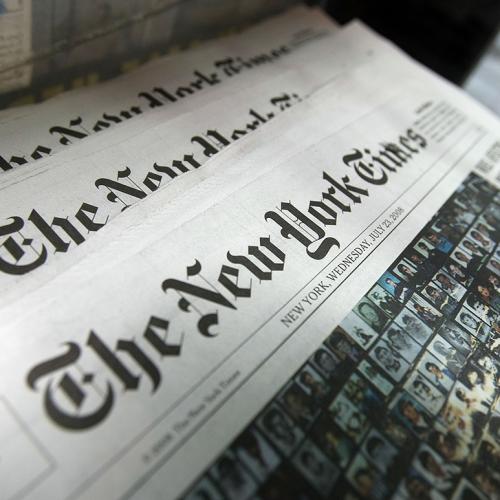
This is one of the articles on the 9/11 summary for which the media website requires payment. For the New York Times website, you must both register as a member (which is free), and then pay a small fee by credit card on line in order to be able to view or download the full article. Once registered, you can view an abstract of the article for no cost. First, go to:
http://select.nytimes.com/gst/abstract.html?res=F70814F8345C0C768DDDA00894D9404482
If you haven't previously signed up as a user, fill in the required information. Once complete, you will see the abstract and have the option to view and download the full article with payment. We provide a copy of the article below for free.
September 15, 2001, Saturday
NATIONAL DESK
AFTER THE ATTACKS: SKY RULES; Pentagon Tracked Deadly Jet But Found No Way to Stop It
By MATTHEW L. WALD (NYT) 1064 words
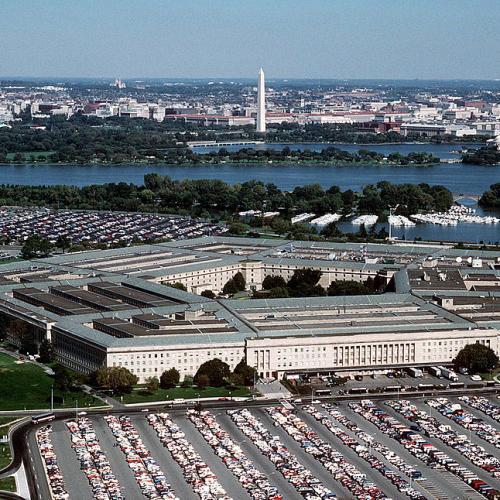
WASHINGTON, Sept. 14 -- During the hour or so that American Airlines Flight 77 was under the control of hijackers, up to the moment it struck the west side of the Pentagon, military officials in a command center on the east side of the building were urgently talking to law enforcement and air traffic control officials about what to do.
But despite elaborate plans that link civilian and military efforts to control the nation's airspace in defense of the country, and despite two other jetliners' having already hit the World Trade Center in New York, the fighter planes that scrambled into protective orbits around Washington did not arrive until 15 minutes after Flight 77 hit the Pentagon. Even if they had been there sooner, it is not clear what they would have done to thwart the attack.
The Federal Aviation Administration has officially refused to discuss its procedures or the sequence of events on Tuesday morning, saying these are part of the Federal Bureau of Investigation's inquiry. But controllers in New England knew about 8:20 a.m. that American Airlines Flight 11, bound from Boston to Los Angeles, had probably been hijacked. When the first news report was made at 8:48 a.m. that a plane might have hit the World Trade Center, they knew it was Flight 11. And within a few minutes more, controllers would have known that both United 175 (the second plane to hit the World Trade Center) and American 77 (which hit the Pentagon) had probably been hijacked.
Flight 77, which took off from Dulles International Airport outside Washington shortly after 8 a.m., stayed aloft until 9:45 a.m. and would have been visible on the F.A.A.'s radar system as it reversed course in the Midwest an hour later to fly back to Washington. The radars would have observed it even though its tracking beacon had been turned off.
By 9:25 a.m. the F.A.A., in consultation with the Pentagon, had taken the radical step of banning all takeoffs around the country, but fighters still had not been dispatched. At that same time, the government learned from Barbara Olson, a political commentator who was a passenger on Flight 77, that the plane had been hijacked. She twice called her husband, Solicitor General Theodore B. Olson, on her cellular phone to tell him what was happening.
Despite provisions for close communication between civilian and military traffic officials, and extensive procedures for security control over air traffic during attacks on the United States, it does not appear that anyone had contemplated the kind of emergency that was unfolding.
The procedures, first devised in the 1950's, cover how to send fighter planes to shadow a hijacked plane on its way, perhaps, to Cuba. They tell how to intercept a plane entering the nation's airspace through the air defense zone along the Atlantic Coast, but not what to do with kamikazes.
''There is no category of 'enemy airliners,' '' a recently retired F.A.A. official said. He and others said they could not recall any instance in which a military plane fired on a civilian one in the United States, though in 1983 a F-4 Phantom fighter that scrambled to intercept an unidentified target off Cherry Point, N.C., accidentally rammed it. That plane was a private twin-engine propeller plane on the way home from the Bahamas, carrying seven people.
The United States is signatory to a treaty that appears to bar using force against civilian airplanes. Congress has voted against letting the military shoot down suspected drug planes trying to cross into the United States. Whether those restrictions would apply to a plane showing clearly hostile intent has never been spelled out. An F.A.A. spokeswoman said earlier this week that there was a policy for shooting down civilian airliners but would not divulge it.
And shooting down a jet as large as a Boeing 757 or 767 raises other problems. One F.A.A. official said, ''If you keep it from hitting a government building, it's going to hit something else.'' That was clearly true for the planes that hit the World Trade Center, which flew over other parts of Manhattan, and the plane that hit the Pentagon, which flew over urbanized Northern Virginia.
John S. Carr, president of the National Air Traffic Controllers Association, the controllers' union, said: ''Our system of unfettered access and freedom has limitations in terms of responding to a case like this. We've created a system for transportation, not defense.''
Today officials were trying to reconstruct that system. Ronald Reagan National Airport -- with approaches that are within a few hundred yards of the Pentagon and just seconds, at jet speeds, from the heart of Washington -- remains closed, ''temporarily and indefinitely.'' Private planes were allowed to resume flying at 4 p.m. today, but only under air traffic control.
Combat aircraft are patrolling the skies; an aircraft carrier is at sea off Washington and another off New York to provide air defense.
Military officials have offered vague descriptions in public about their procedures against airborne terrorists. In a confirmation hearing on Wednesday before the Senate Armed Services Committee, Gen. Richard B. Myer of the Air Force, who has been nominated to be chairman of the Joint Chiefs of Staff, said he did not know whether the F.A.A. had contacted the Pentagon about the hijackings.
''When it became clear what the threat was, we did scramble fighter aircraft, AWACS, radar aircraft and tanker aircraft to begin to establish orbits in case other aircraft showed up in the F.A.A. system that were hijacked,'' he said. He added that once the fighters were aloft, it was not necessary to use force.
In part, that was because American Airlines Flight 77 had already hit the Pentagon, and the hijacked flight from Newark, its target unknown, had crashed in Pennsylvania.
Paul Wolfowitz, the deputy defense secretary, said today that the Pentagon had been tracking that plane and could have shot it down if necessary; it crashed about 35 minutes after the Pentagon crash.
FAIR USE NOTICE: This site contains copyrighted material the use of which has not always been specifically authorized by the copyright owner. We are making such material available in our efforts to advance understanding of criminal justice, political, human rights, economic, democracy, scientific, and social justice issues, etc. We believe this constitutes a 'fair use' of any such copyrighted material as provided for in section 107 of the US Copyright Law. In accordance with Title 17 U.S.C. Section 107, the material on this site is distributed without profit to those who have expressed a prior interest in receiving the included information for research and educational purposes. For more information go to: http://www.law.cornell.edu/uscode/17/107.shtml. If you wish to use copyrighted material from this site for purposes of your own that go beyond 'fair use', you must obtain permission from the copyright owner.
- Inform your media and political representatives of this vital information on 9/11. To contact those close to you, click here. Urge them to call for the release of classified documents and videos and to press for a new, impartial investigation.
- Explore the wealth of reliable, verifiable information on 9/11, including several excellent documentaries, in our 9/11 Information Center available here.
- Learn more about 9/11 and the secret societies likely involved in this powerful lesson from the free Insight Course.
- Explore inspiring ideas on building a brighter future by reading this short essay.
- Spread this news to your friends and colleagues, and recommend this article on key social networking websites so that we can fill the role at which the major media is sadly failing. Together, we can make a difference.
See our exceptional archive of revealing news articles.
Please support this important work: Donate here.
www.momentoflove.org - Every person in the world has a heart
www.personalgrowthcourses.net - Dynamic online courses powerfully expand your horizons
www.WantToKnow.info - Reliable, verifiable information on major cover-ups
www.weboflove.org - Strengthening the Web of Love that interconnects us all
Subscribe here to the WantToKnow.info email list (two messages a week)