
























9/11 Cover-up Document
Media Website Requires Payment to View Article
Free Copy Given Below
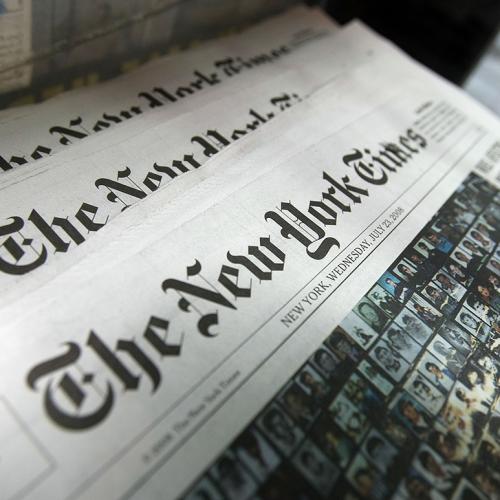
This is one of the documents on the 9/11 summary for which the media website requires payment. For the New York Times website, you must both register as a member (which is free), and then pay a small fee by credit card on line in order to be able to view the full article. Once registered, you can view an abstract of the article for no cost. First, go to:
http://www.nytimes.com/2001/10/16/national/16PLAN.html?pagewanted=all
If you haven't previously signed up as a user, fill in the required information. Once complete, you will see the abstract and have the option to view and download the full article with payment. We provide a free copy of the article below.
October 16, 2001, Tuesday
NATIONAL DESK
A NATION CHALLENGED: THE TAPES; 'We Have Some Planes,' Hijacker Said on Sept. 11
By MATTHEW L. WALD with KEVIN SACK (NYT) 2147 words
WASHINGTON, Oct. 15 -- American Airlines Flight 11 had fallen mysteriously silent. The air traffic controller called over and over for a response. None came. Then he heard an unidentified voice from the cockpit: ''We have some planes. Just stay quiet, and you'll be O.K. We are returning to the airport.''
The controller, confused, asked, ''Who's trying to call me?''
No response. Then he heard the voice again: ''Nobody move please; we are going back to the airport. Don't try to make any stupid moves.''
The man was transmitting on the frequency monitored by pilots and air traffic controllers, either because he thought he was talking to the passengers or because one of the crew had activated the radio microphone, and his voice was the first hint of the horror of Sept. 11.
Transcripts of the communications between pilots and controllers, obtained by The New York Times, reveal the dawning awareness of the terror in cockpits and control centers. Together with interviews and other documents, they offer a previously unseen view of how, moment by moment, a bell-clear and routine morning turned to confusion and then to horror. [Excerpts, Page B9.]
In the cool, clipped jargon of aviation, signals of unprecedented disaster bounced between the ground and air as airline and military personnel struggled to understand and then control the chaos.
The first sure sign of a hijacking was picked up by United Airlines Flight 175, which left Boston for Los Angeles at 8:14 a.m. Just after it took off, the air traffic controller had asked for help from other pilots in finding Flight 11, which was already missing.
''We heard a suspicious transmission on our departure from BOS,'' the pilot reported at 8:41 a.m., just after takeoff. ''Sounds like someone keyed the mike and said everyone stay in your seats.''
Within 90 seconds, his plane became the next piece of the unspooling disaster. Flight 175 took an errant turn off its scheduled course to Los Angeles and ceased communication with the ground. ''There's no transponder, no nothing, and no one's talking to him,'' the controller said.
And at 8:50 a.m., an unidentified pilot said over the common frequency: ''Anybody know what that smoke is in Lower Manhattan?''
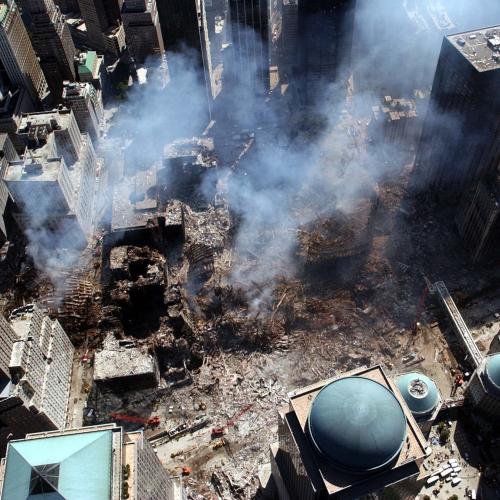
Flight 11 had struck the north tower of the World Trade Center just minutes before, and the air traffic controller's repeated calls for Flight 175 were met with another awful silence.
At 8:53, after Flight 175 had screamed south over the Hudson Valley at about 500 miles per hour -- more than double the legal speed -- the reality was becoming clear to the controller on the ground on Long Island. ''We may have a hijack,'' he said. ''We have some problems over here right now.''
He knew just half of it.
Moments after the first jet hit the World Trade Center, a controller in Indianapolis was trying to make contact with American Flight 77, which was flying from Dulles International Airport outside Washington to Los Angeles. The pilot had confirmed receiving directions to fly towards a navigation beacon at Falmouth, Ky., but then failed to respond to calls from the ground.
''American 77, Indy,'' the controller said, over and over. ''American 77, Indy, radio check. How do you read?''
By 8:56 a.m., it was evident that Flight 77 was lost. The Federal Aviation Administration, already in contact with the Pentagon about the hijackings out of Boston, notified the North American Aerospace Defense Command, or Norad, of American 77 at 9:24, 28 minutes later. Fighters scrambled immediately.
The F.A.A. controller called American's dispatch office in Dallas, and the dispatcher there to try to raise Flight 77 on another radio, but failed.
At 9:09 a.m., the American dispatcher said he could not reach Flight 77, but said the company had ''an unconfirmed report the second airplane hit the World Trade Center and exploded.'' He seemed to suggest that American 77 might be that plane, but in fact American 77 was racing back over Pittsburgh, toward Washington.
At 9:33 a.m., the same air traffic controller at Dulles who had handled the perfectly normal departure of American 77 about 70 minutes earlier, spotted an unidentified blip on the radar screen. The Dulles controllers called their counterparts at Reagan National Airport to report that a ''fast moving primary target,'' meaning an airplane with no transponder, was moving east, headed toward the forbidden airspace over the White House, the Capitol and the Washington Monument.
A Dulles supervisor picked up a hot line to tell the Secret Service at the White House. The president was in Florida, but Vice President Dick Cheney was in the White House; Secret Service agents hustled him into an underground bunker there.
At 9:36 a.m., National Airport, which was on American 77's flight path, asked a military C-130 cargo plane, taking off on a scheduled flight from Andrews Air Force Base -- in Maryland, on the other side of the District of Columbia -- to intercept and identify the fast-moving target. The crew of the C-130 said it was a Boeing 757, moving low and fast.
The airplane was headed for the heart of Washington. But as it crossed the Pentagon at perhaps 7,000 feet -- the exact altitude is uncertain because its transponder had been turned off -- it began a 360-degree turn to the right that brought nearly to ground level. It crashed into the west side of the Pentagon at 9:38 a.m.
At impact, it was moving at well over 500 m.p.h., which both maximized the destruction and made the plane easier to handle. Investigators later determined that it had been flying on autopilot on its path over the Pentagon. Pilots use autopilot to minimize their workload on long days and to assure a precise course and smooth ride.
Just minutes before the crash at the Pentagon, United Airlines Flight 93, flying from Newark to San Francisco, went off course near Cleveland. It now appears that Flight 93 received a warning of the hijackings.
Cutting through the background noise in the cockpit of Flight 93, the crew would have heard the sound of an electronic ''ping'' like one that might announce the arrival of e-mail message on a home computer. It was a text message coming by radio, from a flight dispatcher near Chicago. In green letters on a black background, it said, ''Beware, cockpit intrusion.''
The message was sent by a dispatcher, sitting at the ''transcontinental'' desk at United's operations center near O'Hare International Airport, who had been assigned to follow both 175 and 93, as well as 14 other airplanes that morning. After United 175 was confirmed to have been hijacked, he sent the message to all the planes he was monitoring.
In the cockpit of Flight 93, Capt. Jason Dahl and his first officer, Leroy Homer, continued westbound. In the last few moments of the pre-attack world, there was no particular reason for them to react radically.
''Getting a message like that on any day in the U.S.A., well, I'd think, 'Those poor bastards,' '' one aviation official said. ''Then I'd think, 'It's already happened; it's probably not going to happen again.' ''
Since Sept. 11, details have emerged of a struggle between hijackers and passengers on Flight 93. People involved in air traffic control said the F.B.I. seized the air traffic tapes of the conversations with that airplane, and no transcript was made available of air-to-ground communications for the flight. But according to a person who heard the tape, ''a very noisy sound of a confrontation was heard on the frequency, very garbled, but with some discernible phrase like, 'Hey, get out of here!' ''
There was the sound of a foreign language on the frequency; controllers thought it was Arabic.
Flight 93 crashed in a field western Pennsylvania at 10:10 a.m. But before the final cockpit intrusion of the morning, one of the pilots apparently turned to the e-mail unit that carried the warning from Chicago, touched a button that made the screen display a keyboard and typed a one-word reply: ''Confirmed.''
By the time the F-16's from Langley Air Force Base in Hampton, Va., arrived, the damage was done.
At both Langley and at Otis Air National Guard Base at Falmouth, Mass., on Cape Cod, two sets of fighter pilots were spending the morning as usual: sitting, waiting, and wondering whether they would escape the day without hearing the shrill klaxon blast that occasionally sent them racing to the cockpits of their supersonic jets.
For years, the threat of an incoming aerial attack on the American homeland had been considered so minor that on the morning of Sept. 11, the entire country was being defended by 14 Air National Guard planes dispersed among seven bases.
The first call came to Otis about the hijacking of Flight 11 came at 8:46 a.m., six minutes after the F.A.A. had first notified the North East Air Defense Sector in Rome, N.Y., a division of Norad. Six minutes later two vintage F-15's, built in 1977 and equipped with heat-seeking and radar-guided missiles, had been scrambled, according to a Norad timeline.
One pilot was a part-time Guardsman who flew a commercial plane as his day job; the other jet was flown by a full-time member of the Air National Guard.
But the orders came too late. The first plane was plunging into the World Trade Center when the Otis pilots were racing to their jets. United Flight 175 hit the second tower at 9:02 a.m., 10 minutes after the fighters were airborne, when the F-15's were about 71 miles and eight minutes away. When they arrived, the helpless pilots got the first aerial views of the devastation.
The three F16's at Langley, all of them assigned to the North Dakota Air National Guard's 119th Fighter Wing, nicknamed the Happy Hooligans, were also scrambled too late to intercept American Flight 77 before it crashed into the Pentagon.
But if United Airlines Flight 93 had not crashed in Pennsylvania, the three pilots from Langley -- two of them commercial airline pilots themselves -- may have faced the nightmarish decision of whether to shoot down the commercial airliner, along with its 38 passengers and crew of seven.
''It kept us from having to do the unthinkable,'' said Maj. Gen. Mike J. Haugen, adjutant general of the North Dakota National Guard, ''and that is to use your own weapons and own training against your own citizens.''
The military has not allowed the pilots to be interviewed, and The Times has agreed not to print their names because of security concerns. But details of their activities on Sept. 11 have emerged through interviews with other Guard officials.
At Langley, the pilot designated as the flight lead, a 33-year-old pilot for Northwest Airlines, was getting a cup of coffee when someone yelled from the television room: ''Hey, an airplane just hit the World Trade Center!''
''All of a sudden,'' said Col. Lyle Andvik, a member and former commander of the unit, ''something happens that none of us can believe. They get an order from Northeast Air Defense Sector, the pilots get a scramble horn, and they're down the stairs, out the door, in the jets and off they go. At the time, they didn't realize why they were being scrambled. They didn't realize that other planes had been hijacked.''
At 9:30 a.m., six minutes after receiving their orders from the defense sector, code-named Huntress, three F-16's were airborne, according to the Norad timeline. At first, the planes were directed toward New York at top speed, and probably reached 600 m.p.h. within two minutes, General Haugen said. Then, flying in formation, they were vectored toward the west and given a new flight target: Reagan National Airport.
The planes, each loaded with six missiles, had slowed slightly to just under supersonic speed, flying at about 25,000 feet, when they heard over their radio headsets that the F.A.A. had ordered all civilian aircraft to land. The next sign of how serious the situation had become arrived in the form of a squawk over the plane's transponder, a code that suggests almost an emergency wartime situation.
''They get the squawk and they've heard that planes are supposed to land and then Huntress says, 'Hooligan flight, can you confirm that the Pentagon is on fire?' '' General Haugen said, adding that the lead flier looked down and confirmed that the Pentagon was on fire.
Then the pilots received the most surreal order of the awful morning. ''A person came on the radio,'' General Haugen said, ''and identified themselves as being with the Secret Service, and he said, 'I want you to protect the White House at all costs.' ''
FAIR USE NOTICE: This site contains copyrighted material the use of which has not always been specifically authorized by the copyright owner. We are making such material available in our efforts to advance understanding of criminal justice, political, human rights, economic, democracy, scientific, and social justice issues, etc. We believe this constitutes a 'fair use' of any such copyrighted material as provided for in section 107 of the US Copyright Law. In accordance with Title 17 U.S.C. Section 107, the material on this site is distributed without profit to those who have expressed a prior interest in receiving the included information for research and educational purposes. For more information go to: http://www.law.cornell.edu/uscode/17/107.shtml. If you wish to use copyrighted material from this site for purposes of your own that go beyond 'fair use', you must obtain permission from the copyright owner.
- Inform your media and political representatives of this vital information on 9/11. To contact those close to you, click here. Urge them to call for the release of classified documents and videos and to press for a new, impartial investigation.
- Explore the wealth of reliable, verifiable information on 9/11, including several excellent documentaries, in our 9/11 Information Center available here.
- Learn more about 9/11 and the secret societies likely involved in this powerful lesson from the free Insight Course.
- Explore inspiring ideas on building a brighter future by reading this short essay.
- Spread this news to your friends and colleagues, and recommend this article on key social networking websites so that we can fill the role at which the major media is sadly failing. Together, we can make a difference.
See our exceptional archive of revealing news articles.
Please support this important work: Donate here.
www.momentoflove.org - Every person in the world has a heart
www.personalgrowthcourses.net - Dynamic online courses powerfully expand your horizons
www.WantToKnow.info - Reliable, verifiable information on major cover-ups
www.weboflove.org - Strengthening the Web of Love that interconnects us all
Subscribe here to the WantToKnow.info email list (two messages a week)




