













































9/11 Cover-up Document
Media Website Requires Payment to View Article
Free
Copy Given Below
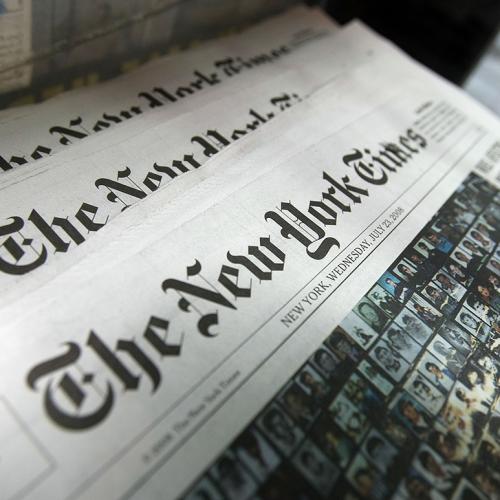
This is one of the articles on the 9/11 summary for which the media website requires payment. For the New York Times website, you must both register as a member (which is free), and then pay a small fee by credit card on line in order to be able to view or download the full article. Once registered, you can view an abstract of the article for no cost. First, go to:
http://select.nytimes.com/gst/abstract.html?res=F30913FA3A5D0C758DDDAC0894DA404482
If you haven't previously signed up as a user, fill in the required information. Once complete, you will see the abstract and have the option to view and download the full article with payment. We provide a copy of the article below for free.
May 16, 2002, Thursday
NATIONAL DESK
BUSH WAS WARNED BIN LADEN WANTED TO HIJACK PLANES
By DAVID E. SANGER (NYT) 858 word s
WASHINGTON, May 15 -- The White House said tonight that President Bush had been warned by American intelligence agencies in early August that Osama bin Laden was seeking to hijack aircraft but that the warnings did not contemplate the possibility that the hijackers would turn the planes into guided missiles for a terrorist attack.
''It is widely known that we had information that bin Laden wanted to attack the United States or United States interests abroad,'' Ari Fleischer, the president's press secretary, said this evening. ''The president was also provided information about bin Laden wanting to engage in hijacking in the traditional pre-9/11 sense, not for the use of suicide bombing, not for the use of an airplane as a missile.''
Nonetheless the revelation by the White House, made in response to a report about the intelligence warning this evening on CBS News, is bound to fuel Congressional demands for a deeper investigation into why American intelligence agencies and the Federal Bureau of Investigation had failed to put together individual pieces of evidence that, in retrospect, now seem to suggest what was coming.
In the past few days, government officials have acknowledged for the first time that an F.B.I. agent in Phoenix had urged the F.B.I. headquarters to investigate Middle Eastern men enrolled in American flight schools. That memorandum also cited Mr. bin Laden by name and suggested that his followers could use the schools to train for terror operations, officials who have seen the memorandum said.
Administration officials reached this evening said the warning given to Mr. Bush did not come from the F.B.I. or from the information developed by the Phoenix agent. Instead, it was provided as part of the C.I.A. briefing he is given each morning, suggesting that it was probably based on evidence gathered abroad.
The C.I.A. had been listening intently over the July 4 holiday last year, after what one investigator called ''a lot of static in the system suggesting something was coming.'' But then the evidence disappeared as quickly as it had arisen, and by August, officials have said, little was heard from Al Qaeda.
The warning of the hijacking was given to the president at his ranch in Crawford, Tex., where he was on vacation.
Taken together, the news of the C.I.A. warning and the information developed separately by the F.B.I. explains Mr. Bush's anger after Sept. 11 that intelligence gathered on American soil and abroad was not being centrally analyzed and that the agencies were not working well together.
Several times he has told audiences that he is working on solving that problem, and these days he is briefed jointly by the F.B.I and the C.I.A., ensuring that each hears information from the other agency.
It was not clear this evening why the White House waited eight months after the terrorist attacks in New York and Washington to reveal what Mr. Bush had been told.
But Mr. Fleischer noted that in the daily flow of intelligence information the president receives, the warning of what appeared to be the threat of a conventional hijacking was not as serious as it appears in retrospect. ''We were a peacetime society, and the F.B.I. had a different mission,'' he said.
Mr. Fleischer said the information given to the president in Texas had prompted the administration to put law enforcement agencies on alert. But there was no public announcement.
Nonetheless, a senior administration official said tonight that there was speculation within the government that heightened security -- if it truly existed in August and September -- might have prompted the hijackers to use box cutters and plastic knives to avoid detection.
The C.I.A. warning might also explain why Mr. Bush's aides were so certain that Mr. bin Laden was behind the attacks almost as soon as they happened. ''We never had any real doubt,'' one senior official involved in the crucial decisions at the White House on Sept. 11 said several months ago.
Until recently, Mr. Bush has deflected demands for a lengthy and detailed investigation into the intelligence failures surrounding the Sept. 11 attacks. White House officials were concerned that the investigation would feed into demands by Senator Richard C. Shelby, the Alabama Republican who is the vice chairman of the Senate Intelligence Committee, for the replacement of George J. Tenet as director of central intelligence.
But the news that the hijacking warning was in the president's brief, which Mr. Tenet sees and approves, and that it was linked to Mr. bin Laden is almost certain to widen the scope of the investigation.
Already, several lawmakers who have read the Phoenix memorandum written by the F.B.I. agent have described it as the most significant document to emerge in Congressional inquiries into whether the government might have been warned about possible hijackings.
Now those investigators are almost certain to demand the details of the president's August briefing by the C.I.A. and may ask to hear about how that evidence was developed.
FAIR USE NOTICE: This site contains copyrighted material the use of which has not always been specifically authorized by the copyright owner. We are making such material available in our efforts to advance understanding of criminal justice, political, human rights, economic, democracy, scientific, and social justice issues, etc. We believe this constitutes a 'fair use' of any such copyrighted material as provided for in section 107 of the US Copyright Law. In accordance with Title 17 U.S.C. Section 107, the material on this site is distributed without profit to those who have expressed a prior interest in receiving the included information for research and educational purposes. For more information go to: http://www.law.cornell.edu/uscode/17/107.shtml. If you wish to use copyrighted material from this site for purposes of your own that go beyond 'fair use', you must obtain permission from the copyright owner.
- Inform your media and political representatives of this vital information on 9/11. To contact those close to you, click here. Urge them to call for the release of classified documents and videos and to press for a new, impartial investigation.
- Explore the wealth of reliable, verifiable information on 9/11, including several excellent documentaries, in our 9/11 Information Center available here.
- Learn more about 9/11 and the secret societies likely involved in this powerful lesson from the free Insight Course.
- Explore inspiring ideas on building a brighter future by reading this short essay.
- Spread this news to your friends and colleagues, and recommend this article on key social networking websites so that we can fill the role at which the major media is sadly failing. Together, we can make a difference.
See our exceptional archive of revealing news articles.
Please support this important work: Donate here.
www.momentoflove.org - Every person in the world has a heart
www.personalgrowthcourses.net - Dynamic online courses powerfully expand your horizons
www.WantToKnow.info - Reliable, verifiable information on major cover-ups
www.weboflove.org - Strengthening the Web of Love that interconnects us all
Subscribe here to the WantToKnow.info email list (two messages a week)




