
















Banking Bailout News Articles
Below are key excerpts of revealing news articles on the 2008 banking bailout from reliable news media sources. If any link fails to function, a paywall blocks full access, or the article is no longer available, try these digital tools.

Europe needs to recapitalise, restructure or shut down its banks as part of a vital clean-up of the industry, International Monetary Fund managing director Christine Lagarde said as she warned that the threat from worlds biggest lenders was more dangerous than ever. Speaking in New York ahead of next weeks IMF Spring meeting, Ms Lagarde launched a broadside against the financial services industry for resisting urgent reform. In too many cases from the United States in 2008 to Cyprus today we have seen what happens when a banking sector chooses the quick buck ..., backing a business model that ultimately destabilizes the economy. We simply cannot have pre-crisis banking in a post-crisis world. We need reform, even in the face of intense pushback from an industry sometimes reluctant to abandon lucrative lines of business. Almost five years since Lehman Brothers collapsed, she claimed: The 'oversize banking model of too-big-to-fail is more dangerous than ever. We must get to the root of the problem with comprehensive and clear regulation. Regulators have forced banks to increase significantly their loss-absorbing capital buffers since the crisis, but are still working on "resolution" mechanisms that will allow giant lenders to fail without hitting the taxpayer and threatening financial stability. Regulators must also work together, she added, amid evidence that some countries are caving into pressure from the banking lobby.
Note: For deeply revealing reports from reliable major media sources on financial corruption, click here.
Elizabeth Warren has a question: How much money does a bank have to launder before people go to jail? Warren ... posed that question numerous times to financial regulators at a Senate Banking Committee hearing [on] banks and money laundering. In December, U.S. Justice Department officials announced that HSBC, Europes largest bank, would pay a $1.92 billion fine after laundering $881 million for drug cartels in Mexico and Colombia. The two regulators, Under Secretary for Terrorism and Financial Intelligence David S. Cohen and Federal Reserve Governor Jerome H. Powell, deflected Warrens questions, saying that criminal prosecutions are for the Justice Department to decide. An exasperated Warren said, as she wrapped up her questioning, If youre caught with an ounce of cocaine, the chances are good youre going to jail. If it happens repeatedly, you may go to jail for the rest of your life. But evidently, if you launder nearly a billion dollars for drug cartels and violate our international sanctions, your company pays a fine and you go home and sleep in your own bed at night every single individual associated with this and I just think thats fundamentally wrong.
Note: For deeply revealing reports from reliable major media sources on the collusion between government and finance, click here.
Attorneys for jailed former Swiss banker Bradley Birkenfeld announced [on September 11] that the IRS will pay him $104 million as a whistleblower reward for information he turned over to the US government. The information Birkenfeld revealed detailed the inner workings of the secretive private wealth management division of the Swiss bank UBS, where the American-born Birkenfeld helped his US clients evade taxes by hiding wealth overseas. Tuesday's announcement represents an astonishing turn of fortune for Birkenfeld, who was released from federal prison in August after serving 31 months on charges relating to his efforts to help a wealthy client avoid taxes. Birkenfeld attorney Stephen Kohn said the information the former Swiss banker turned over to the IRS led directly to the $780 million fine paid to the US by his former employer, UBS, as well as leading over 35,000 taxpayers to participate in amnesty programs to voluntarily repatriate their illegal offshore accounts. That resulted in the collection of over $5 billion dollars in back taxes, fines and penalties that otherwise would have remained outside the reach of the government. Birkenfeld's disclosures also led to the first cracks in the legendarily secretive Swiss banking system, and ultimately the Swiss government changed its tax treaty with the United States. UBS turned over the names of more than than 4,900 U.S. taxpayers who held illegal offshore accounts. Investigations into those accounts are ongoing.
Note: For deeply revealing reports from reliable major media sources on the collusion between financial corporations and government regulators, click here.
On [August 9] the Department of Justice announced it will not prosecute Goldman Sachs or any of its employees in a financial-fraud probe. Despite the Obama administrations promises to clean up Wall Street in the wake of Americas worst financial crisis, there has not been a single criminal charge filed by the federal government against any top executive of the elite financial institutions. Why is that? In a word: cronyism. Take Goldman Sachs, for example. In 2008, Goldman Sachs employees were among Barack Obamas top campaign contributors, giving a combined $1,013,091. [Attorney General] Eric Holders former law firm, Covington & Burling, also counts Goldman Sachs as one of its clients. Furthermore, in April 2011, when the Senate Permanent Subcommittee on Investigations issued a scathing report detailing Goldmans suspicious Abacus deal, several Goldman executives and their families began flooding Obama campaign coffers with donations, some giving the maximum $35,800. The individuals the DOJs Financial Fraud Enforcement Task Force has placed in its prosecutorial crosshairs seem shockingly small compared with the Wall Street titans the Obama administration promised to bring to justice. To be sure, financial fraud of any kind is wrong and should be prosecuted. But locking up pygmies is hardly the kind of financial-fraud crackdown Americans expected in the wake of the largest financial crisis in U.S. history. Increasingly, there appear to be two sets of rules: one for the average citizen, and another for the connected cronies who rule the inside game.
Note: For deeply revealing reports from reliable major media sources on financial corporations' control over government, see our Banking Bailout archive here.
For years, the ratings agencies have contended that the grades they assign debt securities are independent opinions and therefore entitled to First Amendment protections, like those afforded journalists. But newly released documents in a class-action case ... cast doubt on the independence of the two largest agencies, Moodys Investors Service and Standard & Poors. The case, filed in 2008 by a group of 15 institutional investors against Morgan Stanley and the two agencies, involves a British-based debt issuer called Cheyne Finance. Cheyne collapsed in August 2007 under a load of troubled mortgage securities. Even though Cheynes portfolio was bulging with residential mortgage securities, some of its debt received the agencies highest ratings, a grade equal to that assigned to United States Treasury securities. When the primary analyst at S.& P. notified Morgan Stanley that some of the Cheyne securities would most likely receive a BBB rating, not the A grade that the firm had wanted, the agency received a blistering e-mail from a Morgan Stanley executive. S.& P. subsequently raised the grade to A. After the institutions that bought Cheynes debt sued Morgan Stanley and the ratings agencies, Moodys and S.& P. immediately mounted a First Amendment defense. But Shira A. Scheindlin, the federal judge overseeing the matter ... argued that the ratings were not opinions but were misrepresentations that were possibly a result of fraud or negligence.
Note: For deeply revealing reports from reliable major media sources on financial corruption, click here.
Three top executives of MF Global Holdings Ltd. when it collapsed could get bonuses of as much as several hundred thousand dollars each under a plan by a trustee overseeing the securities firm's bankruptcy case. Louis Freeh, the former Federal Bureau of Investigation director now in charge of unwinding what is left of the New York company, is expected to ask a bankruptcy-court judge as soon as this month to approve performance-related payouts for the chief operating officer, finance chief and general counsel at MF Global. Under the expected pay plan, the three executives and as many as 20 other MF Global employees working for Mr. Freeh would get the bonuses only if they hit specified targets such as increasing the value of MF Global's estate for creditors. The bonus plan could face fierce resistance. One reason: Criminal and civil investigators are scrutinizing the role of top executives and others at MF Global in money transfers that resulted in a $1.6 billion shortfall in customer accounts. So far, many hedge funds, farmers and other investors who bought and sold through MF Global have gotten about 72 cents out of every $1 held by the firm when it collapsed. Hopes for additional recoveries have dimmed as the probe grinds on. Neal Wolkoff, a former executive at the New York Mercantile Exchange who now works as a consultant, said it "is shocking" that Messrs. Abelow and Steenkamp still work at MF Global and could earn bonuses "because it represents a conflict of interest."
Note: For an abundance of major media articles revealing major financial manipulations, click here.
Icelanders who pelted parliament with rocks in 2009 demanding their leaders and bankers answer for the countrys economic and financial collapse are reaping the benefits of their anger. Since the end of 2008, the islands banks have forgiven loans equivalent to 13 percent of gross domestic product, easing the debt burdens of more than a quarter of the population, according to a report published this month by the Icelandic Financial Services Association. You could safely say that Iceland holds the world record in household debt relief, said Lars Christensen, chief emerging markets economist at Danske Bank A/S in Copenhagen. Iceland followed the textbook example of what is required in a crisis. Any economist would agree with that. Most polls now show Icelanders dont want to join the European Union, where the debt crisis is in its third year. The islands households were helped by an agreement between the government and the banks, which are still partly controlled by the state, to forgive debt exceeding 110 percent of home values. On top of that, a Supreme Court ruling in June 2010 found loans indexed to foreign currencies were illegal, meaning households no longer need to cover krona losses.
Note: The amazing story of the Icelandic people demanding bank reform is one of the most underreported stories in recent years. Why isn't this all over the news? To see what top journalists say about news censorship, click here. For blatant manipulations of the big banks reported in the major media, click here.
A retired New York Supreme Court judge has claimed she was manhandled by a policeman after watching him beat a woman at the Zuccotti Park raids. Karen Smith was working as a legal observer when she saw a distressed woman pushed to the ground and beaten by an officer, she said. When she demanded he [stop], the unidentified cop pushed her against a wall and threatened her with arrest. Ms Smith had attended the raids ... to note down the names of people arrested as the Occupy Wall Street camp was cleared. She was wearing a fluorescent green baseball cap bearing the words 'National Lawyers Guild Legal Observer' to show she was not taking part in the protests. Ms Smith, who was also carrying a pad and pen, said the incident happened at around 1.30am on Tuesday at Dey Street and Broadway Street in New York City. Speaking to Democracy Now, she described the scene as a paramilitary operation if there ever was one. It was what we call a stealth eviction, she added. Ms Smith explained her son had participated in Occupy Wall Street and she had been very concerned about his safety.
Note: We don't normally use the UK's Daily Mail as a reliable source, but as no other major media are reporting this story, we felt it warranted inclusion. The judge gives her own testimony in a video near the bottom of the article.
Citigroup had to pay a $285 million fine to settle a case in which, with one hand, Citibank sold a package of toxic mortgage-backed securities to unsuspecting customers securities that it knew were likely to go bust and, with the other hand, shorted the same securities that is, bet millions of dollars that they would go bust. It doesnt get any more immoral than this. James Stewart, a business columnist for The [New York] Times, noted that Citigroups flimflam made Goldman Sachs mortgage traders look like Boy Scouts. This gets to the core of why all the anti-Wall Street groups around the globe are resonating. Our financial industry has grown so large and rich it has corrupted our real institutions through political donations. Our Congress today is a forum for legalized bribery. One consumer group using information from Opensecrets.org calculates that the financial services industry, including real estate, spent $2.3 billion on federal campaign contributions from 1990 to 2010, which was more than the health care, energy, defense, agriculture and transportation industries combined. Why are there 61 members on the House Committee on Financial Services? So many congressmen want to be in a position to sell votes to Wall Street.
Note: For lots more from major media sources on the collusion between financial interests and government, click here.
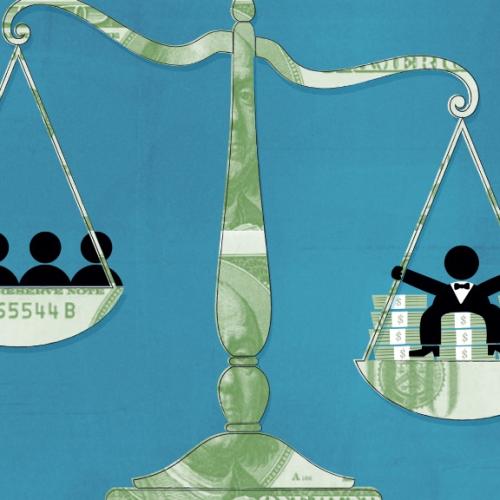
Critics of the growing Occupy Wall Street movement complain that the protesters dont have a policy agenda and, therefore, dont stand for anything. They're wrong. The key isnt what protesters are for but rather what theyre against -- the gaping inequality that has poisoned our economy, our politics and our nation. In America today, 400 people have more wealth than the bottom 150 million combined. Thats not because 150 million Americans are pathetically lazy or even unlucky. In fact, Americans have been working harder than ever -- productivity has risen in the last several decades. Big business profits and CEO bonuses have also gone up. Worker salaries, however, have declined. Most of the Occupy Wall Street protesters [want] an end to the crony capitalist system now in place, that makes it easier for the rich and powerful to get even more rich and powerful while making it increasingly hard for the rest of us to get by. The question is not how Occupy Wall Street protesters can find that gross discrepancy immoral. The question is why every one of us isnt protesting with them. According to polls, most Americans support the 99% movement, even if theyre not taking to the streets.
Note: For lots more on the reasons why people all over the world are occupying their city centers, check out our "Banking Bailout" news articles.
The Occupy Wall Street movement has the potential to turn into a political firestorm. We have become so divided as a nation that it is very difficult to prognosticate if anything good will come out of these protests from a political perspective. Lets examine a number of issues that have been raised by Occupy Wall Street, the Tea Party and liberals and libertarians and see where there is agreement. Get Corporate Money Out Of Politics This is the issue that really kick started Occupy Wall Street. Americans are sick and tired of mega-corporations and Wall Street banks being in bed with our politicians in Washington D.C. End the Federal Reserve The Federal Reserve is directly responsible for the Too Big To Fail banking cartel, the U.S. debt, the perpetual deficits, and ... the Fed has also robbed the poor and working class blind as a result of their inflationary policies. End The Wars The American people are fed up with these conflicts, and even large percentages of the military believe that the wars in both Iraq and Afghanistan were not worth fighting in the first place. It is time for our troops to come home. End The Drug War - The drug war is an absolute failed policy. The U.S. incarcerates a higher percentage of its population than any country on Earth, yet we call ourselves The Home of the Free. Repeal The Patriot Act The assault on our civil liberties in the wake of 9/11 has been swift and draconian. These are the types of things that go on in totalitarian states, and now, apparently the United States as well.
Note: For lots more from major media sources on the reasons why people worldwide are occupying the financial centers of their cities, check out our "Banking Bailout" news articles.
Britain's tax authorities have given Goldman Sachs an unusual and generous Christmas present, leaked documents reveal. In a secret London meeting last December with the head of Revenue, the wealthy Wall Street banking firm was forgiven 10m interest on a failed tax avoidance scheme. HM Revenue and Customs sources admit privately that the interest-free deal is "a cock-up" by officials, but refuse to say who was responsible. Documents leaked to Private Eye magazine and published in full by the Guardian record that Britain's top tax official, HMRC's permanent secretary Dave Hartnett, personally shook hands on a secret settlement last December. Hartnett also refused to give the facts about Goldman Sachs to MP Jesse Norman on the Treasury committee last month, claiming disclosure would be illegal. He also refuses to brief ministers on the details. The 10m Christmas gift for Goldman was the culmination of a prolonged attempt by the US firm to avoid paying national insurance on huge bonuses for its bankers working in London. The sum was pocket change to Goldman, whose employees received $15.3bn (9.5bn) in pay and bonuses last year.
Note: For lots more from reliable sources on corporate and government corruption, click here and here.
The world is facing the worst financial crisis since at least the 1930s if not ever, the Governor of the Bank of England said last night. Sir Mervyn King was speaking after the decision by the Banks Monetary Policy Committee to put 75billion of newly created money into the economy in a desperate effort to stave off a new credit crisis and a UK recession. Economists said the Banks decision to resume its quantitative easing [QE] showed it was increasingly fearful for the economy, and predicted more such moves ahead. Sir Mervyn said the Bank had been driven by growing signs of a global economic disaster. This is the most serious financial crisis weve seen, at least since the 1930s, if not ever. Were having to deal with very unusual circumstances, but to act calmly to this and to do the right thing. Announcing its decision, the Bank said that the eurozone debt crisis was creating severe strains in bank funding markets and financial markets. Financial experts said the committees actions would be a Titanic disaster for pensioners, savers and workers approaching retirement. Under QE, the Bank electronically creates new money which it then uses to buy assets such as government bonds, or gilts, from banks. By increasing the demand for gilts, QE pushes down the interest rate yields paid to holders of these and other bonds. Critics of the policy say it pushes up inflation and drives down sterling.
Note: For lots more on the global financial crisis from reliable sources, click here.
A Senate panel has concluded that Goldman Sachs Group Inc. profited from the financial crisis by betting billions against the subprime mortgage market, then deceived investors and Congress about the firm's conduct. Some of the findings in the report by the Senate's Permanent Subcommittee on Investigations will be referred to the Justice Department and the Securities and Exchange Commission for possible criminal or civil action, said Sen. Carl Levin (D-Mich.), the panel's chairman. The giant investment bank was just one focus of the subcommittee's probe into Wall Street's role in the financial crisis. The 639-page report based on internal memos, emails and interviews with employees of financial firms and regulators casts broad blame, saying the crisis was caused by "conflicts of interest, heedless risk-taking and failures of federal oversight." Among the culprits cited by the panel are Washington Mutual, a major mortgage lender that failed in 2008, as well as the Office of Thrift Supervision, a federal bank regulator, and credit rating firms. Asked if he was disappointed that no Wall Street figures had gone to jail in connection with the crisis, Levin responded, "There's still time."
Note: For many key reports from major media sources illuminating how major financial corporations knowingly brought about the global financial crisis and profited from it, click here.
It's bizarre but, it turns out, Wall Street cut corners when it created those mortgage-backed investments that triggered the financial collapse. Now that banks want to evict people, they're unwinding these exotic investments to find, that often, the legal documents behind the mortgages aren't there. Caught in a jam of their own making, some companies appear to be resorting to forgery and phony paperwork to throw people - down on their luck - out of their homes. This past January in Los Angeles, 37,000 homeowners facing foreclosure showed up to an event to beg their bank for lower payments on their mortgage. In February in Miami, 12,000 people showed up to a similar event. For many that's when the real surprise comes in: these same banks have fouled up all of their own paperwork to a historic degree. There were a million foreclosures last year. And there will be another million this year - those lawsuits are forcing open those bundled, mortgage-backed securities that Wall Street cooked up in the mid 2000s, and exposing a lack of ownership documents all across the country. Banks are defensive because all 50 state attorneys general want to punish them: the states are seeking about $20 billion in damages for what they say is the irresponsible, perhaps criminal way, that some mortgage companies handled what is, for most folks, the most important investment of their lives.
Note: To watch the amazing 14-minute video of this article, click here. Learn how banks paid a company which hired people off the streets to pretend they were bank vice presidents and sign thousands of documents fraudulently. For lots more from reliable sources on the criminal practices of mortgage lenders, click here.
This week, the Michigan legislature passed and the governor signed into law a bill that would permit Governor Rick Snyder to push aside elected city officials and replace them with emergency financial managers in any municipality or school district facing financial difficulties. The law would include virtually every town and city in the state as those cities that arent bankrupt already soon will be once the governors proposed budget which cuts billions in aid to municipalities and school districts is approved by the legislature. One of the most shocking, Draconian, democracy-destroying measures in the history of this country has became law and the nation has seemingly slept through it. The new law, described by one of the GOP legislators sponsoring the bill as financial martial law, empowers the governors appointees [referred to as Emergency Financial Managers] to fire duly elected local officials, cancel labor contracts and even dissolve entire communities and school districts. This is about so much more than collective bargaining agreements and unions. This law gives an appointee of the governor which, by the way, may be a corporation the authority to dismiss any or all of a municipalitys elected government officials.
Note: For a treasure trove of reports by major media sources on the collusion between government and financial powers against the public interest, click here.
What's wrong with this picture: Years have passed since Wall Street's financial meltdown. Due to the crisis, the economy tanked, the mortgage market has yet to recover, and millions of jobs were lost. Many of those jobs losses will be permanent. The only person who went to jail for any of this was Bernie Madoff. When he accepted his Academy Award for the documentary "Inside Job," Berkeley filmmaker Charles Ferguson reminded Americans that the lack of criminal prosecutions for the financial crisis is, simply, "wrong." No matter what kinds of logical, legal explanations that the Justice Department has trotted out to explain why all of these senior financial executives are too big to jail, it's outrageous that there has not been and will not be any comeuppance for the men who plunged the American economy into chaos. The fact that some of these executives have or will receive some financial punishment in civil court is of little consequence - if ruining the economy isn't worth a little jail time, then what is? The Obama administration has not made it a priority to prosecute financial executives. Its reticence to punish was prominently on display last month, when the Justice Department decided not to prosecute Angelo Mozilo, the former CEO of Countrywide Financial. Mozilo left an e-mail trail detailing his feelings about Countrywide's "toxic" mortgage products and negotiated a $67.5 million payout in a civil suit that was brought against him by the Securities and Exchange Commission. If the feds don't go after him, it's unlikely that they'll go after anyone else. It's a bitter contrast to the 1980s savings-and-loan crisis, when the federal government threw enormous resources at criminal prosecutions and sent even well-connected executives, like Charles Keating, to jail.
Note: For other highly revealing major media articles showing just how much control big bankers have over government, click here.
How might you compensate management for a year in which profits plunged, you spent $550 million of shareholder money to settle a fraud investigation and your stock ended up more or less exactly where it started? You might be tempted to nix raises or withhold bonuses to send a responsible message about linking pay to performance. But if so, you wouldn't be Goldman Sachs. It just had the year described above and responded by tripling everyone's base salary while boosting bonuses by 40%. Is this a great country or what? Goldman said in a filing [on January 28] that CEO Lloyd Blankfein will make $2 million this year, and his top lieutenants will each make $1.85 million. Top Goldman brass had been making $600,000 annually in salary since the firm's 1999 initial public offering. All 470 of Goldman's partners will get higher salaries. The top five officers will also get $12.6 million each in bonuses. That's up from $9 million each last year. That may seem like a high price to pay for a pretty lousy year and one that ended with a Fed-inspired reminder that Goldman, just in case anyone forgot, took billions upon billions of dollars in bailout loans in 2008 and 2009.
Note: For key articles from reliable sources detailing the outrageous compensation awarded to the highest officers of Wall Street financial corporations after they were bailed out by the government, click here.
There is [a] financial crisis looming involving state and local governments. In the two years since the "great recession" wrecked their economies and shriveled their income, the states have collectively spent nearly a half a trillion dollars more than they collected in taxes. There is also a trillion-dollar hole in their public pension funds. The states have been getting by on billions of dollars in federal stimulus funds, but the day of reckoning is at hand. The debt crisis [could] cost a million public employees their jobs and require another big bailout package that no one in Washington wants to talk about. "The most alarming thing about the state issue is the level of complacency," Meredith Whitney, one of the most respected financial analysts on Wall Street. "It has tentacles as wide as anything I've seen. I think next to housing this is the single most important issue in the United States, and certainly the largest threat to the U.S. economy," she [said]. California, which faces a $19 billion budget deficit next year, has a credit rating approaching junk status. It now spends more money on public employee pensions than it does on the state university system, which had to increase its tuition by 32 percent. Arizona is so desperate it sold off the state capitol, Supreme Court building and legislative chambers to a group of investors and now leases the buildings from their new owner. The state also eliminated Medicaid funding for most organ transplants.
Note: For key reports from major media sources on the devastating consequences for Main Street of the criminal bailout of Wall Street, click here.
There's a brief scene in "Inside Job," the locally produced documentary on the Great Financial Meltdown, in which a colleague of the head of the Commodity Futures Trading Commission in 1997 describes how "blood drained from her face" after receiving a phoned-in tongue-lashing from deputy Treasury Secretary Larry Summers. The target of Summers' wrath was Brooksley Born, ... the first female president of the Stanford Law Review and a recognized legal expert in the area of complex financial instruments. Her crime: Born had the temerity to push for regulation of the increasingly wild trading in derivatives, which, as we learned a decade later, helped bring the U.S. economy, and much of the world's, to its knees. Summers, with 13 bankers in his office, told Born to get off it "in a very grueling fashion," said the colleague. The story is told in much more detail in All the Devils are Here, the latest, but eminently worthwhile, book on the roots of the crisis, by Bethany McLean and ... Joe Nocera. It makes for dispiriting, even appalling, reading. Responding to growing evidence of manipulation and fraud in unregulated derivatives trading - "the hippopotamus under the rug," as Born and others referred to it - Born suggested the commission should perhaps be given some sort of oversight. She had a 33-page policy paper drawn up, full of questions and suggestions, like, for example, whether establishing a public exchange for derivatives might not be a bad idea. Responding to the policy paper, Summers, "screaming at her," according to the book, told Born the bankers sitting in his office "threatened to move their derivatives business to London," if she didn't stop.
Note: For key reports on financial fraud from reliable sources, click here.
Important Note: Explore our full index to revealing excerpts of key major media news articles on several dozen engaging topics. And don't miss amazing excerpts from 20 of the most revealing news articles ever published.