



















Civil Liberties News Articles
Below are key excerpts of revealing news articles on the erosion of our civil liberties from reliable news media sources. If any link fails to function, a paywall blocks full access, or the article is no longer available, try these digital tools.

More than 3,000 indigenous children and youth died in residential schools - many of them buried in unmarked graves - and those who had the power to prevent these deaths did little to stop it. The heartbreaking details of those deaths are contained in the final report of the Truth and Reconciliation Commission (TRC) released Tuesday, which details the dark history and unsettling legacy of Canadian residential schools that saw 150,000 First Nations, Mtis and Inuit children come through their doors. Many students who went to residential school never returned, says the final report. They died at rates that were far higher than those experienced by the general school-aged population. Their parents were often uninformed. No one took care to count how many died or to record where they were buried. says the final report, [which] includes a volume titled Missing Children and Unmarked Burials detailing the circumstances, when known, of the 3,201 students deaths between 1867 and 2000 it was able to record. Both the regulatory regime in which the schools operated and the level of compliance with that regime were inadequate to the task of protecting the health and safety of the students. "Government, church, and school officials were well aware of these failures and their impact on student health. If the question is, Who knew what when? the clear answer is, Everyone in authority at any point in the systems history was well aware of the health and safety conditions in the schools, the report concludes.
Note: A recent BBC report goes deeper into the role of these schools in Canada's "cultural genocide" of First Nation peoples. For more along these lines, see concise summaries of deeply revealing civil liberties news articles from reliable major media sources.
The devastating civil war in Syria has claimed the lives of more than 19,000 children since the conflict began in 2011, according to new estimates tabulated by the Syrian Human Rights Network. The report found that 18,858 Syrian children were killed by government forces, mostly through missile shelling and the use of barrel bombs in active conflict zones, from March 2011 through October 2015. 582 children were shot by snipers and 159 were tortured to death in government prisons, the group wrote. Rebel forces killed an additional 603 children in that time frame, and another 229 died at the hands of the Islamic State militant group. Since September, Russian airstrikes have resulted in the deaths of at least 86 children, while airstrikes by U.S.-backed coalition forces have killed 75, the report said. The influx of Syrian refugees into Europe has stoked a continent-wide crisis in recent years. But a newer debate around how many refugees to accept, and how to screen them, has cropped up in Europe and the United States in recent days amid fears that terrorists could try to infiltrate refugee groups. Various human rights groups put the total civilian death toll from the Syrian conflict at around 200,000, making child deaths around 10 percent of the carnage. But death counts have been overwhelmingly difficult to calculate; the United Nations announced last year it would stop updating its estimates.
Note: The New York Times recently reported that a Syrian passport found at a Paris bombing site was planted as part of a false evidence trail "to turn public opinion against Syrian refugees." For more along these lines, see concise summaries of deeply revealing war news articles from reliable major media sources.
Its a wretched yet predictable ritual after each new terrorist attack: Certain politicians and government officials waste no time exploiting the tragedy for their own ends. The remarks on Monday by John Brennan, the director of the Central Intelligence Agency, took that to a new and disgraceful low ... after coordinated terrorist attacks in Paris killed 129. Mr. Brennan complained about ... the sustained national outrage following the 2013 revelations by Edward Snowden, a former National Security Agency contractor, that the agency was using provisions of the Patriot Act to secretly collect information on millions of Americans phone records. It is hard to believe anything Mr. Brennan says. Last year, he bluntly denied that the C.I.A. had illegally hacked into the computers of Senate staff members conducting an investigation into the agencys detention and torture programs when, in fact, it did. In 2011 ... he claimed that American drone strikes had not killed any civilians, despite clear evidence that they had. And his boss, James Clapper Jr., the director of national intelligence, has admitted lying to the Senate on the N.S.A.s bulk collection of data. Even putting this lack of credibility aside, its not clear what extra powers Mr. Brennan is seeking. Most of the men who carried out the Paris attacks were already on the radar of intelligence officials in France and Belgium, where several of the attackers lived. The problem in this case was not a lack of data. In fact, indiscriminate bulk data sweeps have not been useful.
Note: The above is an excellent article by the New York Times editorial board. Yet the role of the largely subservient media, which strongly supported Bush's campaign to go to war in Iraq is ignored. Read this analysis to go even deeper. For more along these lines, see concise summaries of deeply revealing news articles about government corruption and the disappearance of privacy.
While deadly police shootings in the United States have gained international attention this year, [Calvon] Reid is one of 47 lesser-known people who lost their lives after law enforcement officers deployed a Taser, according to The Counted, an ongoing Guardian investigation documenting fatalities that follow police encounters. Reid died following shocks administered seemingly in violation of national guidelines. These rules ... acknowledge the lethal potential of electronic control weapons (ECW) deployed for more than three standard shock cycles of five seconds each. Many police departments are still not regulating the use of Tasers in accordance with these nationally accepted standards. Taser International, which sells ECWs to 17,800 of the United States roughly 18,000 law enforcement agencies and commands an overwhelming monopoly on the market, has ... sued medical examiners in the past, in one case leading to the examiners representative body to state that Taser Internationals actions were dangerously close to intimidation. The weapons are likely responsible for many more deaths than coroners can easily record. An epidemiological study on the in-custody death rates of 50 California police departments ... found a startling 600% increase in sudden-death incidents in the year after Taser introduction, and then a 40% increase over pre-Taser rates for the next four years.
Note: Taser International operates a virtual monopoly in the US by trading luxury vacations and cushy retirement jobs to police chiefs in exchange for lucrative no-bid contracts. For more along these lines, see concise summaries of deeply revealing news articles about "non-lethal weapons", or read about how sophisticated and deadly some of these weapons technologies can be.
Confidential files containing evidence of violations committed during El Salvadors civil war have been stolen from a Washington-based human rights group days after it launched legal proceedings against the CIA over classified files on a former US-backed military commander implicated in massacres, death squads and forced disappearances. A computer and hard drive containing testimonies from survivors were stolen from the office of the director of the University of Washington Center for Human Rights (UWCHR) last week. The directors office was the only one raided, there were no signs of forced entry, and items of monetary value were left behind. The stolen files contained details of investigations related to the 1980-1992 civil war, which left at least 75,000 people dead, 8,000 missing and a million displaced. The vast majority of crimes were committed by US-backed military dictatorships against civilians ... suspected of supporting the leftist guerrillas, according to the UN. Perpetrators were granted immunity from prosecution by a 1993 amnesty law, which remains intact despite being ruled illegal by the Inter American Court of Human Rights. The UWCHR has uncovered previously unseen information held by federal agencies such as the CIA and DEA, which it has shared with relatives of victims. The group filed a freedom of information suit against the CIA on 2 October. The sensitive files were stolen two weeks later. Several rights groups in El Salvador investigating war crimes have suffered similarly suspicious robberies.
Note: Several military human rights abusers in El Salvador were trained by the US Army's School of the Americas, along with over 500 known human rights abusers.
American Indians are more likely than any other racial group to be killed by the police, according to the Center on Juvenile and Criminal Justice, which studied police killings from 1999 to 2011. But apart from media outlets like Indian Country Today, almost no attention is paid to this pattern of violence against already devastated peoples. When it comes to American Indians, mainstream America suffers from willful blindness. Economic and health statistics, as well as police-violence statistics, shed light on the pressures on American Indian communities and individuals: Indian youths have the highest suicide rate of any United States ethnic group. Adolescent women have suicide rates four times the rate of white women in the same age group. Indians suffer from an infant mortality rate 60 percent higher than that of Caucasians. At the root of much of this is economic inequality: Indians are the poorest people in the United States. Todays avoidable tragedies of oppressed Indian lives and troubled deaths remain far too often in the shadows. At this moment, when black Americans are speaking up against systemic police violence, and their message is finally being carried by virtually every major news source, its time we also pay attention to a less visible but similarly targeted minority: the people who lived here for many thousands of years before this country was founded, and who also have an unalienable right to respect and justice.
Note: For more along these lines, see concise summaries of deeply revealing news articles on civil liberties and income inequality from reliable major media sources.
Saudi Arabia is having a bad year on the human rights front. In the past few months, the U.S. ally has drawn widespread condemnation for sentencing a blogger to 1,000 lashes with a cane for writing about free speech (only 50 lashes have been delivered so far), and for its plans to execute a young political dissident by beheading him and publicly crucifying his body afterward. The same week ... a watchdog group drew attention to the fact that Saudi Arabia had been selected to oversee an influential U.N. panel on human rights. That panel "selects top officials who shape international human rights standards and report on violations worldwide," said UN Watch, the watchdog group based in Geneva. Saudi Arabia had earlier this year sought the leadership slot of the entire Human Rights Council of the U.N.. The kingdom routinely comes in at the bottom of Freedom House's rankings of world freedom. UN Watch executive director Hillel Neuer said in a statement, "This UN appointment is like making a pyromaniac into the town fire chief, and underscores the credibility deficit of a human rights council that already counts Russia, Cuba, China, Qatar and Venezuela among its elected members." Some observers have questioned why Saudi Arabia has a seat at the 47-member Human Rights Council at all.
Note: Watch an incredibly eye-opening video report by Abby Martin showing how the choice of Saudi Arabia as head of the UN rights panel s reveals just how much money trumps ethics. This brutal regime, run by a king and an all-powerful monarchy without any democracy, is one of four countries to still allow public executions, often by beheading. Women must ask permission of their husbands to work and do almost anything in public. Workers from foreign countries are treated like slaves. The list goes on. Yet the UN chose this country to head up a panel on human rights.
The Chicago Police Department has routinely spied on activist groups during the past six years, police records obtained by the Chicago Sun-Times show including union members, anti-Olympics protesters, anarchists, the Occupy movement, NATO demonstrators and critics of the Chinese government. And it has continued to do so, according to the records ... which the police department fought to withhold. Under the departments rules, cops arent allowed to purposely interfere with people exercising their free-speech rights. In recent years, though, department officials have repeatedly justified spying on protesters by saying they fear they might engage in disorder and civil disobedience. One investigation involving the surveillance of protest groups is still underway, 10 months after it was launched, the records show. The police wont say who is being investigated or discuss the methods being used. Theres something deeply disturbing about monitoring and documenting the exercise of First Amendment rights, says Molly Armour, an attorney who has represented protesters investigated by the police. In July, the Illinois attorney generals office issued an opinion saying worksheets outlining the scope of these investigations are public records under the states Freedom of Information Act. The office ordered the police department to promptly produce unredacted copies of the worksheets. It took nearly two months for the department to comply with the ruling.
Note: Undercover police in New York City have reportedly been spying on Black Lives Matter activists. Does the mention of an unnamed investigation that is "still underway" suggest that Chicago police are doing the same? For more along these lines, see concise summaries of deeply revealing civil liberties news articles from reliable major media sources.
On the evening of April 21 in Building 21 at the Fishkill Correctional Facility, Samuel Harrell ... got into a confrontation with corrections officers, was thrown to the floor and was handcuffed. As many as 20 officers repeatedly kicked and punched Mr. Harrell, who is black, with some of them shouting racial slurs, according to more than a dozen inmate witnesses. Mr. Harrell was then thrown or dragged down a staircase. Corrections officers called for an ambulance, but ... mentioned nothing about a physical encounter, [and] told the ambulance crew that Mr. Harrell probably had an overdose of K2, a synthetic marijuana. An autopsy report ... concluded that Mr. Harrell, 30, had cuts and bruises to the head and extremities and had no illicit drugs in his system. The manner of death: Homicide. No officers have been disciplined in connection with the death. Inmate witnesses at Fishkill say they are the ones who have been punished. Several described being put into solitary confinement and threatened with violence after speaking with Mr. Harrells family, their lawyers and with news reporters. The Times documented similar allegations of abuse from inmates at the Clinton Correctional Facility in Dannemora, N.Y., where in June two convicted murderers escaped, resulting in a three-week manhunt. There, inmates described being beaten and choked with plastic bags by corrections officers seeking information about the escapees.
Note: For more along these lines, see concise summaries of deeply revealing prison system corruption news articles from reliable major media sources.
One of the biggest corruption scandals to hit America's juvenile justice system began unfolding in 2007, when parents in a central Pennsylvania county began to complain that their children had been tossed into for-profit youth centers without a lawyer to represent them. The kickback scheme, known as "kids for cash," has resulted in prison terms for two Luzerne County judges and two businessmen. Convictions of thousands of juveniles have been tossed out. Now the case is entering its final chapter: a few remaining class action lawsuits. One of those claims drew to a close ... when a federal judge signed off on a settlement in which one of the businessmen, Robert Powell, would pay $4.75 million. Powell, who co-owned two private juvenile justice facilities, served an 18-month prison term after admitting to paying hundreds of thousands of dollars in bribes to former ... Judge Mark Ciavarella Jr. and his boss, Judge Michael Conahan. In return, Ciavarella routinely found children guilty and sent them to Powell's facilities. Ciavarella was convicted in 2011 of racketeering and other charges, and sentenced to 28 years in prison. Conahan, a friend of Powell's who oversaw the scam, pleaded guilty to racketeering and was sentenced to more than 17 years behind bars. A fourth conspirator ... pleaded guilty for his part in the plot and was sentenced to a year in prison.
Note: More than 5,000 kids were exposed to a court that jailed them for profit in this conspiracy involving just a handful of corrupt officials. For more along these lines, see concise summaries of deeply revealing news articles on government corruption and civil liberties.
The Defense Department earlier this summer released a comprehensive manual outlining its interpretation of the law of war. The 1,176-page document, the first of its kind, includes guidelines on the treatment of journalists covering armed conflicts that would make their work more dangerous, cumbersome and subject to censorship. Journalists, the manual says, are generally regarded as civilians, but may in some instances be deemed unprivileged belligerents, a legal term that applies to fighters that are afforded fewer protections than the declared combatants in a war. The manual warns that Reporting on military operations can be very similar to collecting intelligence or even spying. It says that governments may need to censor journalists work or take other security measures so that journalists do not reveal sensitive information to the enemy. Allowing this document to stand as guidance for commanders, government lawyers and officials of other nations would do severe damage to press freedoms. Authoritarian leaders around the world could point to it to show that their despotic treatment of journalists including Americans is broadly in line with the standards set by the United States government. The documents broad assertion that journalists work may need to be censored lest it reveal sensitive information to the enemy ... seems to contravene American constitutional and case law, and offers other countries that routinely censor the press a handy reference point.
Note: Read a critical analysis of the Pentagons new manual from the Committee to Protect Journalists. For more along these lines, see concise summaries of deeply revealing news articles about corruption in the intelligence community and the manipulation of public perception.
When police officers shoot people under questionable circumstances, Dr. Lewinski is often there to defend their actions. He has testified in or consulted in nearly 200 cases over the last decade. His conclusions are consistent: The officer acted appropriately, even when shooting an unarmed person. Even when shooting someone in the back. Even when witness testimony, forensic evidence or video footage contradicts the officers story. He has appeared as an expert witness in criminal trials, civil cases and disciplinary hearings, and before grand juries. In addition, his company, the Force Science Institute, has trained tens of thousands of police officers. His research has been roundly criticized by experts. An editor for The American Journal of Psychology called his work pseudoscience. The Justice Department denounced his findings as lacking in both foundation and reliability. Civil rights lawyers say he is selling dangerous ideas. In the protests that have followed police shootings, demonstrators have often asked why officers are so rarely punished for shootings that seem unwarranted. Dr. Lewinski is part of the answer. In testimony on the stand, for which he charges nearly $1,000 an hour, he ... sprinkles scientific explanations with sports analogies. Dr. Lewinski and his company have provided training for dozens of departments. His messages often conflict, in both substance and tone, with the training now recommended by the Justice Department and police organizations.
Note: An article in the UK's Guardian newspaper, titled The Uncounted, describes why the U.S. government claims it is unable to keep track of killings by police, but does not mention that police shootings rise as crime falls. For more along these lines, see concise summaries of deeply revealing government corruption news articles from reliable major media sources.
[One spy unit is] responsible for some of the United Kingdom's most controversial tactics of surveillance, online propaganda and deceit. Documents ... demonstrate how the Joint Threat Research Intelligence Group (JTRIG), a unit of the signals intelligence agency Government Communications Headquarters (GCHQ), is involved in efforts against political groups it considers "extremist". Though its existence was secret until last year, JTRIG quickly developed a distinctive profile [after] Edward Snowden revealed that the unit had engaged in "dirty tricks" like deploying sexual "honey traps" designed to discredit targets, launching denial-of-service attacks to shut down Internet chat rooms, pushing veiled propaganda onto social networks and generally warping discourse online. Particularly revealing is a fascinating 42-page document from 2011 detailing JTRIG's activities. The document lays out the tactics the agency uses to manipulate public opinion, its scientific and psychological research into how human thinking and behavior can be influenced. Many GCHQ documents describing the "missions" of the "customers" for which it works make clear that the agency has a wide mandate far beyond national security, including providing help on intelligence to the Bank of England, ... to various departments on agriculture and whaling activities, to government financial divisions to enable good investment decisions. Beyond JTRIG's targeting of Anonymous, other parts of GCHQ targeted political activists deemed to be "radical," even monitoring the visits of people to the WikiLeaks website. [The document] includes detailed discussions of how to foster "obedience" and "conformity".
Note: Read amazing excerpts of this report at the link above showing how JTRIG plays an active role on the Internet in directly manipulating many political discussions and websites. For more along these lines, see concise summaries of deeply revealing news articles on corruption in intelligence agencies from reliable major media sources.
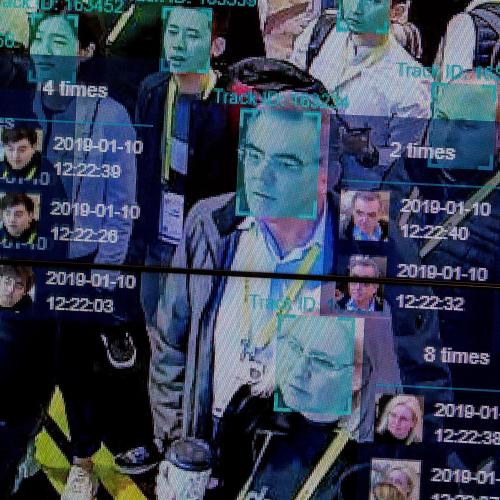
Retailers have the ability to scan your face digitally, and use that identification to offer you special prices or even recognize you as a prior shoplifter. But should they use it? Should they get your permission first? Privacy advocates announced Tuesday they have walked away from a government-run effort with industry intended to ... hash out voluntary protocols for facial recognition technology in a way that doesn't hurt consumers. The Commerce Department's National Telecommunications and Information Administration, or NTIA, was acting as mediator. The two sides had been meeting for 16 months ... until the nine major privacy groups said they had hit a dead end and that "people deserve more protection than they are likely to get in this forum. At a base minimum, people should be able to walk down a public street without fear that companies they've never heard of are tracking their every movement and identifying them by name using facial recognition technology," the groups said. "We have been unable to obtain agreement even with that basic, specific premise." The ability to apply a unique signature to a person's face, even if you don't identify them by name, is particularly invasive, according to privacy advocates. "You can change your password and your credit card number; you cannot change your fingerprints or the precise dimensions of your face. Through facial recognition, these immutable, physical facts can be used to identify you, remotely and in secret, without any recourse."
Note: Read this article for more in this matter. Remember, the same technologies that lead to the disappearance of privacy rights for individuals are also used by corrupt corporations against nonprofit civic organizations to undermine democracy.
At any given time, roughly 480,000 people sit in America's local jails awaiting their day in court, according to an estimate by the International Centre for Prison Studies. These are people who have been charged with a crime, but not convicted. They remain innocent in the eyes of the law. Three quarters of them ... are nonviolent offenders, arrested for traffic violations, or property crimes, or simple drug possession. Many will be found innocent and have their charges dropped completely. Defendants who [are] detained before trial [wait] a median of 68 days in jail. Many ... are forced to wait simply because they can't afford to post bail. A 2013 analysis by the Drug Policy Alliance ... found that nearly 40 percent of New Jersey's jail population fell into this category. People sit behind bars not because they're dangerous, or because they're a flight risk, but simply because they can't come up with the cash. A recent analysis by the Vera Institute ... found that 41 percent of New York City's inmates were sitting in jail on a misdemeanor charge because they couldn't meet a bail of $2,500 or less. For low income people, the consequences of a pre-trial detention, even a brief one, can be disastrous. And in many cases, these people will eventually be found to be innocent. Some civil rights reformers [argue] that bail policies are tantamount to locking people up for being poor. We spend somewhere in the ballpark of $17 billion dollars annually to keep innocent people locked up as they await trial.
Note: For more, read this New York Times article. For more along these lines, see concise summaries of deeply revealing news articles about income inequality and systemic prison industry corruption.
More than 750 plaintiffs are suing the Johns Hopkins Hospital System Corp. over its role in a series of medical experiments in Guatemala in the 1940s and 1950s during which subjects were infected with venereal diseases. The lawsuit in Baltimore seeks $1 billion in damages for individuals, spouses and children of people infected with syphilis, gonorrhea and other sexually transmitted diseases through a U.S. government program between 1945 and 1956. The suit claims Johns Hopkins officials had "substantial influence" over the studies, controlling some advisory panels, and were involved in planning and authorizing the experiments. A Hopkins spokesperson ... confirmed that faculty members took part in reviewing funding applications, but said this did not warrant a lawsuit against the medical center. The statement expressed "profound sympathy for individuals and families impacted by the deplorable 1940s syphilis study conducted by the U.S. Government in Guatemala," and noted that the ethical standards for conducting medical research have changed significantly in the decades since then. It's the latest in a series of lawsuits over the studies. A federal judge in 2012 dismissed a lawsuit against the U.S. government involving the same study.
Note: Explore an excellent list of dozens of studies over the years in which humans were used unknowingly as guinea pigs in clear breach of ethical standards. Links are provided for verification of each study. For more along these lines, see concise summaries of deeply revealing news articles about corruption in the medical industry and in government.
The Chicago police department operates an off-the-books interrogation compound. The facility, a nondescript warehouse on Chicagos west side known as Homan Square, has long been the scene of secretive work by special police units. Police practices at Homan Square [allegedly] include: Keeping arrestees out of official booking databases; Beating by police, resulting in head wounds; Shackling for prolonged periods; Denying attorneys access to the secure facility; Holding people [as young as 15] without legal counsel for between 12 and 24 hours. Unlike a precinct, no one taken to Homan Square is said to be booked. Jacob Church learned about Homan Square the hard way. On May 16 2012, he and 11 others were taken there after police infiltrated their protest against the Nato summit. After serving two and a half years in prison, Church ... and his co-defendants were found not guilty in 2014 of terrorism-related offenses. Tracy Siska, a criminologist and civil-rights activist with the Chicago Justice Project, said that Homan Square, as well as the unrelated case of ex-Guantnamo interrogator and retired Chicago detective Richard Zuley, showed the lines blurring between domestic law enforcement and overseas military operations. The real danger in allowing practices like Guantnamo or Abu Ghraib is the fact that they ... creep into domestic law enforcement, either with weaponry like with the militarization of police, or interrogation practices. Thats how we ended up with a black site in Chicago.
Note: Church was one of three young activists charged with 'terrorism' after police manufactured evidence against peaceful Occupy Wall St protesters in Chicago in 2012. For more, read about the increasing militarization of police in the U.S. after 9/11, or see concise summaries of deeply revealing civil liberties news articles.
Journalist and former Anonymous member ... Barrett Brown was sentenced to 63 months in prison by a federal judge in Dallas on Thursday. The judge also ordered him to pay more than $890,000 in restitution and fines. An investigative journalist, essayist and satirist who has written for the Onion, Vanity Fair and the Huffington Post, as well as for the Guardian, Brown claims to have split with Anonymous in 2011. Brown also founded Project PM, a crowdsourced investigative thinktank dedicated to looking into abuses by companies in the area of surveillance. In September 2012, Brown was arrested by the FBI. In October 2012, after being held for two weeks without charge, he was indicted on charges of making an online threat, retaliating against a federal officer and conspiring to release personal information about a government employee. Two months later, he was indicted on 12 further charges related to the hacking of private intelligence contractor Stratfor in 2011. Jeremy Hammond, the hacker who actually carried out the Stratfor breach, was sentenced to the maximum possible 10 years. Brown, who was accused of sharing a link to the data Hammond obtained from the breach ... at one point faced a possible sentence of 105 years. He will reportedly be eligible for supervised release after one year, and once released will have his computer equipment monitored. The $890,250 in restitution payments will go to Stratfor and other companies targeted by Anonymous.
Note: Even after being targeted by a high level conspiracy, jailed on spurious charges, and forced to pay nearly a million dollars to Stratfor for merely writing about the hack of their private spy agency, Brown states that he remains committed to exposing corruption as a journalist from within the US prison system.
An undercover California Highway Patrol officer who was attempting to infiltrate a demonstration against police brutality in Oakland pulled a gun on the protesters after he and his partner were outed. "About 50 people were marching near Lake Merritt just after 11:30 p.m. Wednesday when some of the demonstrators began calling out two men who were walking with the group," said [news photographer] Michael Short. Just as we turned up 27th Street, the crowd started yelling at these two guys, saying they were undercover cops, Short said Thursday. Somebody snatched a hat off the shorter guys head and he was fumbling around for it. A guy ran up behind him, knocked him down on the ground. The crowd began surging on them. The other taller guy... as the crowd started surging on them, he pulled out a gun. Chief Browne said the officer also pulled out a badge ... though Short, other members of the media and protesters reported that they did not see a badge. The officers, who Browne said he is not identifying, had been trailing the crowd in an unmarked car and began following on foot. Short said the officers were wearing street clothes and had their faces covered with bandannas. Browne confirmed this and ... said it was common. Several protesters took to Twitter to say that the officers had actually instigated acts of vandalism and were banging on windows alongside others.
Note: Here is proof that the police are infiltrating marches by protesters and wearing masks to cover their identities. Often those promoting violence are using masks. Could the police in some instances actually be provoking violence among protesters to discredit the movement?
Eric Garner was not the first American to be choked by the police, and he will not be the last, thanks to legal rules that prevent victims of police violence from asking federal courts to help stop deadly practices. The 1983 case City of Los Angeles v. Lyons vividly illustrates the problem. That case also involved an African-American man choked by the police without provocation. Unlike Mr. Garner, Adolph Lyons survived. He then filed a federal lawsuit, asking the city to compensate him for his injuries. He also asked the court to prevent the Los Angeles Police Department from using chokeholds in the future. The trial court ordered the L.A.P.D. to stop using chokeholds. The Supreme Court overturned this order. The court explained that Mr. Lyons would have needed to prove that he personally was likely to be choked again in order for his lawsuit to be a vehicle for systemic reform. This is the legal standard when a plaintiff asks a federal court for an injunction or a forward-looking legal order. When the stakes are this deadly, federal courts should step in. If police departments still failed to comply, federal judges could impose penalties. How do we know? Consider school segregation. Local officials had promised change but failed to ensure it. It took decades of close supervision by federal courts to make a dent in the problem. As the courts started to leave this field in more recent years, de facto segregation returned.
Note: For more along these lines, see concise summaries of deeply revealing news articles about civil liberties and government corruption from reliable major media sources.
Important Note: Explore our full index to revealing excerpts of key major media news articles on several dozen engaging topics. And don't miss amazing excerpts from 20 of the most revealing news articles ever published.