




















Civil Liberties News Articles
Below are key excerpts of revealing news articles on the erosion of our civil liberties from reliable news media sources. If any link fails to function, a paywall blocks full access, or the article is no longer available, try these digital tools.

Undercover police officers routinely adopted a tactic of "promiscuity" with the blessing of senior commanders, according to a former agent who worked in a secretive unit of the Metropolitan police for four years. The former undercover policeman claims that sexual relationships with activists were sanctioned for both men and women officers infiltrating anarchist, leftwing and environmental groups. Sex was a tool to help officers blend in, the officer claimed, and was widely used as a technique to glean intelligence. He said undercover officers, particularly those infiltrating environmental and leftwing groups, viewed having sex with a large number of partners "as part of the job". His comments contradict claims last week from the Association of Chief Police Officers that operatives were absolutely forbidden to sleep with activists. The claims follow the unmasking of undercover PC Mark Kennedy, who had sexual relationships with several women during the seven years he spent infiltrating a ring of environmental activists. Another two covert officers have been named in the past fortnight who also had sex with the protesters they were sent to spy on, fuelling allegations that senior officers had authorised sleeping around as a legitimate means of gathering intelligence.
Note: For a comprehensive overview of the still-ongoing revelations about police provocateur Mark Kennedy and his cohorts in the UK police infiltration of environmental and related activist groups, click here.
The Transportation Security Administration ... has on its web site a mythbuster that tries to reassure the public. Myth: The No-Fly list includes an 8-year-old boy. Buster: No 8-year-old is on a T.S.A. watch list. Meet Mikey Hicks, said Najlah Feanny Hicks, introducing her 8-year-old son, a New Jersey Cub Scout and frequent traveler who has seldom boarded a plane without a hassle because he shares the name of a suspicious person. Its not a myth. Hickss mother initially sensed trouble when he was a baby and she could not get a seat for him on their flight to Florida at an airport kiosk; airline officials explained that his name was on the list, she recalled. The first time he was patted down, at Newark Liberty International Airport, Mikey was 2. He cried. After years of long delays and waits for supervisors at every airport ticket counter, this years vacation to the Bahamas badly shook up the family. Mikey was frisked on the way there, then more aggressively on the way home. Up your arms, down your arms, up your crotch someone is patting your 8-year-old down like hes a criminal, Mrs. Hicks recounted. It is true that Mikey is not on the federal governments no-fly list, which includes about 2,500 people, less than 10 percent of them from the United States. But his name appears to be among some 13,500 on the larger selectee list, which sets off a high level of security screening.
Note: For many reports from major media sources on the extreme loss of liberties brought about by the highly touted "war on terrorism," click here.
Every phone call, text message, email and website visit made by private citizens is to be stored for a year and will be available for monitoring by government bodies. All telecoms companies and internet service providers will be required by law to keep a record of every customer’s personal communications, showing who they have contacted, when and where, as well as the websites they have visited. Despite widespread opposition to the increasing amount of surveillance in Britain, 653 public bodies will be given access to the information, including police, local councils, the Financial Services Authority, the ambulance service, fire authorities and even prison governors. They will not require the permission of a judge or a magistrate to obtain the information, but simply the authorisation of a senior police officer or the equivalent of a deputy head of department at a local authority. The Government announced yesterday it was pressing ahead with privately held “Big Brother” databases that opposition leaders said amounted to “state-spying” and a form of “covert surveillance” on the public. It is doing so despite its own consultation showing that it has little public support. The new rules ... will not only force communications companies to keep their records for longer, but to expand the type of data they keep to include details of every website their customers visit.
Note: For many more reports from major media sources on the disturbing trend toward increasing government and corporate surveillance and loss of privacy, click here.
A federal appeals court yesterday backed the president's power to indefinitely detain a U.S. citizen captured on U.S. soil without any criminal charges, holding that such authority is vital during wartime to protect the nation from terrorist attacks. The ruling, by the U.S. Court of Appeals for the 4th Circuit, came in the case of Jose Padilla, a former gang member and U.S. citizen arrested in Chicago in 2002 and a month later designated an "enemy combatant" by President Bush. Padilla has been held without trial in a U.S. naval brig for more than three years, and his case has ignited a fierce battle over the balance between civil liberties and the government's power to fight terrorism since the Sept. 11, 2001, attacks. A host of civil liberties groups and former attorney general Janet Reno weighed in on Padilla's behalf, calling his detention illegal and arguing that the president does not have unchecked power to lock up U.S. citizens indefinitely. In its ruling yesterday, the three-judge panel overturned a lower court. Avidan Cover, a senior associate at Human Rights First, said the ruling "really flies in the face of our understanding of what rights American citizens are entitled to." Opponents have warned that if not constrained by the courts, Padilla's detention could lead to the military being allowed to hold anyone who, for example, checks out what the government considers the wrong kind of reading materials from the library.
Note: For many disturbing reports from major media sources on government threats to civil liberties, click here.
Recent pronouncements from the Bush Administration and national security initiatives put in place in the Reagan era could see internment camps and martial law in the United States. When president Ronald Reagan was considering invading Nicaragua he issued a series of executive orders that provided the Federal Emergency Management Agency (FEMA) with broad powers in the event of a "crisis" such as "violent and widespread internal dissent or national opposition against a US military invasion abroad". On July 20 the Detroit Free Press ran a story entitled "Arabs in US could be held, official warns". The story referred to a member of the US Civil Rights Commission who foresaw the possibility of internment camps for Arab Americans. FEMA has practised for such an occasion. FEMA, whose main role is disaster response, is also responsible for handling US domestic unrest. From 1982-84 Colonel Oliver North assisted FEMA in drafting its civil defence preparations. They included executive orders providing for suspension of the constitution, the imposition of martial law, internment camps, and the turning over of government to the president and FEMA. A Miami Herald article on July 5, 1987, reported that the former FEMA director Louis Guiffrida's deputy, John Brinkerhoff, handled the martial law portion of the planning. Today Mr Brinkerhoff is with the highly influential Anser Institute for Homeland Security.
Note: Most of these provisions are still in place today. Isn't it time for a change?
In 1953, Joseph Alsop, then one of Americas leading syndicated columnists, went to the Philippines to cover an election. He did not go because he was asked to do so by his syndicate. He did not go because he was asked to do so by the newspapers that printed his column. He went at the request of the CIA. Alsop is one of more than 400 American journalists who in the past twenty-five years have secretly carried out assignments for the Central Intelligence Agency, according to documents on file at CIA headquarters. Journalists provided a full range of clandestine servicesfrom simple intelligence gathering to serving as go-betweens with spies in Communist countries. Reporters shared their notebooks with the CIA. Editors shared their staffs. Some of the journalists were Pulitzer Prize winners, distinguished reporters who considered themselves ambassadors-without-portfolio for their country. Most were less exalted: foreign correspondents who found that their association with the Agency helped their work; stringers and freelancers who were as interested in the derring-do of the spy business as in filing articles; and, the smallest category, full-time CIA employees masquerading as journalists abroad. In many instances, CIA documents show, journalists were engaged to perform tasks for the CIA with the consent of the managements of Americas leading news organizations.
Note: To understand how the CIA and others manipulate the major media is in its news coverage, see the brilliant summary of the work of 20 award-winning journalists on this key topic at this link.
YouTube has banned any coronavirus-related content that directly contradicts World Health Organization (WHO) advice. The Google-owned service says it will remove anything it deems "medically unsubstantiated". Chief executive Susan Wojcicki said the media giant wanted to stamp out "misinformation on the platform". The move follows YouTube banning conspiracy theories falsely linking Covid-19 to 5G networks. Mrs Wojcicki made the remarks on Wednesday during her first interview since the global coronavirus lockdown began. "So people saying, Take vitamin C, take turmeric, well cure you, those are the examples of things that would be a violation of our policy, she told CNN. Anything that would go against World Health Organization recommendations would be a violation of our policy. Last week, Facebook announced users who had read, watched or shared false Covid-19 information would receive a pop-up alert urging them to visit the WHO's website. Facebook-owned messaging service WhatsApp, meanwhile, stopped users forwarding messages already shared more than four times by the wider community to more than one chat at a time. It comes as some of the UK's largest news publishers, including Daily Telegraph and the Guardian, criticised Google for failing to be transparent about its approach to filtering adverts alongside coronavirus-related content, according to the Financial Times.
Note: So now anything posted by those not deemed to be "experts" will be banned. Whatever happened to free speech? Watch YouTube's CEO spell this out in this video. More excellent, little-known information here in an interview with a respected MD whose video was banned. And how can BBC state links between 5G and Covid-19 are false, when that has yet to be established? Is it just a coincidence this CNBC article states China's 5G networks went online just weeks before the coronavirus outbreak? See also concise summaries of revealing coronavirus news articles.
Our Attorney General submitted a proposal last week that would dramatically erode our civil liberties. Among other things, the proposal suspends habeas corpus ... or the right to appear before a judge before being detained. That right is enshrined in our Constitution and without it, Barr could hold Americans indefinitely without a trial. Our justice system is grounded in an unwavering guarantee that each one of us is entitled to certain inalienable rights, including the right to due process before one's freedom is taken away. On March 13, the President declared a national emergency, which unlocked special powers to keep our country safe. Congress has enacted roughly 120 laws that allow presidents such powers to meet precisely these types of threats while maintaining our democracy. These laws are not without limits. Nor were they meant to be used to capitalize on fear to unnecessarily erode our freedoms. Yet while the world is consumed by this pandemic and when he thought no one was watching, Attorney General William Barr proposed granting himself immense, permanent powers extending far past the needs posed by this threat. For example, the proposal grants Barr personally the power to ask any chief judge to hold a citizen, "whenever the district court is fully or partially closed by virtue of any natural disaster, civil disobedience, or other emergency situation." If this were about COVID-19, the proposal would suspend only certain rights narrowly tailored to fighting this disease.
Note: This New York Times article details how autocrats around the world are using the fear generated to grab power. Read another highly informative article on how this crisis is being exploited to grab power. For more along these lines, see concise summaries of deeply revealing news articles on the coronavirus pandemic and the erosion of civil liberties from reliable major media sources.
Even as President Trump says he tested negative for coronavirus, the COVID-19 pandemic raises the fear that huge swaths of the executive branch or even Congress and the Supreme Court could also be disabled, forcing the implementation of "continuity of government" plans. Above-Top Secret contingency plans already exist for what the military is supposed to do if all the Constitutional successors are incapacitated. Standby orders were issued more than three weeks ago to ready these plans, not just to protect Washington but also to prepare for the possibility of some form of martial law. The various plans codenamed Octagon, Freejack and Zodiac are the underground laws to ensure government continuity. Under these extraordinary plans, "devolution" could circumvent the normal Constitutional provisions for government succession, and military commanders could be placed in control around America. Since Hurricane Katrina in 2006, no emergency has triggered any state to even request federal military aid under these procedures. Part of the reason, the senior officer involved in planning says, is that local police forces have themselves become more capable, acquiring military-grade equipment and training. And part of the reason is that the governors have worked together to strengthen the National Guard, which can enforce domestic law when it is mustered under state control.
Note: For more along these lines, see concise summaries of deeply revealing news articles on the coronavirus pandemic from reliable major media sources.
Law enforcement frequently infiltrates progressive political movements using agent provocateurs who urge others to engage in violence. More rarely, such provocateurs commit acts of violence themselves. In protests across the country over the past week, the clear actor escalating the violence generally hasnt been a protester or even a right-wing infiltrator, but the police themselves. The best documented use of provocateurs by the U.S. government occurred during the Federal Bureau of Investigations Counter-Intelligence Program, or COINTELPRO, from 1956 to 1971. The reason the documentation is available is because a group of citizens broke into an FBI office in Pennsylvania ... and stole files that they then passed to the media. In one notorious example in May 1970, an informant working for both the Tuscaloosa police and the FBI burned down a building at the University of Alabama during protests over the recent Kent State University shootings. The police then declared that demonstrators were engaging in an unlawful assembly and arrested 150 of them. The list goes on and on from there. Thirteen Black Panthers were accused of a plot to blow up the Statue of Liberty after receiving 60 sticks of dynamite from an FBI informant. After 28 people broke into a federal building to destroy draft files in 1971, an FBI informant bragged, I taught them everything they knew. When and whether the FBI ever stopped, however, is an open question. In any case, police forces in the U.S. continued the same tactics.
Note: Read more about the FBI's notorious COINTELPRO program. For more along these lines, see concise summaries of deeply revealing news articles on police corruption and the erosion of civil liberties from reliable major media sources.
Police are violating no clearly established rights when they steal someones property after seizing it with a legal search warrant and, therefore, cant be sued in federal court, an appeals court ruled Wednesday. The Ninth U.S. Circuit Court of Appeals in San Francisco refused to reinstate a suit against Fresno police by two people whose homes and business were searched in 2013 during a gambling investigation. After the search, three officers signed an inventory sheet saying they had seized about $50,000. But the two owners, Micah Jessop and Brittan Ashjian, who operated automatic teller machines ... said the officers had actually taken $276,000 - $151,000 in cash and $125,000 in rare coins - and pocketed the difference. Darrell York, Jessops and Ashjians attorney, said police and a city attorney denied that a theft occurred. Even if Kumagai and his fellow officers stole money and coins from Jessop and Ashjian, the appeals court said, the owners could not sue in federal court to get their money back. Such a suit would require proof that their constitutional rights were violated, the court said, and suits against police must clear the additional hurdle of showing that those rights were clearly established. The allegation of any theft by police officers - most certainly the theft of over $225,000 - is undoubtedly deeply disturbing, Judge Milan Smith said in the 3-0 ruling. Whether that conduct violates the Fourth Amendments prohibition on unreasonable searches and seizures, however, is not obvious.
Note: Read about "civil asset forfeiture" used by police to steal money and other private property for their departments. For more along these lines, see concise summaries of deeply revealing police corruption news articles from reliable major media sources.
YouTube has removed two videos of California doctors ... Dan Erickson and Artin Massihi of Bakersfield, California [which] downplayed the risk of the coronavirus and asserted that stay-at-home measures were unnecessary. Facebook, however, has not removed the doctors' videos. The different reactions of YouTube and Facebook highlight the challenges of moderating high-stakes misinformation as it goes viral, especially when it is considered to be expert opinion. The video removed by YouTube showed a one-hour news conference livestreamed by local media, including NBC and ABC affiliates in Bakersfield. By Wednesday, the video had been seen at least 15 million times. Erickson and Massihi, owners of several urgent care centers in the area, presented data from 5,213 COVID-19 tests. The data, they claimed, showed that the coronavirus was widespread in the community already but had caused few deaths. Their data, they said, supported the need to rethink state stay-at-home measures. Furthermore, Erickson ... claimed that COVID-19 death numbers were inaccurate, citing other unnamed doctors in Wisconsin and California who he said had told him that they were urged to list the disease as a cause of death even if it was unrelated. "The only justification for taking it down was that the two physicians on screen had reached different conclusions from the people currently in charge," said Fox News host Tucker Carlson. Massihi posted a video to his personal Facebook page Tuesday thanking supporters while insisting that their comments were meant only to share their own data, not to drive national or even state policy.
Note: Watch an excellent follow-up interview with Dr. Erickson exposing further deception. Even if these doctors are wrong about some of their conclusions, don't they have a right to express their opinions? Will anyone who disputes the claims of government officials be banned from expressing their opinions on social media? Sadly, this BBC article shows that is already true for the coronavirus on YouTube. For more along these lines, see concise summaries of deeply revealing news articles on the coronavirus from reliable major media sources.
The United States government has been secretly amassing a "large amount" of "sensitive and intimate information" on its own citizens, a group of senior advisers informed Avril Haines, the director of national intelligence. The government effort to accumulate data revealing the minute details of Americans' lives [is] described soberly and at length by the director's own panel of experts in a newly declassified report. The report states that the government believes it can "persistently" track the phones of "millions of Americans" without a warrant, so long as it pays for the information. It is often trivial "to deanonymize and identify individuals" from data that was packaged ... for commercial use. Such data may be useful, it says, to "identify every person who attended a protest or rally based on their smartphone location or ad-tracking records." Such civil liberties concerns are prime examples of how "large quantities of nominally 'public' information can result in sensitive aggregations." What's more, information collected for one purpose "may be reused for other purposes," which may "raise risks beyond those originally calculated," an effect called "mission creep." "In the wrong hands," [Office of the Director of National Intelligence] advisers warn, the same mountain of data the government is quietly accumulating could be turned against Americans to "facilitate blackmail, stalking, harassment, and public shaming." These are all offenses that have been committed by intelligence agencies and White House administrations in the past.
Note: For more along these lines, see concise summaries of deeply revealing news articles on government corruption and the disappearance of privacy from reliable major media sources.
California law enforcement pursued criminal charges against eight anti-fascist activists who were stabbed or beaten at a neo-Nazi rally while failing to prosecute anyone for the knife attacks against them. In addition to the decision not to charge white supremacists or others for stabbings at a far-right rally that left people with critical wounds, police also investigated 100 anti-fascist counter-protesters, recommending more than 500 total criminal charges against them, according to court filings. Meanwhile, for men investigated on the neo-Nazi side of a June 2016 brawl ... police recommended only five mostly minor charges. The documents have raised fresh questions about California police agencies handling of rightwing violence and extremism, renewing accusations that law enforcement officials have shielded neo-Nazis from prosecution while aggressively pursuing demonstrators with leftwing and anti-racist political views. The Guardian previously interviewed two victims who were injured, then pursued by police Cedric OBannon, a black journalist and stabbing victim who ultimately was not charged, and Yvette Felarca, a well-known Berkeley activist whose case is moving forward. Previous records also revealed that police had worked with the neo-Nazi groups to target the anti-racist activists. The records disclosed this week provided new details about six other stabbing and beating victims who were treated as suspects by police after the rally ... which was organized by a neo-Nazi group.
Note: For more along these lines, see concise summaries of deeply revealing news articles on police corruption and the erosion of civil liberties.
From the mid-1970s to the mid-80s, Americas incarceration rate doubled, from about 150 people per 100,000 to about 300 per 100,000. From the mid-80s to the mid-90s, it doubled again. By 2007, it had reached a historic high of 767 people per 100,000. In absolute terms, Americas prison and jail population from 1970 until today has increased sevenfold, from some 300,000 people to 2.2 million. In 2000, one in 10 black males between the ages of 20 and 40 was incarcerated 10 times the rate of their white peers. At a cost of $80 billion a year, American correctional facilities are a social-service program providing health care, meals, and shelter for a whole class of people. An authoritative report issued last year by the National Research Council concluded, the current U.S. rate of incarceration is unprecedented by both historical and comparative standards. Even once an individual is physically out of prison, many do not elude its grasp. In 1984, 70 percent of all parolees successfully completed their term without arrest and were granted full freedom. In 1996, only 44 percent did. As of 2013, 33 percent do. Deindustrialization had presented an employment problem for Americas poor and working class of all races. Prison presented a solution: jobs for whites, and warehousing for blacks. Mass incarceration widened the income gap between white and black Americans, writes [historian] Heather Ann Thompson ... because the infrastructure of the carceral state was located disproportionately in all-white rural communities.
Note: The article above provides a detailed history of some U.S. policies that created the corrupt prison industry.
The United States remains in a heightened threat environment fueled by several factors, including an online environment filled with false or misleading narratives and conspiracy theories, and other forms of mis- dis- and mal-information (MDM) introduced and/or amplified by foreign and domestic threat actors. These threat actors seek to exacerbate societal friction to sow discord and undermine public trust in government institutions to encourage unrest, which could potentially inspire acts of violence. The convergence of the following factors has increased the volatility, unpredictability, and complexity of the threat environment: (1) the proliferation of false or misleading narratives, which sow discord or undermine public trust in U.S. government institutions; (2) continued calls for violence directed at U.S. critical infrastructure; and (3) calls by foreign terrorist organizations for attacks on the United States. COVID-19 mitigation measures—particularly COVID-19 vaccine and mask mandates—have been used by domestic violent extremists to justify violence since 2020 and could continue to inspire these extremists to target government, healthcare, and academic institutions that they associate with those measures. Domestic violent extremists have ... have recently aspired to disrupt U.S. electric and communications critical infrastructure, including by spreading false or misleading narratives about 5G cellular technology.
Note: Since when does questioning how much we trust our government make a person an extremist or terrorist? What ever happened to the first amendment of the U.S. Constitution? Our founding fathers would likely have been declared terrorists by the DHS. So sad... For more along these lines, see concise summaries of deeply revealing news articles on government corruption and the erosion of civil liberties from reliable major media sources.
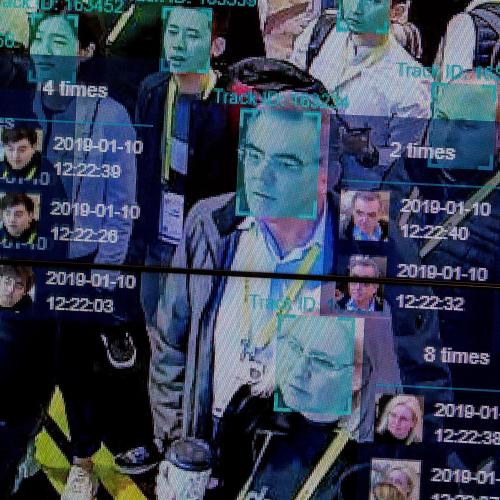
The Covid-19 pandemic is now giving Russian authorities an opportunity to test new powers and technology, and the country's privacy and free-speech advocates worry the government is building sweeping new surveillance capabilities. Perhaps the most well-publicized tech tool in Russia's arsenal for fighting coronavirus is Moscow's massive facial-recognition system. Rolled out earlier this year, the surveillance system had originally prompted an unusual public backlash, with privacy advocates filing lawsuits over unlawful surveillance. Coronavirus, however, has given an unexpected public-relations boost to the system. Last week, Moscow police claimed to have caught and fined 200 people who violated quarantine and self-isolation using facial recognition and a 170,000-camera system. Some of the alleged violators who were fined had been outside for less than half a minute before they were picked up by a camera. And then there's the use of geolocation to track coronavirus carriers. Prime Minister Mikhail Mishustin earlier this week ordered Russia's Ministry of Communications to roll out a tracking system based on "the geolocation data from the mobile providers for a specific person" by the end of this week. According to a description in the government decree, information gathered under the tracking system will be used to send texts to those who have come into contact with a coronavirus carrier, and to notify regional authorities so they can put individuals into quarantine.
Note: For more along these lines, see concise summaries of deeply revealing news articles on the coronavirus pandemic and the disappearance of privacy from reliable major media sources.
Exactly 10 years ago this week, the FBI warned of the potential consequences including bias of white supremacist groups infiltrating local and state law enforcement, indicating it was a significant threat to national security. In the 2006 bulletin, the FBI detailed the threat of white nationalists and skinheads infiltrating police in order to disrupt investigations against fellow members and recruit other supremacists. The bulletin was released during a period of scandal for many law enforcement agencies throughout the country, including a neo-Nazi gang formed by members of the Los Angeles County Sheriffs Department who harassed black and Latino communities. Similar investigations revealed officers and entire agencies with hate group ties in Illinois, Ohio and Texas. Much of the bulletin has been redacted, but in it, the FBI identified white supremacists in law enforcement as a concern, because of their access to both restricted areas vulnerable to sabotage and elected officials or people who could be seen as potential targets for violence. The memo also warned of ghost skins, hate group members who dont overtly display their beliefs in order to blend into society and covertly advance white supremacist causes. At least one white supremacist group has reportedly encouraged ghost skins to seek positions in law enforcement for the capability of alerting skinhead crews of pending investigative action against them, the report read. In the 10 years since the FBIs initial warning, little has changed.
Note: For more along these lines, see concise summaries of deeply revealing news articles on police corruption and the erosion of civil liberties from reliable major media sources.
Even before he became director of the FBI, [J. Edgar] Hoover was conducting secret intelligence operations against U.S. citizens he suspected were anarchists, radical leftists or communists. After a series of anarchist bombings went off across the United States in 1919, Hoover sent five agents to infiltrate the newly formed Communist Party. "From that day forward, he planned a nationwide dragnet of mass arrests to round up subversives, round up communists, round up Russian aliens," [author Tim] Weiner says. On Jan. 1, 1920, Hoover sent out the arrest orders, and at least 6,000 people were arrested and detained throughout the country. "When the dust cleared, maybe 1 in 10 was found guilty of a deportable offense," says Weiner. Hoover, Attorney General Mitchell Palmer and Secretary of the Navy Franklin Delano Roosevelt all came under attack for their role in the raids. Hoover started amassing secret intelligence on "enemies of the United States" — a list that included terrorists, communists, spies — or anyone Hoover or the FBI had deemed subversive. Later on, anti-war protesters and civil rights leaders were added to Hoover's list. "Hoover saw the civil rights movement from the 1950s onward and the anti-war movement from the 1960s onward, as presenting the greatest threats to the stability of the American government since the Civil War," [Weiner] says. "These people were enemies of the state, and in particular Martin Luther King [Jr.] was an enemy of the state."
Note: Read more about the FBI's COINTELPRO program. For more along these lines, see concise summaries of deeply revealing news articles on intelligence agency corruption and the erosion of civil liberties from reliable major media sources.
Tokyos coronavirus state of emergency is as surreal as they come. Though the streets are noticeably quieter than normal, subways and buses are still jammed with commuters. Stock trading goes on as normal. Many bars, restaurants and cafes are abuzz. So are barbershops, beauty salons and home improvement centers. In Shibuya and other meccas of youth culture, teenagers who should be hunkering down at home are out and about. Leave it to Japans largest metropolis to morph shelter-in-place into a giant kabuki performance starring 8.3 million people. [Prime Minister] Abe should dispense with the pandemic kabuki and call for a strict shelter-in-place policy. Though there are legal questions about enforceability, Abe could use the bully pulpit to urge Japanese and companies to comply.
Important Editor's Note: This article is a prime example of how the media is bulldozing it's social isolation agenda and convincing people to willingly give up their freedoms. Japan was one of the first countries hit by the virus, with it's first death due to the coronavirus on Feb. 13th. Yet while the U.S., Italy, France, Spain, and the UK all had their first coronavirus deaths after Japan, all of these countries as of April 12th had tens of thousands of deaths, while Japan had only 124 deaths. That's 100 times less. Instead of calling for stricter policies in Japan, why isn't everyone asking what they are doing to have such an incredibly low death rate without instituting lockdown procedures? For more serious questions on how we are being manipulated, see this excellent essay.
Important Note: Explore our full index to revealing excerpts of key major media news articles on several dozen engaging topics. And don't miss amazing excerpts from 20 of the most revealing news articles ever published.



