
























Income Inequality Media Articles
Below are key excerpts of revealing news articles on income inequality from reliable news media sources. If any link fails to function, a paywall blocks full access, or the article is no longer available, try these digital tools.

Trump loyalist and CIA contractor Larry Ellison’s purchase of CNN appears imminent, and marks the latest venture into media for the world’s second-richest individual. The world’s seven richest individuals are all now powerful media barons, controlling what the world sees, reads, and hears, marking a new chapter in oligarchical control over society and striking another blow at a free, independent press and diversity of opinion. In September, President Trump signed an executive order approving a proposal to force through the sale of social media platform TikTok to an American consortium led by Ellison-owned tech company, Oracle. Under the planned arrangement, Oracle will oversee the platform’s security and operations, giving the world’s second-richest man effective control over the platform that more than 60% of Americans under thirty years of age use for news and entertainment. No other period in history has seen such a rapid and overwhelming buy up of our means of communications by the billionaire class – a fact that raises tough questions about freedom of speech and diversity of opinion. Today, the world’s seven richest individuals are all major media barons, giving them extraordinary control over our media and public square, allowing them to set agendas, and suppress forms of speech they do not approve of. This includes criticisms of them and their holdings, the economic system we live under, and the actions of ... governments.
Note: For more along these lines, read our concise summaries of news articles on financial inequality and media manipulation.
Mark Zuckerberg is said to have started work on Koolau Ranch, his sprawling 1,400-acre compound on the Hawaiian island of Kauai, as far back as 2014. It is set to include a shelter, complete with its own energy and food supplies, though the carpenters and electricians working on the site were banned from talking about it. Asked last year if he was creating a doomsday bunker, the Facebook founder gave a flat "no". The underground space spanning some 5,000 square feet is, he explained, "just like a little shelter, it's like a basement". Other tech leaders ... appear to have been busy buying up chunks of land with underground spaces, ripe for conversion into multi-million pound luxury bunkers. Reid Hoffman, the co-founder of LinkedIn, has talked about "apocalypse insurance". So, could they really be preparing for war, the effects of climate change, or some other catastrophic event the rest of us have yet to know about? The advancement of artificial intelligence (AI) has only added to that list of potential existential woes. Ilya Sutskever, chief scientist and a co-founder of Open AI, is reported to be one of them. Mr Sutskever was becoming increasingly convinced that computer scientists were on the brink of developing artificial general intelligence (AGI). In a meeting, Mr Sutskever suggested to colleagues that they should dig an underground shelter for the company's top scientists before such a powerful technology was released on the world.
Note: Read how some doomsday preppers are rejecting isolating bunkers in favor of community building and mutual aid. For more along these lines, read our concise summaries of news articles on financial inequality.
Erb and his cousin raised money from investors, bought homes in places like the Chatham-Arch neighborhood in Indianapolis ... and rented them out. He was not the first New York finance person to profit from single-family rentals across the United States. The private equity firm Blackstone (commonly confused with BlackRock) more or less invented this buy-to-rent strategy in 2012. It's now a public company valued at more than $18 billion. The response to this development — of Wall Street buying Main Street ... has been bipartisan, populist and patriotic condemnation. Both JD Vance and Kamala Harris called for bans on these corporate landlords. Homeownership has been a primary way that middle-class families build wealth. But now private equity was outbidding aspiring homeowners, making it more expensive to buy a home and pocketing the appreciation in home values. During the Great Recession ... the U.S. had a glut of single-family homes in foreclosure. Many were auctioned off en masse, including by the federal government, which organized auctions for investors like Blackstone and even provided a $1 billion loan guarantee to encourage Blackstone to buy. This allowed private equity firms (which raise money from wealthy families, pension funds and other organizations to seek out profits, often by buying private companies) and real estate investors to efficiently and cheaply buy, say, a dozen similar homes located in the same Phoenix suburb.
Note: For more along these lines, read our concise summaries of news articles on financial inequality and financial system corruption.
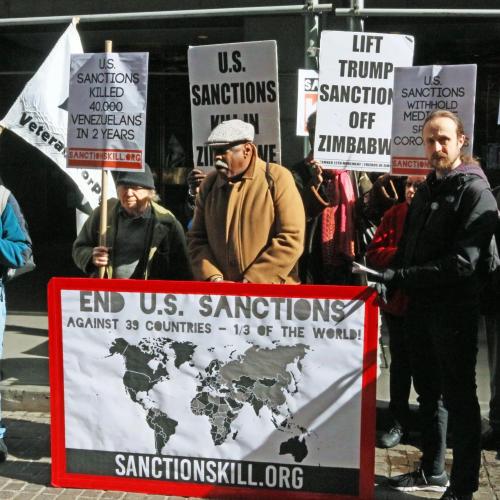
According to the Global Sanctions Database, the United States, European Union, and UN have sanctioned 25% of the countries in the world. The United States by itself sanctioned 40% of these countries, sanctions that are unilateral because they do not have the assent of a UN Security Council resolution. In the 1960s, only 8% of the world’s countries were under sanctions. This inflation of sanctions demonstrates that it has become normal for the powerful North Atlantic states to wage wars without having to fire a bullet. As US President Woodrow Wilson said in 1919 at the formation of the League of Nations, sanctions are ‘something more tremendous than war’. The cruellest formulation of Wilson’s statement was made by Madeleine Albright, then the US ambassador to the UN, regarding the US sanctions against Iraq in the 1990s. From 1990 to 1996, sanctions ... resulted in the excess deaths of over 500,000 children under the age of five. The number of people who die because of sanctions is greater than the number of battle-related casualties (106,000 deaths per year) ‘and similar to some estimates in the total death toll of wars including civilian casualties (around half a million deaths per year)’. The most vulnerable population groups, as you would expect, are children under five and older people. Deaths of children under five years ‘represented 51% of total deaths caused by sanctions over the 1970–2021 period’.
Note: The above article is largely based on an article published in The Lancet titled "Effects of international sanctions on age-specific mortality: a cross-national panel data analysis." Learn more about human rights abuses during wartime in our comprehensive Military-Intelligence Corruption Information Center. For more, read our concise summaries of news articles on government corruption.
In her new book, Bad Company: Private Equity and the Death of the American Dream, journalist and WIRED alum Megan Greenwell chronicles the devastating impacts of one of the most powerful yet poorly understood forces in modern American capitalism. Flush with cash, largely unregulated, and relentlessly focused on profit, private equity firms have quietly reshaped the US economy, taking over large chunks of industries ranging from health care to retail—often leaving financial ruin in their wake. Twelve million people in the US now work for companies owned by private equity, Greenwell writes, or about 8 percent of the total employed population. It is very hard for private equity firms to lose money on deals. They're getting a 2 percent management fee, even if they're running the company into the ground. They're also able to pull off all these tricks, like selling off the company's real estate and then charging the company rent on the same land it used to own. When private equity firms take out loans to buy companies, the debt from those loans is assigned not to the private equity firm but to the portfolio company. It is just not about improving the company at all. It is about, how do we extract money? There was a huge expansion of private equity in the 2010s for the same reason that venture capital exploded: There was a lot of cheap money out there, and cheap money is great for investors.
Note: For more along these lines, read our concise summaries of news articles on financial industry corruption.
If economic inequality increases within a country, the risk of civil war breaking out grows. This is the finding from a study by the Chair of Economic History at the University of Tübingen. The study has been published in the Review of Income and Wealth. The calculations revealed a statistically significant connection between unequal distribution of income and the outbreak of civil wars. The results can be verified using historical events: for example, land was extremely unequally distributed in Russia before the October revolution of 1917—and this critically contributed to the outbreak of revolution and civil war, a marker that was also identified by the new benchmark with a correspondingly high probability. The new benchmark also makes it possible to predict the risk of civil war today: "In the U.S. the inequality in income distribution has risen sharply in the past 30 years. Accordingly, the risk of a civil war in the U.S. has risen drastically from 10% to 21%," says Baten. In Great Britain, China, India and Russia too, inequality has risen greatly in the same period. "We've checked what influence other variables had on the outbreak of civil wars," says Laura Radatz, co-author of the study. "For instance, the size of a country and its population naturally increase the probability that a civil war will break out somewhere in this country." The amount of economic growth in a country does not measurably influence the risk of a civil war, according to the study.
Note: For more along these lines, read our concise summaries of news articles on financial inequality.
Even when the economy appears to be booming, millions struggle to stay afloat. In a recent poll from Demand Progress, 81.6 percent of voters surveyed said they want leaders who break up monopolies, compared to just 47.3 percent who prioritize cutting government red tape. This poll suggests that the public supports a populist approach that confronts corporate power more than an abundance agenda that sidesteps it. It reflects a growing recognition: while bureaucratic inefficiencies certainly exist, corporations are blocking our abundance because scarcity is profitable. The scarcity that so many Americans feel in their daily lives is not by accident, it’s by design. Companies block abundance by strategically reducing output and access to goods and services. Artificial scarcity is a business strategy. One that prioritizes profit maximization over widespread availability, ensuring that demand consistently outstrips supply. This deliberate restriction allows companies to command higher prices. Concentration makes it easier to manufacture scarcity. When a few large players dominate the market, they can manipulate the fundamental dynamics of supply and demand and charge high economic rents. This is made possible by an economic and political system that corporations have spent decades reshaping to suit their needs. As a result, we live in an economy that has quietly redefined freedom as the power of the wealthy to set the terms for the rest.
Note: For more along these lines, read our concise summaries of news articles on corporate corruption and financial inequality.
A few dozen people gathered inside a graffiti-clad building in the Carabanchel district of Madrid. They had come to commiserate about the American investment banks and private equity funds that controlled their homes. Some at this meeting of the Sindicato de Vivienda de Carabanchel (the Carabanchel Housing Union) were fighting eviction orders or skyrocketing rents. Others had lost their homes through mortgage foreclosures. One attendee, Elsa Riquelme, described her yearslong battle to stay in the 600-square-foot apartment where she raised her three sons, which is now owned by Blackstone, the world’s largest private equity firm. Over the past decade, Blackstone has become Madrid’s largest private owner of residential real estate, and the second largest in all of Spain. Ms. Riquelme’s apartment is one of 13,000 that Blackstone currently owns in Madrid, and among 19,600 it owns nationwide. Across Spain, around 185,000 rental properties are now owned by large corporations, half of those by firms based in the United States. Rental prices have increased 57 percent since 2015 and home prices 47 percent ... even as more than 4 million homes sit empty. After the pandemic pushed Spain’s unemployment rate up to 15 percent, evictions nationwide spiked. In Madrid, tenant groups estimate that 20,000 renters in the city currently face the threat of eviction. These days, just 2 percent of Spanish homes available for rent are public housing. In France it’s 14 percent; in the Netherlands it’s 34 percent.
Note: This article is also available here. For more along these lines, read our concise summaries of news articles on corporate corruption and financial inequality.
A three-step process called “Buy, Borrow, Die” ... allows people to amass a huge fortune, spend as much of it as they want, and pass the rest—untaxed—on to their heirs. The technique is so cleverly designed that the standard wish list of progressive tax reforms would leave it completely intact. The ... wealth [of the superrich] consists almost entirely of stock in the companies they’ve built or invested in. Instead of selling their assets to make major purchases, the superrich can use them as collateral to secure loans, which, because they must eventually be repaid, are also not considered taxable income. You might think this couldn’t possibly go on forever. Eventually, the rich will need to sell off some of their assets to pay back the loan. That brings us to step three: die. According to a provision of the tax code known as “stepped-up basis”—or, more evocatively, the “angel of death” loophole—when an individual dies, the value that their assets gained during their lifetime becomes immune to taxation. Those assets can then be sold by the billionaire’s heirs to pay off any outstanding loans without them having to worry about taxes. All of this is completely, perfectly legal. The strategy has basically killed the entire concept of an income tax for the wealthiest individuals. The result is a two-tiered tax system: one for the many, who earn their income through wages and pay taxes, and another for the few, who accumulate wealth through paper assets and largely do not pay taxes.
Note: Average individuals also pay more in taxes than major corporations. For more along these lines, read our concise summaries of news articles on financial inequality.
Lawmakers are facing a deadline to reauthorize the federal program providing insurance to homeowners when private insurers abandon their climate-battered locales. The 56-year-old program holds nearly five million policies and more than $22 billion in liabilities. It was envisioned as a stopgap measure for the working class — but the wealthy are now exploiting the program at the expense of low-income homeowners. That includes Trump’s Mar-a-Lago estate. A 2020 study ... found that the program “provides a substantial subsidy to upper-income groups.” How? By charging lower-income households higher premiums than high-income households — even though the latter’s properties are generating far higher loss ratios. The study found that “almost all of the excess (flood) losses are in the highest income segments” because “insufficient premium is collected from the higher income groups.” In other words, “Buyers that can most afford the premium are not paying their proper rate.” Facing the program’s March 14 expiration, lawmakers have been trying again to greenlight it with few reforms. But Sen. Rand Paul (R-Ky.) recently gummed up the works with amendments barring the program from insuring second homes and placing a cap on eligible home values. “Is there some level of rich person’s mansion that maybe the average ordinary taxpayer should not have to subsidize their insurance?” Paul asked.
Note: For more along these lines, read our concise summaries of news articles on financial inequality.
Five years ago, researchers for RAND found that roughly $47 trillion earned by the working class between 1975 and 2018 was instead given to the richest 1 percent, in 2018 dollars. This calculation was based on calculations of the growth of the bottom 90 percent in the decades after World War II, when income distribution held steady between groups. In a new analysis published last month by RAND extending the analysis to 2023, RAND found that that figure is now $79 trillion in 2023 dollars, with inflation accounting for roughly $10 trillion of the growth. In 2023 alone, $3.9 trillion was redistributed from the bottom 90 percent to the top 1 percent — enough to give every worker a raise of $32,000 per year. In 1975, RAND found in its most recent report, the bottom 90 percent of Americans received about a third of all taxable income in the U.S. That share dropped to 47 percent by 2019, with over half of income going instead to the top 10 percent. If rates of income growth had remained equitable from the rates prior to the 1970s, the median household income today would be double what it is now, the analysis found. According to a recent analysis by the Institute on Taxation and Economic Policy, President Donald Trump’s tax proposals ... would provide $36,320 yearly in tax savings to the richest 1 percent, or people with incomes of over $914,900 a year. Meanwhile, the bottom 95 percent of Americans would see a tax increase.
Note: Two-thirds of all new wealth created since the pandemic has been captured by the 1%. For more along these lines, read our concise summaries of news articles on financial inequality.
“If we broke up the big banks tomorrow, would that end racism? Would that end sexism?” This quote from one of [Hilary Clinton's] campaign rallies has an unusual durability. The Democratic Party’s answer to Bernie Sanders’s propagation of economic justice and economic issues was to smear him as somebody who ignored the plight of what they love to call — their new term — “marginalized groups,” which is people of color, women, trans people, all matters dealing with sexuality. [Hilary Clinton's] victory over Bernie Sanders in the Democratic primary reshaped center-left politics for a decade and established identity politics as a standard tool in the Democratic Party belt. For basically a decade ... you couldn’t even criticize [identity politics] without being smeared as a racist, a sexist, whatever term would work to instantly discredit any criticism while shutting down any critical thought of what that criticism represented. There’s a huge rise in the number of black elected officials, mayors, congressmen, etc. [They] no longer have any reason to cater to working-class blacks because workers are politically disorganized. The political officials end up captured by the same corporate forces as the white politicians — but they get to have the corner on race talk. To deal with the quality of life and life chances of the vast majority of racial minorities, you have to go beyond disparities and look at the actual availability of social goods, not the current distribution of different races. Identity politics promotes strategies and policies that primarily address the interests of elites rather than the vast majority of working Americans. As long as the American political system is run on money, the basic direction of both parties is going to be set by big money. The way out is not by confining ourselves to increasing representation and combating discrimination, but rather by addressing the quality of the jobs and the availability of basic goods.
Note: Watch an excellent interview of journalist Batya Ungar-Sargon discussing how journalism has shifted from being a working class trade that held the powerful accountable to an elite industry that serves the upper class. She articulates that mainstream news has abandoned and divided the working class by creating a culture war around identity and race. Elites shaping the news industry benefit from this political polarization, which hides the tragic reality of income inequality that affect all races across political lines.
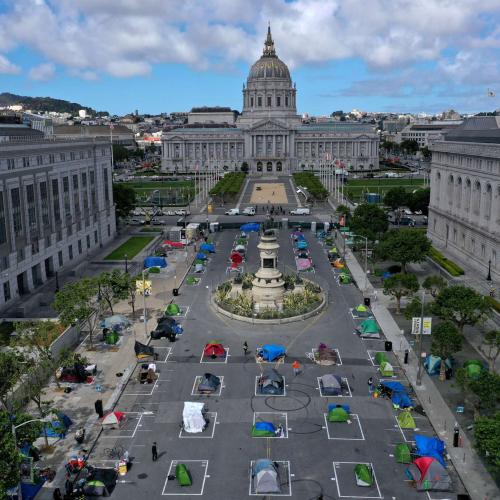
My colleagues Ruth Talbot, Asia Fields, Maya Miller and I have investigated how cities have sometimes ignored their own policies and court orders, which has resulted in them taking homeless people’s belongings during encampment clearings. We also found that some cities have failed to store the property so it could be returned. People told us about local governments taking everything from tents and sleeping bags to journals, pictures and mementos. Even when cities are ordered to stop seizing belongings and to provide storage for the property they take, we found that people are rarely reunited with their possessions. The losses are traumatizing, can worsen health outcomes, and can make it harder for people like Stratton to find stability and get back inside. Cities have recently passed new camping bans or started enforcing ones already on the books following a Supreme Court decision in June that allows local officials to punish people for sleeping outside. The U.S. Interagency Council on Homelessness earlier this year released updated strategies for addressing encampments “humanely and effectively,” advising communities to treat encampment responses with the same urgency they would any other crises. The council recommends providing 30 days’ notice before a removal and giving people two days to pack. The council also recommends that cities store belongings for as long as it typically takes for someone to get permanent housing.
Note: Read about the private contractors clearing California's homelessness camps. For more along these lines, read our concise summaries of news articles on financial inequality.
There is only one group of people that matter the most: those who Dr. Peter Phillips, professor emeritus at Sonoma State University, calls the “titans of capital.” In his new book by the same name, Phillips studies the economic trends following the COVID-19 pandemic and how the wealth concentration in the world took a dramatic turn towards the already ultra-wealthy. The main problem is simple to understand: the ultra-wealthy “doubled their wealth concentration.” That means, according to Phillips, that “the upper one half of 1% of the people got richer and basically, the rest of the world got poorer.” Phillips names the top 10 capital investment companies, such as BlackRock, Vanguard, State Street, Morgan Stanley and others as the main culprits. Over $50 trillion are controlled by 117 people across these 10 companies, according to Phillips. This immense concentration of wealth inevitably renders any semblance of democracy almost useless, as the main decision makers are those who hold the biggest bag. And then there’s policy groups. The largest now is the World Economic Forum, which is the top 2,000 to 3,000 corporations in the world send their CEOs there, to Davos every year. And there’s a global leaders attend, and they’re talking about a better capitalism, a state, what they call stakeholders capitalism, in other words, capitalism with a conscience. It’s not working. They’re not doing anything different, other than allowing the continued concentration of capital globally.
Note: Read more about how the ultra-wealthy profited immensely from the COVID economy. For more along these lines, explore concise summaries of news articles on corporate corruption and financial inequality from reliable major media sources.
The Institute for Policy Studies (IPS) joined Popular Democracy in compiling a 71-page report titled Billionaire Blowback on Housing. The two groups found that a small number of wealthy individuals and their investment arms, who control "huge pools of wealth," have spent some of their vast resources on "predatory investment and wealth-parking in luxury housing." Billionaires and their investment firms, such as Blackstone—now the world's largest corporate landlord—are "taking advantage of the tight low-income rental market, lack of publicly funded affordable housing, displacement after the foreclosure crisis, and inaccessible homeownership to get into the business of single-family and multifamily home rentals, and buying up mobile home parks," the report reads. Blackstone now owns 300,000 residential units across the U.S. and nearly doubled its portfolio in 2021. The housing crisis ... is characterized by record-breaking homelessness in 2023 with more than 653,000 people unhoused; half of tenants paying more than 30% of their income on rent ... and a significantly widened gap between the income needed to buy a house and the actual cost of a home. The number of vacant units in some communities exceed the number of unhoused people. For example, in 2017 there were more than 93,500 vacant units in Los Angeles and an estimated 36,000 unhoused residents, with vacancies treated as "a structural feature of the market thanks to the presence of a small class of wealthy investors who engage in speculative financial behavior."
Note: For more along these lines, see concise summaries of deeply revealing news articles on banking system corruption and financial inequality from reliable major media sources.
Preschools and funeral homes, car washes and copper mines, dermatologists and datacentres – private equity is anywhere and everywhere that money changes hands. If it can in any way be marketed or monetised, private equity firms have bought it. By some estimates, these firms now control more than $13tn invested in more than 50,000 companies worldwide. “We cannot overestimate the reach of private equity across the global economy,” Sachin Khajuria, a former partner at Apollo Global Management, which manages half a trillion dollars in assets, wrote in 2022. More and more people, especially the relatively poor, may live almost their entire lives in systems owned by one or another private equity firm: financiers are their landlords, their electricity providers, their ride to work, their employers, their doctors, their debt collectors. Private equity firms and related asset managers “increasingly own the physical as well as financial world around us,” the scholar Brett Christophers writes. “All of our lives are now part of their investment portfolios.” In order to drive up profits, private equity-controlled dental chains have induced children to undergo multiple unnecessary root canals. One child even died as a result. Some of the most heinous accounts have come from private equity-owned treatment centres for young people with behavioural problems, where children have been physically abused, raped and killed. These cases are extreme, but they are not isolated.
Note: BlackRock and Vanguard manage over $11 trillion and $8 trillion respectively—an unprecedented concentration of financial power. We hear outrage about billionaires and oligarchs, but rarely about private equity firms, who are backed by both political parties and are drastically reshaping our economy, contributing to environmental destruction, and extracting wealth from communities in the US and all over the world. For more along these lines, read our concise summaries of financial inequality and financial industry corruption.
The Gates Foundation is a major influencer and funder of agricultural development in Africa, yet there are no avenues to hold the foundation accountable to the communities it influences. Gates Foundation is the main funder of the controversial AGRA program. AGRA rebranded after evidence-based critiques showed that its 15-year effort to expand high-input, chemical-dependent monoculture farming in Africa has failed to provide food security, despite billions in funding from private donors and government subsidies. Critics say the “green revolution” approach is exacerbating hunger, worsening inequality and entrenching the power of outside corporate agribusiness interests in the hungriest regions of the world. AGRA works to transition farmers away from traditional seeds and crops to patented seeds, fossil-fuel based fertilizers and other inputs to grow commodity crops for the global market. The strategy is modeled on the Indian “green revolution” that boosted production of staple crops but also left a legacy of structural inequity and escalating debt for farmers. Evidence suggests that the green revolution has failed to improve health or reduce poverty and has created many problems. These include hooking farmers in a debt cycle with expensive inputs, growing pesticide use, environmental degradation, worsening soil quality, reduced diversity of food crops, and increased corporate control over food systems.
Note: 50 food sovereignty organizations wrote an open letter to Bill Gates on how the Green Revolution has failed to reduce hunger or increase food access as promised. For more along these lines, see concise summaries of deeply revealing news articles on food system corruption and income inequality from reliable major media sources.
While you may be feeling the pain from high prices at restaurants and supermarkets, many companies making and selling the products are doing remarkably well. Most have seen their profits jump as they continue raising prices on customers. Some companies say they have no choice but to pass inflationary pain on to consumers. Others, however, acknowledge they are exploiting the inflationary atmosphere to raise prices, or to shrink product sizes. Meanwhile, companies spent billions rewarding investors with stock buybacks. Menu and grocery store prices may remain elevated. In earnings calls, executives detail plans to maintain high prices even as some costs are falling. The companies’ net profits are up by a median of 51% since just prior to the pandemic, and in one case as much as 950%. The average American worker has not fared as well: wages are only up 5% since inflation’s peak. For the lowest earners, food price increases during the last two years are outpacing wage gains by over 340%. Kroger’s CEO told investors in June 2022, “a little bit of inflation is always good for our business”, while Hostess’s CEO said rising prices across the economy “helps” it profit because they can raise prices to levels that exceed their increased costs. Food prices have increased more than most other industries, federal data shows. While prices in the economy overall have risen by around 16% since mid-2022, families are now paying 19% more for food.
Note: For more along these lines, see concise summaries of deeply revealing news articles on food system corruption and income inequality from reliable major media sources.
The top 1% has seen its wealth soar by $42 trillion over the past decade, according to a new analysis by Oxfam International, which is being released ahead of the G20 finance ministers and central bank governors’ meeting in Brazil. That’s nearly 34 times more than the bottom 50% of global population. The average net worth of the elite jumped by nearly $400,000 per person, after adjusting for inflation, compared to $335 for the bottom half of residents. “Inequality has reached obscene levels, and until now governments have failed to protect people and planet from its catastrophic effects,” said Max Lawson, Oxfam International’s head of inequality policy. “The richest one percent of humanity continues to fill their pockets while the rest are left to scrap for crumbs.” As part of its G20 presidency, the Brazilian government recently commissioned a study on raising taxes on the wealthy. The report, prepared by French economist and inequality expert Gabriel Zucman, found that a 2% minimum tax on global billionaires’ wealth would yield between $200 billion and $250 billion from about 3,000 taxpayers annually. According to the EU Tax Observatory ... the super-rich in big countries pay a far smaller share of their income in taxes than ordinary people. Plus, their wealth is taxed at effective rates of just 0%-0.5%. Finance officials from the world’s biggest countries began talks earlier this year on introducing a global minimum tax on billionaires.
Note: For more along these lines, see concise summaries of deeply revealing news articles on financial inequality from reliable major media sources.
Renowned economist Gabriel Zucman released a blueprint Tuesday showing the world's governments that a global minimum tax on billionaires would be both technically feasible and economically beneficial, leaving political will as the only major obstacle preventing transformative changes to an international tax structure long exploited by the ultra-rich. A 2% minimum tax on the wealth of global billionaires would raise between $200 billion and $250 billion annually in revenue from roughly 3,000 individuals globally, resources that "could be invested to support sustained economic development through investments in education, health, public infrastructure, the energy transition, and climate change mitigation." Billionaires ... pay lower effective income tax rates than those in the working class, often making use of holding companies and other complex maneuvers to dodge their obligations and stockpile massive fortunes. The world's billionaires collectively own $14.2 trillion in wealth. Structuring a new tax based on a specific percentage of billionaires' wealth would prevent ultra-rich individuals who report little to no taxable income from completely avoiding taxation. The primary barrier to establishing a global tax on billionaires is not technical, Zucman argued, but political, particularly given the sway the ultra-rich have over economic policy. A YouGov poll ... found that 59% of U.S. millionaires would support a global tax on billionaires equal to 2% of their wealth.
Note: For more along these lines, see concise summaries of deeply revealing news articles on financial inequality from reliable major media sources.
An analysis from Accountable.US showed how more than 100 million people who rent their homes in the U.S. are not seeing the benefits of what one Biden spokesperson called "the great American comeback" in their housing costs, particularly millions of people whose homes are owned by corporate landlords. The government watchdog found that the six largest corporate landlord companies brought in close to a combined $300 million in increased profits in the first quarter of 2024, with the profits mostly stemming from rent hikes. Overall in the U.S., rent prices have skyrocketed by 31.4% since 2019 while wages have increased by just 23%, meaning tenants need to earn nearly $80,000 per year to keep from being rent-burdened. The six companies included in the Accountable.US analysis on Wednesday have more than rent increases in common: They have all faced lawsuits regarding their use of the property management software company RealPage, which is alleged to have used an algorithm to fix rent prices, impacting about 16 million rental units in the United States. The group's analysis was released weeks after the Federal Bureau of Investigation conducted a raid on an Atlanta-based property management firm in the Department of Justice's antitrust investigation into RealPage regarding "allegations of a nationwide conspiracy to artificially inflate apartment rents." RealPage's ... influence covers 70% of multifamily apartment buildings.
Note: For more along these lines, see concise summaries of deeply revealing news articles on corporate corruption from reliable major media sources.
Michael Welu worked at the IRS for decades. During his time at the IRS, he says, upper management in the division tasked with auditing large corporations and ultrawealthy people — the Large Business and International Division — was quick to dismiss any suggestion that a powerful taxpayer may have committed a crime, and commonly discouraged frontline agents from pursuing big cases. This stood in deep contrast to the office that policed small businesses and self-employed people, which was empowered to ... take an appropriately firm stance toward taxpayers breaking the law. “I was putting butchers, bakers and candlestick makers in jail, but the big stuff we really wanted to go after was being ignored,” Welu told the International Consortium of Investigative Journalists. “It could be the most egregious, ridiculous scheme and they were just not interested.” Over the past five years, [the Large Business and International Division] flagged no more than 22 instances of possible tax crimes for the agency’s criminal investigators to review further — out of trillions of dollars in annual income from large corporations and ultrawealthy people that the office oversees. During the same five years, the IRS office that covers small businesses and self-employed people flagged roughly 40 times more possible crimes, sending criminal investigators 848 referrals. The IRS says the amount of U.S. taxes left uncollected could exceed $600 billion per year.
Note: According to The Guardian, "Thirty-nine of the S&P 500 or Fortune 500 paid no federal income tax at all from 2018 to 2020 while reporting a combined $122bn in profits to their shareholders." For more along these lines, see concise summaries of deeply revealing news articles on government corruption and income inequality from reliable major media sources.
Food costs have skyrocketed. Americans paid roughly 25 percent more on groceries and dining out this March than they paid in January 2020, outpacing the rate of general inflation. Over that same period, the companies behind the country’s 10 largest grocery and restaurant brands have together returned or pledged to return more than $77 billion to shareholders. The Department of Agriculture calculates that the average American spent 11 percent of their disposable income on food in 2022, the highest amount in nearly four decades. Grocery prices rose over 10 percent that year alone, the largest annual increase since the 1970s. According to an analysis by Food and Water Watch, a corporate watchdog group, food costs for an average family of four living on a “thrifty” budget increased 50 percent from January 2020 to January 2024, from $654 to $976 a month. The number of households facing food insecurity grew by 3.5 million between 2020 and 2022. Some 28 million adults in America lack constant access to enough food to lead an active and healthy life, forcing them to eat unbalanced diets, cut portion sizes, and skip meals. The nation’s biggest food processors and retailers [are] spending billions of their record profits buying back their own shares on the open market to inflate stock value and issuing generous dividends. The main purpose of buybacks is to enrich senior corporate executives and hedge-fund managers.
Note: For more along these lines, see concise summaries of deeply revealing news articles on food system corruption and financial inequality from reliable major media sources.
As Wall Street buys up entire neighborhood blocks, driving up corporate purchases of single-family homes to historic highs, housing advocates warn companies ... are harming their tenants and pricing out would-be homebuyers. Now policymakers in states across the country and Washington, DC, are finally beginning to push back — but they’re facing the might of a powerful new single-family rental lobby. Driven by the pandemic-era real estate boom, corporate landlords are ramping up their purchases of assets like apartment buildings and mobile home communities nationwide. They’re especially active in fast-growing Sun Belt markets like Phoenix and Atlanta, where more than a third of homes on the market are now being purchased by private equity firms like Blackstone or dedicated single-family rental companies. Even Amazon founder Jeff Bezos has entered the single-family housing market. Critics say that such companies’ encroaching presence in the housing market and their focus on short-term profits are pricing out first-time homebuyers and gentrifying neighborhoods, contributing to an ongoing housing crisis. A 2022 study by federal lawmakers found that five major rental companies hiked their fees by 40 percent over a three-year period and saw their tenants fall behind in rent. In California, the state’s largest corporate landlord, Invitation Homes, was forced to pay $2 million in sanctions after the state attorney general found it was charging tenants illegally high rents.
Note: Read about the shadowy global interests buying up land all over the US. For more along these lines, see concise summaries of deeply revealing news articles on financial system corruption and income inequality from reliable major media sources.
People who live in societies with wide gaps between the wealthy and everyone else turn out to live briefer lives than people who call more equal societies home. People who live in more equal societies, meanwhile, tend to live happier lives than their unequal-society counterparts. They face less crime. Their economies crash less often. Recent studies from Northwestern’s Maryam Kouchaki and her colleagues ... have been illuminating how unequal distributions of income and wealth are serving to increase “the acceptability of self-interested unethical behaviors.” The bottom line: People who live in highly unequal societies feel “a lower sense of control” and look less askance at unethical behaviors, either from others or from themselves, than do people who live in distinctly more equal societies. “Overall,” Kouchaki and her colleagues conclude, “our results suggest inequality changes ethical standards.” Other recent psychological research has come to the same core conclusion. “When are people more open to cheating?” asked the Canadian researchers Anita Schmalor, Adrian Schroeder, and Steven Heine in a paper published earlier this year. “Economic inequality makes people expect more everyday unethical behavior.” The longer we let inequality define our contemporary daily lives, this new research helps us understand, the more the unethical behavior all around us will seem to reflect just the way our world naturally works. Economic inequality, in effect, normalizes unethical behavior.
Note: For more along these lines, see concise summaries of deeply revealing news articles on income inequality and mental health from reliable major media sources.
In December, Wired magazine revealed that Mark Zuckerberg, CEO of Meta and one of the richest individuals on the planet, was building a $100-million US compound in Hawaii. The compound includes a bunker — 5,000 square feet, to be specific, with concrete walls and an escape hatch. What does this tell us? It's a sign that at least some of the ultra-rich are anxious about global events and are making contingency plans for the Big One — whatever form that may take. The feeling is very much in the air. Architectural Digest named "luxury bunkers" one of the real estate trends of 2023. Brian Cramden, president of Hardened Structures, a Virginia-based firm that builds multimillion-dollar fortified homes and bomb shelters, said work has been "steady" for years but that he has seen a "major uptick in the last two, three months." "With Putin and North Korea and what's going on in Gaza, I'm getting lots of inquiries," he said. "It's [wars], it's Trump, it's the divisiveness of the nation." Cramden said the most commonly cited threats include a breakdown of law and order; the detonation of a nuclear weapon; a hostile power activating an electromagnetic pulse (EMP) to disrupt the communications network; and the diffuse effects of climate change. Vivos, a California-based company that provides "shelter solutions," told CBC "inquiries and applications are up over 2,000 per cent year over year."
Note: Read more about elite doomsday bunkers.
On an October morning, a small army arrived to evict Rudy Ortega from his home in the Crash Zone, an encampment located near the end of the airport runway in San Jose, California. The camp, one of the largest in California, was cleared between 2021 and 2023 in part by a private company named Tucker Construction. Public spending on private sweep contractors is soaring across California. In total, private firms have been paid at least $100m to clear homeless camps, an investigation by the Guardian and Type Investigations has found. Pete White, the founder of the Los Angeles Community Action Network ... says he’s observed a steady increase in the privatization of sweeps in recent years. “The growth of a private industry geared towards removing and dismantling informal settlements and houseless encampments has grown steadily in Los Angeles and across the country,” said White. “Not only are we seeing a growth in the loss of property, but also the loss of rights.” Firms vying for contracts to sweep encampments in California include mid-size construction companies that also do home renovations, as well as large environmental services firms that specialize in cleaning up hazardous waste and responding to public emergencies. A study of the health impacts of sweeps where the Crash Zone is located found that unhoused residents often lost medicines and other “health necessities” and that sweeps “drove unhoused people into hazardous, isolated, less visible spaces”. As well as the loss of their homes, they allege the destruction of belongings that rules are meant to protect.
Note: Read more about the unprecedented rise in food costs that are leaving millions of Americans facing higher prices and growing food insecurity. For more along these lines, see concise summaries of deeply revealing news articles on corruption in government and in the corporate world from reliable major media sources.
Americans are constantly told we are hopelessly divided. Our politicians relentlessly accuse the other side of undermining democracy and endangering the vulnerable, while our legacy media, which no longer even pretends to be objective, consistently portrays its side’s enemies in the starkest of terms. A 2019 study by James Druckman and Matthew Levendusky in Public Opinion Quarterly found that individuals harbor more animus toward the other party’s elites than they do toward people who vote for the other party. I spent one year interviewing working-class Americans across the country from every political persuasion for my new book, and what I found was a remarkable consensus on the issues. The partisan claims of a polarized America ring especially false to working-class Americans. Two-thirds of Americans agree that abortion should be rare and also legal. This is because—unlike the college-educated elites who run the country—they don’t identify with the full list of policy proposals produced by either party. Working-class Americans across the country ... want higher wages. They want better healthcare—or really, just affordable healthcare. They want stable jobs that reward their immense efforts with [what] top income brackets take for granted: a home. And yet, neither political party represents these positions that unify most Americans. They know that the way they vote reflects only a portion of their political views, and extremely little of their larger identities. There is no party that represents the American Dream, in which a life of hard work is rewarded by a home, retirement, the occasional vacation, and a better life for one’s kids. In other words, a life free from the precariousness that plagues the working class today. It’s led to a working-class electorate that feels alienated from both parties.
Note: A groundbreaking 2022 study by More in Common revealed that Americans significantly overestimated the extremity of the beliefs held by those with differing viewpoints. Read our powerful Substack on healing the polarization poisoning our conversations. For more along these lines, read our concise summaries of news articles on financial inequality.
Our new report for the Groundwork Collaborative finds that corporate profits accounted for more than half — 53 percent — of inflation from April to September 2023. That’s an astronomical percentage. Corporate profits drove just 11 percent of price growth in the four decades prior to the pandemic. Businesses have been quick to blame rising costs on supply chain shocks from the pandemic and the war in Ukraine. But two years later, our economy has mostly returned to normal. In some cases, companies’ costs to make things and stock shelves have actually decreased. A recent survey from the Richmond Fed and Duke University revealed that 60 percent of companies plan to hike prices this year by more than they did before the pandemic, even though their costs have moderated. Corporations across industries, from housing to groceries and used cars, are juicing their profit margins even as the cost of doing business goes down. Since the summer of 2021, Groundwork began listening in on hundreds of corporate earnings calls where we heard CEO after CEO boasting about their ability to raise prices on consumers. Now we hear something slightly different: CEOs crowing about keeping their prices high while their costs go down. PepsiCo raised its prices on snacks and beverages by roughly 15 percent twice in the last year while bragging to shareholders that their profit margins will grow as input costs come down.
Note: For more along these lines, see concise summaries of deeply revealing news articles on corporate corruption from reliable major media sources.
Because of Charles Littlejohn, we know that former President Donald Trump and a whole bunch of other rich people pay next to nothing in taxes. Littlejohn, a former consultant at the Internal Revenue Service, leaked these tax returns. For leaking this sensitive information, Littlejohn has been sentenced to five years in federal prison, the maximum jail term. Littlejohn’s lawyers (Bloomberg, 1/18/24) had argued that he had acted “out of a deep, moral belief that the American people had a right to know the information and sharing it was the only way to effect change.” Littlejohn now joins people like Reality Winner (New York Times, 8/23/18) and Chelsea Manning (NPR, 1/17/17), security and military-sector leakers who put their freedom on the line to disclose government secrets they felt should be a matter of the public record. The fact of the matter is that investigative journalism can only happen because of leakers who take great risks. Adrian Schoolcraft, an NYPD officer who provided the Village Voice (5/4/10) with evidence of statistics manipulation, felt the wrath of government power when he was eventually forced into a psychiatric ward (Chief, 10/5/15). Edward Snowden, who provided the Guardian (6/11/13) with details about widespread NSA surveillance, is still in exile in Russia as a result of his decision to be a whistleblower. By revealing what the rich can legally get away with, [Littlejohn] was demonstrating that we live in an increasingly divided society.
Note: For more along these lines, see concise summaries of deeply revealing news articles on government corruption and income inequality from reliable major media sources.
When Rafael Correa entered Ecuador’s presidency in 2007, the nation faced an opportunity and a challenge. Ecuador’s economy depended on oil, and global crude prices were near a record high. Much of the oil was extracted by foreign companies ... as prices surged more wealth began flowing overseas. Soon after taking office, Correa increased a recently enacted windfall tax on oil companies. The idea was to use the tax as leverage to extract better terms from the companies. Within months, two oil companies working as partners—the independent Anglo-French firm Perenco and Burlington Resources, a subsidiary of ConocoPhillips—ceased paying the tax and sued the government through a system of international tribunals known as investor state dispute settlements, or ISDS. The system allows foreign investors to sue governments before tribunals outside the jurisdiction of national courts. Perenco and Burlington [convinced] arbitrators in two separate tribunals to award the companies more than $800 million. Critics say the ISDS system gives corporations an exclusive, parallel justice system that elevates foreign interests above human rights and environmental concerns. The vast majority of cases have been brought by companies based in North America or Europe against governments in Latin America, Africa and Asia, prompting many critics to liken the ISDS system to a form of market-based colonialism that continues to extract wealth from the Global South.
Note: According to the analysis in the article, fossil fuel companies and investors filed one in five of 1,720 claims since the 1970s, and "have been awarded at least $82.8 billion in compensation from governments." For more along these lines, see concise summaries of deeply revealing news articles on corporate corruption and income inequality from reliable major media sources.
All billionaires’ wealth has grown three times faster than the rate of inflation since before the Covid pandemic, according to a new report. That means they’re 34% richer than they were in 2020, the anti-poverty charity Oxfam International has claimed. Meanwhile, the cost of living crisis for the majority of the global population has risen due to inflation, food prices around the world increasing by 21% to 50% between 2022 and 2023. The five richest men in the world have seen their personal wealth double in three years – all while five billion people around the world found themselves getting poorer. The richest 1% own 43% of all global financial assets, according to Oxfam’s findings. In the UK, the richest 1% own 33% of all financial assets. Seven out of 10 of the world’s biggest corporations also have a billionaire as CEO or principle shareholder. The worth of these companies exceeds the combined GDPs of all countries in Africa and Latin America. In the last three years, the poorest 60% (close to five billion people) around the world have lost money – a figure calculated from the UBS Global Wealth Report and the Credit Suisse Global Wealth Data book 2019. Average real wages for nearly 800 million workers have fallen across 52 countries in the same time frame the billionaires have been building on their personal wealth. Governments worldwide are making deliberate political choices that enable and encourage this distorted concentration of wealth.
Note: The COVID pandemic was extremely profitable for billionaires. At least 75 federal lawmakers were financially invested in COVID vaccines, treatments, and tests. For more along these lines, see concise summaries of deeply revealing news articles on income inequality from reliable major media sources.
Millions of American families fell into poverty last year as the well of government-funded pandemic aid dried up and incomes shrank, according to new data from the U.S. Census. Children were particularly hard-hit, with the poverty rate for kids doubling compared with 2021. The rise in poverty amounts to an increase of 15.3 million people around the U.S. living in poverty. Rising inflation [has] hobbled many households. Last year also marked the end of all pandemic-era benefits that helped families stay afloat during the health crisis, such as stimulus checks and the Child Tax Credit, which distributed as much as $300 per child in cash payments. The Supplemental Poverty Measure (SPM), which measures whether people have enough resources to cover their needs, was 12.4% for U.S. households in 2022, an increase of 4.6 percentage points from a year earlier, the Census said on Tuesday. The child poverty rate, as measured by the SPM, jumped from a historic low of 5.2% in 2021 to 12.4% in 2022, the Census said. That's the largest change in child poverty since the Census began tracking the SPM in 2009, Census officials said. If the expanded Child Tax Credit had been renewed, about 3 million additional children would have been kept out of poverty last year. U.S. households also earned less last year, the Census said. The median household income in 2022 was $74,580, a decline of 2.3% from 2021 and the third year in a row that incomes have dipped.
Note: For more along these lines, see concise summaries of deeply revealing news articles on income inequality from reliable major media sources.
Ray, a man in his 50s, used to live in an emergency homeless shelter in Vancouver, Canada. Then he participated in a study that changed his life. The newly published, peer reviewed PNAS study, conducted by the charity Foundations for Social Change in partnership with the University of British Columbia, was fairly simple. It identified 50 people in the Vancouver area who had become homeless in the past two years. In spring 2018, it gave them each one lump sum of $7,500 (in Canadian dollars). And it told them to do whatever they wanted with the cash. Over the next year, the study followed up with the recipients periodically, asking how they were spending the money and what was happening in their lives. The recipients of the cash transfers did not increase spending on drugs, tobacco, and alcohol, but did increase spending on food, clothes, and rent. What’s more, they moved into stable housing faster and saved enough money to maintain financial security over the year of follow-up. “Counter to really harmful stereotypes, we saw that people made wise financial choices,” Claire Williams, the CEO of Foundations for Social Change, [said]. What’s more ... giving out the cash transfers in the Vancouver area actually saved the broader society money. Enabling 50 people to move into housing faster saved the shelter system $8,277 per person over the year, for a total savings of $413,850. That’s more than the value of the cash transfers, which means the transfers pay for themselves.
Note: Explore more positive stories like this in our comprehensive inspiring news articles archive focused on solutions and bridging divides.
The pressure to repay debts is forcing poor nations to continue investing in fossil fuel projects to make their repayments on what are usually loans from richer nations and financial institutions, according to new analysis from the anti-debt campaigners Debt Justice and partners in affected countries. The group is calling for creditors to cancel all debts for countries facing crisis – and especially those linked to fossil fuel projects. “High debt levels are a major barrier to phasing out fossil fuels for many global south countries,” said Tess Woolfenden, a senior policy officer at Debt Justice. “Many countries are trapped exploiting fossil fuels to generate revenue to repay debt while, at the same time, fossil fuel projects often do not generate the revenues expected and can leave countries further indebted than when they started. This toxic trap must end.” According to the report, the debt owed by global south countries has increased by 150% since 2011 and 54 countries are in a debt crisis, having to spend five times more on repayments than on addressing the climate crisis. Sharda Ganga, the director of the Surinamese civil society group Projekta, said ... “The reality is that this is the new form of colonialism – we have exchanged one ruler for the rule of our creditors who basically already own what is ours. The difference is this time we signed the deal ourselves.”
Note: For more along these lines, see concise summaries of deeply revealing news articles on government corruption and income inequality from reliable major media sources.
The cashless society is effectively already a reality for most of us, but there remains a minority for whom it represents a continuing headache. The government last week told high street banks that they must offer access to cash machines within three miles of customers after the closure of thousands of branches had reduced the number of ATMs. There are also an estimated to be 1.3 million adults in this country who are “unbanked” – ie do not have a bank account. For them, something as mundane as parking a car is increasingly fraught – a quarter of London councils have removed pay and display parking machines in favour of smartphone-centred apps. The shiny, bright future of full computerisation looks very much like a dystopia to someone who either doesn’t understand it or have the means to access it. And almost by definition, the people who can’t access the digitalised world are seldom visible, because absence is not easy to see. What is apparent is that improved efficiency doesn’t necessarily lead to greater wellbeing. Technology doesn’t have to be dehumanising, but if it’s to avoid that outcome it has to be human-focused, not just consumer-focused, and in particular not just digital-consumer-focused. Cash, like printed air tickets or indeed train tickets, will no doubt one day soon seem as anachronistic as the barter system. In the meantime the transition should focus on ensuring that no one is discounted because they are too old, too poor or too disabled to matter to the gods of efficiency.
Note: For more along these lines, see concise summaries of deeply revealing news articles on corporate corruption and income inequality from reliable major media sources.
Ever since Bobbie Wert was 8 years old, her stomach has ached. Wert is part of a vast and mysterious panorama of pain that is increasing, sometimes with no obvious physical cause. And while chronic pain is a global problem, it is particularly puzzling in America. In other wealthy countries, it’s the elderly who report the most chronic pain, which makes some sense. But in the United States it’s the middle-aged — especially the jobless and people like Wert, who did not graduate from high school — who suffer the most. It is a plague on the less educated. All this raises the question: Is this physical suffering a canary in the coal mine warning us of larger dysfunction in our society? Chronic pain is not just a result of car accidents and workplace injuries but is also linked to troubled childhoods, loneliness, job insecurity and a hundred other pressures on working families. “People’s lives are coming apart, and this leads to huge increases in physical pain,” said Angus Deaton, a Nobel Prize winner in economics who with Anne Case popularized the term “deaths of despair.” Americans die from deaths of despair — drugs, alcohol and suicide — at a rate of more than a quarter-million a year, and the number of walking wounded is far greater. Acute pain typically has a specific anatomical source — such as the shock you feel when you touch a hot stove — while chronic pain sometimes, not always, originates in the brain rather than the body.
Note: For more along these lines, see concise summaries of deeply revealing news articles on health from reliable major media sources. Then explore the excellent, reliable resources provided in our Health Information Center.
The neoliberal globalizing paradigm is now the old. Economic nationalism is the new. Neoliberal globalization ... celebrated the profits and growth brought to both private and state-owned/operated enterprises around the world. It downplayed or ignored the other sides of globalization: (1) growing income and wealth inequalities; (2) the shift of production from old to new centers of capitalism; and (3) faster growth of output and markets in new centers than old centers. Instead of a mostly private capitalist system (like that of the U.S. or UK) or a mostly state capitalist system (like that of the USSR), places like China and India produced hybrids. Strong national governments presided over coexisting large private and state sectors to maximize economic growth. The days of the U.S. dollar as the supreme global currency are numbered. U.S. supremacy in high-tech industries must already be shared with China’s high-tech industries. The U.S. empire’s decline raises the question of what comes next. The most interesting possibility and perhaps the likeliest is that China and the entire BRICS (Brazil, Russia, India, China, and South Africa) grouping of nations will undertake the construction and maintenance of a new world economy. The war in Ukraine has already enhanced the prospects of such an outcome by strengthening the BRICS alliance. They have the population, resources, productive capacity, connections, and accumulated solidarity to be a new pole for world economic development.
Note: For more along these lines, see concise summaries of deeply revealing news articles on income inequality from reliable major media sources.
The centibillionaire club–those with over $100 billion in wealth–likely will be welcoming a new member soon. Forbes now estimates Michael Bloomberg’s wealth at $94.5 billion, making him the sixth richest American. If his wealth continues to grow at the rate it’s grown since 2013, Michael Bloomberg will join the centibillionaire club by the end of the year. At that point, he will be the 10th American to have reached that wealth level. Forty years ago, the mere billionaire club had just 13 members, and Daniel Ludwig, the richest American at the time, had a total wealth (adjusted for inflation) of $6.15 billion. Today, $1 billion of wealth in one person’s hands often means far too much political power, but that astounding amount of money is now considered a rounding error in the context of America’s largest fortunes. America’s 20 richest billionaires spent more than the entire Biden campaign on the 2020 elections. According to political scientists Jeffrey Winters and Benjamin Page, the political influence of each of the 400 richest Americans is 22,000 times that of the average member of the bottom 90%. What all Americans whose wealth has passed the $100 billion threshold have in common ... is tax avoidance. Between 2013 and 2018, none made federal income tax payments greater than 11% of their wealth growth–and all but two paid less than 5%. Even Ronald Reagan recognized that it’s “crazy” for a society to tax a bus driver at a higher rate than a millionaire.
Note: The pandemic response sharply increased the wealth of billionaires. For more along these lines, see concise summaries of deeply revealing news articles on income inequality from reliable major media sources.
According to the World Health Organization definition, 1.9 billion adults are considered overweight. Of these, more than 650 million people are classified as obese. In Australia, health authorities suggest being overweight is more dangerous to us than alcohol, and only second in “preventable health risk” to smoking. ABS health data claims 67% of Australian adults are overweight, an increase on 63.4% a decade ago. Last year, Australia’s former conservative government released a “National Obesity Strategy”, concerned Australia was facing health risks of cardiovascular disease, type 2 diabetes, and cancers. That government did recognise weight is influenced by complex “social, environmental, and economic factors”, but their framework of encouraging “healthy choices” as a remedy unhelpfully individualises a collective problem. First, shaming individuals into weight loss doesn’t work. 95% of weight loss attempts fail. Two-thirds of dieters regain the weight they lose. Second, the structural giveaway here is an admission that the poorest “experience the greatest burden of disease linked to excess weight”. Our societies have never produced so much food, yet we live in a capitalist perversion where fresh, healthy food – and the time to prepare it – are priced as a luxury, while highly processed items are inexpensive, easy and aggressively mass-marketed. It’s not a failure of collective willpower that’s jeopardising our health, but a diet of bad food that’s culturally familiar, low in nutrition and super available.
Note: For more along these lines, see concise summaries of deeply revealing news articles on food system corruption from reliable major media sources.
According to Oxfam’s annual inequality report, released to coincide with the World Economic Forum meetings in Davos, the richest 1% of people have captured nearly twice as much new wealth as the rest of the world combined since the pandemic. Their fortune soared by $26tn, increasing their share of new wealth from 50% to two-thirds. The breakdown of these figures exposes how on a global basis, extreme wealth is accumulated not by innovating or increasing production, but by taking advantage of rising prices and exploiting labour. This has been happening for a while, but the pandemic accelerated the trend. Rich people benefited from everything – every positive intervention from the state and negative impact of the crisis somehow still ended up increasing their wealth. They benefited from rising costs by using them as an alibi to charge higher-than-inflation prices, then distributing the rewards as dividends instead of higher wages. Food and energy corporations made a killing, making $306bn in windfall profits in 2022, then distributing 84% to shareholders. Wealthy people have used their wealth to purchase democracy, to warp democracy in their own interests. They’ve done that through a global template that involves lowering taxes, privatising formerly public attempts to deal with common problems, liquidating the spending that went into things like social services, and then putting that money into their own pockets. The system ... is rigged.
Note: For more along these lines, see concise summaries of deeply revealing news articles on the coronavirus and income inequality from reliable major media sources.
Oxfam has called for immediate action to tackle a post-Covid widening in global inequality after revealing that almost two-thirds of the new wealth amassed since the start of the pandemic has gone to the richest 1%. In [a] report to coincide with the annual gathering of the global elite at the World Economic Forum in Davos, the charity said the best-off had pocketed $26tn (£21tn) in new wealth up to the end of 2021. That represented 63% of the total new wealth, with the rest going to the remaining 99% of people. Oxfam said extreme concentrations of wealth led to weaker growth, corrupted politics and the media, corroded democracy and led to political polarisation. The report called on governments to introduce immediate one-off wealth levies on the richest 1%, together with windfall taxes to clamp down on profiteering during the global cost of living crisis. Subsequently, there should be a permanent increase in taxes on rich. In support of its call for redistribution of wealth, Oxfam said: Food and energy companies had more than doubled their profits in 2022, paying out $257bn to wealthy shareholders at a time when more than 800 million people were going hungry. Only 4 cents in every dollar of tax revenue came from wealth taxes, and half the world’s billionaires lived in countries with no inheritance tax. A tax of up to 5% on the world’s multimillionaires and billionaires could raise $1.7tn a year, enough to lift 2 billion people out of poverty, and fund a global plan to end hunger.
Note: For more along these lines, see concise summaries of deeply revealing news articles on income inequality from reliable major media sources.
Job growth and wages are slowing. This is music to the ears of Federal Reserve chair Jerome Powell, because the Fed blames inflation on rising wages. The Fed has been increasing interest rates to slow the economy and thereby reduce the bargaining power of workers to get wage gains. But aren’t higher wages a good thing? The typical American worker’s wage has been stuck in the mud for four decades. Most of the gains from a more productive economy have been going to the top – to executives and investors. The richest 10% of Americans now own more than 90% of the value of shares of stock owned by Americans. Powell’s solution to inflation is to clobber workers even further. But if the demand for workers exceeds the supply, isn’t the answer to pay workers more? Not according to Powell and the Fed. Their answer is to continue to raise interest rates to slow the economy and put more people out of work, so workers can’t get higher wages. The Fed projects that as it continues to increase interest rates, unemployment will rise to 4.6% by the end of 2023 – resulting in more than 1m job losses. The problem isn’t that wages are rising. The real problem is that corporations have the power to pass those wage increases – along with record profit margins – on to consumers in the form of higher prices. If corporations had to compete vigorously for consumers, they wouldn’t be able to do this. Competitors would charge lower prices and grab those consumers away.
Note: The above was written by former US Secretary of Labor Robert Reich. For more along these lines, see concise summaries of deeply revealing news articles on government corruption and income inequality from reliable major media sources.
Douglas Rushkoff’s new book, “Survival of the Richest: Escape Fantasies of the Tech Billionaires,” opens with a surreal scene: For a fee equal to one-third of his annual salary as a professor, Rushkoff flies to a luxurious resort to advise five ultrawealthy men on how to survive the collapse of civilization. More terrifying than the men’s Hollywood-derived nightmares is their naive and profoundly antisocial response: They’d rather optimize their bunkers than work to avert the apocalypse. While few have the means to indulge dystopian fantasies so lavishly, the men are an extreme instance of a broader trend. Bunker sales in America are soaring, and the market now caters to a range of income levels, from $40,000 starter bunkers to a nearly $10 million Luxury Series “Aristocrat” that offers a pool and a bowling lane. Many people now seem fixated on stockpiling enough money to protect themselves from the rest of the world, rather than considering the sort of world they are creating by making money in these ways. Rushkoff ... calls this dynamic the “Insulation Equation.” Anyone who asks some version of the question — can I earn enough money doing X to insulate myself from the effects of doing X — is considering the Insulation Equation. The Insulation Equation is a provocative and illuminating concept, and Rushkoff devotes much of the book to tracing the manifestations and origins of a mind-set that seduces people into believing they can insulate themselves from harms they help create.
Note: For more along these lines, see concise summaries of deeply revealing news articles on income inequality from reliable major media sources.
The most important economic and political issues facing this country are the extraordinary levels of income and wealth inequality, the rapidly growing concentration of ownership, the long-term decline of the American middle class and the evolution of this country into oligarchy. We know how important these issues are because our ruling class works overtime to prevent them from being seriously discussed. We now have more income and wealth inequality than at any time in the last hundred years. Wages ... are lower today than they were almost 50 years ago. When I was a kid growing up, most families were able to be supported by one breadwinner. Now an overwhelming majority of households need two paychecks to survive. Since 1975, there has been a massive redistribution of wealth in America that has gone in exactly the wrong direction. Over the past 47 years, according to the Rand Corporation, $50tn in wealth has been redistributed from the bottom 90% of American society to the top 1%, primarily because a growing percentage of corporate profits has been flowing into the stock portfolios of the wealthy and the powerful. During this terrible pandemic ... some 700 billionaires in America became nearly $2tn richer. Just three Wall Street firms (Blackrock, Vanguard and State Street) control assets of over $20tn and are the major stockholders in 96% of S&P 500 companies. In terms of media, some eight multinational media conglomerates control what we see, hear and read.
Note: The above was written by Sen. Bernie Sanders. For more along these lines, see concise summaries of deeply revealing news articles on income inequality from reliable major media sources.
Social scientists have made it a priority in recent years to understand upward mobility. Money itself is ... important. Other factors — like avoiding eviction, having access to good medical care and growing up in a household with two parents — may also make upward mobility more likely. Now there is another intriguing factor to add to the list, thanks to a study ... in the academic journal Nature: friendships with people who are not poor. “Growing up in a community connected across class lines improves kids’ outcome,” [said] Raj Chetty ... one of the study’s four principal authors. The study ... compares two otherwise similar children in lower-income households — one who grows up in a community where social contacts mostly come from the lower half of the socioeconomic distribution, and another who grows up in a community where social contacts mostly come from the upper half. The average difference between the two, in terms of their expected adult outcomes, is significant. It’s the same as the gap between a child who grows up in a family that makes $27,000 a year and one who grows up in a family that makes $47,000. There seem to be three main mechanisms by which cross-class friendships can increase a person’s chances of escaping poverty. The first is raised ambition: Social familiarity can give people a clearer sense of what’s possible. The second is basic information, such as how to apply to college and for financial aid. The third is networking, such as getting a recommendation for an internship.
Note: Explore a treasure trove of concise summaries of incredibly inspiring news articles which will inspire you to make a difference.
Whether dodging taxes or legal peril, wealthy Americans often succeed in concealing assets from the government by hiding their money in offshore bank accounts. Research from the IRS and a group of economists last year found that the top 1% of earners in the U.S. neglect to report 20% of their income — and that random audits almost never detect offshore accounts. Tax havens like Switzerland or the Cayman Islands have traditionally offered Americans a place to hide their assets because they fiercely guard financial privacy and have minimal to no taxes. Often, they also have laws that inhibit scrutiny from foreign tax officials. Prior to his latest book, [author Patrick Radden] Keefe published "Empire of Pain," which chronicled the billionaire Sackler family's connection to the nation's opioid epidemic. The Sacklers, the notorious family that owned the now bankrupt Purdue Pharma, reportedly have much of their wealth hidden in offshore accounts. An audit commissioned by Purdue showed the family withdrew more than $10 billion from their company during the opioid crisis, CNN reported in October 2020. They began drawing especially large amounts of money from the firm after paying $600 million in a 2007 plea deal with the Justice Department for misleading physicians and consumers about the opioid OxyContin, CNN reported. “The kind of sophistication of the whole industry of financial dissimulation ... such that nobody can put their hands on the money, is really interesting.” Keefe told Yahoo Finance.
Note: A 2015 Guardian newspaper article further describes how the US helps the super-rich hide assets. For more along these lines, see concise summaries of financial industry corruption news articles from reliable major media sources.
The wage gap between chief executives and workers at some of the US companies with the lowest-paid staff grew even wider last year, with CEOs making an average of $10.6m, while the median worker received $23,968. A study of 300 top US companies released by the Institute for Policy Studies (IPS) on Tuesday found the average gap between CEO and median worker pay jumped to 670-to-1. The ratio was up from 604-to-1 in 2020. Forty-nine firms had ratios above 1,000-to-1. At more than a third of the companies surveyed, IPS found that median worker pay did not keep pace with inflation. The report ... comes amid a wave of unionization efforts among low wage workers and growing scrutiny of the huge share buyback programs many corporations have been using to inflate their share prices. US companies announced plans to buy back more than $300bn of their own shares in the first quarter of the year and Goldman Sachs has estimated that buybacks could top $1tn in 2022. Share-related remuneration makes up the largest portion of senior executive compensation and as buybacks generally boost a company’s share price, they also boost executive pay. The biggest buyback firm was home improvement chain Lowe’s, which spent $13bn on share repurchases. That money could have given each of its 325,000 employees a $40,000 raise. Instead, median pay at the company fell 7.6% to $22,697. IPS noted that many of the companies in its sample were also the recipients of large federal government contracts.
Note: For more along these lines, see concise summaries of deeply revealing news articles on the corporate corruption and income inequality from reliable major media sources.
The Covid-19 pandemic has been good for the wallets of the wealthy. Some 573 people have joined the billionaire ranks since 2020, bringing the worldwide total to 2,668, according to an analysis released by Oxfam on Sunday. That means a new billionaire was minted about every 30 hours, on average, so far during the pandemic. The report, which draws on data compiled by Forbes, looks at the rise of inequality over the past two years. It is timed to coincide with the kickoff of the annual World Economic Forum meeting in Davos, Switzerland, a gathering of some of the wealthiest people and world leaders. Billionaires have seen their total net worth soar by $3.8 trillion, or 42%, to $12.7 trillion during the pandemic. A large part of the increase has been fueled by strong gains in the stock markets, which was aided by governments injecting money into the global economy. Much of the jump in wealth came in the first year of the pandemic. It then plateaued and has since dropped a bit. At the same time, Covid-19, growing inequality and rising food prices could push as many as 263 million people into extreme poverty this year. Billionaires in the food and agribusiness sector have seen their total wealth increase by $382 billion, or 45%, over the past two years, after adjusting for inflation. Some 62 food billionaires were created since 2020. Forty new pandemic billionaires were created in the pharmaceutical industry, which has been at the forefront of the battle against Covid-19 and the beneficiary of billions in public funding.
Note: For more along these lines, see concise summaries of deeply revealing news articles on the coronavirus and income inequality from reliable major media sources.
After her longtime partner died of kidney cancer, federal agents knocked on Gail Deckman’s door outside Chicago and told her she was in trouble: She had kept thousands of dollars in Social Security disability benefits that should have stopped when he died. The inspector general’s office, which investigates disability fraud and tries to recoup money for the government, ultimately charged her $119,392 — nearly three times what she received in error. The inflated fees were set in motion during the Trump administration, when attorneys in charge of a little-known anti-fraud program run by the inspector general’s office levied unprecedented fines against Deckman and more than 100 other beneficiaries without due process. The escalating penalties created a giant jump — at least on paper — in the amount of money the inspector general could show lawmakers it was bringing in. A Chicago woman was fined $132,000 after wrongly receiving as much as $10,618 in benefits. A Denver woman was sanctioned $168,000 after cashing as much as $14,960 in wrongly received checks. The remarkable penalties led to tumult inside the Office of Inspector General Gail Ennis, where a whistleblower was targeted for retaliation, according to a ruling this month. [Deborah] Shaw testified that she was shocked when she was directed in early 2019 to issue a penalty of $176,000 to a woman who had already written a check for $26,000 to repay the government the entire amount she had wrongly received in disability benefits.
Note: For more along these lines, see concise summaries of deeply revealing news articles on government corruption from reliable major media sources.
The audit rate for Americans earning more than $5 million a year plunged to just over 2% in 2019 from over 16% in 2010, according to a recent report from the Government Accountability Office, a federal watchdog. The report estimated that taxpayers underreported their income tax by a combined $245 billion a year between 2011 and 2013, and said that "taxpayers are more likely to voluntarily comply with the tax laws if they believe their return may be audited." The main reason for the decline, according to the report, is a lack of IRS funding. In fiscal year 2021, the agency's budget was $11.9 billion – $200 million less than its 2010 budget. The IRS also has seen its staffing levels fall to the same levels as 1973. The decline in funding and auditors means that taxpayers, and especially the top earners, are far less likely to get caught underpaying their taxes than a decade ago. Overall audit rates for American taxpayers fell to 0.2% in 2019 from 0.9% in 2010. The wealthy are still audited at a higher rate than the general taxpayer population. Yet their audit rates have declined at a much higher rate. The audit rate for taxpayers earning between $5 million and $10 million fell to 1.4% from 13.5%. Those earning more than $10 million saw their audit rate fall to 3.9% in 2019 from 21.2% in 2010, while audit rates for $10 million-plus earners ticked up slightly for the 2017 and 2018 tax years due to a Treasury Department mandate to impose audit rates of at least 8% on those making $10 million or more.
Note: For more along these lines, see key news articles on the financial industry from reliable major media sources.
As inflation shot to a new peak in March, cost increases exacted a deep toll on the economy. But for many of the US’s largest companies and their shareholders it has been a very different story. A Guardian analysis of top corporations’ financials and earnings calls reveals most are enjoying profit increases even as they pass on costs to customers, many of whom are struggling to afford gas, food, clothing, housing and other basics. The analysis of Securities and Exchange Commission filings for 100 US corporations found net profits up by a median of 49%, and in one case by as much as 111,000%. Those increases came as companies saddled customers with higher prices and all but ten executed massive stock buyback programs or bumped dividends to enrich investors. In earnings calls, executives detailed how even as demand and profits rose post-vaccine, they passed on most or all inflationary costs to customers via price increases, and some took the opportunity to add more on top. Margins – the share of sales converted into profits – also improved for the majority of the companies. The Guardian’s findings are in line with recent US commerce department data that shows corporate profits rose 35% during the last year and are at their highest level since 1950. Inflation, meanwhile, rose to 8.5% year over year in March. The Guardian’s data ... objectively shows a massive “transfer of wealth” from consumers, who pay higher prices, to shareholders and investment firms.
Note: Meanwhile global poverty has skyrocketed. Do the billionaires really care? For more along these lines, see concise summaries of deeply revealing news articles on corporate corruption from reliable major media sources.
In 1981, Malcolm Forbes, the eccentric and fabulously wealthy magazine publisher, came to his editors with a request: Could they pull together a special issue about the 400 richest Americans? The resulting reporting project took a year, dozens of flights and thousands of interviews. At the top of the very first Forbes 400 list was Daniel K. Ludwig, a shipping magnate, estimated by the magazine to be worth more than $2 billion. Adjusted for inflation, that’s now at least $5.8 billion, a fortune that would land Ludwig in a seven-way tie for the 182nd spot on the last Forbes 400 list, alongside Fred Smith, the founder of FedEx; Gary Rollins, chief executive of Rollins, Inc., which owns several pest-control companies; and who could forget Peter Gassner, the head of a cloud-software company called Veeva. Since 1987, Forbes has published another list, which started smaller but has grown to be much larger: the World’s Billionaires List. The magazine just published this year’s edition, with a staggering 2,668 names. The task of gathering information for both lists is overseen by Kerry Dolan, an editor at Forbes, in a highly collaborative effort that involves at least 92 different reporters from all over the organization, including from the company’s many internationally licensed editions — Russia, Poland, Mexico and more. The 2022 World’s Billionaires list ... grew by 573 names compared with the last prepandemic list, in 2020. That year, the world was minting new billionaires at a rate, Forbes noted, of about one every 17 hours.
Note: For more along these lines, see concise summaries of deeply revealing news articles on income inequality from reliable major media sources.
The pandemic has made the rich richer while the income of the rest of the world – about 99% of humanity – dropped, according to a new Oxfam report titled "Inequality Kills." The wealth of the world's 10 richest men doubled from $700 billion to $1.5 trillion during the pandemic, the global charity said on Monday. "It has never been so important to start righting the violent wrongs of this obscene inequality by clawing back elites' power and extreme wealth including through taxation – getting that money back into the real economy and to save lives," said Oxfam International's Executive Director Gabriela Bucher. A 99% windfall tax on the pandemic gains of the world's 10 richest men would raise enough money to pay for vaccines for the world – as well as finance various social measures for more than 80 countries, the report said. The wealth of billionaires rose more since Covid started compared to the last 14 years, and a new billionaire was minted every 26 hours since the pandemic began. The CEOs of Covid vaccine-developers Moderna and BioNTech made billions in 2020 as a result of the pandemic. At the same time, the vast majority of the population are worse off after losing income during Covid-19, and 160 million more people fell into poverty. One way to "claw back" the huge gains made by billionaires during the crisis is to tax the money that billionaires have made since the start of the pandemic. Even after the tax, the world's 10 richest men would still be billionaires.
Note: For more along these lines, see concise summaries of deeply revealing news articles on the coronavirus and income inequality from reliable major media sources.
The pandemic has made the world's wealthiest far richer but has led to more people living in poverty, according to the charity Oxfam. Lower incomes for the world's poorest contributed to the death of 21,000 people each day. But the world's 10 richest men have more than doubled their collective fortunes since March 2020, Oxfam said. Oxfam typically releases a report on global inequality at the start of the World Economic Forum meeting in Davos. That event usually sees thousands of corporate and political leaders, celebrities, campaigners, economists and journalists gather in the Swiss ski resort for panel discussions, drinks parties and schmoozing. However for the second year running, the meeting (scheduled for this week) will be online-only after the emergence of the Omicron variant derailed plans to return to an in-person event. Danny Sriskandarajah, Oxfam GB's chief executive, said the charity timed the report each year to coincide with Davos to attract the attention of economic, business and political elites. "This year, what's happening is off the scale," he said. "There's been a new billionaire created almost every day during this pandemic, meanwhile 99% of the world's population are worse off because of lockdowns, lower international trade, less international tourism, and as a result of that, 160 million more people have been pushed into poverty." "Something is deeply flawed with our economic system," he added.
Note: BBC sadly fails to mention it is not the pandemic that has caused all of this, but the lockdowns. 21,000 a day, which is one million every 50 days, died as a result of the lockdowns. 160 million humans fell into poverty a result of these lockdowns, not to mention the huge increase in suicides, murders, domestic abuse, shuttered small businesses, and more. Even if a million lives were saved by the lockdowns, was it worth these tremendous costs? For more, see summaries of deeply revealing news articles on the coronavirus from reliable media sources.
The coronavirus pandemic has led to a new era of inflation inequality, economists warn, in which poor households bear the brunt of rising prices. That’s because a bigger portion of their budget goes toward categories that have spiked in cost. Food is up 6.4% over the past year, for example, while gasoline jumped a whopping 58%. And now many people are facing those higher prices as federal stimulus programs fade away. “They’re essentially looking to stretch a dollar most days,” said Chris Wimer ... at Columbia University. “It’s going to lead to difficult choices between putting gas in the car or paying for your kids’ child care or putting food on the table.” A recent analysis by the Penn Wharton Budget Model found that low- and middle-income households spent about 7% more in 2021 for the same products they bought in 2020 or in 2019. That translates into about $3,500 for the average household. Meanwhile, pandemic-related production disruptions have driven up the costs of commodities that poor households rely on. The findings dovetail with an analysis [by] economist Alberto Cavallo. He showed that low-income consumers experienced price increases that were roughly double those of wealthier ones. In 2019, a joint paper from researchers at Columbia and the London School of Economics estimated that about 3 million more people would qualify as living in poverty if their incomes were adjusted for the inflation rates they experience.
Note: For more along these lines, see concise summaries of deeply revealing news articles on income inequality from reliable major media sources.
Closures from COVID-19 have affected 1.6 billion children worldwide. Nearly two years into the pandemic, experts say the economic costs are in the trillions and the social costs are incalculable. $17 trillion. That's how much the pandemic could cost children around the world in terms of lost lifetime earnings. The number comes from a new report by the United Nations and the World Bank. Closed schools combined with the economic crashes all around the world not only means lost learning, it means students driven into the workforce. And some of them are going to stay there. So that all translates to children learning fewer basic skills, which makes them less qualified for higher-waged jobs. And that is how they get that estimate of $17 trillion of lost wages potentially over the lifetimes of these children. UNESCO actually has a really simple benchmark, which is can a child, by the age of 10, read a sentence in their native language? And if they can't, they call that learning poverty. And they found that even before the pandemic, more than half of the children in low- and middle-income countries couldn't do that. And now learning poverty is projected to potentially reach up to 7 in 10 of those children. UNICEF says that 10 million more girls around the world could be forced into child marriage in the next decade as one of the most unusual cascading impacts of the pandemic. Essentially, they've run out of options for survival. So this is really a human toll that they're talking about here.
Note: The media continually blame the many harmful effects of the lockdown on COVID. The virus did not cause these problems, the lockdowns did. For more along these lines, see concise summaries of deeply revealing news articles on the coronavirus from reliable major media sources.
After years of declines, America’s middle class now holds a smaller share of U.S. wealth than the top 1%. The middle 60% of U.S. households by income ... saw their combined assets drop to 26.6% of national wealth as of June, the lowest in Federal Reserve data going back three decades. For the first time, the super rich had a bigger share, at 27%. The data offer a window into the slow-motion erosion in the financial security of mid-tier earners. That continued through the Covid-19 pandemic, despite trillions of dollars in government relief. While “middle class” has different meanings to different people, many economists use income to define the group. The 77.5 million families in the middle 60% make about $27,000 to $141,000 annually, based on Census Bureau data. Their share in three main categories of assets - real estate, equities and private businesses - slumped in one generation. That made their lives more precarious, with fewer financial reserves to fall back on when they lose their jobs. The top 1% represents about 1.3 million households who roughly make more than $500,000 a year - out of a total of almost 130 million. Over the past 30 years, 10 percentage points of American wealth has shifted to the top 20% of earners, who now hold 70% of the total, Fed data show. A generation ago, the middle class held more than 44% of real estate assets in the country. Now it’s down to 38%. The pandemic ... led to soaring rents this year, which hurt those who can’t afford a house.
Note: For more along these lines, see concise summaries of deeply revealing news articles on income inequality from reliable major media sources.
The secret wealth and dealings of world leaders, politicians and billionaires has been exposed in one of the biggest leaks of financial documents. Some 35 current and former leaders and more than 300 public officials are featured in the files from offshore companies, dubbed the Pandora Papers. They reveal the King of Jordan secretly amassed £70m of UK and US property. They also show how ex-UK PM Tony Blair and his wife saved £312,000 in stamp duty when they bought a London office. The couple bought an offshore firm that owned the building. The leak also links Russian President Vladimir Putin to secret assets in Monaco, and shows the Czech Prime Minister Andrej Babis - facing an election later this week - failed to declare an offshore investment company used to purchase two villas for £12m in the south of France. It is the latest in a string of leaks over the past seven years, following the FinCen Files, the Paradise Papers, the Panama Papers and LuxLeaks. The examination of the files is the largest organised by the International Consortium of Investigative Journalists (ICIJ), with more than 650 reporters taking part. Some figures are facing allegations of corruption, money laundering and global tax avoidance. But one of the biggest revelations is how prominent and wealthy people have been legally setting up companies to secretly buy property in the UK. The documents reveal the owners of some of the 95,000 offshore firms behind the purchases.
Note: Read about the Panama Papers leak that previously shed light on the tax havens of the elite. For more along these lines, see concise summaries of deeply revealing news articles on financial corruption and income inequality from reliable major media sources.
The wealthiest 400 American families paid an 8.2% average rate on their federal individual income taxes from 2010 to 2018, according to a White House analysis published Thursday. Those richest 400 families represent the top 0.0002% of all taxpayers. Their estimated tax rate, paid on $1.8 trillion of income over the nine-year period, is “low” relative to other taxpayers, according to the report. By comparison, Americans paid an average 13.3% tax rate on their income in 2018, according to a Tax Foundation analysis. The analysis comes as Democrats have proposed raising taxes on the rich and corporations to help fund up to $3.5 trillion of investments education, paid leave, healthcare, childcare and measures to curb climate change. The report’s findings are similar to those of a recent ProPublica investigation, which found that some of the world’s richest men (Jeff Bezos, Michael Bloomberg, Warren Buffett, Carl Icahn, Elon Musk and George Soros) pay a tiny fraction of their wealth in tax. The 25 richest Americans paid a true federal tax rate of 3.4% from 2014 to 2018, while seeing their net worth grow by $401 billion, according to the investigation, which cited confidential IRS data. Low- and middle-earners pay most of their income tax from wages on jobs. In contrast, the wealthiest Americans generate the bulk of their income from investments, which, if held longer than a year, are taxed at a lower rate than wages.
Note: For more along these lines, see concise summaries of deeply revealing news articles on income inequality from reliable major media sources.
This week, House Democrats released their proposed tax increases to fund Joe Biden’s $3.5tn social policy plan. The biggest surprise: they didn’t go after the huge accumulations of wealth at the top – representing the largest share of the economy in more than a century. You might have thought Democrats would be eager to tax America’s 660 billionaires whose fortunes have increased by $1.8tn since the start of the pandemic, an amount that could fund half of Biden’s plan and still leave the billionaires as rich as they were before the pandemic began. Elon Musk’s $138bn in pandemic gains, for example, could cover the cost of tuition for 5.5 million community college students and feed 29 million low-income public-school kids, while still leaving Musk $4bn richer than he was before Covid. But senior House Democrats decided to raise revenue the traditional way, taxing annual income rather than giant wealth. They aim to raise the highest income tax rate and apply a 3% surtax to incomes over $5m. The dirty little secret is the ultra-rich don’t live off their paychecks. You might also have assumed Democrats would target America’s biggest corporations, awash in cash but paying a pittance in taxes. Thirty-nine of the S&P 500 or Fortune 500 paid no federal income tax at all from 2018 to 2020 while reporting a combined $122bn in profits to their shareholders. But remarkably, House Democrats have decided to set corporate tax rates below the level they were at when Barack Obama was in the White House.
Note: Learn more about this in this New York magazine article. For more along these lines, see concise summaries of deeply revealing news articles on government corruption and income inequality from reliable major media sources.
It was six years ago when CEO Dan Price raised the salary of everyone at his Seattle-based credit card processing company Gravity Payments to at least $70,000 a year. Price slashed his own salary by $1 million to be able to give his employees a pay raise. He was hailed a hero by some and met with predictions of bankruptcy from his critics. But that has not happened; instead, the company is thriving. "So you've almost doubled the number of employees?" CBS News' Carter Evans asked. "Yeah," Price replied. He said his company has tripled and he is still paying his employees $70,000 a year. "How much do you make?" asked Evans. "I make $70,000 a year," Price replied. To pay his own bills, Price downsized his life, sold a second home he owned, and tapped into his savings. According to the Economic Policy Institute, average CEO compensation is 320 times more than the salaries of their typical workers. "This shows that isn't the only way for a company to be successful and profitable," Hafenbrack said. "Do you pay what you can get away with? Or do you pay what you think is ideal, or reasonable, or fair?" Price said despite the success his company has had with the policy, he wishes other companies would follow suit. Bigger paychecks have lead to fiercely loyal employees. "Our turnover rate was cut in half, so when you have employees staying twice as long, their knowledge of how to help our customers skyrocketed over time and that's really what paid for the raise more so than my pay cut," said Price.
Note: Explore a treasure trove of concise summaries of incredibly inspiring news articles which will inspire you to make a difference.
The top 1% of Americans are avoiding paying an estimated $163 billion in taxes a year, according to the Treasury Department. That is pushing the estimated tax gap, the amount of money owed by taxpayers that isn't collected, to nearly around $600 billion annually, and to approximately $7 trillion in lost revenue over the next decade, the Treasury Department finds. Tax evasion is concentrated among the wealthy in part because high-income taxpayers are able to employ experts who can better shield them from reporting their true incomes. More complicated incomes such as partnerships and proprietorships – more frequent among high earners — have a far greater noncompliance rate that can hit as high as 55%. "The tax gap can be a major source of inequity. Today's tax code contains two sets of rules: one for regular wage and salary workers who report virtually all the income they earn; and another for wealthy taxpayers, who are often able to avoid a large share of the taxes they owe," wrote Treasury Deputy Assistant Secretary for Economic Policy Natasha Sarin. The IRS is unable to collect about 15% of taxes owed and the lack of resources has led to a fall in audit rates. For the IRS to appropriately enforce tax laws against high earners and large corporations, it would need money to hire and train agents who can examine thousands of pages of sophisticated tax filings. The Biden administration is pushing to raise the IRS budget by $80 billion over 10 years to help increase enforcement, IT and taxpayer services.
Note: For more along these lines, see concise summaries of deeply revealing news articles on income inequality from reliable major media sources.
Pension funds, investment firms and Wall Street banks are snapping up family homes in Europe and the United States at a rapid pace as prices rocket higher. At the same time, the soaring cost of home ownership means that growing numbers of younger Americans and Brits renting rather than buying houses as they start families. Some of them may find their next landlord is based on Wall Street or in London's financial district. Analysts argue that this will improve standards in the rental sector. But some tenants who rent from corporate landlords dispute this, alleging substandard services and excessive rent increases. If investors are hoovering up existing properties that would otherwise have been sold to individuals, that could squeeze out first-time buyers. Household incomes in the United States and United Kingdom have not kept pace with rising home values in recent years, a trend made worse by the pandemic, which has sent average house prices in both markets to record highs. Invitation Homes, America's biggest single-family home leasing company with some 81,000 houses, is currently facing two lawsuits brought by tenants in California and Maryland who claim that the company's late rent fees constitute illegal penalties under state laws. Current and former tenants of the company ... painted a picture of an uncaring landlord, slow to make repairs and quick to threaten eviction when rent payments are overdue or withheld because of unresolved maintenance issues.
Note: For more along these lines, see concise summaries of deeply revealing news articles on financial industry corruption and income inequality from reliable major media sources.
Worsening inequality, as poorer people and nations lose years of gains in the battle against hunger and poverty, is likely to be one of the lasting legacies of the pandemic. New data released by the United Nations ... illustrates the unequal impact as measured by access to a basic human necessity: Food. Global hunger shot up by an estimated 118 million people worldwide in 2020, according to the U.N. Food and Agriculture Organization, jumping to 768 million people — the most going at least as far back as 2006. The number of people living with food insecurity — or those forced to compromise on food quantity or quality — surged by 318 million, to 2.38 billion. In North America and Europe, formal employment, social safety nets and the widespread availability of remote work cushioned the blow. In those parts of the world, the percentage of people living with food insecurity edged up from 7.7 percent to 8.8 percent. But the developing world, home to billions of informal workers and gaps in government assistance, fared far worse. Latin America and the Caribbean saw the biggest one-year spike in food insecurity: a jump of nine percentage points, to 40.9 percent. “Governments need to open their eyes and adjust their thinking in a crisis, and in some cases, like Peru, they just didn’t,” said Torero of the U.N. Food and Agriculture Organization. “They had the money available to deal with the problem. But they imposed restrictions on movement blindly and did not find a way to help the people who needed it.”
Note: The tragic increase of hunger and starvation worldwide is not a result of the pandemic, but rather of the lockdown in response to the pandemic. Why is that not even mentioned in this article? Many millions have died of starvation and suicide as a result of the lockdowns, yet so few care or are even aware of this. For more along these lines, see concise summaries of deeply revealing news articles on the coronavirus and income inequality from reliable major media sources.
Did you make it to the Allen & Co conference in Sun Valley, Idaho this past week? The investment bank sponsors the annual schmooze-fest and "summer camp for billionaires" for the same reason that companies give away their luxury products in Oscars gift baskets: because if you spoil rich people enough, they may develop sufficiently warm feelings towards you to throw you some business one day. At Sun Valley each year, the billionaires are feted by the mere millionaires; the millionaires drum up enough deals to allow them to buy their third and fourth homes. The Sun Valley conference is primarily known as a place where tech and media moguls gather to do a little fly fishing and strike multibillion-dollar merger deals. More fundamentally, the conference is, like Davos, a mechanism for the concentration of wealth, dressed up as something friendlier. Here, America's wealthiest mega-billionaires gather with the chief executive of America's most powerful companies, the director of the CIA, and America's most worthless pseudo-journalists ... to develop the social and business connections that allow the top 0.00001% of earners to continue to accumulate a share of our nation's wealth that already exceeds the famously cartoonish inequality of the Gilded Age of Rockefeller and Carnegie. We are developing a private class of billionaire kings whose will is omnipotent and untouchable by any democratic force. This is the state of affairs that the Sun Valley conference serves to intensify.
Note: For more along these lines, see concise summaries of deeply revealing news articles on income inequality from reliable major media sources.
The wealth of the richest 0.00001% of the U.S. now exceeds that of the prior historical peak, which occurred in the Gilded Age, according to economist Gabriel Zucman. In the late 19th century, the U.S. experienced rapid industrialization and economic growth, creating an inordinate amount of wealth for a handful of families. This era was also known for its severe inequality; and some have called the period that began around 1990 a “Second Gilded Age.” Back then, just four families represented the richest 0.00001% – today’s equivalent is 18 families. Zucman, a French economist whose doctoral advisor was the historical economist Thomas Piketty, author of bestseller “Capital in the Twenty-First Century,” released data this week showing that as of July 1, the top 0.00001% richest people in the U.S. held 1.35% of the country’s total wealth. These 18 families include those of Jeff Bezos, Mark Zuckerberg and Bill Gates. The richest 0.01% — around 18,000 U.S. families — have also surpassed the wealth levels reached in the Gilded Age. These families hold 10% of the country’s wealth today, Zucman wrote. By comparison, in 1913, the top 0.01% held 9% of U.S. wealth, and a mere 2% in the late 1970s. The increasing concentration of wealth comes as the ultra-rich face more scrutiny for the money they’re not paying in taxes. Recent reports have highlighted that because so much of their wealth consists of unrealized gains in stocks and real estate, they pay little or nothing in income tax.
Note: For more along these lines, see concise summaries of deeply revealing news articles on income inequality from reliable major media sources.
Welcome to what's known as "summer camp for billionaires." This week, the top executives at the biggest and most influential companies in tech and media, including Apple's Tim Cook and Facebook's Mark Zuckerberg, will get together at the Sun Valley Resort. These top moguls are traveling again to Sun Valley for an annual weeklong gathering organized by a boutique investment firm called Allen & Company that is known as intensely private. This week, the aggregate wealth of the men and women staying at the Sun Valley Resort is likely to reach more than $1 trillion. "It really is elitism on full display," says media analyst Colin Gillis. "But actually, it's a very private event; so, I shouldn't say 'on full display.'" Prominent politicians – including heads of state – give talks and take questions. Mike Pompeo attended when he was the head of the C.I.A., and Mauricio Macri was a guest when he was the president of Argentina. Then, at night, there are cocktail parties and lavish dinners. Among Allen & Co.'s deal makers are prominent former members of Congress, including Rep. Will Hurd and Sen. Bill Bradley, and George Tenet, the former director of the C.I.A.. The gathering is geared towards ... building relationships that may one day pay off. Bezos reportedly decided to buy "The Washington Post" when he was in Sun Valley. "They've organized the biggest matchmaking service for media companies," says Steven Davidoff Solomon, the head of the Berkeley Center for Law and Business.
Note: For more along these lines, see concise summaries of deeply revealing news articles on income inequality from reliable major media sources.
This month, ProPublica revealed that American billionaires essentially do not pay taxes, and within hours the White House had awkwardly promised no fewer than four federal investigations into the identity of the individual who had alerted the news organization to this fact. By Thursday, a North Carolina congressman was demanding the FBI director explain why he hadn’t made any arrests or at the very least, “executed any search warrants or raided any offices” in the international manhunt for the leaker. ProPublica carefully chose the six billionaires whose tax returns it chose to single out for specific scrutiny. But ProPublica seems to have deliberately underthrown. After breathlessly informing readers they possessed a “trove” of 15 years’ worth of tax returns on literally “thousands” of the world’s richest people, the story’s three authors proceeded to weave a few juicy and non-contextualized facts into a narrative that felt like a protracted sidebar to the “real” story. We learned that the 25 richest billionaires in America added $401bn to their net worths between 2014 and 2018 and paid about 3% of that amount in taxes, but we didn’t learn much about any specific billionaire’s tax avoidance strategies. Fifteen years of tax return information on thousands of American plutocrats is, to be sure, one of the biggest stories of the decade. It’s just not clear ProPublica has that much appetite for sticking with the story.
Note: In the US, former tax lobbyists often write the rules on tax dodging. For more along these lines, see concise summaries of deeply revealing news articles on government corruption and income inequality from reliable major media sources.
More than five million people became millionaires across the world in 2020 despite economic damage from the Covid-19 pandemic. While many poor people became poorer, the number of millionaires increased by 5.2 million to 56.1 million globally, Credit Suisse research found. In 2020, more than 1% of adults worldwide were millionaires for the first time. Wealth creation appeared to be "completely detached" from the economic woes of the pandemic. The number of ultra-high net worth individuals, usually defined as those having investable assets of more than $30m, grew by 24% worldwide in 2020, the fastest rate of increase since 2003. Credit Suisse said its total of the number of millionaires might be higher than other organizations' estimates because it included both investable and non-investable assets, such as owner-occupied homes. [Economist] Anthony Shorrocks ... said the pandemic had an "acute short-term impact on global markets", but added this was "largely reversed by the end of June 2020". "Global wealth not only held steady in the face of such turmoil, but in fact rapidly increased in the second half of the year," he said. However, wealth differences between adults widened in 2020, and Mr Shorrocks said if asset price increases, such as house price rises, were removed from the analysis, "then global household wealth may well have fallen". "In the lower wealth bands where financial assets are less prevalent, wealth has tended to stand still, or, in many cases, regressed," he said.
Note: For more along these lines, see concise summaries of deeply revealing news articles on income inequality from reliable major media sources.
ProPublica cracked open the vault on America’s biggest tax grifters, revealing how the Midas men dip, dodge and duck, paying pennies on the dollar, if that, while we suckers have to pony up. How rich. “In 2007, Jeff Bezos, then a multibillionaire and now the world’s richest man, did not pay a penny in federal income taxes,” ProPublica reported. “He achieved the feat again in 2011. In 2018, Tesla founder Elon Musk, the second-richest person in the world, also paid no federal income taxes. “Michael Bloomberg managed to do the same in recent years. Billionaire investor Carl Icahn did it twice. George Soros paid no federal income tax three years in a row.” “Taken together,” ProPublica concluded, “it demolishes the cornerstone myth of the American tax system: that everyone pays their fair share and the richest Americans pay the most. The I.R.S. records show that the wealthiest can — perfectly legally — pay income taxes that are only a tiny fraction of the hundreds of millions, if not billions, their fortunes grow each year.” ProPublica shed light on the fact that “the superrich earn virtually all their wealth from the constantly rising value of their assets, particularly in the stock market, and that the sales of those assets are taxed at a lower rate than ordinary income from a paycheck.” And while the value of those assets grows by the billion, untaxed, these rich folks can borrow against them.
Note: Read more in this revealing alternet.com article. For more along these lines, see concise summaries of deeply revealing news articles on income inequality from reliable major media sources.
The wealthiest Americans — including Warren Buffett, Elon Musk and Jeff Bezos — paid little in federal income taxes at times in recent years despite soaring fortunes, according to Internal Revenue Service data obtained by ProPublica. The information published Tuesday shows how billionaires are able to legally reduce their tax burden, highlighting how the American tax system can hit ordinary wage earners harder than the richest people in the country. That’s often because the richest Americans tend to have their wealth tied up in stocks and real estate, allowing them to avoid taxes on unrealized profits. The U.S. tax system focuses on income, not what is known as unrealized gains from unsold stocks, real estate or other assets. The records ... purport to show Buffett, head of Berkshire Hathaway, as having paid $23.7 million in federal income taxes on total income of $125 million from 2014 to 2018, which would indicate a personal income tax rate of 19 percent. ProPublica estimated that Buffett saw his wealth soar by $24.3 billion during that period and so his “true tax rate” was 0.10 percent. Musk, chief executive of Tesla, paid $455 million on $1.52 billion in income during the same period, when his wealth grew by $13.9 billion, accounting for a “true tax rate” of 3.27 percent. Bezos, chief executive of Amazon and the owner of The Washington Post, paid $973 million in taxes on $4.22 billion in income, as his wealth soared by $99 billion, resulting in a 0.98 percent “true tax rate.”
Note: Learn about important facts this article leaves out in this excellent piece. For more along these lines, see concise summaries of deeply revealing news articles on income inequality from reliable major media sources.
The 25 richest Americans, including Jeff Bezos, Warren Buffett and Elon Musk, paid a “true tax rate” of just 3.4% between 2014 and 2018, according to an investigation by ProPublica, despite their collective net worth rising by more than $400bn in the same period. The report by the non-profit news organization exposes the US tax system as income and wealth inequality continues to widen. ProPublica used Internal Revenue Service data to dive into the tax returns of some of America’s wealthiest and most prominent people. It found that in 2007 Bezos, the founder of Amazon and already a billionaire, paid no federal taxes. In 2011, when he had a net worth of $18bn, he was again able to pay no federal taxes – and even received a $4,000 tax credit for his children. ProPublica created what it called a “true tax rate” for the wealthiest 25 Americans by comparing federal income tax paid between 2014 and 2018 to how their net worth increased on Forbes’ well-regarded rich list over the same period. “The results are stark,” ProPublica wrote. “According to Forbes, those 25 people saw their worth rise a collective $401bn from 2014 to 2018. “They paid a total of $13.6bn in federal income taxes in those five years, the IRS data shows. That’s a staggering sum, but it amounts to a true tax rate of only 3.4%.” By contrast, the median American household paid 14% in federal taxes. The top income tax rate is 37% on incomes over $523,600 for single filers.
Note: For more along these lines, see concise summaries of deeply revealing news articles on income inequality from reliable major media sources.
For years, the Gates Foundation has been steered by an unusually small board of trustees, made up of Bill, his estranged wife, Melinda, and the billionaire investor Warren Buffett. The larger the foundation became, the less anyone seemed willing to ask tough questions about its secretive management structure or its penchant for giving money to lucrative pharmaceutical and credit card companies such as Mastercard, despite the fact that giving away billions to wealthy corporations set an unusual and troubling precedent in the philanthropic sector. Billionaires who make their fortunes through corporate practices that undercut workers and deepen inequality — like corporate tax avoidance, insufficient sick pay and the immoral gap in pay between executives and low-paid workers — are not the solution to problems they generate. Asking Bill Gates to fix inequality is like asking an arsonist to hose down your house after he just set it on fire. In April last year, the University of Oxford was reportedly considering offering a Covid-19 vaccine developed by its scientists on a nonexclusive basis. But then, Kaiser Health News reported, “Oxford — urged on by the Bill & Melinda Gates Foundation — reversed course. It signed an exclusive vaccine deal with AstraZeneca that gave the pharmaceutical giant sole rights and no guarantee of low prices.” This dealmaking .. seemed to conflict with the Gates Foundation’s stated mission to improve global access to medicines, but it’s not surprising.
Note: Read more about the Gates Foundation's startling degree of media influence during the pandemic. For more along these lines, see concise summaries of deeply revealing news articles on corporate corruption and the coronavirus vaccine from reliable major media sources.
Easy money pouring out of central banks is a key driver behind this surge in fortunes, and the resulting wealth inequality. In recent decades, as the global population of billionaires rose more than fivefold and the largest fortunes rocketed past $100 billion, I started tracking this wealth. Rising inequality was threatening to provoke popular backlashes against capitalism itself. The pandemic has reinforced this trend. As the virus spread, central banks injected $9 trillion into economies worldwide, aiming to keep growth alive. Much of that stimulus went into financial markets, and from there into the net worth of the ultra-rich. The total wealth of billionaires worldwide rose by $5 trillion to $13 trillion in 12 months, the most dramatic surge ever registered on the annual list compiled by Forbes magazine. The billionaire population boomed as well. On the 2021 Forbes list, which runs to April 6, their numbers rose nearly 700 to more than 2,700. The biggest surge came in China, which added 238 billionaires — one every 36 hours — for a total of 626. Next came the US, which added 110 for a total of 724. India added 38 for a total of 140, and has surpassed Russia for the third largest population of billionaires in the world. The fundamental driver of the market and thus the billionaire boom: easy money pouring out of central banks. Wealth inequality is likely to continue widening until the monetary spigots are turned off.
Note: If you can’t access this article on the FT website, go to this webpage. For more along these lines, see concise summaries of deeply revealing news articles on the coronavirus and income inequality from reliable major media sources.
Covid-19 vaccines have created at least nine new billionaires after shares in companies producing the shots soared. Topping the list of new billionaires are Moderna CEO St©phane Bancel and Ugur Sahin, the CEO of BioNTech, which has produced a vaccine with Pfizer. Both CEOs are now worth around $4 billion, according to an analysis by the People's Vaccine Alliance, a campaign group that includes Oxfam, UNAIDS, Global Justice Now and Amnesty International. Senior executives from China's CanSino Biologics and early investors in Moderna have also become billionaires on paper as shares skyrocketed. Moderna's share price has gained more than 700% since February 2020, while BioNTech has surged 600%. CanSino Biologics' stock is up about 440% over the same period. The company's single-dose Covid-19 vaccine was approved for use in China in February. Activists said the wealth generation highlighted the stark inequality that has resulted from the pandemic. The nine new billionaires are worth a combined $19.3 billion, enough to fully vaccinate some 780 million people in low-income countries. "These billionaires are the human face of the huge profits many pharmaceutical corporations are making from the monopoly they hold on these vaccines," Anne Marriott, Oxfam's health policy manager, said. "These vaccines were funded by public money and should be first and foremost a global public good, not a private profit opportunity," she added.
Note: You would hope that with all the suffering going on in our world, big Pharma wouldn't gouge and make huge profits on their vaccines. Sadly, this is far from the truth. For more along these lines, see concise summaries of deeply revealing news articles on Big Pharma corruption and the coronavirus vaccine from reliable major media sources.
The Institute for Policy Studies calculated that the average CEO compensation in 2020 was $15.3m, when looking at the 100 companies with the lowest median wage for workers in the S&P 500 index. The median worker pay was $28,187. This means that chief executives saw a 29% pay raise compared to 2019, while workers saw a 2% decrease. For all 100 companies, median worker pay was below $50,000 for 2020. The compensation hike came as companies gave their top leaders hefty bonuses and forgiving performance benchmarks during the pandemic, allowing the top executives to cash in while their low-wage employees were essential workers. Hilton’s CEO, Christopher Nassetta, had a compensation package worth $55.9m in 2020, the highest of the executives analyzed in the report, while median pay at the company was $28,608, down from $43,695 in 2019. Since the pandemic affected the company’s expected performance, and thus Nassetta’s expected compensation, the company’s board restructured its stock awards to give its CEO ample pay in 2020, according to the report. Other CEOs were met with friendly treatment from their respective corporate boards. Chipotle’s board removed the company’s poor financial results from the peak of the shutdown and excluded Covid-related costs when calculating CEO Brian Niccol’s compensation. Niccol received $38m last year, which is 2,898 times more than the company’s median worker pay of $13,127.
Note: For more along these lines, see concise summaries of deeply revealing news articles on income inequality from reliable major media sources.
One in two people worldwide saw their earnings drop due to the coronavirus, with people in low-income countries hit particularly hard by job losses or cuts to their working hours, new research shows. US-based polling company Gallup, which surveyed 300,000 people across 117 countries, found that half of those with jobs earned less because of the disruption caused by the Covid-19 pandemic. This translated to 1.6 billion adults globally, it said. “Worldwide, these percentages ranged from a high of 76 per cent in Thailand to a low of 10 per cent in Switzerland,” said researchers in a statement. In Bolivia, Myanmar, Kenya, Uganda, Indonesia, Honduras and Ecuador, more than 70 per cent of people polled said they took home less than before the global health crisis. In the United States, this figure dropped to 34 per cent. The Covid-19 crisis has affected workers across the world – particularly women. International charity Oxfam said ... that according to its own research, the pandemic had cost women around the world $800bn (£578bn) in lost income. The poll also showed that one in three people surveyed had lost their job or business due to the pandemic – translating to just over 1 billion people globally. These figures also varied across nations, with more than 60 per cent of respondents in lower-income countries such as the Philippines, Kenya and Zimbabwe having lost their jobs or businesses, compared to 3 per cent in Switzerland and 13 per cent in the United States.
Note: This article fails to mention that these were consequences not of the virus, but of the lockdowns. For more along these lines, see concise summaries of deeply revealing news articles on the coronavirus from reliable major media sources.
Research Medical's owner, HCA Healthcare Inc., is a profitable, publicly traded network of 185 hospitals. Even in the year of Covid-19, 2020, the company generated $51.5 billion in revenue and increased its pretax earnings by 3.6 percent. That performance helped boost the total compensation HCA's chief executive, Samuel N. Hazen, received last year to $30.4 million, a 13 percent rise from 2019. The total worth of his compensation package equaled 556 times the compensation received by the median employee at HCA — $54,651. The figures highlight the growing CEO pay gap, a problem among many public companies according to some investors and workers and even a few CEOs. In 2019, for example, the average pay ratio among 350 large American companies was 320-to-1, according to research by the Economic Policy Institute. In 1989, the average was 61-to-1. Because [Jamelle] Brown, [an] emergency department worker, makes even less than the median, Hazen got roughly 1,000 times Brown's pay. Brown says he lives with his sister because he doesn't earn enough from his job at Research Medical to pay for his own apartment. HCA isn't alone in paying its chief executive vastly more than what rank-and-file workers earn. Acuity Brands, an industrial technology company, paid its CEO, Neil M. Ashe, $21 million last year, or 2,316 times the median employee's pay. Starbucks ... paid its CEO, Kevin Johnson, $14.7 million last year. That was 1,211 times the pay of its median employee.
Note: For more along these lines, see concise summaries of deeply revealing news articles on income inequality from reliable major media sources.
The number of newly minted and reissued billionaires soared last year, Forbes reported Tuesday in its annual ranking, a staggering accumulation of personal wealth that stands in sharp contrast with the widespread economic struggles unleashed by the coronavirus pandemic. The number of billionaires on Forbes’ 35th annual ranking swelled by 660 to 2,755 — a roughly 30 percent jump from a year ago — and 493 of them are first-timers. Seven of eight are richer than they were before the pandemic. Forbes calculates net worth by using stock prices and exchange rates from March 5. Amazon founder Jeff Bezos, with an estimated fortune of $177 billion, topped the list. Tesla chief executive Elon Musk came in at No. 2 at $151 billion. As a class, billionaires added about $8 trillion to their total net worth from last year, totaling $13.1 trillion. The United States had the most billionaires, at 724, extending a rapid rise in wealth that hasn’t happened since the Rockefellers and the Carnegies roughly a century ago. China ... had the second highest number of billionaires: 698. Gabriel Zucman, an economist ... said in an email that the explosive acceleration of wealth among the richest of the rich has only accelerated during the pandemic. “In the United States, the top 400 wealthiest Americans now own the equivalent 18% of GDP in wealth, twice as much as in 2010 (9% of GDP). The pandemic has reinforced this trend, with a boom in top-end wealth despite the decline in economic activity,” he wrote.
Note: For more along these lines, see concise summaries of deeply revealing news articles on the coronavirus and income inequality from reliable major media sources.
Bill Gates has never been a farmer. So why did the Land Report dub him “Farmer Bill” this year? Gates’ achievement, according to the report, is that he’s largest private owner of farmland in the US. A 2018 purchase of 14,500 acres of prime eastern Washington farmland – which is traditional Yakama territory – for $171m helped him get that title. In total, Gates owns approximately 242,000 acres of farmland with assets totaling more than $690m. To put that into perspective, that’s nearly the size of Hong Kong and twice the acreage of the Lower Brule Sioux Tribe, where I’m an enrolled member. A white man owns more farmland than my entire Native nation! The relationship to land – who owns it, who works it and who cares for it – reflects obscene levels of inequality and legacies of colonialism and white supremacy in the United States, and also the world. Wealth accumulation always goes hand-in-hand with exploitation and dispossession. Our era is dominated by the ultra-rich ... and a burgeoning green capitalism. And Bill Gates’ new book How to Avoid a Climate Disaster positions himself as a thought leader in how to stop putting greenhouse gases into the atmosphere and how to fund what he has called elsewhere a “global green revolution” to help poor farmers mitigate climate change. What expertise in climate science or agriculture Gates possesses beyond being filthy rich is anyone’s guess. Investment firms are making the argument farmlands will meet “carbon-neutral” targets for sustainable investment portfolios.
Note: For more along these lines, see concise summaries of deeply revealing news articles on income inequality from reliable major media sources.
When West Virginia declared a state of emergency to arrest the coronavirus, the social network that aids the homeless froze along with everything else. Ordered to shelter in place, people without shelter died at an alarming rate. In a bad year here ... two to four of the unhoused die. Over the past year, they have tallied 22 deaths, a sevenfold increase. Only two of the deaths are suspected to be from COVID-19. But all occurred during the collapse of the safety net that in normal times addresses the complex mix of afflictions—trauma, medical conditions, addiction—that accompany homelessness, and worsened during the profound isolation of the pandemic. What happened in [West Virginia] is happening across the country. Even before the pandemic lockdowns that fell hardest on low-income Americans –– and stand to push more people out of their homes –– the Department of Housing and Urban Development reported U.S. homelessness at 580,466 people, up 7% from a year earlier. Deaths are rising even faster. In San Francisco, the department of public health says deaths tripled over the past year in an unhoused population of 8,035. In Los Angeles, home to a vast homeless population tallied at 41,290, deaths increased by 32%. Homeless deaths in Washington, D.C., soared by 54%. In New York City, the Coalition for the Homeless reported a death rate up 75%. And over the past year, they died ... at a rate many times higher than the rate of deaths from the virus.
Note: For more along these lines, see concise summaries of deeply revealing news articles on the coronavirus and income inequality from reliable major media sources.
Just as the Biden administration is pushing to raise taxes on corporations, a new study finds that at least 55 of America's largest firms paid no taxes last year on billions of dollars in profits. The sweeping tax bill passed in 2017 by a Republican Congress and signed into law by President Donald Trump reduced the corporate tax rate to 21% from 35%. But dozens of Fortune 500 companies were able to further shrink their tax bill – sometimes to zero – thanks to a range of legal deductions and exemptions that have become staples of the tax code. Salesforce, Archer-Daniels-Midland and Consolidated Edison were among those named in the report, which was done by the Institute on Taxation and Economic Policy. Twenty-six of the companies listed, including FedEx, Duke Energy and Nike, were able to avoid paying any federal income tax for the last three years even though they reported a combined income of $77 billion. Many also received millions of dollars in tax rebates. Publicly traded corporations are required to file financial reports. The institute used that data along with other information supplied by each company. The $2.2 trillion coronavirus relief act ... contained a provision that temporarily allowed businesses to use losses in 2020 to offset profits earned in previous years. Tax avoidance strategies include a mix of old standards and new innovations. Companies, for example, saved billions by allowing top executives to buy discounted stock options in the future and then deducting their value as a loss.
Note: For more along these lines, see concise summaries of deeply revealing news articles on corporate corruption from reliable major media sources.
The world's 2,365 billionaires enjoyed a $4 trillion boost to their wealth during the first year of the pandemic, increasing their fortunes by 54%, according to a new analysis by the Program on Inequality at the ... Institute for Policy Studies. Between March 18, 2020, and March 18, 2021, the wealth held by the world's billionaires jumped from $8.04 trillion to $12.39 trillion, according to the IPS' analysis of data from Forbes, Bloomberg and Wealth-X. Amazon.com founder Jeff Bezos, the world's wealthiest person, saw his fortune soar to $178 billion from $113 billion, or 57%, during that time, the study found. All told, the total wealth of the world's billionaire class grew 54% during the pandemic year, IPS reported. The ballooning wealth among the world's richest people is sparking calls for a "wealth tax," or an additional tax that would be added on top of regular income and capital gains taxes. But so far, a wealth tax is proving elusive in Washington, D.C., even as two-thirds of Americans express support for the idea of raising taxes on people earning more than $400,000. Rather than taxing the growing wealth of the nation's billionaires and millionaires, Mr. Biden wants to pay for his $2 trillion American Jobs Plan by boosting the corporate tax rate to 28% from its current 21%. In the meantime, the wealth disparities between the world's richest and poorest citizens have only widened during the pandemic. The number of people living in poverty globally doubled to more than 500 million during the first nine months of the pandemic.
Note: Why is so little media attention given to the greatest transfer of wealth ever since COVID hit? For more along these lines, see concise summaries of deeply revealing news articles on income inequality from reliable major media sources.
Treasury Secretary Janet Yellen said a "shocking" amount of taxes was going uncollected by the federal government. "The gap between what we're collecting in taxes on current tax and what we should be collecting ... amounts to over $7 trillion over a decade," Yellen said. Yellen's remarks emphasize the Biden administration's efforts to collect tax revenue from the wealthiest Americans and multinational companies to finance $4 trillion in spending programs. At the center of Biden's planned revenue raisers is a provision to increase funding for IRS enforcement. He also wants to slap investors earning above $1 million with a hike in the capital-gains tax and raise the top marginal income-tax rate to 39.6% from 37%. The IRS's official estimate is that there is a tax gap of $441 billion a year. But Charles Rettig, the agency's commissioner, recently told Congress that number could be over $1 trillion. A recent study from IRS researchers and academics found that the top 1% of Americans failed to report about one-quarter of their income to the IRS. The research found income underreporting was nearly twice as high for the top 0.1%, which could account for billions in uncollected taxes. The number of agents devoted to working on sophisticated tax-evasion enforcement dropped by 35% over the past decade. The IRS's budget fell by 20% between 2010 and 2018. There was an 80% decline from 2011 to 2018 in the audit rate for those making over $1 million a year.
Note: Some major US companies pay no taxes at all. For more along these lines, see concise summaries of deeply revealing news articles on income inequality from reliable major media sources.
The end of 2020 brought the sharpest rise in the U.S. poverty rate since the 1960s, according to a new study. Economists Bruce Meyer from the University of Chicago and James Sullivan of the University of Notre Dame found that the poverty rate increased by 2.4 percentage points during the latter half of 2020 as the U.S. continued to suffer the economic impacts of COVID-19. That percentage-point rise is nearly double the largest annual increase in poverty since the 1960s. This means an additional 8 million people nationwide are now considered poor. Moreover, the poverty rate for Black Americans is estimated to have jumped by 5.4 percentage points, or by 2.4 million individuals. The scholars’ findings, released Monday, put the rate at 11.8% in December. While poverty is down from readings of more than 15% a decade earlier, the new estimates suggest that the annual Census Bureau tally due in September will be higher than the last official, pre-pandemic level of 10.5% in 2019. Black Americans were more than twice as likely to be poor than their white counterparts in December — an improvement from the summer months when they were nearly three times more apt to live in poverty — but an increase from before the pandemic, when the differential was under two. Despite improvements in the overall poverty rate since the middle of the 20th century, Black Americans had been about three times as likely to be poor as white Americans for most of the past 60 years.
Note: Meanwhile, as the Washington Post reported on Jan. 1, 2021, "billionaires as a class have added about $1 trillion to their total net worth since the pandemic began." The CDC also reports overdose deaths hit a record high last year. For more along these lines, see concise summaries of deeply revealing news articles on the coronavirus and income inequality from reliable major media sources.
The pandemic has worsened income inequality, with the world's richest people regaining their losses from COVID-19 shutdowns in nine months while the number of people living in poverty has doubled to more than 500 million, according to a new report from the anti-poverty group Oxfam. Almost 9% of total working hours were lost last year when compared with the levels of employment at the end of 2019, before the pandemic shuttered the economy, according to a separate report from the International Labour Organization (ILO), a United Nations agency. That's the equivalent of 255 million full-time jobs lost across the globe, or about four times greater than the impact from the Great Recession of 2009. The world's poorest could take a decade to regain their financial footing. Oxfam describes the pandemic's impact as "the greatest rise in inequality since records began." The International Labour Organization said the crisis has been the most severe on work since the Great Depression in the 1930s. "Its impact is far greater than that of the global financial crisis of 2009," said ILO Director-General Guy Ryder. America's richest people have seen their wealth soar during the pandemic by more than $1 trillion, thanks to a booming stock market and a K-shaped recovery that has benefited the rich, while poorer people have struggled with lost wages and jobs and future opportunities. It's a rich vs. poor phenomenon that is replicating across the globe.
Note: The media continue to blame the pandemic for these dire consequences when it is clearly not the virus, but the lockdown policies that are the main reason for this huge increase in poverty and income inequality. For more along these lines, see concise summaries of deeply revealing news articles on the coronavirus and income inequality from reliable major media sources.
The economic blow from Covid-19 has cost workers around the world $3.7tn (£2.7tn) in lost earnings, after the pandemic wiped out four times the number of working hours lost in the 2008 financial crisis. The International Labour Organization (ILO) said women and younger workers had borne the brunt of job losses and reductions in hours, and warned that people in sectors hardest hit by the crisis – such as hospitality and retail – risked being left behind when the economy recovered. Sounding the alarm that entrenched levels of inequality risked becoming a defining feature of the economic rebound from Covid-19, the Geneva-based agency said that governments around the world needed to take urgent action to support those at the heart of the storm. In its annual analysis of the global jobs market, it said 8.8% of working hours were lost in 2020 relative to the end of 2019, equivalent to 255m full-time jobs. This is approximately four times bigger than the toll on workers as a consequence of the 2008-2009 financial crisis. These “massive losses” resulted in an 8.3% decline in global labour income, before government support measures are included, according to the ILO, equivalent to $3.7tn in earnings – about 4.4% of global GDP. Women have been more affected than men by the disruption to the jobs market, with female workers more likely to drop out of work altogether. Younger workers have also been particularly hard hit, either losing jobs, dropping out of the labour force or delaying the search for a first job.
Note: In the meantime, MSN reports that billionaires made $3.9 trillion during the pandemic. Is this the kind of wealth transfer that supports humanity? For more along these lines, see concise summaries of deeply revealing news articles on the coronavirus from reliable major media sources.
At the end of 2020, Chicago police reported more than 750 murders, a jump of more than 50% compared with 2019. By mid-December, Los Angeles saw a 30% increase over the previous year with 322 homicides. There were 437 homicides in New York City by Dec. 20, nearly 40% more than the previous year. New Orleans-based data consultant Jeff Asher studied crime rates in more than 50 cities and says the crime spikes aren't just happening in big cities. With the numbers of homicides spiking in many places, Asher expects the final statistics for 2020 to tell a startlingly grim story. "We're going to see, historically, the largest one-year rise in murder that we've ever seen," he says. Asher says it has been more than a half-century since the country saw a year-to-year murder rate that jumped nearly 13%. "We have good data that the rise in murder picked up in the early stages of the summer," Asher says, "and we also have good data that the rise of murder picked up again in September and October as some of the financial assistance started to wear off." Chicago minister the Rev. Marshall Hatch Sr. says the spike in violence is sadly not surprising. His church is located in a west side Chicago neighborhood hard hit by both poverty and the pandemic. "COVID has had a disproportionate impact and people are increasingly desperate," Hatch says. "And people, because of the concentration of poverty, tend to turn on each other."
Note: It is not the pandemic which is causing these homicides. It is the lockdown measures that are negatively impacting the emotional and spiritual lives of billions of people around the globe. The CDC also reports overdose deaths hit a record high last year. And poverty had the sharpest rise in 50 years. For more along these lines, see concise summaries of deeply revealing news articles on the coronavirus and income inequality from reliable major media sources.
The pandemic has forced untold hardships onto many Americans, with tens of millions of families now reporting that they don’t have enough to eat and millions more out of work on account of layoffs and lockdowns. America’s wealthiest, on the other hand, had a very different kind of year: Billionaires as a class have added about $1 trillion to their total net worth since the pandemic began. And roughly one-fifth of that haul flowed into the pockets of just two men: Jeff Bezos, chief executive of Amazon (and owner of The Washington Post), and Elon Musk of Tesla and SpaceX fame. Musk has quintupled his net worth since January, according to estimates put together by Bloomberg, adding $132 billion to his wealth and vaulting him to the No. 2 spot among the world’s richest with a fortune of about $159 billion. Bezos’s wealth has grown by roughly $70 billion over the same period, putting his net worth estimate at roughly $186 billion as the year came to an end. Such a rapid accumulation of individual wealth hasn’t happened in the United States since the time of the Rockefellers and Carnegies a century ago, and we as a society are only just beginning to grapple with the ethical implications. What does it mean, for instance, that two men amassed enough wealth this year to end all hunger in America (with a price tag of $25 billion) eight times over? Or that the $200 billion accumulated by Bezos and Musk is greater than the amount of coronavirus relief allocated to state and local governments in the Cares Act?
Note: The new richest man in Asia reached his position partially through making vaccines for the coronavirus. For more along these lines, see concise summaries of deeply revealing news articles on income inequality from reliable major media sources.
When I called up Chuck Collins on Tuesday afternoon, I found him glued to one of the grimmest new metrics documenting America’s economic and social unraveling. Collins is a scholar of inequality at the Institute for Policy Studies, a progressive think tank, and since March he has been tracking how the collective wealth of American billionaires has been affected by the coronavirus pandemic. In previous recessions, Collins said, billionaires were hit along with the rest of us; it took almost three years for Forbes’s 400 richest people to recover losses incurred in 2008’s Great Recession. But in the coronavirus recession of 2020, most billionaires have not lost their shirts. Instead, they’ve put on bejeweled overcoats and gloves made of spun gold — that is, they’ve gotten richer than ever before. On Tuesday, as the stock market soared to a record, Collins was watching the billionaires cross a depressing threshold: $1 trillion. That is the amount of new wealth American billionaires have amassed since March, at the start of the devastating lockdowns that state and local governments imposed to curb the pandemic. On March 18, according to a report Collins and his colleagues published last week, America’s 614 billionaires were worth a combined $2.95 trillion. When the markets closed on Tuesday, there were 650 billionaires and their combined wealth was now close to $4 trillion. In the worst economic crisis since the 1930s, American billionaires’ wealth grew by a third.
Note: For more along these lines, see concise summaries of deeply revealing news articles on income inequality and the coronavirus from reliable major media sources.
More Americans are going hungry now than at any point during the deadly coronavirus pandemic, according to a Post analysis of new federal data — a problem created by an economic downturn that has tightened its grip on millions of Americans and compounded by government relief programs that expired or will terminate at the end of the year. Experts say it is likely that there’s more hunger in the United States today than at any point since 1998, when the Census Bureau began collecting comparable data about households’ ability to get enough food. One in 8 Americans reported they sometimes or often didn’t have enough food to eat in the past week, hitting nearly 26 million American adults, an increase several times greater than the most comparable pre-pandemic figure. That number climbed to more than 1 in 6 adults in households with children. Nowhere has there been a hunger surge worse than in Houston, with a metro-area population of 7 million people. More than 1 in 5 adults in Houston reported going hungry recently, including 3 in 10 adults in households with children. The growth in hunger rates has hit Hispanic and Black households harder than White ones, a devastating consequence of a weak economy that has left so many people trying to secure food even during dangerous conditions. Yet the hunger crisis seems to have escaped widespread notice in a nation where millions of households have weathered the pandemic relatively untouched.
Note: Meanwhile, as the Washington Post reported on Jan. 1, 2021, "billionaires as a class have added about $1 trillion to their total net worth since the pandemic began." For more along these lines, see concise summaries of deeply revealing news articles on the coronavirus and income inequality from reliable major media sources.
A COVID-19 envoy appointed by Director-General of the World Health Organisation (WHO) Dr Tedros Adhanom Ghebreyesus has appealed to world leaders to stop resorting to lockdown to control the pandemic. Dr David Nabarro, who has spent his career working for the WHO and the United Nations (UN), seems to have marked a departure from the global health body's early stance on the COVID-19 pandemic, warning about the economic and social consequences of lockdown as a means of controlling the spread of the disease. On Sunday, Dr Nabarro appealed to world leaders to stop "using lockdowns as your primary control method", insisting that such drastic measures can have a dire impact on global poverty rates. The British doctor stated: "We in the World Health Organisation do not advocate lockdowns as the primary means of control of this virus. The only time we believe a lockdown is justified is to buy you time to reorganise, regroup, rebalance your resources, protect your health workers who are exhausted, but by and large, we'd rather not do it." Dr Nabarro went on to say that developing economies had been indirectly affected by lockdown measures, adding: "Look what's happened to smallholder farmers all over the world -- look what's happening to poverty levels. "It seems that we may well have a doubling of world poverty by next year. We may well have at least a doubling of child malnutrition. Lockdowns just have one consequence that you must never ever belittle, and that is making poor people an awful lot poorer."
Note: Strangely, this article has been removed from the MSN website. Even the copy at archive.org shows for a minute and then disappears. The full, revealing article can still be found on this webpage. For more along these lines, see concise summaries of deeply revealing news articles on the coronavirus and income inequality from reliable major media sources.
David Beasley, the executive director of the World Food Programme, knows the existence of his organization is both a blessing and a curse: it helps so many, but that means many are suffering. On Friday, that World Food Programme's fight against hunger ... was honored with the Nobel Peace Prize. "[COVID-19] comes on top of what you already thought was a worst-case scenario. It is literally horrific," Beasley told ABC News. At the beginning of this year, 135 million people already faced starvation from manmade conflict and climate extremes, Beasley said. Now, 270 million people are on the brink of starvation. "We've got a vaccine against starvation. It's called food," said Beasley. The award comes with the equivalent of a $1.1 million U.S. cash prize and a gold medal to be handed out at a ceremony in Oslo, Norway, on Dec. 10. "The economies of the world's strongest nations on Earth are struggling. We are not going to have the money we need next year. And not only are the resources going to go down, but the needs are going to be going up," said Beasley. Established in 1962, the United Nations World Food Programme is the world's largest humanitarian organization that delivers food assistance in emergencies and works with communities to improve nutrition and resilience, according to the website. The World Food Programme assisted 97 million people in 88 counties in 2019 alone.
Note: As of early October 2020, 1.5 million people had reportedly died from the virus, yet 135 million had been pushed to "the brink of starvation" not by the virus, but by the lockdown measures. Are the consequences of the lockdown policies worse than the consequences of the virus itself? For more along these lines, see concise summaries of deeply revealing news articles on the coronavirus from reliable major media sources.
Billionaires have seen their fortunes hit record highs during the pandemic, with top executives from technology and industry earning the most. The world's richest saw their wealth climb 27.5% to $10.2trn (7.9trn) from April to July this year, according to a report from Swiss bank UBS. That was up from the previous peak of $8.9trn at the end of 2017 and largely due to rising global share prices. UBS said billionaires had done "extremely well" in the Covid crisis. It also said the number of billionaires had hit a new high of 2,189, up from 2,158 in 2017. It comes as a World Bank report on Wednesday showed extreme poverty is set to rise this year for the first time in more than two decades due to the pandemic. Among the billionaires, the biggest winners this year have been industrialists, whose wealth rose a staggering 44% in the three months to July. "Industrials benefited disproportionately as markets priced in a significant economic recovery [after lockdowns around the world]," UBS said. Tech billionaires have also had a good pandemic, seeing their wealth soar 41%. UBS said this was "due to the corona-induced demand for their goods and services" and social distancing accelerating "digital businesses [and] compressing several years' evolution into a few months". Healthcare billionaires also benefited as the crisis put drug makers and medical device companies in the spotlight.
Note: For more along these lines, see concise summaries of deeply revealing news articles on the coronavirus and income inequality from reliable major media sources.
Current COVID-19 lockdowns protect low-risk college students and young professional bankers, attorneys, journalists, scientists and others who can work from home, while older high-risk working-class people are risking their lives building the population immunity that will eventually protect us all. While mortality is inevitable during a pandemic, the COVID-19 lockdown strategy has led to more than 220,000 deaths, with the urban working class carrying the heaviest burden. Many older workers have been forced to accept high mortality risk or increased poverty, or both. While the current lockdowns are less strict than in March, the lockdown and contact tracing strategy is the worst assault on the working class since segregation and the Vietnam War. Lockdown policies have closed schools, businesses and churches, while not enforcing strict protocols to protect high-risk nursing home residents. Denying in-person teaching to students is harmful to their education and physical and mental health, with working-class children hardest hit. Online schooling puts a disproportional burden on our children, despite their own minimal risk. For ages 1 to 15, Sweden kept day care and schools open throughout the height of the pandemic, and among the 1.8 million children of that age, there were zero COVID-19 deaths without masks used or physical distancing. Neither was there any excess risk for in-person teachers compared with the average of other professions.
Note: The above article was written by three doctors, one from Stanford, one from Harvard, and one from the UK’s Oxford. Explore an abundance of good information questioning the official story of COVID. Explore a summary of alternative views on the coronavirus. Explore a revealing article questioning the origin and causes of the coronavirus. For more along these lines, see concise summaries of deeply revealing news articles on the coronavirus from reliable major media sources.
The worlds wealthiest individuals have become even richer during the coronavirus pandemic as the prices of financial assets have been supported by widespread policy intervention while employment and wages, well, not so much. The Institute for Policy Studies, a liberal think tank in Washington, chronicles just how bifurcated the road the recovery from an economy slump is likely to be. At the upper end of the spectrum, the combined wealth of all U.S. billionaires increased by $821 billion or 28% between March 18, 2020 and September 10, 2020, from approximately $2.947 trillion to $3.768 trillion. That means they own the equivalent of nearly 20% of U.S. gross domestic product. The richest five billionaires, Jeff Bezos, Bill Gates, Mark Zuckerberg, Warren Buffett, and Elon Musk, saw a 59% increase in their total wealth, from $358 billion to $569 billion. One University of Chicago study found that, between the start of February and the end of June, the lowest-income group had the highest job loss rate while the highest-income workers had the [lowest] rate of lob losses. Black and Hispanic workers were also much more likely to become unemployed during the pandemic than Whites despite their predominant role in work deemed ... essential. As the pandemic forced many industries into remote work, millions of Black and Hispanic workers have been left out. Only 19.7% of Black and 16.2% of Latinx people work in jobs where they are able to telework, compared to 29.9% of White and 37.0% of Asian workers, the report said.
Note: For more along these lines, see concise summaries of deeply revealing news articles on the coronavirus and income inequality from reliable major media sources.
The level of hunger in U.S. households almost tripled between 2019 and August of this year, according to an analysis of new data from the Census Bureau and the Department of Agriculture. Even more alarming, the proportion of American children who sometimes do not have enough to eat is now as much as 14 times higher than it was last year. The Agriculture Department conducts yearly studies on food insecurity in the U.S., with its report on 2019 released this month. The Census Bureau began frequent household surveys in April in response to Covid-19 that include questions about hunger. The analysis, by the Washington, D.C.-based Center on Budget and Policy Priorities, found that 3.7 percent of U.S. households reported they sometimes or often had not enough to eat during 2019. Meanwhile, the most recent Census data from the end of August of this year showed that 10 percent of households said they sometimes or often did not have enough to eat within the past seven days. Levels of food insecurity in Black and Latino households are significantly higher, at 19 percent and 17 percent, respectively, compared to 7 percent in white households. Remarkably, this increase in hunger has nothing to do with any actual shortage of food. It is purely the result of political decisions.
Note: How much is severe collateral damage like this from the coronavirus lockdown policies being considered? For more along these lines, see concise summaries of deeply revealing news articles on income inequality from reliable major media sources.
Millions of Americans have lost jobs during a pandemic that kept restaurants, shops and public institutions closed for months and hit the travel industry hard. While lower-wage workers have borne much of the brunt, the crisis is wreaking a particular kind of havoc on the debt-laden middle class. Before the pandemic, Americans had amassed $4.2 trillion in consumer debt, excluding mortgages, according to the Federal Reserve Bank of New York, a record even when adjusting for inflation. Housing debt added an additional $10 trillion to the tally. The coronavirus has spared few industries and expanded unemployment benefits designed to replace the average American income didnt cover all the lost pay of higher-earning workers, especially in or near expensive cities. The extra $600 weekly payments expired in July, putting them even further behind. Unemployment has fallen from its pandemic peak of near 15%, but the rate stood at 8.4% in August, up from 3.5% in February, according to the Bureau of Labor Statistics. Unemployment for the arts, design, media, sports and entertainment was 12.7% in August, more than triple its year-earlier level. In education, it more than doubled to 10.2%. Sales and office unemployment was 7.8% in August, up from 3.8% in August 2019. It could get worse. Many people who have jobs are struggling with pay cuts. As of August, 17 million workers were getting paid less due to the pandemic. Some 9.5 million took pay cuts; the remaining 7.5 million are working fewer hours.
Note: You can find the full article available for free viewing on this webpage. For more along these lines, see concise summaries of deeply revealing news articles on the coronavirus and income inequality from reliable major media sources.
The elephant in the room is extreme income inequality. How big is this elephant? A staggering $50 trillion. That is how much the upward redistribution of income has cost American workers over the past several decades ... according to a groundbreaking new working paper by Carter C. Price and Kathryn Edwards of the RAND Corporation. Had the more equitable income distributions of the three decades following World War II (1945 through 1974) merely held steady, the aggregate annual income of Americans earning below the 90th percentile would have been $2.5 trillion higher in the year 2018 alone. That is an amount equal to nearly 12 percent of GDP - enough to more than double median income - enough to pay every single working American in the bottom nine deciles an additional $1,144 a month. Price and Edwards calculate that the cumulative tab for our four-decade-long experiment in radical inequality had grown to over $47 trillion from 1975 through 2018. As a result, the top 1 percents share of total taxable income has more than doubled, from 9 percent in 1975, to 22 percent in 2018, while the bottom 90 percent have seen their income share fall, from 67 percent to 50 percent. This represents a direct transfer of income ... from the vast majority of working Americans to a handful at the very top. A 2014 report from the OECD estimated that rising income inequality knocked as much 9 points off U.S. GDP growth over the previous two decades.
Note: For more along these lines, see concise summaries of deeply revealing news articles on income inequality from reliable major media sources.
Income inequality has given the rich a greater share of the economic spoils than middle- and low-income earners. That's resulted in a very real impact on the incomes of middle- and low-income households, with the typical full-time American worker now earning $42,000 less than they would have if inequality hadn't surged over the last four decades. That's according to a new analysis from researchers at Rand, the global policy think tank. Its researchers wanted to look at the dollars-and-cents impact on U.S. households from yawning income inequality. Prior to the mid-1970s, Americans' incomes, no matter their level, generally rose in step with overall economic growth. That changed in the late 1970s, with the rich capturing the lion's share of economic growth, while middle-class and lower-income workers eked out gains far below par. In 2018, the typical full-time worker earned about $50,000 but if that same worker had kept up with the economy's expansion, they would have earned $92,000 annually, the Rand analysis found. Only the top 5% of Americans have enjoyed earnings that approached or exceeded the nation's economic growth. Meanwhile, the top 1% has come out far ahead, gaining a far greater share of economic growth than they did prior to the 1970s. The typical person in the top 1% earned $1.4 million in 2018, but would have earned $630,000 less than half that amount were it not for benefitting from widening inequality, the analysis found.
Note: For more along these lines, see concise summaries of deeply revealing news articles on income inequality from reliable major media sources.
U.S. stocks are hovering near a record high, a stunning comeback since March that underscores the new phase the economy has entered: The wealthy have mostly recovered. The bottom half remain far from it. Jobs are fully back for the highest wage earners, but fewer than half the jobs lost this spring have returned for those making less than $20 an hour. The pandemic is causing especially large gaps between rich and poor, and between White and minority households. It is also widening the gap between big and small businesses. Some of the largest companies, such as Nike and Best Buy, are enjoying their highest stock prices ever while many smaller businesses fight for survival. Some economists have started to call this a K-shaped recovery because of the diverging prospects for the rich and poor, and they say policy failures in Washington are exacerbating the problems. For many of the unemployed, the downturn is lasting far longer than they had anticipated. Nearly 80 percent of furloughed or laid-off workers thought they would be rehired, a Washington Post-Ipsos poll conducted April 27-May 4 found. Yet so far, only 42 percent of jobs have returned. This has been a very clear K-shaped recovery, says Peter Atwater ... at the College of William & Mary. The biggest and wealthiest have been on a clear path toward recovery. Meanwhile, for most small businesses and those worst off, things have only become worse. The contrast is piercing: One group feels better than ever while the other borders on hopelessness.
Note: For more along these lines, see concise summaries of deeply revealing news articles on the coronavirus and income inequality from reliable major media sources.
For 23 years, Larry Collins worked in a [toll] booth. But one day in mid-March, as confirmed cases of the coronavirus were skyrocketing, Collins supervisor called and told him not to come into work the next day. Collins job was disappearing, as were the jobs of around 185 other toll collectors at bridges in Northern California, all to be replaced by technology. The drive to replace humans with machinery is accelerating as companies struggle to avoid workplace infections of COVID-19 and to keep operating costs low. The U.S. shed around 40 million jobs at the peak of the pandemic. Some will never return. One group of economists estimates that 42% of the jobs lost are gone forever. This replacement of humans with machines may pick up more speed in coming months as companies move from survival mode to figuring out how to operate while the pandemic drags on. Robots could replace as many as 2 million more workers in manufacturing alone by 2025. Look at the business model of Google, Facebook, Netflix. Theyre not in the business of creating new tasks for humans, says Daron Acemoglu, an MIT economist. The U.S. government incentivizes companies to automate, he says, by giving tax breaks for buying machinery and software. A business that pays a worker $100 pays $30 in taxes, but a business that spends $100 on equipment pays about $3 in taxes, he notes. The 2017 Tax Cuts and Jobs Act lowered taxes on purchases so much that you can actually make money buying equipment, Acemoglu says.
Note: For more along these lines, see concise summaries of deeply revealing news articles on corporate corruption and the coronavirus from reliable major media sources.
All around the world, the coronavirus and its restrictions are pushing already hungry communities over the edge, cutting off meager farms from markets and isolating villages from food and medical aid. Virus-linked hunger is leading to the deaths of 10,000 more children a month over the first year of the pandemic, according to an urgent call to action from the United Nations shared with The Associated Press ahead of its publication in the Lancet medical journal. Further, more than 550,000 additional children each month are being struck by what is called wasting, according to the U.N. – malnutrition that manifests in spindly limbs and distended bellies. Over a year, that's up 6.7 million from last year's total of 47 million. Wasting and stunting can permanently damage children physically and mentally, transforming individual tragedies into a generational catastrophe. From Latin America to South Asia to sub-Saharan Africa, more families than ever are staring down a future without enough food. The analysis published Monday found about 128,000 more young children will die over the first 12 months of the virus. In April, World Food Program head David Beasley warned that the coronavirus economy would cause global famines "of biblical proportions" this year.
Note: Meanwhile, as the Washington Post reported on Jan. 1, 2021, "billionaires as a class have added about $1 trillion to their total net worth since the pandemic began." For more along these lines, see concise summaries of deeply revealing news articles on the coronavirus and income inequality from reliable major media sources.
Disruption to food production and supplies due to COVID-19 could cause more deaths from starvation than the disease itself, according to an Oxfam report. The report found that 121 million more people could be pushed to the brink of starvation this year as a result of disruption to food production and supplies, diminishing aid as well as mass unemployment. The report estimates that COVID-19 related hunger could cause 12,000 deaths per day: the peak global mortality rate for COVID-19 in April was 10,000 deaths per day. COVID-19 is the last straw for millions of people already struggling with the impacts of conflict, climate change, inequality and a broken food system that has impoverished millions of food producers and workers, said Oxfams Interim Executive Director Chema Vera. Oxfam says Yemen, Democratic Republic of Congo (DRC), Afghanistan, Venezuela, the West African Sahel, Ethiopia, Sudan, South Sudan, Syria, and Haiti are extreme hunger hotspots that are likely to be severely affected by the pandemic. Women, who also make up a significant portion of informal workers, are more likely to have been severely affected by lockdown measures. The report notes that there are enough funds globally to address starvation. Eight out of ten of the biggest food and drink companies paid more than $18 billion to shareholders since the beginning of this year, an amount that is ten times more than the UN says is needed to stop people going hungry, according to the report.
Note: For more along these lines, see concise summaries of deeply revealing news articles on the coronavirus and income inequality from reliable major media sources.
The world economy is expected to contract by 5.2 percent this year - the worst recession in 80 years - but the sheer number of countries suffering economic losses means the scale of the downturn is worse than any recession in 150 years, the World Bank said in its latest Global Economic Prospects report. The depth of the crisis will drive 70 to 100 [million] people into extreme poverty - worse than the prior estimate of 60 million. Economists have been struggling to measure the impact of the crisis they have likened to a global natural disaster, but the sheer size of the impact across so many sectors and countries has made it hard to calculate, and made predictions about any recovery highly uncertain. Under the worst-case scenario, the global recession could mean a contraction of eight percent, according to the report. There remain some "exceptionally high" risks to the outlook, particularly if the current outbreaks linger or rebound, causing authorities to re-impose restrictions that could make the downturn as bad as eight percent. "Disruptions to activity would weaken businesses' ability to remain in operation and service their debt," the report cautioned. That, in turn, could raise interest rates for higher-risk borrowers and, "With debt levels already at historic highs, this could lead to cascading defaults and financial crises across many economies." But even if the 4.2 percent global recovery projected for 2021 materializes, "In many countries, deep recessions triggered by COVID-19 will likely weigh on potential output for years to come."
Note: What this article fails to mention is that it is not the pandemic that is driving all this, but rather the questionable lockdown policies developed to address the pandemic. Sweden, which has never instituted a lockdown, did not spiral out of control and has been less impacted economically. For more along these lines, see concise summaries of deeply revealing news articles on the coronavirus and income inequality from reliable major media sources.
The coronavirus pandemic and corresponding lockdown made way for "one of the greatest wealth transfers in history," CNBC's Jim Cramer said. The stock market is rising as big business rebounds from state-ordered stoppage of nonessential activity, while small businesses drop like flies. Despite the ongoing economic woes, the S&P index of 500 large-cap companies, which is considered a benchmark for the stock market, is within striking distance of its levels from the start of the trading year. Since bottoming near 2,191 in March, the index is up about 42%. The tech-heavy Nasdaq 100 has recovered all of its losses from the coronavirus meltdown and set a new high. Many investors are betting on a V-shaped economic recovery, Cramer said. "I think we're looking at a V-shaped recovery in the stock market, and that has almost nothing to do with a V-shaped recovery in the economy," he said. Chapter 11 bankruptcies in May ballooned by 48% compared to a year ago. "That's that pesky real world asserting itself, but the only big bankruptcy we've seen in the stock market is Hertz," Cramer said. Cramer said it still only scratches the surface of what impact the halt in global economic activity will have on the country.
Note: This report is from June 2020, early in the pandemic. How many more bankruptcies occurred after that? This astoundingly blunt 10-minute interview from 2006 by the Street's James Altucher of CNBC's Jim Cramer telling his secrets is amazingly revealing. A Harvard-educated former hedge fund manager, Cramer shows just how depraved and heartless some stock market trading is and how corrupt hedge funds traders are in particular. For more, see concise summaries of deeply revealing news articles on the coronavirus from reliable major media sources.
An inspiring discussion about racism between a white woman and black man ... has captured the attention of [millions]. Caroline Brock and Ernest Skelton share a special relationship. It all started with Skelton coming over to fix one of her appliances. People judge me before I even come in the door, so thats the reason why I ask, Is it OK for me to come in? said Skelton. The question caught Brock completely off guard. Over the weekend, Skelton went back over to Brocks home for second appliance repair appointment. Thats when Brock asked him a question that was a little more personal. How are you doing right now given the current climate? Brock wanted to know what the day-to-day life of a black man is like. Skelton opened up and told her some stories about how racism has affected him. He gets pulled over in his work vehicle at least half a dozen times a year. I dont even remember the last time I was pulled over, Brock said. Sometimes I have customers that need me after 5 oclock and I have to reschedule for another day. Im afraid that Ill wind up getting pulled over, and this time, I wont make it home," Skelton said. Brock asked Ernest if she could post their interaction on Facebook. He thought it would be a great idea. A few days later, they had more than 100,000 shares. In the comments ... a lot of white people say, Id love to have these conversations, but Im scared ... Im going to offend someone," Brock explained. But Skelton said he wasnt offended. If we want to change the world and make our country stronger, we have to be willing to step into the uncomfortableness," Brock said. The two hope that their interaction can inspire others to open up the conversation.
Note: Don't miss this highly inspiring and educational facebook post. This is how we change the world for the better. Explore a treasure trove of concise summaries of incredibly inspiring news articles which will inspire you to make a difference.
The Internal Revenue Service is letting hundreds of thousands of high-income individuals duck tax obligations, according to a government watchdog report. The Treasury inspector general for tax administration found that 879,415 high-income individuals who didnt file returns cumulatively failed to pay $45.7 billion in taxes from 2014 to 2016 and that the agency hasnt tried to collect from many of those taxpayers. The IRS didnt input 326,579 of the cases into its enforcement system, and it closed 42,601 of the cases without ever working on them. In addition, the remaining 510,235 high-income nonfilers, totaling estimated tax due of $24.9 billion, are sitting in one of the Collection functions inventory streams and will likely not be pursued as resources decline, the report, released Monday, found. The report defines high-income taxpayers as those earning at least $100,000. The IRS didnt immediately respond to a request for comment, but agency management in the report agreed with a recommendation to prioritize collecting from people who didnt file tax returns.
Note: For more along these lines, see concise summaries of deeply revealing news articles on government corruption from reliable major media sources.
The growing gap between Americas rich and everyone else is hardly new. But the extra-ordinarily rapid economic collapse catalyzed by COVID-19 has made the chasm deeper and wider. Since mid-March, more than 30 million people have filed for unemployment. Meanwhile, after a steep but brief dip in March, the stock market rallied. The richest and most wellconnected are seeing their wealth reaccumulate, as if by magic, while middle- and workingclass families drown in debt that deepens with every passing week. The contrast isnt just between low-wage workers and billionaire bosses. Bills are mounting for small restaurants and retailers as their applications for the federal Paycheck Protection Program go unanswered. Small retailers closed to comply with socialdistancing orders while e-commerce sales, especially from the biggest online platforms, have spiked. Assistance is most readily available to those with lawyers and lobbyists on the payroll. Its not an exaggeration to say that inequality has the potential to undermine democratic society and threaten global stability. Only about 1 in 4 adults in lower-income households say they have enough money to cover expenses for three months in the case of an emergency. The majority of people laid off are workingclass and disproportionately women and people of color. One lost job or missed rent payment threatens to tip them into an economic abyss. More businesses will fail, creating more unemployment and further diminishing consumer demand. About 12.7 million Americans have likely lost employerprovided health insurance since the pandemic began. The richest are steadily climbing ever higher while workers without stable jobs, incomes or savings are sent plummeting downward.
Note: Note that the financial ruin is not caused by the virus, but by the severe lockdown policies being implemented. These policies have no scientific basis. Meanwhile in Sweden with no lockdown policies, no one is being arrested, the country has not spiraled out of control as predicted, and the economy is fairing well. Is it worth saving thousand of lives with these severe policies at the cost of hundreds of millions being plunged into poverty worldwide? For more along these lines, see concise summaries of deeply revealing news articles on the coronavirus from reliable major media sources.
“Capital in the 21st Century” is based on the bestselling 2013 book by Thomas Piketty, a French economist. The film, directed by Justin Pemberton, undermines that core power of the world’s elites — shaping how we think — in a particularly wise, sneaky way. The movie starts by going back to the ... Industrial Revolution. Both the American and French revolutions were in part fights between old feudal elites and a new business elite struggling to be born. And while the old and new elites disagreed on who should be in charge, they both agreed that regular people shouldn’t be. By 1914 in Paris, the top 1 percent owned 70 percent of all wealth, and two-thirds of the population died with nothing. In the face of this raw brutality, all kinds of alternatives, from communism to socialism to Georgism, gained adherents across Europe. Capitalists were petrified. What could they do that wouldn’t require them to share any wealth or power? “You have this rise in nationalism and competition between European countries,” Piketty says. “Nationalism is often used by elites to make people forget class conflict and instead focus on national identity.” It was only with the worldwide slaughter of the Second World War that capitalism was willing to make some changes. But as World War II receded into the distance, capitalism mounted a counterattack with the elections of Ronald Reagan in the U.S. and Margaret Thatcher in the U.K.
Note: For more along these lines, see concise summaries of deeply revealing news articles on income inequality from reliable major media sources.
The Covid-19 pandemic is putting the deepening class divide in America into stark relief. Four new classes are emerging. The Remotes: These are professional, managerial, and technical workers an estimated 35% of the workforce who are putting in long hours at their laptops ... and collecting about the same pay as before the crisis. The Essentials: Theyre about 30% of workers, including nurses, homecare and childcare workers, farm workers, food processors, truck drivers, warehouse and transit workers, drugstore employees, sanitation workers, police officers, firefighters, and the military. Too many Essentials lack adequate protective gear, paid sick leave, health insurance, and childcare. They also deserve hazard pay. The Unpaid: Theyre an even larger group than the unemployed whose ranks could soon reach 25%, the same as in the Great Depression. 43% of adults report they or someone in their household has lost jobs or pay. The unpaid most need cash to feed their families and pay the rent. Fewer than half say they have enough emergency funds to cover three months of expenses. The Forgotten: This group includes everyone ... packed tightly into places most Americans dont see: prisons, jails for undocumented immigrants, camps for migrant farmworkers, Native American reservations, homeless shelters, and nursing homes. The Essentials, the Unpaid, and the Forgotten are disproportionately poor, black, and Latino and they are disproportionately becoming infected.
Note: For more along these lines, see concise summaries of deeply revealing news articles on the coronavirus pandemic and income inequality from reliable major media sources.
The coronavirus pandemic has brought hunger to millions of people around the world. National lockdowns and social distancing measures are drying up work and incomes, and are likely to disrupt agricultural production and supply routes leaving millions to worry how they will get enough to eat. Already, 135 million people had been facing acute food shortages, but now with the pandemic, 130 million more could go hungry in 2020, said Arif Husain, chief economist at the World Food Program, a United Nations agency. Altogether, an estimated 265 million people could be pushed to the brink of starvation by years end. Weve never seen anything like this before, Mr. Husain said. It wasnt a pretty picture to begin with, but this makes it truly unprecedented and uncharted territory. This hunger crisis, experts say, is global and caused by a multitude of factors linked to the coronavirus pandemic and the ensuing interruption of the economic order: the sudden loss in income for countless millions who were already living hand-to-mouth; the collapse in oil prices; widespread shortages of hard currency from tourism drying up; overseas workers not having earnings to send home; and ongoing problems like climate change, violence ... and humanitarian disasters. The curfews and restrictions on movement are already devastating the meager incomes of displaced people. The effects of the restrictions may cause more suffering than the disease itself, said Kurt Tjossem ... at the International Rescue Committee.
Note: For more along these lines, see concise summaries of deeply revealing news articles on income inequality and the coronavirus pandemic from reliable major media sources.
The COVID-19 pandemic is far from a great equalizer. In the same month that 22 million Americans lost their jobs, the American billionaire class’s total wealth increased about 10%—or $282 billion more than it was at the beginning of March. They now have a combined net worth of $3.229 trillion. The initial stock market crash may have dented some net worths at first—for instance, that of Jeff Bezos, which dropped down to a mere $105 billion on March 12. But his riches have rebounded: As of April 15, his net worth has increased by $25 billion. These “pandemic profiteers,” as a new report from the Institute for Policy Studies, a progressive think tank, calls them, is just one piece of the wealth inequality puzzle in America. In the background is the fact that since 1980, the taxes paid by billionaires, measured as a percentage of their wealth, dropped 79%. “We’re reading about benevolent billionaires sharing .0001% of their wealth with their fellow humans in this crisis, but in fact they’ve been rigging the tax rules to reduce their taxes for decades—money that could have been spent building a better public health infrastructure,” says Chuck Collins [of] the Institute for Policy Studies and coauthor of the new report, titled “Billionaire Bonanza 2020: Wealth Windfalls, Tumbling Taxes, and Pandemic Profiteers.” Another key finding of the report is that after the 2008 financial crisis, it took less than 30 months for billionaire wealth to return to its pre-meltdown levels. That wealth then quickly exceeded pre-2008 levels. But as of 2019, the middle class in America has not even yet recovered to the level of its 2007 net worth.
Note: This New York Post article shows how 43,000 millionaires in the U.S. will receive a "stimulus" gift averaging $1.6 million each. At the same time, this Reuters article claims that the coronavirus lockdown could plunge half a billion worldwide into poverty. And this BBC article warns of potential massive famines. So who is this lockdown really serving? For more along these lines, see concise summaries of deeply revealing news articles on the coronavirus from reliable major media sources.
At least 43,000 American millionaires who are too rich to get coronavirus stimulus checks are getting a far bigger boost averaging $1.6 million each, according to a congressional committee. The Coronavirus Aid, Relief, and Economic Security (CARES) Act trumpeted its assistance for working families and small businesses, but it apparently contains an even bigger benefit for wealthy business owners, the committee found. The act allows pass-through businesses ones taxed under individual income, rather than corporate an unlimited amount of deductions against their non-business income, such as capital gains. They can also use losses to avoid paying taxes in other years. That gives the roughly 43,000 individual tax filers who make at least $1 million a year a savings of $70.3 billion or about $1.6 million apiece, according to the Joint Committee on Taxation. Hedge-fund investors and real estate business owners are far and away the ones who will benefit the most, tax expert Steve Rosenthal [said]. Rep. Lloyd Doggett (D-Texas) claimed that someone wrongly seized on this health emergency to reward ultrarich beneficiaries. For those earning $1 million annually, a tax break buried in the recent coronavirus relief legislation is so generous that its total cost is more than total new funding for all hospitals in America and more than the total provided to all state and local governments, he stressed in a statement.
Note: For more along these lines, see concise summaries of deeply revealing news articles on government corruption and the coronavirus pandemic from reliable major media sources.
As millions of Americans woke up to $1,200 checks in their bank accounts, some of the nation’s richest taxpayers learned they were about to receive a bit of relief as well — about $1.7m each, to be exact. Nearly 43,000 millionaires across the country would soon profit off a loophole adapted from the Republican tax code overhaul of 2017, which allows certain business owners to significantly reduce their tax liability by temporarily suspending the limit of deductions they can place against non-business income. The loophole was included as a provision in the sweeping $2.2tn Coronavirus Aid, Relief and Economic Security (CARES) Act, according to a report published by the Joint Commission on Taxation. Democrats who ordered the report have since accused Republicans of having “wrongly seized on this health emergency to reward ultrarich beneficiaries”, and called for the tax break to be immediately repealed. The Joint Commission on Taxation said that a staggering “82 per cent of the benefits of the policy go to about 43,000 taxpayers who earn more than $1m annually”. Those 43,000 taxpayers eligible for the loophole would receive an average windfall of nearly $1.7m. Rep. Lloyd Doggett (D-TX) ... slammed his Republican colleagues over the tax break in a statement alleging the loophole was “so generous that its total cost is more than total new funding for all hospitals in America and more than the total provided to all state and local governments”.
Note: For more along these lines, see concise summaries of deeply revealing news articles on government corruption and income inequality from reliable sources.
Amid a humanitarian crisis compounded by mass layoffs and collapsing economic activity, the last course our legislators should be following is the one they appear to be on right now: bailing out shareholders and executives who, while enriching themselves, spent the past decade pushing business corporations to the edge of insolvency. The $500bn dollars of public money that Congresss relief bill provides will be used for a corporate bailout, with the only oversight in the hands of an independent council similar to the one used in the 2008 financial crisis. While that body was able to report misuses of taxpayer money, it could do nothing to stop them. As currently structured, there is nothing to keep this bailout from, like its predecessor, putting cash directly into the hands of those at the top rather than into the hands of workers. Without strong regulation and accountability, asking corporations to preserve jobs with these funds will be nothing more than a simple suggestion, leaving millions of everyday Americans in financial peril. If not properly managed, this economic disaster has the potential to be the worst in American history. Our country cannot allow a small number of executives and shareholders to profit from taxpayer funds that we have injected into these corporations for reasons of pure emergency. We need to stop this rot at the core of our economic system and realign the priorities of government with those of workers and consumers.
Note: For more along these lines, see concise summaries of deeply revealing news articles on government corruption and the coronavirus pandemic from reliable major media sources.
The fallout from the coronavirus spread that has killed more than 83,000 people and wreaked havoc on economies around the world could push around half a billion people into poverty, Oxfam said on Thursday. The report released by the Nairobi-based charity ahead of next week's International Monetary Fund (IMF)/World Bank annual meeting calculated the impact of the crisis on global poverty due to shrinking household incomes or consumption. "The economic crisis that is rapidly unfolding is deeper than the 2008 global financial crisis," the report found. "The estimates show that, regardless of the scenario, global poverty could increase for the first time since 1990," it said, adding that this could throw some countries back to poverty levels last seen some three decades ago. Under the most serious scenario - a 20% contraction in income - the number of people living in extreme poverty would rise by 434 million people to nearly 1.2 billion worldwide. Women are at more risk than men, as they are more likely to work in the informal economy with little or no employment rights. "Living day to day, the poorest people do not have the ability to take time off work, or to stockpile provisions," the report warned, adding that more than 2 billion informal sector workers worldwide had no access to sick pay. To help mitigate the impact, Oxfam proposed a six point action plan that would deliver cash grants and bailouts to people and businesses in need, and also called for debt cancellation, more IMF support, and increased aid.
Note: The New York Times strangely removed this article. Yet it is also available on the Reuters website. For more along these lines, see concise summaries of deeply revealing news articles on income inequality and the coronavirus pandemic from reliable major media sources.
India declared a 21-day lockdown with four hours notice on the midnight of 24 March to prevent the spread of coronavirus. All over India, millions of migrant workers are fleeing its shuttered cities and trekking home to their villages. These informal workers are the backbone of the big city economy. Escaping poverty in their villages, most of the estimated 100 million of them live in squalid housing in congested urban ghettos. Last week's lockdown turned them into refugees overnight. Their workplaces were shut, and most employees and contractors who paid them vanished. Sprawled together, men, women and children began their journeys at all hours of the day last week. When the children were too tired to walk, their parents carried them on their shoulders. Clearly, a lockdown to stave off a pandemic is turning into a humanitarian crisis. In the end, India is facing daunting and predictable challenges in enforcing the lockdown and also making sure the poor and homeless are not fatally hurt. India has already announced a $22bn relief package for those affected by the lockdown. The next few days will determine whether the states are able to transport the workers home or keep them in the cities and provide them with food and money. "People are forgetting the big stakes amid the drama of the consequences of the lockdown: the risk of millions of people dying," says Nitin Pai of Takshashila Institution, a prominent think tank. "There too, likely the worst affected will be the poor."
Note: In how many countries besides India is this scenario playing out? For more along these lines, see concise summaries of deeply revealing news articles on government corruption and the coronavirus pandemic from reliable major media sources.
Politicians, celebrities, social media influencers and even N.B.A. teams have been tested for the new coronavirus. But as that list of rich, famous and powerful people grows by the day, so do questions about whether they are getting access to testing that is denied to other Americans. With testing still in short supply in areas of the country, leaving health care workers and many sick people unable to get diagnoses, some prominent personalities have obtained tests without exhibiting symptoms or having known contact with someone who has the virus. In areas of the country where the virus has been slow to appear, people have been able to obtain tests easily. But in New York, California, Washington State and Massachusetts, where the virus has spread rapidly and demand for tests is most high, it is very difficult. The New York City Health Department has directed doctors only to order tests for patients in need of hospitalization. People with mild symptoms are being told to quarantine themselves at home. Even health care workers, at high risk of contracting the virus and transmitting it, have struggled to get tested. Police chiefs across the country are growing concerned that they cannot get their hands on tests. Whats frustrating is to continue to hear that there arent testing kits available, and my rank and file have to continue to answer calls for service while professional athletes and movie stars are getting tested without even showing any symptoms, said Eddie Garcia, the police chief of San Jose, Calif..
Note: For more along these lines, see concise summaries of deeply revealing news articles on the coronavirus pandemic from reliable major media sources.
A bookkeeping change at the Education Department will kick hundreds of rural school districts out of a federal program that for nearly two decades has funneled funding to some of the most geographically isolated and cash-strapped schools in the United States. More than 800 schools stand to lose thousands of dollars from the Rural and Low-Income School Program because the department has abruptly changed how districts are to report how many of their students live in poverty. The change ... comes after the Education Department said a review of the program revealed that districts had erroneously received funding because they had not met eligibility requirements outlined in the federal education law since 2002. The department said it was simply following the law, which requires that in order to get funding, districts must use data from the Census Bureaus Small Area Income and Poverty Estimates to determine whether 20 percent of their areas school-age children live below the poverty line. For about 17 years though, the department has allowed schools to use the percentage of students who qualify for federally subsidized free and reduced-price meals, a common proxy for school poverty rates. In its latest report, Why Rural Matters, the Rural School and Community Trust found that ... nearly one in six students living in rural areas lives below the poverty line, one in seven qualifies for special education services, and one in nine has changed residence in the previous 12 months.
Note: For more along these lines, see concise summaries of deeply revealing news articles on income inequality from reliable major media sources.
The percentage of national income that is absorbed by health care has grown over the past half-century, from 5% in 1960 to 18% in 2017, reducing what is available for anything else from 95% in 1960 to 82% today. The costs of health care contribute to the long-term stagnation in wages; to fewer good jobs, especially for less educated workers; and to rising income inequality. American health care is the most expensive in the world, and yet American health is among the worst among rich countries. The U.S. has lower life expectancy than the other wealthy countries but vastly higher expenditures per person. In 2017, the Swiss lived 5.1 years longer than Americans but spent 30% less per person; other countries achieved a similar length of life for still fewer health dollars. How is it possible that Americans pay so much and get so little? The money is certainly going somewhere. What is waste to a patient is income to a provider. The industry is not very good at promoting health, but it excels at promoting wealth among health care providers. Employer-based coverage is a huge barrier to reform. So is the way that the health care industry is protected in Washington by its lobbyistsfive for every member of Congress. Our government is complicit in an extortion that is an important contributor to income inequality. Through pharma companies that get rich by addicting people, and through excessive costs that lower wages and eliminate good jobs, the industry that is supposed to improve our health is undermining it.
Note: For more along these lines, see concise summaries of deeply revealing news articles on health from reliable major media sources.
For nearly 20 years, Dolores Acevedo-Garcia has been collecting data on the accessand lack thereofthat children in neighborhoods across the U.S. have to necessities like healthy food and a good education. She and her team ... manage diversitydatakids.org, a data project designed to guide the high-level policy decisions that affect childhood and equality. In January, Acevedo-Garcia and her team published the latest edition of the Child Opportunity Index, an ambitious project that takes a deep look at 47,000 neighborhoods across the 100 largest U.S. metro areas, scoring them from 1 to 100, where a higher number means more childhood opportunity based on 29 key measures. Many of the more diverse metro areas in the U.S., especially cities with large black populations, have enormous opportunity gaps; the few diverse cities with small gaps tend to have low opportunity scores overall. Its hard to find a place that is equitable and racially diverse, says Acevedo-Garcia. In all 100 metro areas ... combined, white children live in neighborhoods with a median score of 73, compared with neighborhood scores of 72 for Asian children, 33 for Hispanic children and 24 for black children. Black and Hispanic kids live with less opportunity than their white and Asian peers almost without exception. Milwaukee and its surrounding area has the widest racial disparity in the U.S.. A white child there lives ... with a median opportunity score of 85. For a black child, the median neighborhood score is 6.
Note: For more along these lines, see concise summaries of deeply revealing news articles on income inequality from reliable major media sources.
The criminal justice system has given up all pretense that the crimes of the wealthy are worth taking seriously. In January 2019, white-collar prosecutions fell to their lowest level since researchers started tracking them in 1998. Since 2015, criminal penalties levied by the Justice Department have fallen from $3.6 billion to roughly $110 million. Illicit profits seized by the Securities and Exchange Commission have reportedly dropped by more than half. In 2018, a year when nearly 19,000 people were sentenced in federal court for drug crimes alone, prosecutors convicted just 37 corporate criminals. Tax evasion ... siphons up to 10,000 times more money out of the U.S. economy every year than bank robberies. In 2017, researchers estimated that fraud by Americas largest corporations cost Americans up to $360 billion annually between 1996 and 2004. Thats roughly two decades worth of street crime every single year. Over the last four decades, the agencies responsible for investigating elite and white-collar crime ... have seen their enforcement divisions starved into irrelevance. More than a third of the FBI investigators who patrol Wall Street were reassigned between 2001 and 2008. Even though auditing millionaires and billionaires is one of the most cost-effective government activities imaginablean independent report estimated in 2014 that it yielded up to $4,545 in recovered revenue per hour of staff timethe IRS investigated the returns of just 3 percent of American millionaires in 2017.
Note: For more along these lines, see concise summaries of deeply revealing news articles on government corruption and income inequality from reliable major media sources.
Getting audited by the IRS is increasingly less certain. An audit is about half as likely as it was five years ago. Even so, some groups face higher audit rates than others. The tax agency is auditing fewer individual taxpayers not because were more honest, but because the IRS is working with fewer employees. The agencys workforce has dropped from 94,000 workers in 2010 to roughly 78,000 in the most recent fiscal year, according to IRS data. With fewer agents available to perform audits, the agencys audit rate has been whittled to 0.45% of individual returns in fiscal 2019, the IRS said. That compares with an audit rate of 0.9% in the fiscal 2014. Two types of taxpayers are more likely to draw the attention of the IRS: the rich and the poor, according to IRS data of audits by income range. Poor taxpayers, or those earning less than $25,000 annually, have an audit rate of 0.69% more than 50% higher than the overall audit rate. Low-income taxpayers are more likely to get audited than any other group, except Americans with incomes of more than $500,000. The least likely group to get audited? That would be upper-middle-class households with an annual income of $100,000 to $200,000. Low-income households are more likely to get audited than some wealthier taxpayers ... due to the IRS checking for fraud and errors related to the Earned Income Tax Credit. Americans with annual incomes of more than $10 million have enjoyed a 75% decline in audit rates since 2013.
Note: For more along these lines, see concise summaries of deeply revealing news articles on government corruption and income inequality from reliable major media sources.
$13,000,000,000. If all those 000s are making your eyes go funny, I’ll spell it out: thirteen billion. That’s how much Jeff Bezos added to his net worth in one day last July after the pandemic caused Amazon’s stock price to surge. Bezos’s $13bn (£10bn) payday set a record for the largest single-day increase in individual wealth ever recorded; however, he was far from the only billionaire getting that corona cash. According to a report by Oxfam, the combined wealth of the world’s 10 richest men has increased by $540bn since March 2020. How much money is half a trillion dollars? Enough to vaccinate everyone in the world and ensure no one is pushed into poverty by the pandemic, Oxfam’s report, The Inequality Virus, claims. Oxfam releases a report on inequality, timed to coincide with the Davos summit, every year. If there is one upside to the pandemic, it’s that some ideas formerly dismissed as “radical” are now anything but. The idea of wealth taxes (levies on assets rather than income) is ... gaining global momentum. The British government has been urged to levy a one-off wealth tax on the value of household assets above £1m. Wealth taxes are also being pushed by progressive politicians in Germany and the US. A system in which 10 men can see their collective wealth increase by half a trillion during a global crisis can’t be fixed with a one-off wealth tax – we need greed taxes that prevent people amassing that much in the first place.
Note: For more along these lines, see concise summaries of deeply revealing news articles on the coronavirus and income inequality from reliable major media sources.
The world's 2,153 billionaires have more wealth between them than a combined 4.6 billion people, new research has claimed. In a study published Monday, international charity Oxfam called on governments to implement policies that may help to reduce wealth inequality. The report comes as delegates gather in Davos, Switzerland, for the annual World Economic Forum conference. Oxfam's report noted that someone who saved $10,000 a day since the construction of the Egyptian pyramids would still be 80% less wealthy than the world's five richest billionaires. Oxfam urged policymakers to increase taxes on the world's wealthiest by 0.5% over the next decade in a bid to reduce wealth inequality. A 0.5% increase in taxes on the wealthy would generate enough funding to create 117 million jobs in sectors like education and health, according to the researchers. Other suggestions made by Oxfam to help mitigate inequality included investing in national care systems, challenging sexism, introducing laws to protect carers' rights, and ending extreme wealth. "Extreme wealth is a sign of a failing economic system," the report said. "Governments must take steps to radically reduce the gap between the rich and the rest of society and prioritize the wellbeing of all citizens over unsustainable growth and profit." The call for a tax overhaul reinforces the charity's message ahead of last year's WEF summit, when Oxfam urged governments to hike tax rates for corporations and society's richest to reduce wealth disparity.
Note: For more along these lines, see concise summaries of deeply revealing news articles on income inequality from reliable major media sources.
The Senate will be voting this week on the Trump military budget, which calls for a massive increase in defense spending. I strongly oppose this legislation. At a time when we have massive levels of income and wealth inequality; when half of our people are living paycheck to paycheck; when more than 500,000 Americans are homeless; and when public schools throughout the country are struggling to pay their teachers a livable salary, it is time to change our national priorities. I find it ironic that when I and other progressive members of Congress propose legislation to address the many unmet needs of workers, the elderly, the children, the sick and the poor, we are invariably asked, How will we pay for it? Yet we rarely hear that question with regard to huge increases in military spending, tax breaks for billionaires or massive subsidies for the fossil fuel industry. When it comes to giving the Pentagon $738 billion even more money than it requested there is a deafening silence within Congress and the ruling elites about what our nation can and cannot afford. When I talk about changing national priorities, Im talking about the fact that the $120 billion increase in Pentagon spending compared with the final year of the Obama administration could have made every public college, university, trade school and apprenticeship program in the United States tuition free, eliminated homelessness and provided universal school meals to every kid in our nations public schools.
Note: The above article was written by Bernie Sanders. For more along these lines, see concise summaries of deeply revealing news articles on government corruption and income inequality from reliable major media sources.
Emmanuel Saez and Gabriel Zucman say were coddling a tiny minority of ultra-rich Americans, and theyd like to put a stop to it. The Triumph of Injustice demonstrates how small sets of wealthy, white, well-connected citizens command inordinate financial and political clout. This, it seems, is the season for such books. Investigative reporter Aaron Glantzs Homewreckers focuses on billionaires who cash in when the middle class struggles. Anne Nelsons Shadow Network is about a coterie of influential far-right operatives. Taken together, these smart, engrossing titles paint a stark picture of the power wielded by a handful of plutocrats and religious hard-liners. Theres always been economic inequality, but its worse today than just decades ago. According to Saez and Zucman, Americas richest 1% own 37% of the nations wealth (housing, pension funds, and all financial assets), up from 22% at the end of the 1970s. Conversely, the wealth share of the bottom 90% of adults has declined from 40% to 27%. Counting all forms of taxation, Saez and Zucman say that the great majority of Americans pay 25% to 30% of their income in taxes into the public coffers. By contrast, Americas 400 richest people barely pay 20%. This disparity is the result of many factors. These include ... access to offshore bank accounts, exotic trusts (and) hidden shell corporations, Saez and Zucman write. Corporations use similar tactics. Facebook, for one, has dodged billions in corporate taxes by establishing a presence in the Cayman Islands.
Note: For more along these lines, see concise summaries of deeply revealing news articles on income inequality from reliable major media sources.
The U.S.s historic economic expansion has so enriched one-percenters they now hold almost as much wealth as the middle- and upper-middle classes combined. The top 1% of American households have enjoyed huge returns in the stock market in the past decade, to the point that they now control more than half of the equity in U.S. public and private companies, according to data from the Federal Reserve. The very richest had assets of about $35.4 trillion in the second quarter, or just shy of the $36.9 trillion held by the tens of millions of people who make up ... much of the middle and upper-middle classes. It may not be long before one-percenters actually surpass the middle and upper-middle classes. Household wealth in the upper-most bracket grew by $650 billion in the second quarter of 2019, while Americans in the 50th to 90th percentiles saw a $210 billion gain. By another measurement the top 1% of taxpayers had incomes starting at $515,371 in 2017, according to the latest Internal Revenue Service data. For now, those Americans in 90th to 99th percentiles - well-to-do, but not the super rich - still control the biggest share of wealth, with $42.6 trillion in assets. The lone group left out of the fun: the bottom 50% of Americans. Those households have 35.7% of liabilities in the U.S. and just 6.1% of assets.
Note: For more along these lines, see concise summaries of deeply revealing news articles on income inequality from reliable major media sources.
The political and economic power wielded by the approximately 750 wealthiest people in America has become a sudden flash point in the 2020 presidential election, as the nations billionaires push back with increasing ferocity against calls by liberal politicians to vastly reduce their fortunes and clout. On Thursday, Michael Bloomberg, a billionaire and former mayor of New York City, took steps to enter the presidential race, a move that would make him one of four billionaires who either plan to seek or have expressed interest in seeking the nations highest office in 2020. His decision came one week after Sen. Elizabeth Warren (D-Mass.) proposed vastly expanding her wealth tax on the nations biggest wealth holders and one month after Sen. Bernie Sanders (I-Vt.) said America should not have any billionaires at all. The leaders of the anti-billionaire populist surge, Warren and Sanders, have cast their plans to vastly increase taxes on the wealthy as necessary to fix several decades of widening inequality. Financial disparities between the rich and everyone else have widened over the past several decades in America, with inequality returning to levels not seen since the 1920s, as the richest 400 Americans now control more wealth than the bottom 60 percent of the wealth distribution. At least 16 billionaires have in recent months spoken out against what they regard as the danger posed by the populist Democrats, particularly over their proposals to enact a wealth tax on vast fortunes.
Note: For more along these lines, see concise summaries of deeply revealing news articles on income inequality from reliable major media sources.
Hitting back against presidential candidate Bernie Sanderss assertion that billionaires should not exist and his calls to tax their wealth at much higher rates Facebook CEO Mark Zuckerberg, worth $70bn, took to Fox News to defend his beleaguered class. Billionaires, he argued, should not exist in a cosmic sense, but in reality most of them are simply people who do really good things and kind of help a lot of other people. And you get well compensated for that. He warned too about the dangers of ceding too much control over their wealth to the government, allegedly bound to stifle innovation and competition. Zuckerbergs reasoning isnt unique among the 1%. As common as this argument is, it also happens not to be true. Take the basis of Mark Zuckerbergs fortune. The internet was developed out of a small Pentagon network intended to allow the military to exchange information during the Cold War. And of the top 88 innovations rated by R & D Magazine as the most important between 1971 and 2006, economists Fred Block and Matthew Keller have found that 77 were the beneficiaries of substantial federal research funding, particularly in early stage development. This isnt all to say that the private sector hasnt played a significant role in driving innovation. But the the fortunes built off of each couldnt exist were it not for the government more often than not taking the first step, funding innovation far riskier than venture capitalists and angel investors can usually stomach.
Note: For more along these lines, see concise summaries of deeply revealing news articles on income inequality from reliable major media sources.
More than 10 years after the housing crash that devastated the economy, people are still debating just what happened. Although the economy and the housing market have made a comeback, homeownership remains low. Aaron Glantz, a prize-winning investigative journalist ... set out to explain why, in "Homewreckers: How a Gang of Wall Street Kingpins, Hedge Fund Magnates, Crooked Banks, and Vulture Capitalists Suckered Millions Out of Their Homes and Demolished the American Dream." Eight million Americans lost their homes in the bust. Where did those homes go? Those houses didnt just disappear. Who won, when everyone else lost? The people who won - a small group of businessmen who pounced to seize thousands of homes and made billions of dollars - theyre the homewreckers. But even though the housing bust is over, the nations homeownership rate is at its lowest in 50 years, and continues to go down. It helps explain why people feel so uneasy. As long as the unemployment rate is low and people have jobs and they can afford rents, the financial market is secure. If people lose their jobs, whats going to happen? We could be back in another housing bust. Right now theres a real crisis of affordability. People think we dont have enough inventory because we havent built enough houses. Only 10 years ago, our country was awash in real estate. We have to ask ourselves if we really have a housing shortage, or if we have rigged the market so it only benefits a few of the players.
Note: For more along these lines, see concise summaries of deeply revealing news articles on income inequality from reliable major media sources.
A new book-length study on the tax burden of the ultrarich begins with a startling finding: In 2018, for the first time in history, Americas richest billionaires paid a lower effective tax rate than the working class. The Triumph of Injustice, by economists Emmanuel Saez and Gabriel Zucman of the University of California at Berkeley, presents a first-of-its kind analysis of Americans effective tax rates since the 1960s. It finds that in 2018, the average effective tax rate paid by the richest 400 families in the country was 23 percent, a full percentage point lower than the 24.2 percent rate paid by the bottom half of American households. In 1980, by contrast, the 400 richest had an effective tax rate of 47 percent. In 1960, that rate was as high as 56 percent. The effective tax rate paid by the bottom 50 percent, by contrast, has changed little over time. The tipping point came in 2017, with the passage of the Tax Cuts and Jobs Act. The legislation, championed by President Trump and then-House Speaker Paul D. Ryan (R-Wis.), was a windfall for the wealthy: It lowered the top income tax bracket and slashed the corporate tax rate. By 2018, according to Saez and Zucman, the rich were already enjoying the fruits of that legislation: The average effective tax rate paid by the top 0.1 percent of households dropped by 2.5 percentage points. The benefits promised by the bills supporters higher rates of growth and business investment and a shrinking deficit have largely failed to materialize.
Note: For more along these lines, see concise summaries of deeply revealing news articles on income inequality from reliable major media sources.
For the first time on record, the 400 wealthiest Americans last year paid a lower total tax rate spanning federal, state and local taxes than any other income group, according to newly released data. Thats a sharp change from the 1950s and 1960s, when the wealthy paid vastly higher tax rates than the middle class or poor. Since then, taxes that hit the wealthiest the hardest like the estate tax and corporate tax have plummeted, while tax avoidance has become more common. President Trumps 2017 tax cut, which was largely a handout to the rich, plays a role, too. It helped push the tax rate on the 400 wealthiest households below the rates for almost everyone else. The overall tax rate on the richest 400 households last year was only 23 percent, meaning that their combined tax payments equaled less than one quarter of their total income. This overall rate was 70 percent in 1950 and 47 percent in 1980. For middle-class and poor families, the picture is different. Federal income taxes have also declined modestly for these families, but they havent benefited much if at all from the decline in the corporate tax or estate tax. And they now pay more in payroll taxes (which finance Medicare and Social Security) than in the past. Over all, their taxes have remained fairly flat. The combined result is that over the last 75 years the United States tax system has become radically less progressive.
Note: For more along these lines, see concise summaries of deeply revealing news articles on government corruption and income inequality from reliable major media sources.
Since the Reagan administration, Republicans have fervently claimed lower taxes will unleash the "makers" incentivizing them to work harder and invest more, thereby trickling down to benefit ordinary Americans. Moreover, they have consistently claimed that their tax cuts would create such dramatic economic growth that theyd literally pay for themselves. Instead, the national debt is at a record high, and the gap between the richest and the poorest U.S. households is now the largest it has been in the 52 years the Census Bureau has been tracking it. And that inequality gap started to expand dramatically about the same time the Republican Party started cutting taxes. The American economy since 1950 offers a chance to consider the impact of these tax cuts. From 1950 to 1980, the top federal marginal tax rates ... were as high as 92% and never below 70%. Republicans have been slashing the top tax bracket for annual earned income since the early 1980s, and it is now 37%. Further, in 2003 the GOP shrank the tax rate on unearned income (such as dividends) to 15%, resulting (for example) in the billionaire Warren Buffett having a lower tax rate than his secretary. With such dramatic tax cuts, GOP dogma predicted a booming U.S. economy. But it turns out U.S. economic growth was substantially higher during the period of high taxes. From 1950 to 1980, average annual growth in real (inflation-adjusted gross domestic product) was 3.9%, while from 1981 to 2018 the comparable number was 2.7%.
Note: For more along these lines, see concise summaries of deeply revealing news articles on government corruption and income inequality from reliable major media sources.
The gap between the haves and have-nots in the United States grew last year to its highest level in more than 50 years. Income inequality in the United States expanded from 2017 to 2018, with several heartland states among the leaders of the increase, even though several wealthy coastal states still had the most inequality overall, according to figures released Thursday by the U.S. Census Bureau. The nation's Gini Index, which measures income inequality, has been rising steadily over the past five decades. The Gini Index grew from 0.482 in 2017 to 0.485 last year, according to the bureau's 1-year American Community Survey data. The Gini Index is on a scale of 0 to 1; a score of "0" indicates perfect equality, while a score of "1" indicates perfect inequality, where one household has all the income. The inequality expansion last year took place at the same time median household income nationwide increased to almost $62,000 last year, the highest ever measured by the American Community Survey. But the 0.8% income increase from 2017 to 2018 was much smaller compared to increases in the previous three years, according to the bureau. Even though household income increased, it was distributed unevenly, with the wealthiest helped out possibly by a tax cut passed by Congress in 2017, said Hector Sandoval, an economist at the University of Florida.
Note: For more along these lines, see concise summaries of deeply revealing news articles on income inequality from reliable major media sources.
In the fields of south Texas Mexican women work long hours in dangerous conditions under the ever-present threat of deportation. Many of them are paid on a contract basis, by the box. A box of cilantro will earn a worker $3; experienced farmworkers say they can fill one within an hour, which means a typical 5am to 6pm work day would earn them $39 total. The work can vary from physically uncomfortable and mundane (cilantro, lettuce, beets) to outright painful and dangerous (watermelon, parsley, grapefruit). The few women who work in the fields face even more hardships. Instances of workplace sexual harassment and rape are rampant and are both underreported and under-prosecuted. It is common for women to relent to a supervisors advances because she cant risk losing her job or deportation. Most of these women are supporting children as well. [They] represent a diverse cross-section of lives upturned by drug-related and domestic violence in Mexico. Under new US immigration protocols, these are extraordinarily tense times for immigrants. A report by Human Rights Watch notes that although US law entitles undocumented workers to workplace protections, the US governments interest in protecting unauthorized workers from abuse conflicts with its interest in deporting them. That report was written in 2015, but President Trumps heightened drive for deportation and border closure has only made things more impossible for undocumented farmworkers attempting to protect their labor rights.
Note: For more along these lines, see concise summaries of deeply revealing news articles on civil liberties from reliable major media sources.
Los Angeles has sentenced more people to death than any other county in the US, and only people of color have received the death penalty under the regions current prosecutor, a new report shows. LA countys district attorney, Jackie Lacey, has won death sentences for a total of 22 defendants, all people of color, and eight of them were represented by lawyers with serious misconduct charges prior or after their cases, according to a new analysis by the American Civil Liberties Union (ACLU). Lacey has also faced intense scrutiny for her refusal to prosecute police officers who kill civilians, even in the most egregious circumstances. Some key findings: In California, 222 people currently sentenced to death are from LA county. LA is one of only three counties in the country to have more than 10 death sentences from 2014 to 2018. Under Laceys tenure, which began in 2012, zero white defendants have been sentenced to death, and her capital punishment sentences disproportionately targeted cases involving white victims. Although 12% of homicide victims in LA county are white, 36% of Laceys death penalty wins involved white victims. 737 inmates [are] currently awaiting execution in California. Defense lawyers in five of the 22 cases under Lacey were suspended or disbarred, which is the most serious discipline for ethics violations, the ACLU said. The ACLU, which reviewed lawyer misconduct records, cited one particularly egregious case in which an attorney declined to make an opening statement offering no defense at all and then repeatedly fell asleep during the trial.
Note: For more along these lines, see concise summaries of deeply revealing news articles on corruption in the courts from reliable major media sources.
Some Democratic presidential candidates say that Americas economic system is badly broken and in need of sweeping, structural change. In its new Distributive Financial Accounts data series, the central bank offers a granular picture of how American capitalism has been distributing the gains of economic growth over the past three decades. Matt Bruenig of the Peoples Policy Project took the Feds data and calculated how much the respective net worth of Americas top one percent and its bottom 50 percent has changed since 1989. He found that Americas superrich have grown about $21 trillion richer ... while those in the bottom half of the wealth distribution have grown $900 billion poorer. Notably, this measure of wealth includes liabilities. And it does not include consumer goods. But if one did include the Feds data on the distribution of consumer goods, the wealth gap between the top one percent and bottom 50 would actually be even larger. In 2011, Michael Norton of Harvard Business School and Dan Ariely of Duke University published a study on Americans views of how wealth was distributed in their society, and how they felt it should be distributed. They found that, in the average Americans ideal world, the richest 20 percent would own 32 percent of national wealth. In reality, the top quintile owned 84 percent as of 2011. And that share has grown in the intervening years. Today, the one percent alone commands roughly 40 percent of all Americas wealth.
Note: For more along these lines, see concise summaries of deeply revealing news articles on income inequality from reliable major media sources.
Gabriel Zucman started his first real job the Monday after the collapse of Lehman Brothers. A decade later, Zucman, 32, is an assistant professor at the University of California at Berkeley and the worlds foremost expert on where the wealthy hide their money. His doctoral thesis ... exposed trillions of dollars worth of tax evasion by the global rich. For his most influential work, he teamed up with his Berkeley colleague Emmanuel Saez. Their 2016 paper, Wealth Inequality in the United States Since 1913, distilled a century of data to answer one of modern capitalisms murkiest mysteries: How rich are the rich in the worlds wealthiest nation? The answer - far richer than previously imagined - thrust the pair deep into the American debate over inequality. Zucman and Saezs latest estimates show that the top 0.1% of taxpayers - about 170,000 families in a country of 330 million people - control 20% of American wealth, the highest share since 1929. The top 1% control 39% of U.S. wealth, and the bottom 90% have only 26%. The bottom half of Americans combined have a negative net worth. The shift in wealth concentration over time charts as a U, dropping rapidly through the Great Depression and World War II, staying low through the 1960s and 70s, and surging after the 80s as middle-class wealth rolled in the opposite direction. Zucman has also found that multinational corporations move 40% of their foreign profits, about $600 billion a year, out of the countries where their money was made and into lower-tax jurisdictions.
Note: For more along these lines, see concise summaries of deeply revealing news articles on income inequality from reliable major media sources.
Why the audit rate for the rich is falling: Congressional Republicans cut IRS spending after the party took control of the House in 2011 in an effort to reduce wasteful spending. The agency also drew criticism from Republicans after the IRS said it targeted some conservative nonprofit groups in 2013. Adjusted for inflation, the 2019 IRS budget is 19% below its funding in 2010, according to the Government Accountability Office, which means fewer auditors. While most audits are done via computer, the process is far more complex for big earners, which involves more people with specialized knowledge, said Julie Roin ... at the University of Chicago. Most people with $10 million or more are running businesses or have business interests on the side, so their income is coming from sources that are harder to audit and their deductions are coming from sources that are harder to audit, Roin said. Why isnt the audit rate for poorer Americans falling at the same rate? Concerned with fraud, Congress has made it a priority to audit filers claiming the Earned Income Tax Credit, an anti-poverty program that gives low-to-moderate working Americans money back on their taxes. In 2018, 25% of taxpayers who received EITC money didnt actually qualify. Although, ProPublica reported, the law is so complex that many erroneous EITC claims are mistakes rather than outright fraud. More than a third of all audits are of EITC recipients, according to ProPublica. And now, the counties with the highest audit rates are predominantly poor.
Note: For more along these lines, see concise summaries of deeply revealing news articles on government corruption and income inequality from reliable major media sources.
The Federal Reserve recently reported that about half of Americans have virtually no wealth at all, with four in 10 unable to afford a $400 emergency expense. That means that if their car breaks down or their child gets sick, they have to charge those expenses to a credit card. And when they do that, they get ripped off big time. Despite the fact that banks can borrow money from the Fed at less than 2.5%, the median credit card interest rate ... is now over 21%. Last year, Wall Street banks made $113 billion in credit card interest alone, up by nearly 50% in just five years. In other words, while working class Americans pay outrageously high interest rates, Wall Street banks get rich. And if you live in a low-income community without a bank or cannot get a credit card, what do you do when you need to borrow money? You may have to turn to a predatory payday lender where the average interest rate on an annual basis is a jaw-dropping 391%. When banks and payday lenders charge these unconscionably high interest rates, they are not engaged in the business of making credit available. They are involved in extortion. We need a national usury law that caps interest rates ... at 15%. And that's exactly what the legislation I introduced with Representative Alexandria Ocasio-Cortez would do. Under our Loan Shark Prevention Act, we would make sure that no bank or store in America could charge an interest rate higher than 15%. 88% of Americans support a cap on credit card interest rates.
Note: The above was written by Senator Bernie Sanders. For more along these lines, see concise summaries of deeply revealing news articles on financial industry corruption and income inequality.
Mark Zuckerberg has had plenty of difficult days in the past year, but this past week was a good one for him. The Facebook CEOs net worth jumped $5.5 billion in the week through Thursday April 25. The 34-year-old is worth $71.3 billion, $20 billion more than at the beginning of 2019. He is now the 5th richest person in the world, up from No. 8 in March. The positive quarterly earnings report overshadowed news that Facebook is setting aside as much as $5 billion to pay a fine to the Federal Trade Commission over privacy issues. Zuckerbergs gain was by far the biggest of the week, but he is in good company. The fortunes of Zuckerberg and four other tech billionaires, including Amazons Jeff Bezos, rose by a collective $13 billion in seven days. A day after Facebook released its first-quarter earnings report, Amazon announced a quarterly profit of $3.6 billion, an all-time record for the e-commerce giant. Amazons share price rose 2.2% in the week through Thursday, causing Bezos net worth to surge by $3.2 billion. The net worth of Steve Ballmer, Microsofts former CEO, rose $1.7 billion in the week through Thursday as the software giants share price increased by 4.7%. Michael Dell, chairman and CEO of Dell Technologies, is now worth $40 billion after gaining $1.4 billion in a week due to a 6.6% stock uptick. Larry Page, the cofounder of Google and CEO of its parent company Alphabet, got $1.1 billion richer, with an estimated fortune of $57.6 billion.
Note: For more along these lines, see concise summaries of deeply revealing income inequality news articles from reliable major media sources.
American billionaires are calling for changes to the system that enabled them to get rich. Warren Buffett, Jamie Dimon, Ray Dalio, Bill Gates and a list of others say that capitalism in its current form simply doesnt work for the rest of the United States. Some of their remedies involve higher taxes. Hedge fund titan Ray Dalio is the most recent to criticize the current economic system. On Monday, the Bridgewater founder told CNBC that while it doesnt need to be destroyed, capitalism does need to present an equal opportunity, which Dalio said he received through public education. The issue chafing billionaires and politicians alike is a growing income gap. The inequality between rich and poor Americans is as high as it was in late 1930s, Dalio pointed out in a paper posted online. The wealth of the top 1 percent of the population is now more than that of the bottom 90 percent of the population combined. Dalio called growing inequality and lack of investment in public education an existential risk for the U.S. Berkshire Hathaway CEO Warren Buffett - third on Forbes 2019 billionaires list - has repeatedly said the wealthy should be taxed more. In 2006, the CEO committed to give all of his Berkshire Hathaway stock to philanthropic foundations. He and Bill and Melinda Gates have asked hundreds of wealthy Americans to pledge at least 50 percent of their wealth to charity in the so-called the Giving Pledge. There are now 190 people signed on, including Facebook CEO Mark Zuckerberg and Netflix CEO Reed Hastings.
Note: For more along these lines, see concise summaries of deeply revealing financial industry corruption news articles from reliable major media sources.
Taxpayers in rural, poor parts of the U.S. are more likely be audited by the Internal Revenue Service than those living in wealthier counties, according to a new analysis. The county where residents are most likely to face an audit: tiny Humphreys County, Mississippi, where the median household income is less than $24,000 a year, or less than half the income of a typical U.S. family. The higher audit rates in poor regions comes down to an IRS policy of scrutinizing taxpayers who claim the Earned Income Tax Credit, or EITC, a refundable tax credit aimed at low- and moderate-income Americans. Counties with higher-than-average audit rates tend to be located in the South, the northern Plains, Mountain and Western states. The upper Midwest, Mid-Atlantic and New England states have lower audit rates. Many of the counties with the highest IRS audit rates have larger minority populations. That includes Humphreys, where 3 of every 4 residents is black. By comparison ... Denali, Alaska, with the lowest audit rate of all U.S. counties, is 84 percent white and has a median household income of more than $83,000. Audit rates for millionaires have declined by half since 2010. Corporate audits are also on the wane. But the audit rates for people who claim the EITC hasn't fallen as sharply as for the rich and corporations, ProPublica reported in December. That means a typical EITC claimant, who earns less than $20,000 per year, is more likely to face an audit than a millionaire.
Note: For more along these lines, see concise summaries of deeply revealing news articles on government corruption and income inequality from reliable major media sources.
Amazon hasn't paid any taxes to the US government in the past two years. Actually, Amazon received hundreds of millions of dollars in federal tax credits in 2017 and 2018. That might seem nuts, considering Amazon is the third-most valuable company in the world and earned a record $10 billion last year. But critics of Amazon's tax bill aren't accusing Amazon of doing anything improper. "This is tax avoidance, not tax evasion. There's no indication of any wrongdoing, except on the part of Congress," said Matthew Gardner, senior fellow at the Institute on Taxation and Economic Policy. US tax code allows money-losing companies to reduce their future taxable income. Amazon's total earnings have easily topped its losses many times over. But some of Amazon's earnings came from sales outside the United States, on which Amazon paid either lower or no US taxes. Many companies that lose money pay little or no federal income taxes. For example, General Motors (GM) has paid little federal tax money since emerging from bankruptcy in 2009, despite posting record profits for several years. Amazon declined to comment on its federal tax payments.
Note: Read how former tax lobbyists now run the tax-writing committees. For more along these lines, see concise summaries of deeply revealing news articles on corruption in government and in the corporate world.
Filing for bankruptcy is often considered a worst-case scenario. And for many Americans who do pursue that last-ditch effort to rescue their finances, it is because of one reason: health-care costs. A new study from academic researchers found that 66.5 percent of all bankruptcies were tied to medical issues — either because of high costs for care or time out of work. An estimated 530,000 families turn to bankruptcy each year because of medical issues and bills, the research found. Other reasons include unaffordable mortgages or foreclosure, at 45 percent; followed by spending or living beyond one’s means, 44.4 percent; providing help to friends or relatives, 28.4 percent; student loans, 25.4 percent; or divorce or separation, 24.4 percent. The culprit ... was inadequate health-care insurance, according to a co-author of the research, Dr. David U. Himmelstein, a distinguished professor at Hunter College. Most families do not have enough saved for a simple emergency, let alone thousands of dollars in unexpected medical costs. A recent study ... found that only 40 percent of Americans have enough saved to cover a $1,000 emergency expense. To help combat this problem, Physicians for a National Health Program is advocating for a national Medicare for All program that would broaden insurance coverage for Americans.
Note: For more along these lines, see concise summaries of deeply revealing news articles on income inequality and health from reliable major media sources.
Rutger Bregman had not really intended to stick it to the global elite. But when the Dutch historian decided to go off-piste at the World Economic Forum and tell the assembled billionaires they should stop avoiding paying tax, he became an overnight social media sensation. Its been a crazy week and just for stating the obvious, said Bregman, when asked about a panel discussion at the WEF last month in which he said the issue was taxes, taxes, taxes, and all the rest is bullshit in my opinion. Bregman had not been to Davos before. He was invited on the basis of the book Utopia for Realists, which argued for a basic income and a shorter working week. But he grew more irritated as the week wore on. He was surprised and maddened by the pushback when he mentioned tax. As a result, Bregman decided to change his plan for a panel on inequality. What Bregman said, put simply, was the Davos emperors have no clothes. They talk a lot about how something must be done about inequality and the need to address social unrest, but cavil at the idea they might be a big part of the problem. He told his audience that people in Davos talked about participation, justice, equality and transparency, but nobody raises the issue of tax avoidance and the rich not paying their share. It is like going to a firefighters conference and not talking about water. As a historian, Bregman noted the most successful period for capitalism occurred in the years after the second world war, when the top rate of tax in the US was above 90%.
Note: This historian later confronted Tucker Carlson of Fox News, who had a few choice dirty words for him. For more along these lines, see concise summaries of deeply revealing news articles on income inequality and corporate corruption.
There was a time when leading American politicians were proud to proclaim their willingness to tax the wealthy, not just to raise revenue, but to limit excessive concentration of economic power. It is important, said Theodore Roosevelt in 1906, to grapple with the problems connected with the amassing of enormous fortunes some of them, he declared, swollen beyond all healthy limits. Today we are once again living in an era of extraordinary wealth concentrated in the hands of a few people, with the net worth of the wealthiest 0.1 percent of Americans almost equal to that of the bottom 90 percent combined. Elizabeth Warren has released an impressive proposal for taxing extreme wealth. The Warren proposal would impose a 2 percent annual tax on an individual households net worth in excess of $50 million, and an additional 1 percent on wealth in excess of $1 billion. The proposal was released along with an analysis by Emmanuel Saez and Gabriel Zucman of Berkeley, two of the worlds leading experts on inequality. Saez and Zucman found that this tax would affect only a small number of very wealthy people around 75,000 households. But because these households are so wealthy, it would raise a lot of revenue, around $2.75 trillion over the next decade. The usual suspects are ... already comparing Warren to Nicols Maduro or even Joseph Stalin, despite her actually being more like Teddy Roosevelt or, for that matter, Dwight Eisenhower. But public opinion surveys show overwhelming support for raising taxes on the rich. One recent poll even found that 45 percent of self-identified Republicans support Alexandria Ocasio-Cortezs suggestion of a top rate of 70 percent.
Note: For more on Warren's proposal, see this Boston Globe article. For more along these lines, see concise summaries of deeply revealing news articles on income inequality from reliable major media sources.
While the executives who presided over the bankruptcy of Sears and Kmart will ring out 2018 with news of $25.3 million in bonuses, laid-off worker Ondrea Patrick will be using her unemployment check to pay for new brakes on her 2000 Dodge Durango. Patrick, who lost her job when the Kmart she worked at in Rockford, Illinois, closed in October, had been hoping to use the money to buy her kids ... something new for Christmas. Theyll be getting hand-me-downs and relying on charity this Christmas while the people in charge are handsomely rewarded. Those top people and (Sears CEO Eddie) Lampert are having a wonderful Christmas, Patrick [said]. They got $25 million in bonuses. Me? Im late on my bills. The electric company is threatening to shut me off. And I dont have anything left to spend on the kids this Christmas. Patrick, who worked part-time for Kmart for nine years, is one of the thousands of workers whose lives were upended in October when Sears Holdings ... declared bankruptcy. A U.S. bankruptcy court judge allowed Sears Holdings to hand out the bonuses after the company successfully argued that it would lose its top people if theres nothing in their stockings this Christmas. Meanwhile, Patricks former co-worker Sheila Brewer, 47, has cancelled Christmas for herself and her husband. The eight weeks of severance she was supposed to get ended after four weeks when the bankruptcy court stopped the rest of the payments to laid-off Sears Holdings workers.
Note: For more along these lines, see concise summaries of deeply revealing news articles on corporate corruption and income inequality.
[California] Gov. Jerry Brown has issued more than 1,100 pardons and commuted more than 150 sentences since taking office in 2011 - far more than have his recent predecessors. The governors intervention creates a new pathway to justice for people serving long prison sentences under some of the nations harshest sentencing laws. His action moves California away from the brutality of mass incarceration and toward a renewed focus on rehabilitation and redemption. I know well the power of hope in the darkness behind prison walls. In 2012, I was released after serving 24 years of a life sentence. Now I lead the Hope and Redemption Team, an initiative funded by the California Department of Corrections and Rehabilitation to provide rehabilitative programming inside seven state prisons. Our model is unique. Every member of our full-time staff is a former lifer who has served decades of time and is now a living example of redemption. Success stories rarely make the news, but I see them every day. Graduates of our program and job-readiness training offered by the Anti-Recidivism Coalition have earned their release and built careers in the building and construction trades, prison ministry, higher education, entertainment and tech. Trained in violence prevention, they go into juvenile halls and work with youth to break the cycle of incarceration before it begins. They are contributing to society and making communities stronger and safer - things that prison can never accomplish.
Note: Explore a treasure trove of concise summaries of incredibly inspiring news articles which will inspire you to make a difference.
By the time Lehman Brothers filed for the largest bankruptcy in American history on Sept. 15, 2008, the country had been navigating stormy global financial waters for more than a year. Throughout the mess, the Federal Reserve and the U.S. Treasury had been permitting the largest banks in the country to funnel as much cash as they wanted to their shareholders ― even as it became clear those same banks could not pay their debts. Ben Bernanke, Hank Paulson and Timothy Geithner ... didnt really rescue the banking system. They transformed it into an unaccountable criminal syndicate. Since the crash, the biggest Wall Street banks have been caught laundering drug money, violating U.S. sanctions against Iran and Cuba, bribing foreign government officials, making illegal campaign contributions to a state regulator and manipulating the market for U.S. government debt. Citibank, JPMorgan, Royal Bank of Scotland, Barclays and UBS even pleaded guilty to felonies for manipulating currency markets. Not a single human being has served a day in jail for any of it. As a percentage of each familys overall wealth, the poorer you were, the more you lost in the crash. The top 1 percent of U.S. households ultimately captured more than half of the economic gains over the course of the Obama years, while the bottom 99 percent never recovered their losses from the crash. The result has been a predictable and terrifying resurgence of authoritarian politics unseen since the Second World War.
Note: For more along these lines, see concise summaries of deeply revealing news articles on financial industry corruption and income inequality.
On Saturday, September 13th, 2008, the world was about to end. The New York Federal Reserve was a zoo. The crowd included future Treasury Secretary Timothy Geithner, then-Treasury Secretary (and former Goldman Sachs CEO) Hank Paulson, the representatives of multiple regulatory offices, and the CEOs of virtually every major bank in New York. In the twin collapses of top-five investment bank Lehman Brothers and insurance giant AIG, Wall Street saw a civilization-imperiling ball of debt hurtling its way. The legend of that meeting ... is that the tough-minded bank honchos found a way to scrape up just enough cash to steer the debt-comet off course. The plan included a federal bailout of incompetent AIG, along with key mergers Bank of America buying Merrill, Barclays swallowing the sinking hull of Lehman, etc. The legend is bull. Accurate chronicles of the crisis period [include] the just-released Financial Exposure by Elise Bean of the Senate Permanent Subcommittee on Investigations. The crisis response dramatically accelerated two huge problems. First, we made Too Big To Fail worse by making the companies even bigger and more dangerous through ... state-aided mergers. In the next crisis, letting losers lose will be even more unimaginable. Secondly, an already-serious economic inequality issue became formalized. The people responsible for the crisis werent just saved, but made beneficiaries of another decade of massive unearned profits.
Note: For more along these lines, see concise summaries of deeply revealing news articles on financial industry corruption and income inequality.
CEOs at the 350 largest U.S. companies received 312 times as much in compensation as typical employees in 2017, according to a study released Thursday. The average chief executive received $18.9 million last year, a 17.6 percent increase from 2016, as the wages of a typical worker rose just 0.3 percent, according to research by the Economic Policy Institute, a Washington-based think tank. The highest CEO-to-worker pay ratio ever recorded is 344-to-1, in 2000. In 1965, it was 20-to-1. In 1989, it was 58-to-1. "CEO compensation has grown far faster than stock prices or corporate profits," EPI said in an online summary of the findings. "CEO compensation rose by 979 percent [based on stock options granted] or 1,070 percent [based on stock options realized] between 1978 and 2017. ... Higher CEO pay does not reflect correspondingly higher output or better firm performance. Exorbitant CEO pay therefore means that the fruits of economic growth are not going to ordinary workers."
Note: For more along these lines, see concise summaries of deeply revealing income inequality news articles from reliable major media sources.
Corporate profits are booming, but average wages havent budged. In the early 1980s, large American companies sent less than half their earnings to shareholders, spending the rest on their employees and other priorities. But between 2007 and 2016, large American companies dedicated 93% of their earnings to shareholders. Because the wealthiest 10% of U.S. households own 84% of American-held shares, the obsession with maximizing shareholder returns effectively means Americas biggest companies have dedicated themselves to making the rich even richer. In the four decades after World War II, shareholders on net contributed more than $250 billion to U.S. companies. But since 1985 they have extracted almost $7 trillion. Thats trillions of dollars in profits that might otherwise have been reinvested in the workers who helped produce them. Before shareholder value maximization ideology took hold, wages and productivity grew at roughly the same rate. But since the early 1980s, real wages have stagnated even as productivity has continued to rise. Workers arent getting what theyve earned. Companies also are setting themselves up to fail. Retained earnings were once the foundation for long-term investments. But from 1990 to 2015, nonfinancial U.S. companies invested trillions less than projected, funneling earnings to shareholders instead. This underinvestment handcuffs U.S. enterprise and bestows an advantage on foreign competitors. We should insist on a new deal.
Note: The above was written by Sen. Elizabeth Warren in conjunction with her introduction of the "Accountable Capitalism Act". For more along these lines, see concise summaries of deeply revealing news articles on corporate corruption and income inequality.
With few exceptions, todays populist insurgents are more concerned with immigration and sovereignty than with the top rate of income tax. This disconnect may be more than an oddity. It may be a sign of the corrupting influence of inequality on democracy. Rather than straightforwardly increasing pressure on politicians to do something about skewed income distributions ... rising inequality might instead boost the power of the rich, thus enabling them to counter the popular will. Research in political science gives substance to the impression that Americas rich wield outsize influence. The relation between concentrated wealth and the political power of the rich is scarcely limited to political spending, or to America. The rich have many means to shape public opinion: financing nominally apolitical think-tanks, for instance, or buying media outlets. Although their power may sometimes be used to influence the result of a particular vote, it is often deployed more subtly, to shape public narratives about which problems deserve attention. Rising inequality ... is associated with political agendas more focused on matters related to social order, such as crime and immigration. Issues such as economic justice are crowded out. As their wealth increases, [the rich] have a greater ability to press politicians to emphasise some topics rather than others. The rich are powerful, but not all-powerful. If political leaders tried it, they might well find that redistribution is a winner at the ballot box.
Note: For more along these lines, see concise summaries of deeply revealing news articles on government corruption and income inequality.
The combined wealth of the worlds millionaires and billionaires has hit $70.2 trillion, reaching a new record for collective wealth among the worlds richest, Capgemini revealed on Tuesday in its annual World Wealth Report. The research firm said that it was sixth-straight year of high-net-worth individuals adding more cash to their coffers. The collective wealth was more than double the $32.8 trillion in wealth the worlds richest people had in 2008. The study defines a high-net-worth individual as someone who has assets of $1 million or more. That sum needs to be available to invest and cannot include a primary residence and collectibles, among other products. The U.S. has the most wealthy people in the world with 5,285 individuals hitting the mark of a high-net-worth individual. Japan and Germany landed in second and third place with 3,162 and 1,365 wealthy people, respectively. In its evaluation of the worlds wealthiest people, Capgemini analyzed how their wealth is dispersed among asset classes. It found that 30.9% of their wealth is kept in equities and 27.2% in cash and cash equivalents. Another 16.8% of their wealth resides in real estate. Additionally, Capgemini found that high-net-worth individuals are investing in cryptocurrency more than ever. More than 71% of younger high-net-worth individuals place a high importance on getting cryptocurrency information from their wealth managers, compared to 13% of those aged 60 and over.
Note: For more along these lines, see concise summaries of deeply revealing income inequality news articles from reliable major media sources.
The rich are getting a lot richer and doing so a lot faster. Personal wealth around the globe reached $201.9 trillion last year, a 12 percent gain from 2016 and the strongest annual pace in the past five years, Boston Consulting Group said in a report released Thursday. Booming equity markets swelled fortunes, and investors outside the U.S. got an exchange-rate bonus as most major currencies strengthened against the greenback. The growing ranks of millionaires and billionaires now hold almost half of global personal wealth, up from slightly less than 45 percent in 2012, according to the report. In North America, which had $86.1 trillion of total wealth, 42 percent of investable capital is held by people with more than $5 million in assets. Investable assets include equities, investment funds, cash and bonds.
Note: Read an intriguing CNBC article on the good habits of the rich that help them to the top. For more along these lines, see concise summaries of deeply revealing income inequality news articles from reliable major media sources.
This is the first year that businesses are required to disclose the ratio of CEO pay to median worker pay in their annual proxies, due to a provision of the Dodd-Frank financial reforms passed during the Obama administration. The AFL-CIO's annual Executive PayWatch database, released Tuesday, compiled that data and shows that in many cases, the pay for top executives is hundreds or even thousands of times that of the median worker at their companies. The largest pay gap for proxies released so far in 2018 ... belongs to Mattel (MAT), according to the AFL-CIO. But companies will continue to release their pay ratios in SEC filings in coming months, so any superlatives are subject to change. The AFL-CIO said it will keep updating its database as the relevant documents are filed. Mattel CEO Margo Georgiadis was awarded almost $31.3 million in 2017. Meanwhile, the median worker at the company, earned $6,271. The ratio? 4,987 to 1. Mattel is followed by McDonald's (MCD), where CEO Steve Easterbrook, who earned nearly $21.8 million last year, made 3,101 times as much as the company's median employee. The newly available pay ratios also highlight exactly how much standard workers earn. Amazon disclosed that the median pay for its employees was just $28,446 in 2017.
Note: For more along these lines, see concise summaries of deeply revealing income inequality news articles from reliable major media sources.
The first comprehensive study of the massive pay gap between the US executive suite and average workers has found that the average CEO-to-worker pay ratio has now reached 339 to 1, with the highest gap approaching 5,000 to 1. The study, titled "Rewarding Or Hoarding?," was published [by] US congressman Keith Ellison. Just the summary makes for sober reading. In 188 of the 225 companies in the reports database, a single chief executives pay could be used to pay more than 100 workers; the average worker at 219 of the 225 companies studied would need to work at least 45 years to earn what their CEO makes in one. Now we know why CEOs didnt want this data released, says Ellison, who championed the implementation of the pay ratio disclosure rule as it was written into the Dodd-Frank financial reform bill of 2010. I knew inequality was a great problem in our society but I didnt understand quite how extreme it was. The requirements, long resisted by some of the largest US companies, simply tells companies to identify a median worker and then calculate how much the CEO makes in comparison to that person. According to a recent Bloomberg analysis of 22 major world economies, the average CEO-worker pay gap in the US far outpaces that of other industrialized nations. The average US CEO makes more than four times his or her counterpart in the other countries analyzed. Ellison said the data remains imperfect, as companies are still able to exclude contracted workers from their reporting.
Note: For more along these lines, see concise summaries of deeply revealing income inequality news articles from reliable major media sources.
About five decades ago, the core values that make America great began to bring America down. The First Amendment became a tool for the wealthy to put a thumb on the scales of democracy. Americas rightly celebrated dedication to due process was used as an instrument to block government from enforcing job-safety rules ... and otherwise protecting the unprotected. Election reforms ... wound up undercutting democracy. Ingenious financial and legal engineering turned our economy ... into a casino with only a few big winners. Distinctly American ideas became the often unintended instruments for splitting the country into two classes: the protected and the unprotected. The protected overmatched, overran and paralyzed the government. The unprotected were left even further behind. Income inequality has soared: Middle-class wages have been nearly frozen for the last four decades, while earnings of the top 1% have nearly tripled. For adults in their 30s, the chance of earning more than their parents dropped to 50% from 90% just two generations earlier. Many of the most talented, driven Americans used what makes America great - the First Amendment, due process, financial and legal ingenuity, free markets and free trade, meritocracy, even democracy itself - to chase the American Dream. And they won it, for themselves. Then, in a way unprecedented in history, they were able to consolidate their winnings ... and pull up the ladder so more could not share in their success or challenge their primacy.
Note: For more along these lines, see concise summaries of deeply revealing news articles on government corruption and income inequality.
Sen. Bernie Sanders, speaking at a policy forum here Tuesday, identified a singular roadblock to achieving success on a host of progressive policies. Its American oligarchy. Sanders ... argued that the small number of multi-billionaires who now have power over the countrys economic, political and social life is one issue out there which is so significant and so pervasive that, unless we successfully confront it, it will be impossible to succeed on any of these other important issues. The solution, he said, is not only ending voter suppression, extreme gerrymandering and overturning the Citizens United Supreme Court decision, which helped pave the way for super PACs, but moving toward automatic voter registration. He called for Wall Street, billionaires and big corporations to start paying their fair share in taxes, and for substantially increasing the estate tax. The annual conference ... was billed in part as an opportunity for speakers to preview and sharpen the best arguments for rejecting far-right conservatism and for enacting progressive policies at all levels of government. During his speech Tuesday, Sanders ... said the current grotesque level of income and wealth inequality is immoral and causing massive suffering.
Note: For more along these lines, see concise summaries of deeply revealing news articles on government corruption and income inequality.
A federal appeals court ruled Monday that employers cannot justify paying a woman less than a man doing similar work because of her salary history - a move advocates say will help close the wage gap between the sexes. The U.S. Court of Appeals for the 9th Circuit sided with the California math consultant at the center of Rizo v. Fresno County Office of Education, which argued that considering prior compensation when setting a workers pay perpetuates gender disparities and defies the spirit of the Equal Pay Act. In the United States, women earn an average of 82 cents for every dollar paid to men. This is a leap from the 1980 figure (60.2 cents for every dollar), but the chasm hasnt narrowed much over the last 15 years, and it tends to be worse for women of color. Black women earn about 63 percent of what white men make, and the share is 67 percent for Hispanic women. Ariane Hegewisch, a labor economist ... said women, on average, are still paid less than their male counterparts in most industries. Companies that determine a workers value based on prior pay, she said, exacerbate the problem.
Note: For more along these lines, see concise summaries of deeply revealing income inequality news articles from reliable major media sources.
The CEO of Marathon Petroleum, Gary Heminger, took home an astonishing 935 times more pay than his typical employee in 2017. One of Marathons gas station workers would have to toil more than nine centuries to make as much as Heminger grabbed in just one year. Employees of at least five other US firms would have to work even longer more than a millennium to catch up with their top bosses. These companies include the auto parts maker Aptiv (CEO-worker pay ratio: 2,526 to 1), the temp agency Manpower (2,483 to 1), amusement park owner Six Flags (1,920 to 1), Del Monte Produce (1,465 to 1), and apparel maker VF (1,353 to 1). These revelations come thanks to a new federal regulation that requires publicly traded US corporations to disclose, for the first time ever, how much their chief executives are making compared with their median workers. The disclosures are just now starting to flow in. Ever since 2010, the year Congress plugged a ratio disclosure mandate into the Dodd-Frank financial reform act, corporate lobbyists have been scheming to delay and repeal that mandates implementation. But responsible investors and other activists rallied and kept the mandate in place. The new ratios offer a benchmark for corporate greed that exposes exactly which firms are sharing the wealth their employees create and which arent, knowledge we can use to impose consequences on the corporations doing the most to make the United States more unequal.
Note: For more along these lines, see concise summaries of deeply revealing income inequality news articles from reliable major media sources.
The cumulative net worth of senators and House members jumped by one-fifth in the two years before the start of this Congress, outperforming the typical Americans improved fortunes as well as the solid performance of investment markets during that time. The total wealth of all current members was at least $2.43 billion when the 115th Congress began, 20 percent more than the collective riches of the previous Congress, a significant gain during a period when both the Dow Jones industrial average and Standard & Poors 500 index rose slightly less than 10 percent. Beyond that grand total, the median minimum net worth (meaning half are worth more, half less) of todays senators and House members was $511,000 at the start of this Congress, an upward push of 16 percent over just two years and quintuple the median net worth of an American household, which the Federal Reserve pegged at $97,300 in 2016. The financial disparity between those who try to govern and those who are governed is almost certainly even greater than that. Members of Congress are not required to make public the value of their residences and their contents, which are the principal assets of most Americans. Nor are they required to reveal their other assets and debts to the penny, or even close instead using 11 broad categories of value ... that do a comprehensive job of obscuring what each member is precisely worth.
Note: The above article fails to mention that laws against insider trading do not apply to members of Congress. For more along these lines, see concise summaries of deeply revealing news articles on government corruption and income inequality.
Fifty years after the federal Fair Housing Act banned racial discrimination in lending, African Americans and Latinos continue to be routinely denied conventional mortgage loans at rates far higher than their white counterparts. This modern-day redlining persisted in 61 metro areas even when controlling for applicants' income, loan amount and neighborhood, according to millions of ... records analyzed by Reveal from The Center for Investigative Reporting. Lenders and their trade organizations do not dispute the fact that they turn away people of color at rates far greater than whites, [and] singled out the three-digit credit score ... as especially important in lending decisions. Reveal's analysis included all records publicly available under the Home Mortgage Disclosure Act. Credit score was not included because that information is not publicly available. That's because lenders have deflected attempts to force them to report that data to the government. America's largest bank, JPMorgan Chase & Co., has argued that the data should remain closed off even to academics. At the same time, studies have found proprietary credit score algorithms to have a discriminatory impact on borrowers of color. The "decades-old credit scoring model" currently used "does not take into account consumer data on ... bill payments," Republican Sen. Tim Scott of South Carolina wrote in August. "This exclusion disproportionately hurts African-Americans, Latinos, and young people who are otherwise creditworthy."
Note: For more along these lines, see concise summaries of deeply revealing news articles on financial industry corruption and civil liberties.
The gap between the super rich and the rest of the world widened last year as wealth continued to be owned by a small minority, Oxfam has claimed. Some 82% of money generated last year went to the richest 1% of the global population while the poorest half saw no increase at all, the charity said. It blamed tax evasion, firms' influence on policy, erosion of workers' rights, and cost cutting for the widening gap. Oxfam has produced similar reports for the past five years. In 2017 it calculated that the world's eight richest individuals had as much wealth as the poorest half of the world. This year, it said 42 people now had as much wealth as the poorest half, but it revised last year's figure to 61. Oxfam said the revision was due to improved data and said the trend of "widening inequality" remained. Oxfam's report coincides with the start of the World Economic Forum in Davos, a Swiss ski resort. The annual conference attracts many of the world's top political and business leaders. The charity is urging a rethink of business models, arguing their focus on maximising shareholder returns over broader social impact is wrong. It said there was "huge support" for action with two thirds (72%) of 70,000 people it surveyed in ten countries saying they wanted their governments to "urgently address the income gap between rich and poor". Oxfam's report is based on data from Forbes and the annual Credit Suisse Global Wealth databook, which gives the distribution of global wealth going back to 2000.
Note: For more along these lines, see concise summaries of deeply revealing income inequality news articles from reliable major media sources.
More than $8 of every $10 of wealth created last year went to the richest 1%. That's according to a new report from Oxfam International, which estimates that the bottom 50% of the world's population saw no increase in wealth. Oxfam says the trend shows that the global economy is skewed in favor of the rich, rewarding wealth instead of work. "The billionaire boom is not a sign of a thriving economy but a symptom of a failing economic system," said Winnie Byanyima, executive director of Oxfam International. The head of the advocacy group argued that the people who "make our clothes, assemble our phones and grow our food" are being exploited in order to enrich corporations and the super wealthy. The study, released ahead of the World Economic Forum in Davos, was produced using data from Credit Suisse's (CS) Global Wealth Databook. Oxfam said Monday that it is time for the global elite to stop talking about inequality and start changing their ways. "It's hard to find a political or business leader who doesn't say they are worried about inequality. It's even harder to find one who is doing something about it," said Byanyima. Oxfam said that governments should focus on policies that would lead to fairer distribution of wealth and stronger workers' rights.
Note: For more along these lines, see concise summaries of deeply revealing income inequality news articles from reliable major media sources.
The global economy created a record number of billionaires last year, exacerbating inequality amid a weakening of workers rights and a corporate push to maximize shareholder returns, charity organization Oxfam International said in a new report. The world now has 2,043 billionaires. The group of mostly men saw its wealth surge by $762 billion, which is enough money to end extreme poverty seven times over, according to Oxfam. According to separate data compiled by Bloomberg, the top 500 billionaires net worth grew 24% to $5.38 trillion in 2017, while the worlds richest person, Amazon.com Inc.s Jeff Bezos, saw a gain of $33.7 billion. The billionaire boom is not a sign of a thriving economy but a symptom of a failing economic system, said Winnie Byanyima, executive director of Oxfam International. The people who make our clothes, assemble our phones and grow our food are being exploited. Oxfam published the report as global leaders, chief executives and bankers arrive in Davos, Switzerland, for the World Economic Forums annual meeting. Noting that many of the worlds elite say theyre concerned about income inequality, the charity said most governments are shamefully failing to improve the matter. Oxfam called on governments to limit shareholder and executive returns, while ensuring workers receive a living wage. It also recommended eliminating the gender pay gap and raising taxes on the wealthy, among other suggestions.
Note: For more along these lines, see concise summaries of deeply revealing income inequality news articles from reliable major media sources.
Iceland is the first country to make it illegal to pay men more than women. Equal pay policies is now mandatory for companies with 25 or more employees. Those that cannot show that they provide equal pay will be subject to fines. The law, which was passed last year, went into effect on Jan. 1. Iceland is already a leader in gender parity. The World Economic Forum (WEF) ranked Iceland as the top country for gender quality for the last nine years based on criteria involving economics, education, health, and politics. For example, Icelandic women make up 48% of the countrys parliament - without a quota system. Despite this, wage inequality has persisted. In 2016, thousands of women in Iceland left work at 2:38 p.m., to protest pay disparity. The time was symbolic of when woman stop receiving pay during their 9 to 5 work day compared to men. The wage gap in Iceland was 72 cents to every mans dollar. On International Womens Day in 2017, the country moved to change that. The tiny country, pop. 323,000, aims to completely eliminate the wage gap by 2020.
Note: Explore a treasure trove of concise summaries of incredibly inspiring news articles which will inspire you to make a difference.
The worlds richest individuals increased their wealth by a weighty $1 trillion, or about 750bn, in 2017. Most of us here in the UK battled stagnant wages [and] rising shop prices. In fact, the figures are quite startling. Bloombergs Billionaire Index, which measures the wealth of the worlds top 500 people, shows that the richest of the rich controlled a total of $5.3 trillion in 2017, up from an already staggering $4.4 trillion at the same point in 2016. For context, the United States of America - the worlds largest economy - has a gross domestic product of somewhere around $19 trillion. So all in all, not a bad year to be a billionaire. But what does it mean for the rest of us? Back in 2016 ... a group of academics from such esteemed institutions as the University of Oxford, London School of Economics and Cornell University found that as the rich get richer the rest of us get grumpier. The findings were quite clear: in societies where the richest control the majority of the countrys income, the population as a whole is more likely to report feeling stressed, worried or angry. As the rich get richer, they are responsible for pricing certain goods and services out of the reach of the rest of the population think top schools, the best hospitals and property in particularly desirable locations. And then theres also a crucial psychological factor that may play a part: seeing the most prosperous becoming even more affluent might make you feel like your chances of moving up the ladder are fluttering away.
Note: For more along these lines, see concise summaries of deeply revealing income inequality news articles from reliable major media sources.
Todays inaugural World Inequality Report shows that income inequality has increased in nearly every country around the world since 1980 but at very different speeds. Since [1980], the gap between the richest and the rest has surged in the US, while in western Europe it has increased only moderately. In both regions, the top 1% of adults earned about 10% of national income in 1980. Today that cohorts share has risen modestly to 12% in western Europe, but dramatically to 20% of all income in the US. The good times have rolled especially fast for those at the very top in the US, with annual income booming by 205% since 1980 for the top 1%. But this boomtime at the very top has not benefited the rest of the American population in any measurable way. For the 117 million American adults in the bottom 50%, income growth has been nonexistent for a generation. In western Europe, by contrast, incomes of the bottom half have matched overall economic growth. What explains this dramatic divergence? The US has experienced a perfect storm of radical policy changes. The tax system, which used to be progressive, has become much less so over time. The federal minimum wage has collapsed, unions have been weakened and access to higher education has become increasingly unequal. At the same time, deregulation in the finance industry and overly protective patent laws have contributed to booms on Wall Street and in the healthcare sector, which now makes up 20% of national income.
Note: For more along these lines, see concise summaries of deeply revealing income inequality news articles from reliable major media sources.
Few people realize that the loans they take out to pay for their education could eventually derail their careers. But in 19 states, government agencies can seize state-issued professional licenses from residents who default on their educational debts. Another state, South Dakota, suspends drivers licenses, making it nearly impossible for people to get to work. Firefighters, nurses, teachers, lawyers, massage therapists, barbers, psychologists and real estate brokers have all had their credentials suspended or revoked. Determining the number of people who have lost their licenses is impossible because many state agencies and licensing boards dont track the information. Public records requests by The New York Times identified at least 8,700 cases in which licenses were taken away or put at risk of suspension in recent years, although that tally almost certainly understates the true number. With student debt levels soaring the loans are now the largest source of household debt outside of mortgages so are defaults. Lenders have always pursued delinquent borrowers: by filing lawsuits, garnishing their wages, putting liens on their property and seizing tax refunds. Blocking licenses is a more aggressive weapon, and states are using it on behalf of themselves and the federal government. Tennessee is one of the most aggressive states at revoking licenses. From 2012 to 2017, officials reported more than 5,400 people to professional licensing agencies. Many - nobody knows how many - lost their licenses. Some ... lost their careers.
Note: For more along these lines, see concise summaries of deeply revealing news articles on corruption in government and in the financial industry.
Wealth concentration is at peak levels. That was the gist of a recent report published by the Institute for Policy Studies, a left-leaning think tank based in Washington, D.C.. Using data from Forbes annual ranking of the 400 richest Americans, the institute reached a number of conclusions regarding wealth disparities in the United States. Most dramatically, it found that the countrys three richest individuals - Bill Gates, Warren Buffett and Jeff Bezos - collectively hold more wealth than the bottom 50% of the domestic population, a total of 160 million people or 63 million American households. Roughly a fifth of Americans have zero or negative net worth, the authors wrote. Over the years, the cutoff for The Forbes 400 has risen dramatically. In 1982, the rankings inaugural year, the minimum net worth was $100 million. This year the barrier to entry hit an all-time high of $2 billion. In its report, the think tank also found that, collectively, the individuals on The Forbes 400 hold more wealth than the bottom 64% of the country, "more people than the populations of Mexico and Canada combined." Altogether, the list members were worth $2.7 trillion this year, a 59% increase over the last five years alone. The net worth of the median American family, meanwhile, has declined by about 3% on an inflation-adjusted basis since Forbes began publishing the 400 in the early 1980s, the institute says. It reports that the typical U.S. family is presently worth some $80,000.
Note: For more along these lines, see concise summaries of deeply revealing income inequality news articles from reliable major media sources.
Microsoft co-founder Bill Gates, Amazon boss Jeff Bezos, and veteran financier Warren Buffett now have a combined wealth of $248.5bn (190bn) which is more than the net worth of the 160 million poorest US citizens, the Institute for Policy Studies think tank said. In its report, the Billionaire Bonanza, IPS found that Americas top 25 wealthiest people now hold [more than] $1 trillion in wealth. Our wealthiest 400 now have more wealth combined than the bottom 64 per cent of the US population, the report said. The study found that the median American family has a net worth of $80,000 ... while one in five US households have zero or negative net worth, meaning that their debts are equal to or greater than the worth of their cash and possessions. The figure is higher for people of colour - underwater households make up over 30 per cent of black households, and 27 per cent of Latino households. Last month, Forbes reported that it was another record year for the wealthiest people in the worlds richest nation. The minimum net worth required to make into the top 400 list is now a record $2bn, up almost a fifth from $1.7bn just twelve months ago.
Note: Explore also a CNN article titled "America's wealth gap is bigger than ever." For more along these lines, see concise summaries of deeply revealing income inequality news articles from reliable major media sources.
Growing up in Stockton, California, a little extra money would've meant the world to Michael Tubbs' family. Tubbs' mother worked long hours ... and still had to borrow from check cashing places to get by. "If we had $300 a month, life would be less stressful," Tubbs says. Today, Tubbs is Stockton's 27-year-old mayor. Last week, he announced the launch of an experimental program that will give people like his mom about $500 a month, with no strings attached. Stockton will likely become the first city in the nation to test out a version of universal basic income, an economic system that would regularly provide all residents enough money to cover basic expenses, with no conditions or restrictions. The concept of universal basic income - or UBI - has been around for decades. Martin Luther King advocated for it in 1967 to create a minimum standard of living. Up until recently, it has mostly been a subject of discussion among academics. But universal basic income has started to gain traction as poverty has grown and fears of automation killing jobs have mounted. Large-scale trials began this year in Finland and Canada to test whether the program improves outcomes like health and employment. A ... non-profit called the Economic Security Project has committed $1 million to the Stockton effort, with funding from donors that include Facebook co-founder Chris Hughes. Backers hope larger cities and states will eventually adopt universal basic income programs.
Note: Explore a treasure trove of concise summaries of incredibly inspiring news articles which will inspire you to make a difference.
Environmental pollution - from filthy air to contaminated water - is killing more people every year than all war and violence in the world. More than smoking, hunger or natural disasters. More than AIDS, tuberculosis and malaria combined. One out of every six premature deaths in the world in 2015 - about 9 million - could be attributed to disease from toxic exposure, according to a major study ... in The Lancet medical journal. The financial cost from pollution-related death, sickness and welfare is equally massive, the report says, costing some $4.6 trillion in annual losses - or about 6.2 percent of the global economy. The report marks the first attempt to pull together data on disease and death caused by all forms of pollution combined. "Pollution is a massive problem that people aren't seeing because they're looking at scattered bits of it," [lead study author Philip] Landrigan said. Experts say the 9 million premature deaths the study found was just a partial estimate, and the number of people killed by pollution is undoubtedly higher. And there are still plenty of potential toxins still being ignored, with less than half of the 5,000 new chemicals widely dispersed throughout the environment since 1950 having been tested for safety or toxicity. The vast majority of pollution-related deaths ... occur in low- or middle-income developing countries, where policy makers are chiefly concerned with developing their economies. In wealthier countries where overall pollution is not as rampant, it is still the poorest communities that are more often exposed, the report says.
Note: For more along these lines, see concise summaries of deeply revealing news articles on income inequality and health.
Most readers have probably heard of Bitcoin, the digital coin that dominates the cryptocurrency market. It has gained notice both because of its skyrocketing value (from less than a cent in early 2010 to around $2,600 currently). But do you know Ethereum, with a total value of coins in circulation of close to $20 billion? Then there are more than 800 lower-value and often creatively named coins among those listed on Coinmarketcap.com. After years as a niche market for technologically sophisticated anarchists and libertarians excited about a decentralised financial network not under government control, digital coins may be on the verge of going mainstream. Cryptocurrency has understandable appeal to millennials, who came of age during the 2008 financial crisis. Theres a low cost for entry, you dont pay a lot of fees and millennials are the most tech-savvy, said John Guarco, 22. Like most of the people interviewed for this article, [Guarco] asked that names of the coins he has invested in not be published. Unlike previous generations, many of these greenhorn investors dont have pensions, are mistrustful of saving money in mutual funds, and are fully accustomed to owning digital assets. As traditional paths to upper-middle-class stability are being blocked by debt, exorbitant housing costs and a shaky job market, these investors view cryptocurrency not only as a hedge against another stock market crash, but also as the most rational, and even utopian, means of investing their money.
Note: The media has given surprisingly little coverage to the huge gains of bitcoin and other digital currencies. If you had invested $1,000 in Bitcoin four years ago when the price was about $110 per coin, your investment would now be worth nearly $44,000, a whopping 40 times increase. The fact that the media is covering this so little suggests that the price may continue to rise as more people find out, though this is highly speculative and uncertain.
Many Americans cant remember anything other than an economy with skyrocketing inequality, in which living standards for most Americans are stagnating and the rich are pulling away. It feels inevitable. But its not. A well-known team of inequality researchers ... has been getting some attention recently for a chart it produced. It shows the change in income between 1980 and 2014 for every point on the distribution, and it neatly summarizes the recent soaring of inequality. The message is straightforward. Only a few decades ago, the middle class and the poor werent just receiving healthy raises. Their take-home pay was rising even more rapidly, in percentage terms, than the pay of the rich. The post-inflation, after-tax raises that were typical for the middle class during the pre-1980 period - about 2 percent a year - translate into rapid gains in living standards. At that rate, a households income almost doubles every 34 years. In recent decades, by contrast, only very affluent families ... have received such large raises. Yes, the upper-middle class has done better than the middle class or the poor, but the huge gaps are between the super-rich and everyone else. The basic problem is that most families used to receive something approaching their fair share of economic growth, and they dont anymore.
Note: The graphics at the link above clearly show how inequality has been skyrocketing in recent years. For more along these lines, see concise summaries of deeply revealing income inequality news articles from reliable major media sources.
Among politicians, college administrators, educators, parents and students, college affordability seems to be seen as a purely financial issue. The roots of the current student debt crisis are neither economic nor financial in origin, but predominantly social. In 2012, more than 44 million Americans were still paying off student loans. And the average graduate in 2016 left college with more than $37,000 in student loan debt. Student loan debt has become the second-largest type of personal debt among Americans. From 1995 to 2015, tuition and fees at 310 national universities ... rose considerably, increasing by nearly 180 percent at private schools and more than 225 percent at public schools. During the 19th century, college education in the United States was offered largely for free. College education was considered a public good. Students who received such an education would put it to use in the betterment of society. The perception of higher education changed dramatically [as] private colleges began to attract more students from upper-class families. In 1927, John D. Rockefeller began campaigning for charging students the full cost it took to educate them. Further, he suggested that students could shoulder such costs through student loans. Tuition - and student loans - thus became commonly accepted aspects of the economics of higher education. If the United States is looking for alternatives to what some would call a failing funding model for college affordability, the solution may lie in looking further back than the current system.
Note: According to former US Secretary of Labor Robert Reich, the sharply increasing cost of a college education serves to redistribute wealth from the poor to the rich. For more along these lines, see concise summaries of deeply revealing income inequality news articles from reliable major media sources.
Tax records are invaluable for the study of economic inequality. Graphs published on the World Wealth and Income Database, for example, show just how ... this information can inform the public debate. The top 1% income share is now closely scrutinised by journalists and policymakers. But if the rich dodge taxes more than others, tax records will underestimate inequality. The key data source used in rich countries to study tax evasion is random tax audits but these audits do not capture tax evasion by the very wealthy. In our recent study, however, we exploited a massive trove of data leaked from HSBC Switzerland, the so-called HSBC files, to fill this gap. We also made use of the Panama Papers, which last year revealed the identity of the shareholders of shell companies created by the Panamanian firm Mossack Fonseca. Just as with HSBC, this leak is valuable as it can be seen as a random event and involves a prominent provider of offshore financial services. We combined random audits with these new sources of information to shed light on who really evades taxes. The higher one moves up the wealth distribution, the higher the probability of hiding assets. So what are the consequences for inequality? At the very top of the pyramid, it is much greater than previously estimated. In Norway, where the available wealth data is particularly detailed, the super-wealthy appear to be 30% wealthier than previously though. The share of wealth owned by the top 0.1% increases from 8% to 10%.
Note: For more along these lines, see concise summaries of deeply revealing news articles on income inequality and financial industry corruption.
Your average life expectancy now varies by more than 20 years depending on where you live in the United States, according to an in-depth study by the University of Washington. Americas life expectancy gap is also predicted to grow even wider in future, with 11.5% of US counties having experienced an increase in the risk of death for residents aged 2545 over the period studied (1980-2014). No previous study has put the disparity at even close to 20 years. This is way worse than any of us had assumed, said [study author] Ali Mokdad. The researchers found that while residents of certain affluent counties in central Colorado had the highest life expectancy at 87 years, people in several counties of North and South Dakota, typically those with Native American reservations, could expect to die far younger, at only 66. Inequalities will only increase further if recent trends are allowed to continue uncontested, the report states. If the figures are surprising, the factors cited in the study to explain the large and increasing geographic inequalities perhaps are not. The authors point the finger at differences in socioeconomic and race/ethnicity factors, the availability of and access to quality healthcare and insurance, and preventable risk factors such as smoking, drinking and physical inactivity. You expect disparities in any country, but you dont expect the disparities to be increasing in a country with our wealth and might, Mokdad said.
Note: For more along these lines, see concise summaries of deeply revealing news articles on income inequality and health.
Residents in North Carolina are fighting back against one of the state's most prominent industries: hog farming. But the legislation may not be on their side - a group of lawmakers in the state passed House Bill 467 last week, legislation that limits how much residents can collect in damages from hog farms. Hog farms in North Carolina dispose of pig feces and urine by spraying it, untreated, into the air where residents live. In response, nearly 500 of those residents ... from eastern North Carolina, brought a class action suit against Murphy-Brown, the state's largest producer of hogs. The lawsuit has now made its way to federal court. Residents have said the process of waste disposal has caused health problems. Much of the waste disposal affects low-income residents and black communities. "It can, I think, very correctly be called environmental racism or environmental injustice that people of color, low-income people bear the brunt of these practices," [University of North Carolina professor] Steve Wing ... said. "I shut my hog operation down, and I got out of it. And I ... just couldn't do another person that way, to make them smell that," Don Webb, a former pig factory farm owner, told Democracy Now. "You get stories like, 'I can't hang my clothes out.' Feces and urine odor comes by and attaches itself to your clothes." HB 467 ... was passed by both houses of the North Carolina Legislature. The bill would prevent people from recovering damages like those for healthcare bills and pain and suffering.
Note: In 2014, video footage of toxic cesspools around North Carolina farms exposed shockingly lax agricultural waste disposal standards. In response, the North Carolina Legislature passed a law to prevent whistle-blowers from exposing corporate wrongdoing. For more along these lines, see concise summaries of deeply revealing news articles on corruption in government and in the corporate world.
Public appeals by families or individuals for help paying basic medical bills seem to be on the rise in the United States. Crowdfunding websites such as GoFundMe.com report that medical expenses rank as their largest single category of appeals; other sites such as HelpHopeLive have sprung up specifically for medical expense appeals. [This points] to a crisis in the American healthcare system in two ways. One involves the gaps and other problems with U.S. healthcare that make crowdfunding campaigns necessary. Lawmakers who support policies that drive people to expose their personal lives in order to obtain desperately needed care should be ashamed of themselves. The other crisis underscored by the rise of crowdfunding concerns the ethical issues raised by public appeals for medical care itself. Those are addressed in a new article in the Journal of the American Medical Assn.. Crowdfunding for expenses that should be met by private insurers or government healthcare programs ... can make the delivery of healthcare fundamentally unfair. They can direct resources away from patients who need them the most toward those whose campaigns are merely more vocal, photogenic, or emotionally appealing.
Note: For more along these lines, see concise summaries of deeply revealing news articles on income inequality and health.
Despite the urgings of all of the worlds great religions, neoliberalism, the economic narrative that now runs the world, has convinced us that greed is good. The sole goal of the economy and business, it says, is to generate financial wealth. Markets are perfect and all of us individualistically maximizing our own desires will somehow deliver a world that works. Except that it didnt. Today eight men have as much wealth as the bottom 3.5 billion humans on earth. The middle class is sinking into poverty with mothers working two jobs to support their families, while proponents of austerity cut social services to give greater tax benefits to the richest one percent. The rich call themselves job creators. But they invest not in new companies, but in financial instruments that benefit the big banks. So in 2016 the bonuses paid to Wall St. bankers, if shared among minimum wage earners, would have doubled the minimum wage. Just the bonuses. The old narrative is based on ... assumptions that scientists now reject. Psychologists, evolutionary biologists, anthropologists and others find that most people are not greedy, rugged individualists. We seek to meet our needs, but more, people seek goodness, connection, and caring. We desire to be rewarded for meaningful contributions with a decent living. We are not mostly motivated to acquire wealth. To thrive, businesses and society must pivot toward a new purpose: shared well-being on a healthy planet.
Note: The above article was written in support of the Regenerative Future Summit, which will take place in May 2017 in Boulder, Colorado. For more along these lines, see concise summaries of deeply revealing news articles on corporate corruption and income inequality.
Canada's largest province is experimenting with giving poor people a basic income with no strings attached. The three-year study will test whether this basic income is better than current social welfare programmes. Randomly selected participants living in three communities in Ontario will be given at least C$16,989 ($12,600, 9,850) a year to live on. Ontario Premier Kathleen Wynne said it is time to be "bold" in figuring out how to help society's most vulnerable. Ontario is not the only one trying this policy out. Finland recently launched its own trial in January, and the Scottish government has expressed interest. The idea is popular with both progressives and libertarians alike because it has the potential to reduce poverty and cut out red tape. Ontario's pilot project will roll out in Hamilton and Thunder Bay this spring, and Lindsay this fall. The program will cost C$50m a year, and will include 4,000 households from across those three communities. Participants must have lived in one of the areas for over a year, be between 18-64 and be living on a lower income. Single adults will be given a yearly income of C$16,989, while couples will earn C$24,027, minus 50% of any income earned from a job. By allowing people to keep part of their earnings, the government hopes people will be encouraged to work and not rely solely on assistance. "It's not an extravagant sum by any means," Wynne said, noting that many people who are struggling in the province are employed part-time and need additional assistance to make ends meet.
Note: Explore a treasure trove of concise summaries of incredibly inspiring news articles which will inspire you to make a difference.
Increasing inequality means wealthy Americans can now expect to live up to 15 years longer than their poor counterparts, reports in the British medical journal the Lancet have found. Researchers said these disparities appear to be worsened by the American health system itself, which relies on for-profit insurance companies, and is the most expensive in the world. Their conclusion? Treat healthcare as a human right. The Lancet studies looked at how the American health system affects inequality and structural racism, and how mass incarceration and the Affordable Care Act (ACA), also known as Obamacare, have changed public health. Among the studies key findings: the richest 1% live up to 15 years longer than the poorest 1%; the same gap in life expectancy widened in recent decades, making poverty a powerful indicator for death; more than one-third of low-income Americans avoid medical care because of costs; the poorest fifth of Americans pay twice as much for healthcare as a share of income; and life expectancy would have grown 51.1% more from 1983 to 2005 had mass incarceration not accelerated in the mid-1980s. The poorest Americans have suffered in particular, with life expectancies falling in some groups even while medicine has advanced. All of these health outcomes arrive in the context of widening general inequality. The share of total income going to the top 1% of earners has more than doubled since 1970.
Note: For more along these lines, see concise summaries of deeply revealing news articles on income inequality and health.
We live in a time of massive, unprecedented trade: Goods, information and money all flow across borders almost seamlessly (people, of course, are another matter). While this new era of trade has brought immense prosperity to many ... this transfer of commodities tends to benefit only a tiny sliver of the global population, and the trade system has yet to address this. Those who farm cocoa, palm oil, or soy profit little from global commodity prices or access to new markets instead, they are often forced to sell for less or be forced out of the market. This applies to workers as well, such as the hundreds of thousands working on palm oil plantations in Indonesia, the majority of whom are contract laborers who see few benefits from the multibillion-dollar palm oil trade. The Fair Trade movement started as a response to this global trade paradigm that focused too much on profits and not people. Their goal was to tilt the balance toward farmers and workers, if even just a bit, ensuring they got a decent living. The Fair Trade model proved successful, but it still only operates at the margins. Those of us living in well-off communities can afford the higher premiums of Fair Trade coffee, chocolate and tea, but the vast majority of people ... cannot. This means that, despite the growth of Fair Trade, inequality is getting worse overall. Fair Trade needs to become more than a niche it needs to grow into the norm, a true alternative. And all of us the media, companies, and, yes, the 1 percent, all need to play our role.
Note: Explore a treasure trove of concise summaries of incredibly inspiring news articles which will inspire you to make a difference.
Iceland will be the first country in the world to make employers prove they offer equal pay regardless of gender, ethnicity, sexuality or nationality. The government said it will introduce legislation to parliament this month, requiring all employers with more than 25 staff to obtain certification to prove they give equal pay for work of equal value. While other countries, and the U.S. state of Minnesota, have equal-salary certificate policies, Iceland is thought to be the first to make it mandatory for both private and public firms. The North Atlantic island nation, which has a population of about 330,000, wants to eradicate the gender pay gap by 2022. Equality and Social Affairs Minister Thorsteinn Viglundsson said "the time is right to do something radical about this issue. Equal rights are human rights. We need to make sure that men and women enjoy equal opportunity in the workplace. It is our responsibility to take every measure to achieve that." Iceland has been ranked the best country in the world for gender equality by the World Economic Forum, but Icelandic women still earn, on average, 14 to 18 percent less than men. In October thousands of Icelandic women left work at 2:38 p.m. and demonstrated outside parliament to protest the gender pay gap. Women's rights groups calculate that after that time each day, women are working for free. The new legislation is expected to be approved by Iceland's parliament. The government hopes to implement it by 2020.
Note: Explore a treasure trove of concise summaries of incredibly inspiring news articles which will inspire you to make a difference.
Activists who say too many poor people are unfairly languishing in U.S. jails because they cant afford to post cash bail are increasingly deploying a new tactic: Bailing out strangers. Community groups are collecting donations from individuals, churches, cities and other organizations in more than a dozen cities, including New York, Chicago, Seattle and Nashville, to bail out indigent prisoners. Theyve freed several thousand people in the last few years, and the number is growing. The overwhelming majority of defendants still show up for court. Once free, the defendants are better able to fight their case, often leading to charges being dropped or reduced. Many, many people are having their lives ruined pre-trial because they cant afford to get out of jail, said Max Suchan, who co-founded the Chicago Community Bond Fund, which had bailed out 50 people as of December. The bail funds are a step toward a larger goal for some legal reform activists: abolishing the cash bail system. Advocates say it creates two unequal tiers of justice: one for people who can afford bail and one for people who cant. In Chicago the anti-cash bail movement has a seemingly unlikely ally in Cook County Sheriff Tom Dart. He argues the cash system should be abolished and replaced with more thorough background checks; if a person is considered dangerous, they stay in jail and if theyre not, they go free, with access to services such as drug-addiction counseling if needed.
Note: Explore a treasure trove of concise summaries of incredibly inspiring news articles which will inspire you to make a difference.
For the investors and market-movers at the annual World Economic Forum [in Davos, Switzerland], a threat lurks. At cocktail parties where the Champagne flows, financiers have expressed bewilderment over the rise of populist groups that are feeding a backlash against globalization. The world order has been upended. As the United States retreats from the promise of free trade, China is taking up the mantle. The stark shift leaves investors trying to assess the new risk and opportunities in the global economy. This is the first time there is absolutely no consensus, said William F. Browder ... who has been coming to Davos for 21 years. Everyone is looking into the abyss. The religion of the global elite - free trade and open markets - is under attack, and there has been a lot of hand-wringing, [but] little agreement on how to deal with it. The biggest concern? Finding a way to make the people who are driving populist movements feel like they are part of the global economic pie that Davos participants have created and largely own. Ian Bremmer, the president of Eurasia Group, a political-research firm, offered his advice: Elites wont be able to manage populism until they stop seeing it as a threat and start seeing it as a symptom. If that is the case, Davos has, so far, made little progress. Jack Ma, the founder of Alibaba in China, offered his view of the problem in the United States. Americans, he said, do not distribute the money properly.
Note: For more along these lines, see concise summaries of the secret societies of the elite which manipulate global politics from behind the scenes, and deeply revealing income inequality news articles from reliable major media sources.
History-altering numbers of people have grown enraged at the economic elite and their tendency to hog the spoils of globalization. The people gathered ... in the Swiss Alps for the annual World Economic Forum have noticed this. They are the elite, [and] they are eager to talk about how to set things right, soothing the populist fury by making globalization a more lucrative proposition for the masses. Myriad panel discussions are focused on finding the best way to reform capitalism, make globalization work and revive the middle class. What is striking is what generally is not discussed: bolstering the power of workers to bargain for better wages and redistributing wealth from the top to the bottom. That agenda is anathema to a lot of Davos men and women, said Joseph E. Stiglitz, a Nobel laureate economist. The stark reality is that globalization has reduced the bargaining power of workers, and corporations have taken advantage of it. The Davos elites have enjoyed outsize influence over economic policies in recent decades as a growing share of wealth has, perhaps not coincidentally, landed in the coffers of people with a need for bank accounts in the British Virgin Islands, while poor and middle-class households have seen their earnings stagnate and decline. Yet the solutions that have currency seem calculated to spare corporations and the wealthiest people from having to make any sacrifices at all, as if there is a way to be found to tilt the balance of inequality while those at the top hang on to everything they have.
Note: For more along these lines, see concise summaries of deeply revealing income inequality news articles from reliable major media sources.
The gap between the super-rich and the poorest half of the global population is starker than previously thought, with just eight men, from Bill Gates to Michael Bloomberg, owning as much wealth as 3.6 billion people, according to an analysis by Oxfam released Monday. Presenting its findings on the dawn of the annual gathering of the global political and business elites in the Swiss ski resort of Davos, anti-poverty organization Oxfam says the gap between the very rich and poor is far greater than just a year ago. "It is obscene for so much wealth to be held in the hands of so few when 1 in 10 people survive on less than $2 a day," said Winnie Byanyima, executive director of Oxfam International, who will be attending the meeting in Davos. "Inequality is trapping hundreds of millions in poverty; it is fracturing our societies and undermining democracy." The same report a year earlier said that the richest 62 people on the planet owned as much wealth as the bottom half of the population. However, Oxfam has revised that figure down to eight following new information gathered by Swiss bank Credit Suisse.
Note: For more along these lines, see concise summaries of deeply revealing income inequality news articles from reliable major media sources.
Moving to address income inequality on a local level, the City Council in Portland, Ore., voted on Wednesday to impose a surtax on companies whose chief executives earn more than 100 times the median pay of their rank-and-file workers. The surcharge, which Portland officials said is the first in the nation linked to chief executives pay, would be added to the citys business tax for those companies that exceed the pay threshold. Under the new rule, companies must pay an additional 10 percent in taxes if their chief executives receive compensation greater than 100 times the median pay of all their employees. Companies with pay ratios greater than 250 times the median will face a 25 percent surcharge. The tax will take effect next year, after the Securities and Exchange Commission begins to require public companies to calculate and disclose how their chief executives compensation compares with their workers median pay. The S.E.C. rule was required under the Dodd-Frank legislation enacted in 2010. Criticism of how much chief executives are paid has risen in recent years as their compensation has grown substantially. A 2014 study ... found that chief executive pay compared with the earnings of average workers had surged from a multiple of 20 in 1965 to almost 300 in 2013. Income inequality is real, it is a national problem and the federal government isnt doing anything about it, [said Portland Mayor Charlie] Hales. But local action replicated around the country can start to make a difference.
Note: For more along these lines, see concise summaries of deeply revealing income inequality news articles from reliable major media sources.
Here is what we need to understand: a hell of a lot of people are in pain. Under neoliberal policies of deregulation, privatisation, austerity and corporate trade, their living standards have declined precipitously. They have lost jobs. They have lost pensions. They have lost much of the safety net that used to make these losses less frightening. They see a future for their kids even worse than their precarious present. At the same time, they have witnessed the rise of the Davos class, a hyper-connected network of banking and tech billionaires, elected leaders who are awfully cosy with those interests, and Hollywood celebrities who make the whole thing seem unbearably glamorous. They know in their hearts that this rising wealth and power is somehow directly connected to their growing debts and powerlessness. For the people who saw security and status as their birthright ... these losses are unbearable. Donald Trump speaks directly to that pain. The Brexit campaign spoke to that pain. So do all of the rising far-right parties in Europe. They answer it with nostalgic nationalism and anger at remote economic bureaucracies. And of course, they answer it by bashing immigrants and people of colour, vilifying Muslims, and degrading women. Elite neoliberalism has nothing to offer that pain, because neoliberalism unleashed the Davos class.
Note: Learn more about the highly secretive Davos class in these summaries of major media articles on secret societies. For more along these lines, see concise summaries of deeply revealing news articles on government corruption and income inequality.
Essential medicines could be provided for as little as $1-$2 US a month per person in developing countries, experts said on Monday as they called on governments to boost efforts to ensure everyone can access basic healthcare. Although global spending on medicines is about eight times this amount, one in five countries spends less than $1 per month per person, according to the first analysis of the cost of providing key drugs by The Lancet Commission on Essential Medicines. The commission, comprising 21 international experts, said lack of access to affordable, quality medicines was threatening progress towards universal health coverage. The list of essential medicines contains 201 drugs needed for a basic healthcare system. The commission estimated the cost of providing essential medicines to the populations of low- and middle-income countries to be between $77 billion and $152 billion a year. It said 41 countries were spending less than $1 per person per month on medicines while global spending on medicines in 2017 was predicted to be $1.2 trillion. The experts said "massive inequities and inefficiencies" in financing and governance were restricting access to drugs for many people. They said persistent problems with the quality and safety of medicines in many low- and middle-income countries must also be addressed with better regulation, [and] called for urgent reforms in the way essential drugs are developed and patented to improve affordability and access.
Note: For more along these lines, see concise summaries of deeply revealing news articles on income inequality and health.
The world cannot rely solely on free markets to deliver medicines needed by billions of people in poor countries, so governments should commit to a legally binding convention to coordinate and fund research and development. That's the conclusion of a major United Nations report. The high-level panel was set up last year by UN Secretary-General Ban Ki-moon to find solutions to the "policy incoherence" between the rights of inventors, international human rights law, trade rules and public health needs. The final report ... calls for a de-linkage of R&D costs and drug prices at least in areas where the system is failing, such as tropical diseases and the hunt for new antibiotics against "superbug" resistant bacteria. The report attacks the "implicit threats" it says are sometimes used by Western governments and companies to stop poorer countries from exercising their right to over-ride drug patents under World Trade Organization rules. That may not go down well in Washington, given the United States' long-standing defence of the international intellectual property system, which has governed world trade for more than two decades. The panel also calls for greater transparency on the true cost of developing a new drug, citing estimates of anything between $150 million US and $4 billion US per medicine. And it wants disclosure on the real prices paid by insurers and governments for drugs, after discounts. The UN panel consisted of representatives from government, academia, health activism and industry.
Note: Big Pharma has long lobbied for protection of its rights to huge profits from new medicines and kept secret its costs for R&D by refusing to separate these costs from marketing costs. For lots more, read a profoundly revealing essay by the former head of one of the most prestigious medical journals in the world. For more along these lines, see concise summaries of deeply revealing news articles on Big Pharma corruption and income inequality.
Despite having one of the world's most advanced economies, the United States lags far behind other countries in its policies for expectant mothers. In addition to being the only highly competitive country where mothers are not guaranteed paid leave, it sits in stark contrast to countries such as Cuba and Mongolia that offer expectant mothers one year or more of paid leave. Countries finance paid-maternal-leave policies in a variety of ways. Some require that the employer finance the leave; in others, the money comes from public funds. For low-income residents or those who work in the informal sector, an increasing number of governments are providing maternity cash benefits, according to the International Labor Organization, a U.N.-affiliated agency. From Gambia to Bangladesh, a majority of low- and middle-income countries offer some form of paid leave to mothers. Because current U.S. policy doesn't mandate paid maternity leave, many women feel they have to choose between working and raising a family. This gender inequity undermines their prospects of equal opportunity at work and, experts say, it disproportionately affects women from lower socioeconomic backgrounds. A 2012 study conducted by the Department of Labor found that, of the workers it polled, 23 percent of women who had left work to care for an infant took less than two weeks off, increasing health risks for both mothers and children.
Note: For more along these lines, see concise summaries of deeply revealing news articles on income inequality and health.
Massachusetts is set to adopt a first of its kind equal pay law one that its supporters are lauding as the most thorough in the nation. The law ... will make it illegal for employers to inquire about salary or wage history. However, employees will be able to share their salary history if they choose to. Massachusetts is the first US state to bar inquiries into salary history. The law is intended to break the pattern of unequal pay for women in the workforce, since employers will no longer be encouraged to low-ball female employees in negotiations who may have been paid unequally in their previous jobs. For too many generations women have done equally hard, equally skilled, and equally responsible work as men in the same workplace, said state senator Pat Jehlen, one of the bills backers. This is an important milestone on the journey toward equity for women and families all across this Commonwealth. Supporters cite a study which shows women in the state still earn 82 cents for every dollar earned by their male peers, despite the fact that Massachusetts was the first in the nation to adopt an equal pay law more than 60 years ago, nine years before the first federal legislation was passed. [The law] will also make Massachusetts the one of a few states including California and New York to pass a comparable work law, giving leverage to employees who may try to sue their employers over unequal pay.
Note: For more along these lines, see concise summaries of deeply revealing income inequality news articles from reliable major media sources.
More than 40 nations are proposing to boost their 'bioeconomy' - the part of the economy based in biology and the biosciences. Around US$2 trillion of products in agriculture and forestry, food, bioenergy, biotechnology and green chemistry were exported worldwide in 2014, amounting to 13% of world trade, up from 10% in 2007. These sectors are central to at least half of the UN Sustainable Development Goals (SDGs), from food security to ensuring energy access and health. But conflicting national priorities make it hard to align bioeconomy policies to meet the SDGs on a global scale. Ecological sustainability is a prime concern in rich and industrializing countries; inclusive rural development and equitable sharing of resources is central in developing countries. Decisions made in one place may be felt elsewhere. A global bioeconomy must rebuild natural capital and improve the quality of life for a growing world population. It should balance managing common goods, such as air, water and soil, with the economic expectations of people. Three types of innovation will be needed: technological (such as systems to reduce emissions), organizational (changes in institutional behaviour) and social (such as job creation).
Note: For an excellent, more recent discussion on the global bioeconomy, see this informative article.
The top 1% of Americans are finally recovering from the great recession. A new analysis of IRS data revealed that the average income of the top 1% of income earners grew by 7.7% in 2015, reaching $1.36m. Report author Emmanuel Saez, an economics professor at the University of California-Berkeley ... revealed that in 2015, the rich were also taking home larger chunk of the US income. The share of income going to the top 10% of income earners those making on average about $300,000 a year increased to 50.5% in 2015 from 50.0% in 2014, the highest ever except for 2012, Saez wrote. It should not come as a shock that to many Americans talk of economic recovery rings hollow. The top 1% of families saw their income grow by 37% between 2009 to 2015, from $990,000 to $1.36m. The incomes of the other 99%, however, grew by just 7.6% during that time from $45,300 in 2009 to $48,800 in 2015. In 2015, the income of the 99% grew by just 3.9%. After factoring in inflation, Saez calls it: the best real income growth in 17 years. And the rich? At 7.7%, their growth was twice that. Economy remains a top concern for US voters, according to a recent Gallup survey of 1,530 adults. The gap between rich and poor is bigger now than its been just about any time since the 1920s.
Note: For more along these lines, see concise summaries of deeply revealing income inequality news articles from reliable major media sources.
CEOs at the biggest companies got a 4.5 percent pay raise last year. That's almost double the typical American worker's, and a lot more than investors earned from owning their stocks - a big fat zero. The typical chief executive in the Standard & Poor's 500 index made $10.8 million, including bonuses, stock awards and other compensation, according to a study by executive data firm Equilar for The Associated Press. That's up from the median of $10.3 million the same group of CEOs made a year earlier. The raise alone for median CEO pay last year, $468,449, is more than 10 times what the typical U.S. worker makes in a year. The median full-time worker earned $809 weekly in 2015, up from $791 in 2014. "With inflation running at less than 2 percent, why?" asks Charles Elson, director of the John L. Weinberg Center for Corporate Governance at the University of Delaware. The answer is complicated. CEO pay packages now hinge on multiple layers of sometimes esoteric measurements of performance. That's a result of corporate boards attempting to respond to years of criticism ... from Main Street America, regulators and even candidates on the presidential trail this year. One bright spot, experts say, is the rise in the number of companies that tie CEO pay to how well their stocks perform. "There's progress generally in aligning compensation with shareholder returns," says Stu Dalheim, vice president of governance and advocacy at Calvert Investments. "But I don't think this compensation is sustainable."
Note: For more along these lines, see concise summaries of deeply revealing income inequality news articles from reliable major media sources.
The Federal Reserve's monetary policies "probably" fueled wealth inequality in the U.S. during the aftermath of the Great Recession, according to a former regional Fed bank president. Narayana Kocherlakota, who until this year headed the Federal Reserve Bank of Minneapolis ... wrote in a candid op-ed Wednesday that "it's not surprising that poorer American families got the impression that the Fed did more to help banks during the financial crisis and associated recession than it did to help them. The wealth of the typical family in the bottom three-quarters of the distribution declined by a lot more than that of the typical family in the top 10th [between 2007 and 2010]," Kocherlakota wrote. "This was partly the result of leverage: The poorer families tended to have more debt for each dollar in assets, so any decline in assets translated into a much larger percentage decrease in net worth." So as housing prices collapsed in the late 2000s, poorer families were left with large pools of debt and significantly diminished assets, while more wealthy families suffered less drastic blows even though they largely had greater exposure to high-value assets. The Fed's policies, then, appeared to more dramatically affect the fortunes of lower-income Americans than the nation's richest households. Kocherlakota thinks the Fed could have done more. Suggesting that the Fed's moves inherently contributed to rising income inequality in the U.S., though, is a surprising stance for a former regional bank president to take.
Note: For more along these lines, see concise summaries of deeply revealing income inequality news articles from reliable major media sources.
Manufacturing jobs used to be a path to the middle class. But now many skilled, working Americans need some form of public assistance because their wages dont pay for basic living expenses. Over 2 million supervised manufacturing workers, or about a third of the total, need food stamps, Medicaid, tax credits for the poor or other forms of publicly subsided assistance while they work on goods that can carry the tag Made in the U.S.A., according to research of official government wage and welfare data released Tuesday by the University of California, Berkeley. The cost of these benefits to the U.S. taxpayer? From 2009 to 2013, federal and state governments subsidized the low manufacturing wages paid by the private sector to the tune of $10.2 million per year. In decades past, production workers employed in manufacturing earned wages significantly higher than the U.S. average, but by 2013 the typical manufacturing production worker made 7.7 percent below the median wage for all occupations, said the paper. The research aimed to extend an already well-established national debate on wages paid in the service industry, which are often juxtaposed to the factory work that lifted millions of Americans out of poverty for much of the 20th century. The research comes as U.S. workers overall are experiencing one of the lowest paces of wage growth on record.
Note: For more along these lines, see concise summaries of deeply revealing income inequality news articles from reliable major media sources.
The Panama Papers affair has widened, with a huge database of documents relating to more than 200,000 offshore accounts posted online. The papers belonged to Panama-based law firm Mossack Fonseca and were leaked by a source simply known as "John Doe". The documents have revealed the hidden assets of hundreds of politicians, officials, current and former national leaders, celebrities and sports stars. They list more than 200,000 shell companies, foundations and trusts set up ... around the world. Offshore companies are not illegal but their function is often to conceal both the origin and the owners of money, and to avoid tax payments. 11.5 million documents [were] originally given to the German newspaper, Sueddeutsche Zeitung. The paper allowed the ICIJ to have access. Hundreds of journalists ... then worked on the data. Their reporting was published last month. On Monday, 300 economists signed a letter urging world leaders to end tax havens, saying they only benefited rich individuals and multinational corporations, while boosting inequality. Last week, "John Doe" issued an 1,800-word statement, citing "income equality" as his motive [for leaking the documents]. He said: "Banks, financial regulators and tax authorities have failed. Decisions have been made that have spared the wealthy while focusing instead on reining in middle- and low-income citizens." He revealed he had never worked for a spy agency or a government and offered to help law authorities make prosecutions in return for immunity.
Note: Explore an excellent webpage on how to use this database of the Panama Papers. For more along these lines, see concise summaries of deeply revealing news articles about financial industry corruption and income inequality.
A small core of super-rich individuals is responsible for the record sums cascading into the coffers of super PACs for the 2016 elections, a dynamic that harks back to the financing of presidential campaigns in the Gilded Age. Close to half the money - 41 percent - raised by the groups by the end of February came from just 50 mega-donors and their relatives, according to a Washington Post analysis. Donors this cycle have given more than $607 million to 2,300 super PACs, which can accept unlimited contributions from individuals and corporations. That means super PAC money is on track to surpass the $828 million that the Center for Responsive Politics found was raised by such groups for the 2012 elections. The top 50 contributors together donated $248 million personally and through their privately held companies, or more than $4 out of every $10 raised by all super PACs. The last time political wealth was so concentrated was in 1896, when corporations and banking moguls helped McKinley, the Republican candidate, outspend Democratic rival William Jennings Bryan. Populist anger over how presidential races were financed led to a 1907 ban on corporations donating to federal campaigns. Forty years later, Congress prohibited unions and corporations from making independent expenditures in federal races. The picture dramatically changed in 2010, when the Supreme Court said in Citizens United v. Federal Election Commission that corporations and unions could spend unlimited sums on politics.
Note: The "Koch Empire" alone plans to spend $889 million on US elections in 2016. For more along these lines, see concise summaries of deeply revealing news articles about elections corruption and the manipulation of public perception. Then explore the excellent, reliable resources provided in our Elections Information Center.
The top 50 U.S. companies have stored $1.4 trillion in tax havens, Oxfam America reported Thursday. Oxfam released its new report, Broken at the Top, ahead of Tax Day in the U.S. and shortly after of the Panama Papers leak to show the extent to which major corporations such as Pfizer, Walmart, Goldman Sachs, Alphabet, Disney and Coca-Cola keep money in offshore funds. The use of over 1,600 subsidiaries lowered their global tax rate on $4 trillion of profit to an average of 26.5%, compared to the statutory minimum of 35%, according to Oxfam. Additionally, for every dollar of taxes these companies paid, they collectively received $27 in federal loans, loan guarantees and bailouts - footed by American taxpayers. The vast sums large companies stash in tax havens should be fighting poverty and rebuilding Americas infrastructure, not hidden offshore in Panama, Bahamas, or the Cayman Islands, Oxfam America president Raymond Offenheiser said in a statement.
Note: For more along these lines, see concise summaries of deeply revealing news articles on corporate corruption and income inequality from reliable major media sources.
The Justice Department is asking local courts across the country to be wary of how they slap poor defendants with fines and fees. In a letter ... to the chief judges and court administrators in all 50 states, Vanita Gupta, the head of the departments Civil Rights Division, and Lisa Foster, director of the Office for Access to Justice, wrote that illegal enforcement of fines and fees had been receiving increased attention. Individuals may confront escalating debt; face repeated, unnecessary incarceration for nonpayment despite posing no danger to the community; lose their jobs; and become trapped in cycles of poverty that can be nearly impossible to escape, Gupta and Foster wrote. Furthermore, in addition to being unlawful, to the extent that these practices are geared ... toward raising revenue, they can cast doubt on the impartiality of the tribunal and erode trust between local governments and their constituents. The White House and the department convened a summit on the issue in December. The Justice Department alleged in a recent lawsuit that officers in Ferguson, Mo., were violating citizens civil rights in part because their policing tactics were meant to generate revenue. The financial penalties - typically for minor misdemeanors, traffic infractions or violations of city code - disproportionately affect the poor, who cannot afford to pay immediately and are then hit with arrest warrants or additional penalties. Some towns [derive] 40 percent or more of their annual revenue from [these] petty fines and fees.
Note: Along with relying on municipal fines and fees that disproportionately impact the poor, some police departments simply steal from people when times get tough. For more along these lines, see concise summaries of deeply revealing news articles about government corruption and income inequality.
The pernicious influence of "economic hit men" has spread around the globe. John Perkins revealed his first-hand experience of this violent and coercive phenomenon. Now, in The New Confessions of an Economic Hit Man, he brings this story of greed and corruption up to date. The treacherous cancer beneath the surface, which was revealed in the original Confessions of an Economic Hit Man, has ... spread from the economically developing countries to the United States and the rest of the world; it attacks the very foundations of democracy and the planet's life-support systems. Although this cancer has spread widely and deeply, most people still aren't aware of it; yet all of us are impacted by the collapse it has caused. It has become the dominant system of economics, government, and society today, [and] created a "death economy" - one based on wars or the threat of war, debt, and the rape of the earth's resources. Although the death economy is built on a form of capitalism, it is important to note that the word capitalism ... includes local farmers' markets as well as this very dangerous form of global corporate capitalism, controlled by the corporatocracy. Despite all the bad news and the attempts of modern-day robber barons to steal our democracy and our planet ... when enough of us perceive the true workings of this EHM system, we will take the individual and collective actions necessary to control the cancer and restore our health.
Note: Read a revealing seven-page summary of Economic Hit Man and spread the word!
The Bureau of Labor Statistics released its monthly employment report at 8:30 a.m.. [Daniel Nadler] sat at the kitchen table in his one-bedroom apartment ... as the software of his company, Kensho, scraped the data from the bureaus website. Within two minutes, an automated Kensho analysis popped up on his screen. At 8:35 a.m., Kenshos analysis would be made available to employees at Goldman Sachs. In addition to being a customer, Goldman is also Kenshos largest investor. "People always tell me ... I used to have a guy whose job it was to do nothing other than this one thing," Nadler said. Within a decade, he said, between a third and a half of the current employees in finance will lose their jobs to Kensho and other automation software. If jobs can be displaced at Goldman, they can probably be displaced even more quickly at other, less sophisticated companies, within the financial industry as well as without. In late 2013, two Oxford academics released a paper claiming that 47 percent of current American jobs are at "high risk" of being automated within the next 20 years. So far the burden of job losses is stopping just short of the executive suites, even as the gains in efficiency are worsening already troubling levels of income inequality.
Note: Global elites capture most of the rewards of technological advancement. This results in growing inequality.
Has Michael Moore gone soft? You might think so, making a snap judgment of Where to Invade Next, a ... documentary hellbent on seeing the best in people. Other people. Not us Americans. Moore sets up his film by daydreaming about a summons from the Joint Chiefs of Staff. "Instead of using Marines, use me," he pleads. As we watch a collage of America at its worst bank scandals, stock frauds, housing foreclosures, black teens murdered by cops Moore sets out to invade the world for bright ideas. In Italy, he meets a couple who get 30 days paid vacation each year with no loss in productivity. In France, Moore is astonished by school kids who are served nutritional food. On a visit to a Norway prison, the worst felons are treated with compassion, with sentences capped at 21 years, even for murderers. Yet the crime rate is low, as is recidivism. In Tunisia, women win free health care from a hidebound Islamist regime. And get a load of Portugal, where using drugs is not a crime, but rehab is offered to those who want it. A trip to Iceland finds that the bankers who brought economic ruin to their country are thrown in jail instead of being bailed out. Love him or hate his methods, Moore touches a nerve in Where to Invade Next. In a climactic remembrance at the Berlin Wall, he recalls a time when a corrupt regime was brought down by people willing to protest. What counted most were humanitarian principles, the same bedrock concepts that America was founded on. See, the joke's on us.
Note: Moore's films have looked critically at for-profit medicine and the downside of capitalism in recent years.
Around the developed world consumers seem to be losing their appetite for more. Even goods for which there once seemed insatiable demand seem to be losing their lustre. At a Guardian Sustainable Business debate, Steve Howard, head of Ikeas sustainability unit, declared: In the west, we have probably hit peak stuff. We talk about peak oil. Id say weve hit peak red meat, peak sugar ... peak home furnishings. The average western consumers home is bulging with all the materials and goods it needs. Only in developing countries have consumers the capacity to want more, but as Howard accepted, for that they need buying power, which in turn rests on the global distribution of income and wealth being fairer. Economist Tomas Sedlacek, who has won an international following for his book Economics of Good and Evil, insists that [most people today] work in jobs they do not much like, to buy goods they do not much value the opposite of any idea of the good life. What we want is purpose and a sense of continual self-betterment, which is not served by buying another iPhone, wardrobe or a kitchen. Yet purpose and betterment need a social context: purpose is a shared endeavour and self-betterment is to act on the world better with others. The New Economics Foundation has developed a matrix of five key performance measures to get beyond indicators of stuff such as GDP: job quality, wellbeing, health, environment and fairness. These are the categories we should measure and track.
Note: For more along these lines, see concise summaries of deeply revealing income inequality news articles from reliable major media sources.
Wealth inequality has grown to the stage where 62 of the worlds richest people own as much as the poorest half of humanity combined. The [new] research, conducted by the charity Oxfam, found that the wealth of the poorest half of the worlds population 3.6 billion people has fallen by 41 per cent, or a trillion US dollars, since 2010. While this group has become poorer, the wealth of the richest 62 people on the planet has increased by more than half a trillion dollars. The report, An Economy for the 1%, says the gap between the global richest and the global poorest has widened in just the last 12 months. In 2010, 388 people had the same wealth as the poorest half of humanity. In 2011, this fell to 177, [and] has continued to fall each year. Oxfam GB chief executive Mark Goldring said a crackdown on global tax havens was a necessary step towards ending the rampant global inequality. "World leaders concern about the escalating inequality crisis has so far not translated into concrete action to ensure that those at the bottom get their fair share of economic growth. We need to end the era of tax havens which has allowed rich individuals and multinational companies to avoid their responsibilities to society," [he said].
Note: Read about reliable news articles on secretive meetings where global elites make decisions with far-reaching implications. For more along these lines, see concise summaries of deeply revealing income inequality news articles from reliable major media sources.
Politicians and business leaders gathering in the Swiss Alps this week face an increasingly divided world. Just 62 people ... own as much wealth as the poorest half of the entire world population and the richest 1 percent own more than the other 99 percent put together, anti-poverty charity Oxfam said on Monday. The wealth gap is widening faster than anyone anticipated, with the 1 percent overtaking the rest one year earlier than Oxfam had predicted only a year ago. Rising inequality and a widening trust gap between people and their political leaders are big challenges for the global elite as they converge on Davos for the annual World Economic Forum, which runs from Jan. 20 to 23. Edelman's annual "Trust Barometer" survey shows a record gap this year in trust between the informed publics and mass populations in many countries, driven by income inequality and divergent expectations of the future. The gap is the largest in the United States, followed by the UK, France and India. The next wave of technological innovation, dubbed the fourth industrial revolution and a focus of the Davos meeting, threatens further social upheaval as many traditional jobs are lost to robots. "Far from trickling down, income and wealth are instead being sucked upwards at an alarming rate," the report says. It points to a "global spider's web" of tax havens that ensures wealth stays out of reach of ordinary citizens and governments.
Note: Read about the annual Davos forum and other more secretive meetings where global elites make decisions with far-reaching implications. For more along these lines, see concise summaries of deeply revealing income inequality news articles from reliable major media sources.
Robert Reich, former secretary of labor under President Bill Clinton and a professor of public policy at University of California, Berkeley, spent years warning of twin demons: Technology and globalization. Machines displaced ... workers whose routine jobs could be automated, and globalization meant the flight of manufacturing and service jobs to factories and call centers in emerging countries. The result was ever-widening inequality. In his latest book, Saving Capitalism: For the Many, Not the Few, hes changed his tune. While those two factors still play a role in growing inequality, he cites a new culprit: the increasing concentration of political power in a corporate and financial elite that has been able to influence the rules by which the economy runs. [Reich explains], "Capitalism is based on trust. Its impossible to have a system that works well and is based on billions of transactions if people dont trust that others are going to fulfill their obligations, or they fear someone will take advantage of them or exploit them. Thats when a system moves from production to protection. Economists have been documenting inequality using various measures, but I havent seen much documentation of this issue of power. Political scientists and economists are [reluctant] to get into this field. Economists look at market power and monopolies, but the other areas Ive talked about - this vicious cycle of compounded wealth and power that changes the rules of the game - economists are really not taking it on."
Note: Read how the market is rigged to grow inequality in this summary of a Robert Reich essay that recently appeared in Newsweek. For more along these lines, see concise summaries of deeply revealing income inequality news articles from reliable major media sources.
The very richest Americans have financed a sophisticated and astonishingly effective apparatus for shielding their fortunes. Some call it the income defense industry, consisting of a high-priced phalanx of lawyers, estate planners, lobbyists and anti-tax activists. All are among a small group providing much of the early cash for the 2016 presidential campaign. Operating largely out of public view - in tax court, through arcane legislative provisions and in private negotiations with the Internal Revenue Service - the wealthy have used their influence to steadily whittle away at the governments ability to tax them. The effect has been to create a kind of private tax system, catering to only several thousand Americans. Two decades ago ... the 400 highest-earning taxpayers in America paid nearly 27 percent of their income in federal taxes, according to I.R.S. data. By 2012 ... that figure had fallen to less than 17 percent, which is just slightly more than the typical family making $100,000 annually. Some of the biggest current tax battles are being waged by some of the most generous supporters of 2016 candidates. Whatever tax rates Congress sets, the actual rates paid by the ultra-wealthy tend to fall over time as they exploit their numerous advantages.
Note: The IRS now conducts only half as many audits of the super-rich as it did five years ago. Over half of the money contributed so far to 2016 US presidential candidates has come from just 158 families. For more along these lines, see concise summaries of deeply revealing news articles on government corruption and income inequality from reliable major media sources.
Half of all the money contributed so far to Democratic and Republican presidential candidates - $176 million - has come from just 158 families, along with the companies they own or control. Who are these people? According to the report, most of these big contributors live in exclusive neighborhoods where they have private security guards instead of public police officers, private health facilities rather than public parks and pools. Most send their kids and grand kids to elite private schools rather than public schools. They fly in private jets and get driven in private limousines rather than rely on public transportation. They don't have to worry about whether Social Security or Medicare will be there for them in their retirement because they've put away huge fortunes. It's doubtful that most of these 158 are contributing to these campaigns out of the goodness of their hearts. They're largely making investments, just the way they make other investments. And the success of these investments depends on whether their candidates get elected, and will lower their taxes even further, expand tax loopholes, shred health and safety and environmental regulations so their companies can make even more money, and cut Social Security and Medicare and programs for the poor - and thereby allow these 158 and others like them to secede even more from the rest of our society. These people are, after all, are living in their own separate society. They want to elect people who will represent them, not the rest of us.
Note: As the Democrats and Republicans duke it out, the ultra-rich laugh all the way to the bank. What if instead of fighting each other, we worked together to expose the manipulations of the ultra-rich? This essay was written by former US Secretary of Labor Robert Reich. For more along these lines, see concise summaries of deeply revealing income inequality news articles from reliable major media sources.
Every hour spent auditing a taxpayer with more than $5 million in income nets the government $4,545, the Treasury Inspector General for Tax Administration found in a report released Friday. Auditing taxpayers in the $200,000 to $399,999 income bracket was less fruitful, generating just $605 in revenue per audit-hour. And yet the IRS spent more than four times as many hours examining taxpayers in the $200,000 to $399,999 income bracket than the $5 million-plus. That's especially important as congressional budget cuts have forced the IRS to pare back its taxpayer audits. The percentage of individual taxpayers audited each year has reached the lowest point in a decade, and is now just 0.84%. The highest-income taxpayers have seen the biggest decline in audit rates. In 2011, 30% of tax returns from taxpayers making more than $10 million got a second look by the IRS. In 2014, it was just 16%. The IRS already gives special attention to tax returns with an income above $200,000. But the inspector general recommends that the IRS increase that threshold. The agency will consider changing those thresholds, said Douglas O'Donnell, the commissioner of the IRS's Large Business and International Division. But he also said the IRS does not target groups of taxpayers based just on how much revenue an audit will generate.
Note: In the US in recent years, the super-rich have been taxed less and less while companies like General Electric sometimes pay no taxes at all. For more along these lines, see concise summaries of deeply revealing news articles on income inequality and government corruption news articles.
Much of the national debate about widening inequality ... ignores the upward redistributions going on every day, from the rest of us to the rich. These redistributions are hidden inside the market. The only way to stop them is to prevent big corporations and Wall Street banks from rigging the market. For example, Americans pay more for pharmaceuticals than do the citizens of any other developed nation. This costs you and me an estimated $3.5 billion a year - a hidden upward redistribution of our incomes to Pfizer, Merck and other big proprietary drug companies. Likewise, the interest we pay on ... loans is higher than it would be if the big banks ... had to work harder to get our business. As recently as 2000, Americas five largest banks held 25 percent of all U.S. banking assets. Now they hold 44 percent which gives them a lock on many such loans. The net result: another hidden upward redistribution. Why have food prices been rising faster than inflation, while crop prices are now at a six-year low? Because the giant corporations that process food have the power to raise prices. Result: a redistribution from average consumers to Big Agriculture. Why do you suppose health insurance is costing us more? Health insurers are hiking rates 20 to 40 percent next year, and their stock values are skyrocketing. Add it up - the extra money were paying for pharmaceuticals, Internet communications, home mortgages, student loans, airline tickets, food and health insurance - and you get a hefty portion of the average familys budget.
Note: This essay was written by former Secretary of Labor Robert Reich. For more along these lines, see concise summaries of deeply revealing income inequality news articles from reliable major media sources.
In the past year, global wealth reversed a steady upward climb and fell by $12.4 trillion, largely due to currency fluctuations. But worldwide wealth inequality continued its upward march: The top 1 percent of households account for half of all assets in the world, according to the 2015 Credit Suisse Global Wealth Report. Thats a first since the Swiss bank began compiling the data in 2000, and a level possibly not seen for almost a century, the researchers write. For those on the other end of the wealth spectrum, meanwhile, the numbers are reversed. The poorest half of the worlds population owns just 1 percent of its assets. Financial assets have seen a 6 percent rise in the share of total wealth since 2008, benefiting the wealthy, who hold a disproportionate amount of capital. The overall rise in global wealth continued to be driven in large part by China and the emerging markets, which have doubled their aggregate wealth since 2000. China, whose wealth has grown fivefold since the beginning of the century, was shaken by market turmoil in the middle of the year but still managed to add $1.5 trillion in wealth. In 2015, a household net worth of $759,000 will put you in the ranks of the global one-percenters. The cutoff for the top 10 percent stood at $68,800.
Note: For more along these lines, see concise summaries of deeply revealing income inequality news articles from reliable major media sources.
American Indians are more likely than any other racial group to be killed by the police, according to the Center on Juvenile and Criminal Justice, which studied police killings from 1999 to 2011. But apart from media outlets like Indian Country Today, almost no attention is paid to this pattern of violence against already devastated peoples. When it comes to American Indians, mainstream America suffers from willful blindness. Economic and health statistics, as well as police-violence statistics, shed light on the pressures on American Indian communities and individuals: Indian youths have the highest suicide rate of any United States ethnic group. Adolescent women have suicide rates four times the rate of white women in the same age group. Indians suffer from an infant mortality rate 60 percent higher than that of Caucasians. At the root of much of this is economic inequality: Indians are the poorest people in the United States. Todays avoidable tragedies of oppressed Indian lives and troubled deaths remain far too often in the shadows. At this moment, when black Americans are speaking up against systemic police violence, and their message is finally being carried by virtually every major news source, its time we also pay attention to a less visible but similarly targeted minority: the people who lived here for many thousands of years before this country was founded, and who also have an unalienable right to respect and justice.
Note: For more along these lines, see concise summaries of deeply revealing news articles on civil liberties and income inequality from reliable major media sources.
They are deploying their vast wealth in the political arena, providing almost half of all the seed money raised to support Democratic and Republican presidential candidates. Just 158 families, along with companies they own or control, contributed $176 million in the first phase of the campaign, a New York Times investigation found. Not since before Watergate have so few people and businesses provided so much early money in a campaign, most of it through channels legalized by the Supreme Courts Citizens United decision five years ago. The 158 families each contributed $250,000 or more in the campaign through June 30. An additional 200 families gave more than $100,000. Together, the two groups contributed well over half the money in the presidential election - the vast majority of it supporting Republicans. The campaign finance system is now a countervailing force to the way the actual voters of the country are evolving and the policies they want, said Ruy Teixeira, a political and demographic expert. The donor families wealth reflects, in part, the vast growth of the financial-services sector and the boom in oil and gas. They are also the beneficiaries of political and economic forces that are driving widening inequality. Together, the [energy and finance] industries accounted for well over half of the cash contributed by the top 158 families.
Note: What does it mean for democracy when billionaire oligarchs have their own political party? For more along these lines, see concise summaries of deeply revealing elections news articles from reliable major media sources. Then explore the excellent, reliable resources provided in our Elections Information Center.
According to a new book called Saving Capitalism ... rather than rescuing capitalism, the newly announced Trans-Pacific Partnership deal may simply perpetuate the problems identified by the book's author ... former U.S. labour secretary Robert Reich. From the Protection of Lawful Commerce in Arms Act, which shields the firearms industry from lawsuits by bereft family members, to laws that let companies charge high rates for slow internet, Reich offers a depressing litany of rules made by governments for the sole purpose of protecting rich corporations at the expense of the American public. "Contrary to the conventional view of an American economy bubbling with innovative small companies, the reality is quite different," Reich writes. In left-leaning circles, the conventional view is that creating equality requires redistribution of wealth from the rich to the poor. Reich says the real problem is something he calls "pre-distribution." By lobbying for laws such as those that make life-saving pharmaceuticals expensive and technological patents unbreakable, large corporations and their teams of lawyers rig the game in their favour long before the issue of redistribution arises. Drug companies are rewarded not for inventing drugs but for extending the exclusivity of existing drugs. (The TPP does exactly that.) Companies like Google, Amazon and Apple capture the value of patents and then are rewarded for "strategic litigation" to prevent anyone else from using them.
Note: For more along these lines, see concise summaries of deeply revealing news articles about government corruption and income inequality from reliable major media sources.
You often hear inequality has widened because globalization and technological change have made most people less competitive, while making the best educated more competitive. Theres some truth to this. The tasks most people used to do can now be done more cheaply by lower-paid workers abroad or by computer-driven machines. But this common explanation overlooks ... the increasing concentration of political power in a corporate and financial elite that has been able to influence the rules by which the economy runs. As I argue in my new book, Saving Capitalism: For the Many, Not the Few, this transformation has ... resulted in higher corporate profits, higher returns for shareholders and higher pay for top corporate executives and Wall Street bankers and lower pay and higher prices for most other Americans. [These changes] amount to a giant pre-distribution upward to the rich. The underlying problem ... is that the market itself has become tilted ever more in the direction of moneyed interests that have exerted disproportionate influence over it, while average workers have steadily lost bargaining power. The most important political competition over the next decades will not be between the right and left, or between Republicans and Democrats. It will be between a majority of Americans who have been losing ground, and an economic elite that refuses to recognize or respond to its growing distress.
Note: This essay was written by former Secretary of Labor Robert Reich. For more along these lines, see concise summaries of deeply revealing income inequality news articles from reliable major media sources.
Pope Francis will meet more than 100 men and women from a dangerously overcrowded prison population. Some 80% of those inmates at that prison, [Philadelphia's] Curran-Fromhold Correctional Facility (CFCF), have not yet been convicted of the crime with which they were charged. Most of them are behind bars because they have not paid or cannot afford to pay bail while awaiting trial. Francis has visited prisons in multiple countries. This particular prison ... presents an extreme microcosm of two of the most pressing national prison problems: pretrial detention and overcrowding. The prison system particularly in holding those who cannot afford to pay bail targets the very people Pope Francis has shown the most concern for: the poor. With 2.2 million people incarcerated mostly in state prisons and jails like Philadelphias, the US now ... spends about $80bn on prisons. At any given time, between 400,000 to 500,000 of those people [are] held in pretrial or midtrial detention, sometimes for weeks, months and even years, usually because they cannot afford to pay bail. The Justice Department estimates that two-thirds of those inmates are non-dangerous defendants.
Note: For more along these lines, see concise summaries of deeply revealing news articles about income inequality and systemic prison industry corruption.
We could live in a country powered entirely by renewable energy, woven together by accessible public transit. Caring for one another and caring for the planet could be the economys fastest growing sectors. Many more people could have higher-wage jobs with fewer work hours. Canada is not this place today but it can be. Climate scientists have told us this is the decade to take decisive action to prevent catastrophic global warming. That means small steps will no longer suffice. So we need to leap. There is no longer an excuse for building new infrastructure projects that lock us into increased extraction decades into the future. That applies equally to oil and gas pipelines; fracking in New Brunswick, Quebec and British Columbia; increased tanker traffic off our coasts; and to Canadian-owned mining projects the world over. Since this leap is beginning late, we need to invest in our decaying public infrastructure so it can withstand increasingly frequent extreme weather events. Moving to a far more localized and ecologically based agricultural system would reduce reliance on fossil fuels, capture carbon in the soil and absorb sudden shocks in the global supply as well as produce healthier and more affordable food for everyone. Austerity which has systematically attacked low-carbon sectors such as education and health care is a fossilized form of thinking that has become a threat. One thing is clear: Public scarcity in times of unprecedented private wealth is a manufactured crisis, designed to extinguish our dreams.
Note: The esteemed authors of this essay are Naomi Klein, David Suzuki, Leonard Cohen, Donald Sutherland and Ellen Page. For more, read the complete essay, and see concise summaries of deeply revealing global warming news articles from reliable major media sources.
Jeremy Corbyns stunning transformation from perennial leftist rebel to leader of Britains Labour Party upended British politics Saturday. The Corbyn victory represented an extraordinary rebuke to Labours more centrist powers-that-be, especially to former prime minister Tony Blair, who had campaigned vigorously against Corbyn. But interventions from Blair and other party heavyweights apparently did little to halt Corbyns momentum and may have even backfired. In a fiery victory speech, Corbyn vowed to combat societys grotesque inequality and make Britain a more humane country. Corbyn has often bucked the Labour leadership on critical issues including the vote to authorize the Iraq war and his message resonated among Labour voters who believe their party has been reduced to a pale imitation of the Tories, especially as it lurched to the center under Blair. He has previously called for Britain to leave NATO, favors unilateral nuclear disarmament and champions the nationalization of vast sectors of the economy. He has also said that he will apologize on behalf of Labour for the Iraq invasion and that Blair could face war-crimes charges. In Britain ... voters on both ends of the spectrum are looking for alternatives to the traditional power-brokers. This isnt just a leftist phenomenon. Its a populist phenomenon, [Queen Mary University professor Tim] Bale said. Its the idea that voters are fed up with politics as usual and an elite thats compromised.
Note: Former prime minister Tony Blair was reported to have personally made millions from warmongering, and was convicted in a symbolic Malaysian trial of crimes against peace in Iraq. Will Corbyn actually attempt to bring formal charges against Blair in the U.K.?
When Paola Gonzalez received a phone call from RIP Medical Debt, she was certain what she heard was a mistake. A prank, maybe. The caller said a $950 hospital bill had been paid for in full. She wouldnt have to worry about it again. They wanted to pay a bill for me, she said. I was just speechless. The 24-year-old student ... has lupus, a chronic autoimmune disease. I cant always work, Gonzalez said. Ill be fine today and sick tomorrow. Its really amazing that people would help out like this. Gonzalez is one of many people who have had a debt paid by RIP Medical Debt, a nonprofit founded by two former debt collectors, Jerry Ashton and Craig Antico, that buys debt on the open market and then abolishes it, no strings attached. In [its first] year, the group has abolished just under $400,000. On July 4, it launched a year-long campaign to ... abolish $17.6 million of other peoples debt. It works like this: typical collection agencies will buy debts from private practices, hospitals, and other collection agencies. The buyers often [purchase] a debt for pennies on the dollar while charging the debtor the full amount, plus additional fees. Antico and Ashton are plugged into the same marketplace. They buy the debt for around one percent of the amount it's worth. Then, they forgive it. Ashton worked in the debt collections business for more than 30 years. The industry treated debts as commodities and sold them for a profit while the debtor struggled to pay off the full amount. That I find to be unconscionable, says Ashton.
Note: Ashton was inspired to rethink debt by Rolling Jubilee, a program that came out of the Occupy Wall Street movement which similarly abolishes student loan debt.
The Securities and Exchange Commission just ruled that large publicly held corporations must disclose the ratios of the pay of their top CEOs to the pay of their median workers. About time. In 1965, CEOs of America's largest corporations were paid, on average, 20 times the pay of average workers. Now, the ratio is over 300 to 1. It turns out the higher the CEO pay, the worse the firm does. Professor Michael J. Cooper of the University of Utah [and colleagues] recently found that companies with the highest-paid CEOs returned about 10 percent less to their shareholders than do their industry peers. So why aren't shareholders hollering about CEO pay? Because corporate law in the United States gives shareholders at most an advisory role. They can holler all they want, but CEOs don't have to listen. Larry Ellison, the CEO of Oracle, received a pay package in 2013 valued at $78.4 million, a sum so stunning that Oracle shareholders rejected it. That made no difference because Ellison controlled the board. In Australia, by contrast, shareholders have the right to force an entire corporate board to stand for re-election if 25 percent or more of a company's shareholders vote against a CEO pay plan two years in a row. Which is why Australian CEOs are paid an average of only 70 times the pay of the typical Australian worker. The new SEC rule requiring disclosure of pay ratios ... isn't perfect. Some corporations could try to game it. But the rule marks an important start.
Note: The above article was written by former U.S. Secretary of Labor Robert Reich. For more along these lines, see concise summaries of deeply revealing income inequality news articles from reliable major media sources.
At first glance, it looks as if Americans incomes grew robustly in the years 2003 through 2012. Total income reported on tax returns, adjusted for inflation, rose almost 18 percent. So why do so many Americans report economic distress? Here are some eye-popping facts ... distilled from a new government report on tax returns filed in 2003 and 2012: Just 1,361 households enjoyed 8.5 percent of the total increase. During the years 2003-2012, the income of those 1,361 households rose from an average of $86 million to $161 million, per income tax filer, per year. As their income increased, their income tax burden fell by 3 cents on the dollar to 17.6 percent of their income. The top 1 percent, or 1.36 million taxpayers, enjoyed more than half of all the increased income in America. Average income declined for 95 percent of households. Think about how vast America is, from Key West, Fla., to Nome, Alaska, from Maine to Hawaii. Most people would never have heard of a town with just 1,361 households, a speck too small for most maps. And yet an economic community that size enjoyed a much thicker slice of the national income pie, while the vast majority of people had to get by on a smaller slice of income pie. While politicians and pundits talk in vagaries about ideology and politics, our Congress slowly but steadily builds an economic, legal and tax structure that takes from the many to benefit the few.
Note: For more along these lines, see concise summaries of deeply revealing income inequality news articles from reliable major media sources.
The cost of living increased an average of 9.9 percent across the top 50 major cities in the U.S. between July 1, 2014, and June 30, 2015, according to the Chapwood Index. The Index ... is a more precise measure of the cost of living than the government's Consumer Price Index (CPI), which showed a cost-of-living increase of less than 1 percent over the same time span. The 9.9 percent increase exposes why middle-class Americans - salaried workers who are given routine pay raises and retirees who depend on annual increases in their corporate pensions and Social Security payments - cannot maintain their standard of living. The Chapwood Index shows what the CPI tries to conceal: that the government keeps the CPI low to avoid spiraling debt increases, which are due primarily to corporate, income, sales and other tax increases at the local, state and federal levels, as well as rising insurance costs. For more than a century, the CPI has purported to reflect the fluctuation in prices for a typical "basket of goods" in American cities. But it hasn't really done that for more than 30 years, and since salary and benefit increases are pegged to the CPI, the middle class has seen its purchasing power decline dramatically over the last three decades. And this trend will continue as long as pay raises and benefit increases are tied to a false CPI, [Chapwood Index founder Ed] Butowsky says. "The CPI ... has been manipulated to show a lower cost of living increase in order to reduce government outlays," he says.
Note: For more along these lines, see concise summaries of deeply revealing news articles on government corruption and income inequality.
America ... is indecently over-incarcerated. We lock up far more people per capita than any nation even close to our size: roughly 2.4 million men, women, and children. The financial toll of mass incarceration is irresponsible; the human toll is unconscionable. Just 40 years ago, our incarceration rates were much lower, and on par with our peer nations. Since then, however, our prison population has ballooned by about 700%. What happened? We launched the so-called War on Drugs. Criminalizing drug abuse only further shatters people and families that are already in pieces. Our criminal-justice system ... takes people whom we have failed since birth subjecting them to substandard food, poor living conditions, failing schools, unsafe communities and then tries to correct them through inhumane, over-punitive treatment. For four decades, we have embraced the lie that incarceration ... protects us. Mass incarceration does not make us safer; it makes us more vulnerable. It destroys communities, wastes resources, separates families, ruins lives. It is the result of policies that criminalize poverty and make prisons and jails become warehouses for deeply damaged people with little or no access to mental health or substance abuse treatment. Instead, lets invest those resources in our neighbors and family members so they dont end up in the system to begin with, and if they do, so they can get back on their feet.
Note: What is not mentioned here is the role of the greedy prison-industrial complex which has privatized prisons and made imprisoning people profitable. For more along these lines, see concise summaries of deeply revealing news articles about the corrupt prison industry built upon by systematic violations of civil rights.
President Obama has spent the summer at war with his own party over how to write the rules of global trade. Not since Woodrow Wilson promised to break the money monopoly ... has the Democratic Party found itself so inflamed against the intersection of wealth and power. The giants of the party now find their credentials, and motivations, under attack. The new fire is fueled by a shift in economics that feels like a crisis for many Americans. Real wages have increased 138% for the top 1% of American income earners since 1979, but only 15% for the 90% below. From 2002 to 2013, the only groups of American households that did not see their real incomes on average decline or stagnate were headed by college graduates and young people in their 20s. At the same time, over a quarter-century, fixed costs such as housing, education and health care have outpaced inflation. [Sen. Elizabeth Warrens] message ... is that both Republicans and Democrats have misread the economic challenge and been co-opted by the forces of greed. The pressure on the middle class is not simply a natural force, she says. It is the result of deliberate decisions made by the leaders of this country. Americas enemy, in other words, lurks within. This is not a top-vs.-bottom story, she continues. This is a top-and-everyone-else story. This is a 90-10 story. Two-thirds of Americans now believe that wealth should be more evenly distributed. An even greater share of the country supports raising taxes on those who make more than $1 million.
Note: For more along these lines, see concise summaries of deeply revealing income inequality news articles from reliable major media sources. Then explore the excellent, reliable resources provided in our Elections Information Center.
The Dutch city of Utrecht ... has paired up with the local university to establish whether the concept of 'basic income' can work in real life, and plans to begin the experiment at the end of the summer holidays. Basic income is a universal, unconditional form of payment to individuals, which covers their living costs. The concept is to allow people to choose to work more flexible hours in a less regimented society, allowing more time for care, volunteering and study. University College Utrecht has paired with the city to place people on welfare on a living income, to see if a system of welfare without requirements will be successful. The Netherlands as a country is no stranger to less traditional work environments - it has the highest proportion of part time workers in the EU, 46.1 per cent. However, Utrecht's experiment with welfare is expected to be the first of its kind in the country. Alderman for Work and Income Victor Everhardt: "One group ... will have compensation and consideration for an allowance, another group with a basic income without rules and of course a control group which adhere to the current rules. Our data shows that less than 1.5 percent abuse the welfare. What happens if someone gets a monthly amount without rules and controls? Will someone sitting passively at home or do people develop themselves and provide a meaningful contribution to our society?"
Note: Explore a treasure trove of concise summaries of incredibly inspiring news articles which will inspire you to make a difference.
Despite an explosion in technology and a huge increase in worker productivity, the middle class continues its 40-year decline. Today, millions of Americans are working longer hours for lower wages and median family income is almost $5,000 less than it was in 1999. Meanwhile, the wealthiest people and the largest corporations are doing phenomenally well. Today, 99 percent of all new income is going to the top 1 percent, while the top one-tenth of 1 percent own almost as much wealth as the bottom 90 percent. In the last two years, the wealthiest 14 people in this country increased their wealth by $157 billion ... more than is owned by the bottom 130 million Americans. Large corporations and their lobbyists have created loopholes enabling corporations to avoid an estimated $100 billion a year in taxes by shifting profits to ... offshore tax havens. US companies are buying back billions of dollars of their own stock in a way that manipulates stock prices, hurts the economy and, by the way, used to be against the law. Instead of putting resources into innovative ways to build their businesses or hire new employees, corporations are pumping their record-breaking profits into buying back their own stock and increasing dividends to benefit their executives and wealthy shareholders. It is a major reason why CEOs are now making nearly 300 times what the typical worker makes. We ... must do a lot more to rebuild the middle class, check corporate greed, and make our economy work again for working families. It is time to say loudly and clearly that corporate greed and the war against the American middle class must end.
Note: The above article was written by 2016 presidential candidate Bernie Sanders. For more along these lines, see concise summaries of deeply revealing news articles on income inequality from reliable major media sources.
At any given time, roughly 480,000 people sit in America's local jails awaiting their day in court, according to an estimate by the International Centre for Prison Studies. These are people who have been charged with a crime, but not convicted. They remain innocent in the eyes of the law. Three quarters of them ... are nonviolent offenders, arrested for traffic violations, or property crimes, or simple drug possession. Many will be found innocent and have their charges dropped completely. Defendants who [are] detained before trial [wait] a median of 68 days in jail. Many ... are forced to wait simply because they can't afford to post bail. A 2013 analysis by the Drug Policy Alliance ... found that nearly 40 percent of New Jersey's jail population fell into this category. People sit behind bars not because they're dangerous, or because they're a flight risk, but simply because they can't come up with the cash. A recent analysis by the Vera Institute ... found that 41 percent of New York City's inmates were sitting in jail on a misdemeanor charge because they couldn't meet a bail of $2,500 or less. For low income people, the consequences of a pre-trial detention, even a brief one, can be disastrous. And in many cases, these people will eventually be found to be innocent. Some civil rights reformers [argue] that bail policies are tantamount to locking people up for being poor. We spend somewhere in the ballpark of $17 billion dollars annually to keep innocent people locked up as they await trial.
Note: For more, read this New York Times article. For more along these lines, see concise summaries of deeply revealing news articles about income inequality and systemic prison industry corruption.
President Obama chose Nike headquarters ... to deliver a defense last week of his proposed Trans-Pacific Partnership. It was an odd choice of venue. While Nike still makes some shoe components in the United States, it hasnt assembled shoes here since 1984. Last year, a third of Nikes remaining 13,922 American production workers were laid off. Most of Nikes products are made by 990,000 workers in low-wage countries whose abysmal working conditions have made Nike a symbol of global sweatshop labor. America has a huge and growing problem of inequality. Most Americans are earning no more than the typical American earned 30 years ago, adjusted for inflation even though the U.S. economy is almost twice as big. Since then, almost all the economic gains have gone to the top. The so-called economic recovery that began in 2009 has ... had no effect on the wages of most Americans. Jobs are coming back, but wages are still stuck in the mud. Heres where Nike comes in. Congressional Republicans and the president want a giant trade deal that protects corporate investors but will lead to even more offshoring of lower-skilled American jobs. We know that when Americans displaced from manufacturing jobs join the glut of Americans competing for personal service jobs ... their wages decline. Its not Nikes fault. Nike is simply playing by the rules. But the rules are tilted against the interests of most American workers.
Note: The above article further clarifies why the Trans-Pacific Partnership is a pending disaster. The article was written by former US Secretary of Labor and current professor of public policy at UC Berkeley Robert Reich, who also released a two minute video to educate the public about the dangers of the TPP. For more, see concise summaries of deeply revealing income inequality news articles from reliable major media sources.
Many of the non-poor and, in fact, a lot of the rich receive benefits from government ... for which we don't make them pee in a cup. We've rounded up some ... examples: 1. The mortgage interest deduction for big houses and second homes. 5 million households in America making more than $200,000 a year get a lot more housing aid than the 20 million households living on less than $20,000. 2. The yacht tax deduction. 3. Rental property. If you're a landlord ... you can deduct many of the expenses you incur renting a home. 4. Fancy business meals. Talking business over an expensive dinner [is] tax deductible. That puts taxpayer spending on food stamps into relief. 5. Investment income is taxed at a much lower rate than regular income. 6.The estate tax. 7. Gambling loss deductions. 8. The Social Security earnings limit. Social Security taxes only apply to income up to $118,500 anything after that is Social Security tax-free. So the more money you make, the less your effective Social Security tax rate is, making this tax about as regressive as they come. Social Securitys own actuaries estimate that eliminating this cap would reduce the programs long-term deficit by about 86 percent. 9. Retirement plans. 10. Tax prep.
Note: For more, read what the Washington Post had to say about our corporate predator state in 2013, and see concise summaries of deeply revealing income inequality news articles from reliable major media sources.
Not long ago I was asked to speak to a religious congregation about widening inequality. Shortly before I began, the head of the congregation asked that I not advocate raising taxes on the wealthy. I had a similar exchange last year with the president of a small college who had invited me to give a lecture that his board of trustees would be attending. Id appreciate it if you didnt criticize Wall Street, he said. It seems to be happening all over. A nonprofit group devoted to voting rights decides it wont launch a campaign against big money in politics for fear of alienating wealthy donors. A Washington think tank releases a study on inequality that fails to mention the role big corporations and Wall Street have played ... presumably because the think tank doesnt want to antagonize its corporate and Wall Street donors. A major university shapes research and courses around economic topics of interest to its biggest donors, notably avoiding any mention of the increasing power of large corporations and Wall Street on the economy. Its bad enough that big money is buying off politicians. Its also buying off nonprofits that used to be sources of investigation, information and social change, from criticizing big money. Our democracy is directly threatened when the rich buy off politicians. But no less dangerous is the quieter and more insidious buy-off of institutions democracy depends on to research, investigate, expose and mobilize action against what is occurring.
Note: The above article was written by former U.S. Secretary of Labor and UC Berkeley professor Robert Reich. For more along these lines, see concise summaries of deeply revealing income inequality news articles from reliable major media sources.
Many believe that poor people deserve to be poor because theyre lazy. In reality, a large and growing share of the nations poor work full time sometimes 60 or more hours a week yet still dont earn enough to lift themselves and their families out of poverty. Its also commonly believed ... that the rich deserve their wealth because they work harder than others. In reality ... their wealth has been handed to them. The rise of these two groups the working poor and non-working rich is relatively new. Why are these two groups growing? The ranks of the working poor are growing because wages at the bottom have dropped, adjusted for inflation. The real value of the federal minimum wage is lower today than it was a quarter century ago. In addition, most recipients of public assistance must now work in order to qualify. The new work requirements havent reduced the number or percentage of Americans in poverty. Theyve just moved poor people from being unemployed and impoverished to being employed and impoverished. At the same time, the ranks of the non-working rich have been swelling. A study by the Boston College Center on Wealth and Philanthropy projects a total of $59 trillion passed down to heirs between 2007 and 2061. This is ... about to become the major source of income for a new American aristocracy. The tax code encourages all this by favoring unearned income over earned income.
Note: The above article was written by former U.S. Secretary of Labor Robert Reich. For more along these lines, see concise summaries of deeply revealing income inequality news articles from reliable major media sources.
When Jack Dawley returned in 2007 to his hometown, Norwalk, Ohio, after eight years in prison and on parole in Wisconsin, he knew getting by would be difficult. For four years, he ... paid down the $1,400 in fines and court fees he owed. But in 2012, he injured his back, lost his job and missed a payment on his court debt. He was arrested and sentenced to jail for 10 days. When he got out, he had 90 days to make a payment. He failed, and went back to jail. A cycle was beginning: jail every 90 days. Although the United States outlawed debtors prison two centuries ago, that, in effect, is where Dawley kept going. It is crowded there. [In] Ferguson, MO ... the recent Department of Justice investigation of the police and courts portrays a system designed to jail the poor for their poverty. Across America, courts levy fines and fees ... on misdemeanor offenders, and jail them when they cannot pay. You dont go to jail for walking your dog without a leash, making an illegal left turn or burning leaves without a permit, but in many states you will go to jail if you cant pay the resulting fees and fines. We have a two-tier system: The rich pay fines. The poor go to jail. Debtors prison is both senseless and illegal. In 1983, the Supreme Court ruled that courts must inquire about a defendants ability to pay fines and can jail only those who can pay but wont. Yet defendants dont know [that] they can ask for a hearing on their ability to pay, [and] courts routinely fail to suggest a hearing.
Note: For more along these lines, see concise summaries of deeply revealing news articles about income inequality and systemic prison industry corruption.
David Korten began his professional life as a professor at the Harvard Business School on a mission to lift struggling people in Third World nations out of poverty by sharing the secrets of U.S. business success. Yet, after a couple of decades in which he applied his organizational development strategies in places as far-flung as Ethiopia, Nicaragua, and the Philippines, Korten underwent a change of heart. In 1995, he wrote the bestseller When Corporations Rule the World, followed by a series of books that helped birth the movement known as the New Economy, a call to replace transnational corporate domination with local economies, control, ownership, and self-reliance. This month, Korten, who is also the co-founder and board chair of YES!, publishes a new book challenging readers to rethink their relationship with Earthindeed, with all creation, from the smallest quantum particle to the whole of the universe. The world needs a new story, he says. Buying into the Sacred Money and Markets story that money is wealth and the key to happiness locks us into indentured servitude to corporate rule. Its the traditional development model, or transnational capitalism, that damages Earth as a living community, including not just humans but all life forms. Control of money is the ultimate mechanism of social control in a society in which most every person depends on money for the basic means of living. The only legitimate purpose of the economy is to serve life, is to serve us as living beings making our living in co-productive partnership with living Earth.
Note: David Korten's new book is titled: Change the Story, Change the Future. Explore a treasure trove of concise summaries of incredibly inspiring news articles which will inspire you to make a difference.
Jim Clifton, longtime CEO of Gallup ... penned an op-ed on the company website referring to the big lie of the official Bureau of Labor Statistics monthly unemployment rate. The 5.7% rate for January he says is woefully inadequate and does not take into account part-time workers, those earning $20 a week, those underemployed, and the hundreds of thousands of others who have simply given up looking for work. The real unemployment is much larger. In all of this, Clifton is absolutely right. The published rate is not only woefully inadequate, it is misleading and dishonest. In a follow up interview on CNBC ... he notes that he fears that telling the truth will endanger his life. So he backed off the big lie headline by telling CNBC: I think that the number that comes out of BLS [Bureau of Labor Statistics] and the Department of Labor is very, very accurate. I need to make that very, very clear so that I dont suddenly disappear. I need to make it home tonight.
Note: Read the article by Gallup CEO Jim Clifton showing that the US official unemployment rate of 5.6% is very misleading. Gallup research finds 44% of US citizens available to work are not getting enough work. Then watch the video where he admits he fears for his life for reporting on this. Notably, the Forbes article summarized above confirms that Clifton's statements are accurate, but criticizes him for revealing that mass media is manipulated by the financial and political elite.
The chairman of the venerable Gallup research and polling firm says the official U.S. unemployment rate is really an underestimation and a big lie" perpetuated by the White House, Wall Street and the media. What CEO and Chairman Jim Clifton revealed in his blog Tuesday about how the Labor Department arrives at the monthly unemployment rate is no secret -- including that Americans who have quit looking for work after four weeks are not included in the survey. The department's current rate of 5.6 percent unemployment is the lowest since June 2008, with President Obama using his State of the Union address and campaign-style stops across the country to tout an economic recovery. There's no other way to say this, Clifton says. The official unemployment rate amounts to a big lie. His arguments are similar to those made by Washington Republicans after the Bureau of Labor Statistics announced the rate each month during the height of the recession. However, Gallup is an 80-year-old, nonpartisan firm. Clifton suggests the biggest misconception about the official rate is that it doesnt denote good full-time jobs. When the media, talking heads, the White House and Wall Street start reporting the truth -- the percent of Americans in good jobs; jobs that are full time and real -- then we will quit wondering why Americans aren't feeling something that doesn't remotely reflect the reality in their lives. And we will also quit wondering what hollowed out the middle class, he said.
Note: Read the article by Gallup CEO Jim Clifton showing that the US official unemployment rate of 5.6% is very misleading. Gallup research finds 44% of US citizens available to work are not getting enough work. Fox News was the only media source to report on this story without attacking Clifton for his comments.
The middle class can't be saved unless Wall Street is tamed. Yet most presidential aspirants don't want to talk about taming the Street because Wall Street is one of their largest sources of campaign money. Six years ago ... the financial collapse crippled the middle class and poor, consuming the savings of millions of average Americans and causing 23 million to lose their jobs, 9.3 million to lose their health insurance and some 1 million to lose their homes. A repeat performance is not unlikely. Wall Street's biggest banks are much larger now than they were then. Five of them hold about 45 percent of America's banking assets. In 2000, they held 25 percent. Meanwhile, the Street's lobbyists have gotten Congress to repeal a provision of Dodd-Frank curbing excessive speculation by the big banks. The language was drafted by Citigroup and personally pushed by Jamie Dimon, CEO of JPMorgan Chase. It's nice that presidential aspirants are talking about rebuilding America's middle class. But to be credible, the candidates have to [propose] to limit the size of the biggest Wall Street banks, to resurrect the Glass-Steagall Act (which used to separate investment banking from commercial banking), to define insider trading the way most other countries do (using information any reasonable person would know is unavailable to most investors), and to close the revolving door between the Street and the U.S. Treasury. It also means not depending on the Street to finance their campaigns.
Note: For more along these lines, see concise summaries of deeply revealing news articles about corruption in government and the financial industry.
The billionaires and corporate oligarchs meeting in Davos this week are getting worried about inequality. The architects of the crisis-ridden international economic order are starting to see the dangers ... of the widest global economic gulf in human history. The scale of the crisis has been laid out for them by the charity Oxfam. On current trends, the richest 1% will have pocketed more than the other 99% put together next year. The 0.1% have been doing even better, quadrupling their share of US income since the 1980s. In most of the world, labours share of national income has fallen continuously and wages have stagnated under this regime of privatisation, deregulation and low taxes on the rich. At the same time finance has sucked wealth from the public realm into the hands of a small minority, even as it has laid waste the rest of the economy. Now the evidence has piled up that not only is such appropriation of wealth a moral and social outrage, but it is fuelling social and climate conflict, wars, mass migration and political corruption, stunting health and life chances, increasing poverty, and widening gender and ethnic divides. Escalating inequality has also been a crucial factor in the economic crisis of the past seven years, squeezing demand and fuelling the credit boom. The thinking persons Davos oligarch realises that allowing things to carry on as they are is dangerous. What they wont accept is any change in the balance of social power.
Note: Oxfam's complete report "identifies the two powerful driving forces that have led to the rapid rise in inequality" as "market fundamentalism and the capture of politics by elites." For more along these lines, see concise summaries of deeply revealing news articles on income inequality and secret societies which manipulate global politics.
The richest 1 percent are likely to control more than half of the globe’s total wealth by next year, the charity Oxfam reported in a study released on Monday. The warning about deepening global inequality comes just as the world’s business elite prepare to meet this week at the annual World Economic Forum in Davos, Switzerland. The 80 wealthiest people in the world altogether own $1.9 trillion, the report found, nearly the same amount shared by the 3.5 billion people who occupy the bottom half of the world’s income scale. And the richest 1 percent of the population, who number in the millions, control nearly half of the world’s total wealth, a share that is also increasing. The type of inequality that currently characterizes the world’s economies is unlike anything seen in recent years, the report explained. “Between 2002 and 2010 the total wealth of the poorest half of the world in current U.S. dollars had been increasing more or less at the same rate as that of billionaires,” it said. “However since 2010, it has been decreasing over that time.” Investors with interests in finance, insurance and health saw the biggest windfalls, Oxfam said. Using data from Forbes magazine’s list of billionaires, it said those listed as having interests in the pharmaceutical and health care industries saw their net worth jump by 47 percent. The charity credited those individuals’ rapidly growing fortunes in part to multimillion-dollar lobbying campaigns to protect and enhance their interests.
Note: A single ticket to the World Economic Forum event in Davos costs a small fortune. Will the global elites that attend this event pay attention to Oxfam's latest paper, and make it a priority to reduce income inequality?
The [richest] 1% of the world’s population will own more global wealth than the 99% [by next year]. Oxfam executive director, Winnie Byanyima, is arguing that this increasing concentration of wealth ... is “bad for growth and bad for governance”. What’s more, inequality is bad not just for the poor, but for the rich too. That’s why we have the likes of the IMF’s Christine Lagarde kicking off with warnings about rising inequality. Visceral inequality ... is still seen as somehow being [a] moral failure of the poor. This in turn sustains the idea that rich people deserve their incredible riches. Most wealth, though, is not earned: huge assets, often inherited, simply get bigger [for] deliberate and systemic reasons. Inequality is not inevitable, it’s engineered. Many mainstream economists do not question the degree of this engineering. Neoliberalism [has been] a stage of capitalism in which the financial markets were deregulated, public services privatised, welfare systems run down, laws to protect working people dismantled, and unions cast as the enemy. Oxfam’s suggestions at Davos are attempts to claw back some basic rights. But isn’t it rather incredible that a charity has to do this?
Note: Oxfam's complete report "identifies the two powerful driving forces that have led to the rapid rise in inequality" as "market fundamentalism and the capture of politics by elites." For more along these lines, see concise summaries of deeply revealing income inequality news articles from reliable major media sources.
According to public disclosures, by giving just 12 speeches to Wall Street banks, private equity firms, and other financial corporations, [Hillary] Clinton made $2,935,000 from 2013 to 2015. Clintons most lucrative year was 2013, right after stepping down as secretary of state. That year, she made $2.3 million for three speeches to Goldman Sachs and individual speeches to Deutsche Bank, Morgan Stanley, Fidelity Investments, Apollo Management Holdings, UBS, Bank of America, and Golden Tree Asset Managers. To put these numbers into perspective, compare them to lifetime earnings of the median American worker. In 2011, the Census Bureau estimated, that across all majors, a bachelors degree holder can expect to earn about $2.4 million over his or her work life. A Pew Research analysis published the same year estimated that a typical high school graduate can expect to make just $770,000 over the course of his or her lifetime. This means that in one year - 2013 - Hillary Clinton earned almost as much from 10 lectures to financial firms as most bachelors degree-holding Americans earn in their lifetimes and nearly four times what someone who holds only a high school diploma could expect to make. The Associated Press notes that during Hillary Clintons time as secretary of state, Bill Clinton earned $17 million in talks to ... financial firms.
Note: For more along these lines, see concise summaries of deeply revealing news articles about corruption in government and in the financial industry.
Nicholas and Jill Woodman ... will receive a huge tax deduction for their [charitable] donation of 5.8 million shares of company stock to a donor-advised fund. But theres no guarantee that one dollar of their October donation will ever be spent [on charity]. Donors gets an immediate, one-time tax break by depositing their money or assets in a donor-advised fund. They can advise the institution holding their money where and when to spend it on their timetable. Boston College Law School Professor Ray Madoff points out, It is like money-laundering." There was $54 billion under management in donor-advised funds in 2013. Top financial houses like Fidelity, Schwab and Vanguard have fully embraced donor-advised funds. Fidelity Charitable, with $13.2 billion worth of assets under management, is now the nations second-largest charity. Even though organizations like Fidelity Charitable, Schwab Charitable and Vanguard Charitable were founded by their financial house namesakes, they are separate 501(c)3 charities. But while Fidelity Charitable is independent from the financial institution, roughly two-thirds of the money in the charitable arm is invested in Fidelity mutual funds. Madoff said that because investment advisers can charge a fee for managing the money in these accounts, they have a natural incentive to keep the money in these accounts growing and not leaving.
Note: For more along these lines, see these concise summaries of deeply revealing articles about widespread corruption in government and banking and finance.
Consider the new spending bill Congress and the president agreed to a few weeks ago. Under the $1.1 trillion measure, government spending doesn't rise as a percent of the total economy. If the economy grows as expected, government spending will actually shrink over the next year. The problem with the legislation is who gets the goodies and who's stuck with the tab. Only about 12 percent of federal spending goes to individuals and families. An increasing portion goes to corporate welfare. In addition to the provisions in the recent spending bill that reward Wall Street, health insurers, the travel industry, food companies and defense contractors, other corporate goodies have long been baked into the federal budget. Big agribusiness gets price supports. Hedge-fund and private-equity managers get their own special "carried-interest" tax loophole. The oil and gas industry gets its special tax subsidies. Big Pharma gets a particularly big benefit: a prohibition on government using its vast bargaining power under Medicare and Medicaid to negotiate low drug prices. The new spending legislation, just enacted, makes it easier for wealthy individuals to write big checks to political parties. Much of government is no longer working for the vast majority it's intended to serve. Unless or until we can reverse the vicious cycle of big money getting political favors that makes big money even bigger, we can't get the government we want and deserve.
Note: For more along these lines, see concise summaries of deeply revealing government corruption and income inequality news articles from reliable major media sources.
A report released on Wednesday by the Pew Research Center found that the wealth gap between the countrys top 20 percent of earners and the rest of America had stretched to its widest point in at least three decades. Last year, the median net worth of upper-income families reached $639,400, nearly seven times as much of those in the middle, and nearly 70 times the level of those at the bottom. There has been growing attention to the issue of income inequality. But while income and wealth are related ... the wealth gap zeros in on a different aspect of financial well-being: how much money and other assets you have accumulated over time. The Great Recession destroyed a significant amount of middle-income and lower-income families wealth, and the economic recovery has yet to be felt for them, the report concluded. The median household net worth last year for those in the middle was $96,500, only slightly above the $94,300 mark it hit in 1983 (after being adjusted for inflation). A poor household actually had a higher median net worth 30 years ago ($11,400 in 1983) than it counted last year ($9,300). Compare those results with the top fifth of income earners. In 1983, when the Fed began collecting the data, that group had a median wealth of $318,000; in 2013 it owned more than twice that.
Note: For more along these lines, see concise summaries of deeply revealing income inequality news articles from reliable major media sources.
Some of the highest employment rates in the advanced world are in places with the highest taxes and most generous welfare systems, namely Scandinavian countries. The United States and many other nations with relatively low taxes and a smaller social safety net actually have substantially lower rates of employment. In Scandinavian countries, working parents have the option of heavily subsidized child care. Leave policies make it easy for parents to take off work. Heavily subsidized public transportation may make it easier for a person in a low-wage job to get to and from work. And free or inexpensive education may make it easier to get the training to move from the unemployment rolls to a job. Wages for entry-level work are much higher in the Nordic countries than in the United States, reflecting a higher minimum wage, stronger labor unions and cultural norms that lead to higher pay. Perhaps more Americans would enter the labor force if even basic jobs paid [adequate wages], regardless of whether the United States provided better child care and other services. There is a lesson from Scandinavia useful in its simplicity: If you make it easier for people to work, it may be the case that more will.
Note: Explore a treasure trove of concise summaries of incredibly inspiring news articles which will inspire you to make a difference.
In 2015, the pope will issue a lengthy message on [climate change] to the worlds 1.2 billion Catholics, give an address to the UN general assembly and call a summit of the worlds main religions. The reason for such frenetic activity, says Bishop Marcelo Sorondo, chancellor of the Vaticans Pontifical Academy of Sciences, is the popes wish to directly influence next years crucial UN climate meeting in Paris. The idea is to convene a meeting with leaders of the main religions to make all people aware of the state of our climate and the tragedy of social exclusion. In March ... the pope will publish a rare encyclical on climate change and human ecology. Urging all Catholics to take action on moral and scientific grounds, the document will be sent to the worlds 5,000 Catholic bishops and 400,000 priests, who will distribute it to parishioners. In recent months, the pope has argued for a radical new financial and economic system to avoid human inequality and ecological devastation. Franciss environmental radicalism is likely to attract resistance from Vatican conservatives and in rightwing church circles, particularly in the US. Francis will also be opposed by the powerful US evangelical movement, said Calvin Beisner, spokesman for the conservative Cornwall Alliance for the Stewardship of Creation, which has declared the US environmental movement to be un-biblical and a false religion. The pope should back off, he said.
Note: For more along these lines, see concise summaries of deeply revealing articles on climate change and income inequality from reliable major media sources.
The US is dominated by a rich and powerful elite. So concludes a recent study by Princeton University Prof Martin Gilens and Northwestern University Prof Benjamin I Page. This is not news, you say. Perhaps, but the two professors have conducted exhaustive research to try to present data-driven support for this conclusion. Here's how they explain it: "Multivariate analysis indicates that economic elites and organised groups representing business interests have substantial independent impacts on US government policy, while average citizens and mass-based interest groups have little or no independent influence." In English: the wealthy few move policy, while the average American has little power. "A proposed policy change with low support among economically elite Americans (one-out-of-five in favour) is adopted only about 18% of the time," they write, "while a proposed change with high support (four-out-of-five in favour) is adopted about 45% of the time." On the other hand: When a majority of citizens disagrees with economic elites and/or with organised interests, they generally lose. Moreover, because of the strong status quo bias built into the US political system, even when fairly large majorities of Americans favour policy change, they generally do not get it. Eric Zuess, writing in Counterpunch, isn't surprised by the survey's results. "American democracy is a sham, no matter how much it's pumped by the oligarchs who run the country" he writes. "The US, in other words, is basically similar to Russia or most other dubious 'electoral' 'democratic' countries. We weren't formerly, but we clearly are now."
Note: Read an article by Robert Reich with excellent thoughts on this. Read also how "billionaire oligarchs" are becoming their own political party. For more, see concise summaries of deeply revealing news articles on government corruption and income inequality from reliable major media sources.
Congressional liberals rebelled Wednesday against a must-pass spending bill that would ... roll back critical limits on Wall Street and sharply increase the influence of wealthy campaign donors. Sen. Elizabeth Warren (D-Mass.), a popular figure on the left, led the insurrection with a speech on the Senate floor, calling the $1.01 trillion spending bill the worst of government for the rich and powerful. Meanwhile, White House press secretary Josh Earnest said, I dont think the vast majority of Democrats or even Republicans are going to look too kindly on a Congress thats ready to go back and start doing the bidding of Wall Street interests again. On the Senate floor, Warren said the changes in the spending bill would let derivatives traders on Wall Street gamble with taxpayer money and get bailed out by the government when their risky bets threaten to blow up our financial system. She added: These are the same banks that nearly broke the economy in 2008 and destroyed millions of jobs. Rep. Chris Van Hollen (D-Md.), who opposed the 2013 bill, said he would vote against the new spending measure in its current form. The change to Dodd-Frank coupled with the campaign finance provision makes for a toxic blend, he said. Van Hollen was one of the few Democrats willing to risk a government shutdown by blocking the bill. Pressed by reporters, even Warren would not make that commitment.
Note: For more along these lines, see these concise summaries of deeply revealing articles about widespread corruption in government and banking and finance.
The end-of-year spending bill deal crafted by congressional leaders Tuesday would dramatically expand the amount of money that wealthy political donors could inject into the national parties, drastically undercutting the 2002 landmark McCain-Feingold campaign finance overhaul. The language inserted on page 1,599 of the 1,603-page bill would allow ... a donor who gave the maximum $32,400 this year to the Democratic National Committee or Republican National Committee ... to donate another $291,600 on top of that to the partys additional arms -- a total of $324,000, ten times the current limit. In a two-year election cycle, a couple could give $1,296,000 to a party's various accounts. "These provisions have never been considered by the House or Senate, and were never even publicly mentioned before today," said Fred Wertheimer, president of the advocacy group Democracy 21. Adam Smith, spokesman for the group Every Voice, said in a statement, Very few people can write checks almost twice the size of the countrys median income, but thats what this provision will allow. It gives the biggest donors another opportunity to influence politics and buys them more access to politicians. Campaign finance experts were taken aback by the scope of the measure, rumors of which first surfaced Tuesday, hours before the deal was finalized.
Note: For more along these lines, see these summaries of deeply revealing elections corruption and income inequality news articles from reliable major media sources.
According to new research by Emmanuel Saez of the University of California at Berkeley and Gabriel Zucman of the London School of Economics, the richest one-hundredth of one percent of Americans now hold more than 11 percent of the nation's total wealth. That's a higher share than the top .01 percent held in 1929, before the Great Crash. We're talking about 16,000 people, each worth at least $110 million. This explosion of wealth at the top has been accompanied by an erosion of the wealth of the middle class and the poor. Some might think [that] if those at the top are winning big while the bottom 90 percent is losing, too bad. That's the way the game is played. But the top .01 percent have also been ... changing the game. Their political investments have paid off in the form of lower taxes on themselves and their businesses, subsidies for their corporations, government bailouts, federal prosecutions ... where executives don't go to jail, watered-down regulations, and non-enforcement of antitrust laws. Since the top .01 began investing big time in politics, corporate profits and the stock market have risen to record levels. That's enlarged the wealth of the richest .01 percent. But the bottom 90 percent ... rely on wages, which have been trending downward. Politicians don't seem particularly intent on reversing this trend. If you want to know what's happened to our democracy, follow the richest .01 percent. They'll lead you to the politicians who have been selling our democracy.
Note: For more along these lines, see these summaries of deeply revealing income inequality news articles.
The number of billionaires has doubled since the start of the financial crisis, according to a major new report from anti-poverty campaigners. According to Oxfam, the worlds rich are getting richer, leaving hundreds of millions of people facing a life trapped in poverty as global inequality spirals out of control. The report found that the number of billionaires in the world has more than doubled to 1,646 since the financial crisis of 2009, and Oxfam says is evidence that the benefits of a return to economic growth are not being shared with the vast majority. The influential report is supported by Bank of England chief economist Andrew Haldane and Nobel Prize-winning economist Joseph Stiglitz. Mark Goldring, Oxfams chief executive, said: Inequality is one of the defining problems of our age. In a world where hundreds of millions of people are living without access to clean drinking water and without enough food to feed their families, a small elite have more money than they could spend in several lifetimes. Earlier this month the OECD said global inequality was at its worst levels since 1820. Mr Haldane agreed, saying: In highlighting the problem of inequality Oxfam not only speaks to the interests of the poorest people but also the wider collective interest: there is rising evidence that extreme inequality harms, durably and significantly, the stability of the financial system and growth in the economy. It slows development of the human, social and physical capital necessary for raising living standards and improving well-being.
Note: For more along these lines, see these concise summaries of deeply revealing income inequality news articles.
TIME: Your book Just Mercy is about getting legal help for poor people in Alabama. What are the biggest impediments? BRYAN STEVENSON (Lawyer and founder of the Equal Justice Initiative): We have a criminal-justice system that treats you better if youre rich and guilty than if youre poor and innocent. I dont believe that Americas system is shaped by culpability. I think its shaped by wealth. TIME: 1 in 3 black men in the U.S. under 30 is in jail, on probation or on parole. Is this the scariest stat? STEVENSON: That 1 in 3 black males born in 2001 is expected to go to jail or prison during their lifetimes is more astonishing because its about the future. And 1 in 6 Latino boys. That wasnt true in the 20th century. TIME: What do you say to people who say, Its easy to not go to jaildont commit a crime? STEVENSON: In this country we have a presumption of guilt that follows young kids of color. Ive represented 10-year-olds being prosecuted as adults. They are put in an adult jail. Its so unnecessarywe have juvenile facilities. No one defends it, and yet we still have 10,000 children in an adult jail or prison. TIME: Whats the role of the corporations that build prisons? STEVENSON: Corporations have really corrupted American criminal justice by creating these perverse incentives where they actually pay legislators to create new crimes so that we can maintain these record-high-level rates of imprisonment. These companies spend millions of dollars a year on lobbying. Prison spending has gone from $6 billion in 1980 to $80 billion today.
Note: For more details about Stevenson's uphill battle as a legal advocate for the poor, read the full article of the Time interview at the link above. For more along these lines, see these excellent, concise summaries of prison corruption news stories from major media sources.
Once upon a time, the American economy worked. The new, harsh reality is that the bottom 90 percent of households are poorer today than they were in 1987 -- it turns out that everybody but the richest 10 percent of Americans are worst off. That includes the poor, the entire middle class, and even what we would consider much of the upper class. In this chart, I've taken each group's inflation-adjusted net worth from 1945 and indexed that to 100, so we can compare how wealth has grown for people with lots or little of it. It's been a lost 25 years for the bottom 90 percent, but a lost 15 for the next 9 percent, too. That's right: altogether, the bottom 99 percent are worth less today than they were in 1998. But this isn't a story about the top 1 percent running away from everybody else. It's a story about the top 0.1 scratch that, the top 0.01 percent doing so. Indeed, since 1980, the top 0.01 percent's piece of the wealth pie has increased by 8.6 percentage points, while the next 0.09 percent's has done so by 5.4. The bottom 99 percent, meanwhile, have seen their wealth share fall an astonishing 18 percentage points.
Note: For more along these lines, see concise summaries of deeply revealing income inequality news articles from reliable major media sources. For more on how our financial system produces inequality, see the excellent, reliable resources provided in our Banking Corruption Information Center.
Citizens United v. Federal Election Commission in 2010 tossed aside decades of legislative restrictions, freeing corporations and unions to spend as much as they wished. Six months ago, the Supreme Court took its Citizens United decision further. In McCutcheon v. Federal Election Commission, it struck down long standing caps on what an individual may contribute to all federal candidates, collectively, in any two-year election cycle. With conservative justices dominant, the court expanded the concept that money is equivalent to speech, protected by the First Amendment. Corporations, it said, enjoy the same political rights as individuals. A study by the Sunlight Foundation, an advocate for government transparency, found that 31,385 people that is 1 percent of 1 percent of the United States population accounted for 28 percent of all disclosed contributions in the 2012 elections. This year, an analysis by The New York Times shows, more than half of broadcast advertising in the midterm elections has been paid for by groups that reveal little or nothing about their donors. Overwhelmingly, the main beneficiaries have been conservative organizations.
Note: For more along these lines, see concise summaries of deeply revealing election news articles from reliable major media sources. For more along these lines, see the excellent, reliable resources provided in our Elections Information Center.
Before 2002, parties could accept unlimited donations from individuals or groups (corporations, labor unions, etc.). The McCain-Feingold law, as it came to be known, banned soft-money contributions, and it also prohibited political groups that operate outside the regulated system and its donation limits from running issue ads that appear to help or hurt a candidate close to an election. In 2010, the Citizens United decision by the Supreme Court effectively blew apart the McCain-Feingold restrictions on outside groups and their use of corporate and labor money in elections. That same year, a related ruling from a lower court made it easier for wealthy individuals to finance those groups. What followed has been the most unbridled spending in elections since before Watergate. In 2000, outside groups spent $52 million on campaigns, according to the Center for Responsive Politics. By 2012, that number had increased to $1 billion. The result was a massive power shift. With the advent of Citizens United, any players with the wherewithal, and there are surprisingly many of them, can start what are in essence their own political parties, built around pet causes or industries and backing politicians uniquely answerable to them. No longer do they have to buy into the system. Instead, they buy their own pieces of it outright. Suddenly, we privatized politics, says Trevor Potter, an election lawyer who helped draft the McCain-Feingold law.
Note: To understand the decisive role that money plays in elections politics, read this entire, revealing article. For more along these lines, see concise summaries of deeply revealing election process news articles from reliable major media sources. For more along these lines, see the excellent, reliable resources provided in our Elections Information Center.
Imagine a system of college education supported by high and growing government spending on elite private universities that mainly educate children of the wealthy and upper-middle class, and low and declining government spending on public universities that educate large numbers of children from the working class and the poor. You can stop imagining. That's the American system right now. The annual government subsidy to Princeton University, for example, is about $54,000 per student, according to an estimate by economist Richard Vedder. Other elite privates aren't far behind. Public universities, by contrast, have little or no endowment income. They get almost all their funding from state governments. But these subsidies have been shrinking. State and local financing for public higher education came to about $76 billion last year, nearly 10 percent less than a decade before. Since more students attend public universities now than ten years ago, that decline represents a 30 percent drop per student. That means the average annual government subsidy per student at a public university comes to less than $4,000, about one-tenth the per student government subsidy at the elite privates. So what justifies the high per-student government subsidies at the elite private universities, and the low per-student subsidies in public universities? There is no justification.
Note: For more along these lines, see concise summaries of deeply revealing news articles about income inequality from reliable major media sources.
Occupy Wall Street is tackling a new beast: student loans. Marking the third anniversary of the Occupy Wall Street movement, the group's Strike Debt initiative announced ... it has abolished $3.8 million worth of private student loan debt since January. It said it has been buying the debts for pennies on the dollar from debt collectors, and then simply forgiving that money rather than trying to collect it. In total, the group spent a little more than $100,000 to purchase the $3.8 million in debt. While the group is unable to purchase the majority of the country's $1.2 trillion in outstanding student loan debt because it is backed by the federal government, private student debt is fair game. This debt Occupy bought belonged to 2,700 people who had taken out private student loans to attend Everest College, which is run by Corinthian Colleges. Occupy zeroed in on Everest because Corinthian Colleges is one of the country's largest for-profit education companies and has been in serious legal hot water lately. Following a number of federal investigations, the college told investors this summer that it plans to sell or close its 107 campuses due to financial problems -- potentially leaving its 74,000 students in [the] lurch. "Despite Corinthian's dire financial straits, checkered past, and history of lying to and misleading vulnerable students, tens of thousands of people may still be liable for the loans they have incurred while playing by the rules and trying to get an education," a Strike Debt member said in an email.
Note: Explore a treasure trove of concise summaries of incredibly inspiring news articles which will inspire you to make a difference.
Income inequality is taking a toll on state governments. The widening gap between the wealthiest Americans and everyone else has been matched by a slowdown in state tax revenue. Even as income for the affluent has accelerated, it has barely kept pace with inflation for most other people. That trend can mean a double-whammy for states: The wealthy often manage to shield much of their income from taxes. And they tend to spend less of it than others do, thereby limiting sales tax revenue. As the growth of tax revenue has slowed, states have faced tensions over whether to raise taxes or cut spending to balance their budgets. Rising income inequality is not just a social issue, said Gabriel Petek, the S&P credit analyst who wrote the report. It presents a very significant set of challenges for the policy makers. Stagnant pay for most people has compounded the pressure on states to preserve funding for education, highways, and social programs such as Medicaid. Income inequality isnt the only factor slowing state tax revenue. Online retailers account for a rising chunk of consumer spending. Yet they often manage to avoid sales taxes. Consumers are spending more on untaxed services, too. Before income inequality began to rise consistently, state tax revenue grew an average of 9.97 percent a year from 1950 to 1979. That average steadily fell with each subsequent decade, dipping to 3.62 percent between 2000 and 2009.
Note: For more on this, see concise summaries of deeply revealing income inequality news articles from reliable major media sources.
Take a stroll through just about any commercial district in San Francisco, and you're likely to see a revolutionary sight that spread from the city around the world - homeless people hawking copies of a newspaper that is all about poverty. The newspaper is the Street Sheet, and when it started there was nothing like it. Now, the buck-a-copy publication is marking a major milestone: the 25th anniversary of its first issue. It's grown to become an eight-page broadsheet on newsprint, filled with artwork, journalism, poetry and opinion pieces produced by homeless people themselves. There are 125 homeless vendors who sell a combined 17,000 copies twice a month, and they keep all the proceeds in hopes of earning a small living without panhandling. Many of the pieces are produced by homeless people. The Street Sheet is billed by its publisher, the Coalition on Homelessness, as the longest continuously produced newspaper covering homeless issues in the world, although New York City's Street News came out around the same time. Together, they set the stage for similar papers in more than 30 countries, including Britain's the Big Issue, Spare Change News in Boston and Seattle's Real Change News. The Coalition on Homelessness was founded in 1987 to fight for the rights of homeless people and to advocate for more housing.
Note: Read a rich sample of this publication discussing the courageous work of peaceworker David Hartsough. Explore a treasure trove of concise summaries of incredibly inspiring news articles which will inspire you to make a difference.
Senator Elizabeth Warren ... believes the most important [problem] to solve is how to get the American economy working for someone other than billionaires. It's a message she's been taking all over the country, and she isn't afraid to call banks, credit card companies and some employers cheats and tricksters. "The biggest financial institutions figured out they could make a lot of money by cheating people on mortgages, credit cards and payday loans," she told a packed auditorium at the Graduate Center of the City University of New York, where she spoke alongside New York Times columnist Paul Krugman. The biggest applause of the night was on three issues that come up frequently in Warren's speeches. 1) Financial regulation: Warren was the driving force behind the creation of the Consumer Financial Protection Bureau after the 2008 financial crisis. The agency has returned billions of dollars to Americans who were wronged. 2) Reducing student loans: Last summer Warren made headlines for arguing that student loans should have the same interest rates that banks get when they borrow money from the Federal Reserve. As she likes to remind people, "Student loans issued from 2007 to 2012 are on target to produce $66 billion in profit for the United States government." 3) Raising the minimum wage: "No one should work full time and still live in poverty," Warren said. Her other big push is for basic worker rights.
Note: For more on this, see concise summaries of deeply revealing income inequality news articles from reliable major media sources.
In recent weeks, the managers, employees and customers of a New England chain of supermarkets called Market Basket have joined together to oppose the board of directors' decision in June to oust the chain's popular chief executive, Arthur T. Demoulas. Their demonstrations and boycotts have emptied most of the chain's 71 stores. What was so special about Arthur T., as he's known? Mainly, his business model. He kept prices lower than his competitors, paid his employees more, and gave them and his managers more authority. Late last year, he offered customers an additional 4 percent discount, arguing they could use the money more than the shareholders. In other words, Arthur T. viewed the company as a joint enterprise from which everyone should benefit, not just shareholders. Which is why the board fired him. Patagonia, a large apparel manufacturer based in Ventura, has organized itself as a "B corporation." That's a for-profit company whose articles of incorporation require it to take into account the interests of workers, the community and the environment as well as shareholders. The performance of B corporations according to this measure is regularly reviewed and certified by a nonprofit entity called B Lab. To date, more than 500 companies in 60 industries have been certified as B corporations, including the household products firm Seventh Generation. In addition, 27 states have passed laws allowing companies to incorporate as "benefit corporations." This gives directors legal protection to consider the interests of all stakeholders rather than just the shareholders who elected them.
Note: What would the world be like if each corporation put the welfare of its workers and quality of its products at the same level of priority as profits for its stockholders? For more on this, see concise summaries of deeply revealing income inequality news articles from reliable major media sources.
Market economies need a certain amount of inequality to function. But American inequality has become so extreme that its inflicting a lot of economic damage. And this, in turn, implies that redistribution that is, taxing the rich and helping the poor may well raise, not lower, the economys growth rate. There is solid evidence, coming from places like the International Monetary Fund, that high inequality is a drag on growth, and that redistribution can be good for the economy. [This] view about inequality and growth got a boost from Standard & Poors, the rating agency, which put out a report supporting the view that high inequality is a drag on growth. There is, at this point, no reason to believe that comforting the comfortable and afflicting the afflicted is good for growth, and good reason to believe the opposite. If you look systematically at the international evidence on inequality, redistribution, and growth which is what researchers at the I.M.F. did you find that lower levels of inequality are associated with faster, not slower, growth. Furthermore, income redistribution at the levels typical of advanced countries (with the United States doing much less than average) is robustly associated with higher and more durable growth. That is, theres no evidence that making the rich richer enriches the nation as a whole, but theres strong evidence of benefits from making the poor less poor. Incentives arent the only thing that matters for economic growth. Opportunity is also crucial. And extreme inequality deprives many people of the opportunity to fulfill their potential.
Note: For more on this, see concise summaries of deeply revealing income inequality news articles from reliable major media sources.
This summer, [Raymond Burse,] the interim president at Kentucky State University, made a large gesture to his school's lowest-paid employees. Burse announced that he would take a 25 percent salary cut to boost their wages. The 24 school employees making less than $10.25 an hour, who mostly serve as custodial staff, groundskeepers and lower-end clerical workers, will see their pay rise to that new baseline. Some had been making as little as $7.25, the current federal minimum. Burse, who assumed the role of interim president in June, says he asked the school's chief financial officer how much such an increase would cost. The amount: $90,125. "I figured it was easier for me to forgo that amount, rather than adding an additional burden on the institution," Burse says. The school ratified his employment contract on the spot decreasing it from $349,869 to $259,744. He has pledged to take further salary cuts any time new minimum-wage employees are hired on his watch, to bring their hourly rate to $10.25. Burse describes himself as someone who believes in raising wages, and who also has high expectations and demands for his staff. "I thought that if I'm going to ask them to really be committed and give this institution their all, I should be doing something in return," Burse says. "I didnt have any examples of it having been done out there and I didnt do it to be an example to anyone else," Burse says. "I did it to do right by the employees here."
Note: Explore a treasure trove of concise summaries of incredibly inspiring news articles which will inspire you to make a difference.
New York Citys budget for the 2015 fiscal year includes a new item that supporters of a fairer economy will want to celebrate: $1.2 million set aside for the development of worker-owned cooperative businesses. The spending is a small fraction of the $75 billion budget, which the City Council approved on June 26. But, according to a statement by U.S. Federation of Worker Cooperatives, it's the largest investment in the sector ever made by a city government in the United States. Cooperative businesses are both owned and operated by employees. They focus on maximizing value for all their members as well as creating fair and quality jobs. This is a great step forward for worker cooperatives, Melissa Hoover, executive director of the U.S. Federation of Worker Cooperatives, said in a press release. According to Hoover the co-op funding received widespread support from city council members, which shows that they understand cooperatives can be a viable tool for economic development that creates real opportunity." Heres how the citys newly adopted budget describes the program: "Funding will support the creation of 234 jobs in worker cooperative businesses by coordinating education and training resources and by providing technical, legal and financial assistance. The initiative will fund a comprehensive citywide effort to reach 920 cooperative entrepreneurs, provide for the start-up of 28 new worker cooperative small businesses and assists another 20 existing cooperatives."
Note: Explore a treasure trove of concise summaries of incredibly inspiring news articles which will inspire you to make a difference.
Sen. Elizabeth Warren has built a sizable political profile including the requisite presidential speculation by espousing a simple idea: that the system is "rigged" against average Americans. And you might be surprised who agrees with her: A whole bunch of conservatives. According to a new Pew survey, 62 percent of Americans think that the economic system unfairly favors the powerful, and 78 percent think that too much power is concentrated in too few companies. The discontent isn't limited to those who share Warren's liberal ideology; 69 percent of young conservative-leaning voters and 48 percent of the most conservative voters agree that the system favors the powerful, according to Pew. Although Warren seems an outlier in the legislative branch for her fiery discontent with inequality and the role she says Wall Street plays in exacerbating it the Pew survey suggests that the vast majority of Americans are at least open to her underlying premise.
Note: Watch Chris Matthews of Fox News interview Elizabeth Warren to see how the right is opening to support of good people on the left. For more on this, see concise summaries of deeply revealing income inequality news articles from reliable major media sources.
UN Secretary General Ban Ki-moon on [June 14] opened a Group of 77 plus China summit in Bolivia, with developing countries calling for a more fair new world economic order. Ban spoke to a vast audience that included some 30 heads of government and representatives of more than 100 nations, about two-thirds of the world's countries. The destiny of billions of poor people and the state of the planet depends on their work, Ban told the group. Dignitaries at the event include the presidents of Venezuela, Ecuador, Cuba and host nation Bolivia. China, which is not a G77 member, is participating in the summit, partly in a nod to its expanding trade ties in Latin America. Leaders at the summit are pressing a "fight for fair and sustainable economic growth, and for a new world economic order," said Venezuelan President Nicolas Maduro. Ecuador's President Rafael Correa slammed the current global economic system as morally flawed. "Only when we are united across Latin America and united around the world, will we be able to make our voice heard and change an international order that is not just unfair -- it is immoral," Correa said. The summit closes [with a document that] sets forth ambitious new commitments to reduce poverty and inequality, foster sustainable development, protect sovereignty over natural resources and promote fair trade and technology transfers.
Note: This important news was reported almost nowhere in the US media other than this one MSN article. For more on this, see concise summaries of deeply revealing income inequality news articles from reliable major media sources.
Yesterday's Conference on Inclusive Capitalism ... brought together the people who control a third of the world's liquid assets the most powerful financial and business elites to discuss the need for a more socially responsible form of capitalism that benefits everyone, not just a wealthy minority. Leading financiers referred to statistics on rising global inequalities and the role of banks and corporations in marginalising the majority while accelerating systemic financial risk vindicating the need for change. While the self-reflective recognition by global capitalism's leaders that business-as-usual cannot continue is welcome, sadly the event represented less a meaningful shift of direction than a ... transparent effort to rehabilitate a parasitical economic system on the brink of facing a global uprising. Central to the proceedings was an undercurrent of elite fear that the increasing disenfranchisement of the vast majority of the planetary population under decades of capitalist business-as-usual could well be its own undoing. The Conference on Inclusive Capitalism is the brainchild of the Henry Jackson Society (HJS), a little-known but influential British think tank with distinctly neoconservative and xenophobic leanings.
Note: For more on this, see concise summaries of deeply revealing income inequality news articles from reliable major media sources.
Recent data from the Luxembourg Income Study Database [is] shocking. While median per capita income in the United States has stagnated since 2000, it's up significantly in Canada and Northern Europe. Their typical worker's income is now higher than ours, and their disposable income -- after taxes -- higher still. Most of them get free health care and subsidized child care. And if they lose their jobs, they get far more generous unemployment benefits than we do. (In fact, right now, 75 percent of jobless Americans lack any unemployment benefits.) If you think we make up for it by working less and getting paid more on an hourly basis, think again. There, at least three weeks paid vacation is the norm, along with paid sick leave and paid parental leave. We're working an average of 4.6 percent more hours more than the typical Canadian worker, 21 percent more than the typical French worker, and a whopping 28 percent more than your typical German worker. But at least Americans are more satisfied, aren't we? Not really. According to opinion surveys and interviews, Canadians and Northern Europeans are. They also live longer, their rate of infant mortality is lower, and women in those countries are far less likely to die as result of complications in pregnancy or childbirth. But at least we're the land of more equal opportunity, right? Wrong. Their poor kids have a better chance of getting ahead. While 42 percent of American kids born into poor families remain poor through their adult lives, only 30 percent of Britain's poor kids remain impoverished -- and even smaller percentages in other rich countries.
Note: For more on the devastating impacts of the income inequality, see the deeply revealing reports from reliable major media sources available here.
Talk of economic mobility and the wealth gap is hardly new. From the Occupy movement to President Obama's re-election campaign, income inequality has been in the spotlight for years. Even so, the "inclusive capitalism" conference in London ... broke new ground. Not because of the conversation, but because of the people having it. The 250 people from around the world invited to attend this one-day conference do not represent "the 99 percent," or even the 1 percent. It's more like a tiny fraction of the 1 percent. "We have $30 trillion of assets under management in the room," says conference organizer Lynn Forester de Rothschild, who runs E. L. Rothschild, a major investment firm she and her husband, of the storied Rothschild banking family. That amount $30 trillion is roughly one-third of the total investable wealth in the world. "If this bulk of capital decides that they are going to invest in companies that aren't only thinking about the short-term profit," says Rothschild, "then we will see corporate behavior change." The titans of commerce and finance didn't necessarily fly to this meeting in London out of a sense of ethics or moral duty, though that may be a motivation for some. For many, says Rothschild, it's a sense of self-preservation. Capitalism appears to be under siege. "It's true that the business of business is not to solve society's problems," she says. "But it is really dangerous for business when business is viewed as one of society's problems. And that is where we are today."
Note: For more on this, see concise summaries of deeply revealing income inequality news articles from reliable major media sources.
The 25 highest-paid hedge fund managers ... made a combined $21 billion in 2013. In particular, lets think about how their good fortune refutes several popular myths about income inequality in America. Apologists for soaring inequality almost always try to disguise the gigantic incomes of the truly rich by hiding them in a crowd of the merely affluent. Instead of talking about the 1 percent or the 0.1 percent, they talk about the rising incomes of college graduates. The goal of this misdirection is to soften the picture, to make it seem as if were talking about ordinary white-collar professionals who get ahead through education and hard work. But many Americans are well-educated and work hard. The vast gulf that now exists between the upper-middle-class and the truly rich didnt emerge until the Reagan years. Second, ignore the rhetoric about job creators and all that. Conservatives want you to believe that the big rewards in modern America go to innovators and entrepreneurs, people who build businesses and push technology forward. But thats not what those hedge fund managers do for a living; theyre in the business of financial speculation. Once upon a time, you might have been able to argue with a straight face that all this wheeling and dealing was productive, that the financial elite was actually providing services to society commensurate with its rewards. But, at this point, the evidence suggests that hedge funds are a bad deal for everyone except their managers; they dont deliver high enough returns to justify those huge fees, and theyre a major source of economic instability. Were still living in the shadow of a crisis brought on by a runaway financial industry.
Note: For more on financial corruption, see the deeply revealing reports from reliable major media sources available here.
Until the 1980s, corporate CEOs in America were paid, on average, 30 times what their typical worker was paid. Since then, CEO pay has skyrocketed to 280 times the pay of a typical worker; in big companies, to 354 times. Meanwhile, over the same 30-year span, the median American worker has seen no pay increase at all, adjusted for inflation. Even though the pay of male workers continues to outpace that of females, the typical male worker between the ages of 25 and 44 peaked in 1973 and his pay has been dropping ever since. Wages of the median male worker across all age brackets have dropped 10 percent, after inflation, since 2000. CEOs and other top executives use their fortunes to fuel speculative booms followed by busts. CEOs and top corporate executives in Europe, Canada and Japan don't get paid vast multiples of what their employees earn. At the same time, their workers are starting to command better pay than the typical American. The median wage in Canada is already higher than the median wage in the United States. There's no easy answer for reversing this trend, but ... a bill introduced in the California Legislature ... creates the right incentives. The proposed legislation sets corporate taxes according to the ratio of CEO pay to the pay of the company's typical worker. Corporations with low pay ratios get a tax break. Those with high ratios get a tax increase. For the last 30 years, almost all the incentives for companies have been to lower the pay of their workers while increasing the pay of their CEOs and other top executives. It's about time some incentives were applied in the other direction.
Note: For more on income inequality, see the deeply revealing reports from reliable major media sources available here.
The American middle class, long the most affluent in the world, has lost that distinction. While the wealthiest Americans are outpacing many of their global peers, a New York Times analysis shows that across the lower- and middle-income tiers, citizens of other advanced countries have received considerably larger raises over the last three decades. After-tax middle-class incomes in Canada substantially behind in 2000 now appear to be higher than in the United States. The poor in much of Europe earn more than poor Americans. The numbers ... suggest that most American families are paying a steep price for high and rising income inequality. The struggles of the poor in the United States are even starker than those of the middle class. A family at the 20th percentile of the income distribution in this country makes significantly less money than a similar family in Canada, Sweden, Norway, Finland or the Netherlands. Thirty-five years ago, the reverse was true. The findings are striking because the most commonly cited economic statistics such as per capita gross domestic product continue to show that the United States has maintained its lead as the worlds richest large country. But those numbers are averages, which do not capture the distribution of income. With a big share of recent income gains in this country flowing to a relatively small slice of high-earning households, most Americans are not keeping pace with their counterparts around the world.
Note: For more on income inequality, see the deeply revealing reports from reliable major media sources available here.
The US is dominated by a rich and powerful elite. So concludes a recent study by Princeton University Prof Martin Gilens and Northwestern University Prof Benjamin I Page. Multivariate analysis indicates that economic elites and organised groups representing business interests have substantial independent impacts on US government policy, while average citizens and mass-based interest groups have little or no independent influence. In English: the wealthy few move policy, while the average American has little power. The two professors came to this conclusion after reviewing answers to 1,779 survey questions asked between 1981 and 2002 on public policy issues. They broke the responses down by income level, and then determined how often certain income levels and organised interest groups saw their policy preferences enacted. "A proposed policy change with low support among economically elite Americans (one-out-of-five in favour) is adopted only about 18% of the time," they write, "while a proposed change with high support (four-out-of-five in favour) is adopted about 45% of the time." When a majority of citizens disagrees with economic elites and/or with organised interests, they generally lose. Moreover, because of the strong status quo bias built into the US political system, even when fairly large majorities of Americans favour policy change, they generally do not get it. They conclude: "We believe that if policymaking is dominated by powerful business organisations and a small number of affluent Americans, then America's claims to being a democratic society are seriously threatened."
Note: For more on the antidemocratic impacts of income inequality, see the deeply revealing reports from reliable major media sources available here.
The US government does not represent the interests of the majority of the country's citizens, but is instead ruled by those of the rich and powerful, a new study from Princeton and Northwestern Universities has concluded. The report ... used extensive policy data collected from between the years of 1981 and 2002 to empirically determine the state of the US political system. The peer-reviewed study ... says: "Economic elites and organised groups representing business interests have substantial independent impacts on US government policy, while mass-based interest groups and average citizens have little or no independent influence." Researchers concluded that US government policies rarely align with the the preferences of the majority of Americans, but do favour special interests and lobbying organisations: "When a majority of citizens disagrees with economic elites and/or with organised interests, they generally lose. Moreover, because of the strong status quo bias built into the US political system, even when fairly large majorities of Americans favour policy change, they generally do not get it." The politics of average Americans and affluent Americans sometimes does overlap. This is merely a coincidence, the report says. The theory of "biased pluralism" that the Princeton and Northwestern researchers believe the US system fits holds that policy outcomes "tend to tilt towards the wishes of corporations and business and professional associations."
Note: Note: Watch an excellent six minute video showing how corruption in the US is legal. For more along these lines, see concise summaries of deeply revealing income inequality news articles from reliable major media sources.
Corporate profits are at their highest level in at least 85 years. Employee compensation is at the lowest level in 65 years. The Commerce Department last week estimated that corporations earned $2.1 trillion during 2013, and paid $419 billion in corporate taxes. The after-tax profit of $1.7 trillion amounted to 10 percent of gross domestic product during the year, the first full year it has been that high. In 2012, it was 9.7 percent, itself a record. Until 2010, the highest level of after-tax profits ever recorded was 9.1 percent, in 1929, the first year that the government began calculating the number. Before taxes, corporate profits accounted for 12.5 percent of the total economy, tying the previous record that was set in 1942, when World War II pushed up profits for many companies. But in 1942, most of those profits were taxed away. The effective corporate tax rate was nearly 55 percent, in sharp contrast to last years figure of under 20 percent. The trend of higher profits and lower effective taxes has been gaining strength for years, but really picked up after the Great Recession temporarily depressed profits in 2009. The effective rate has been below 20 percent in three of the last five years. Before 2009, the rate had not been that low since 1931. The Commerce Department also said total wages and salaries last year amounted to $7.1 trillion, or 42.5 percent of the entire economy. That was down from 42.6 percent in 2012 and was lower than in any year previously measured.
Note: For more on income inequality, see the deeply revealing reports from reliable major media sources available here.
Mark Zuckerberg has decided hes a $1-a-year man. Zuckerberg, who is Facebook Inc.s chief executive officer and also the 22nd richest person in the world as ranked by the Bloomberg Billionaires Index, was paid $1 in salary for 2013, according to a regulatory filing with the U.S. Securities and Exchange Commission yesterday. Thats down from a base salary of $503,205 in 2012, the year that Facebook went public. Zuckerberg is following the well worn path of other Silicon Valley technology moguls who also chose to take on the symbolic annual salary of $1 after they were already wealthy. Apple Inc.s late co-founder Steve Jobs helped popularize the practice, which is today also espoused by Google Inc. co-founders Larry Page and Sergey Brin, among others. All own sizable equity stakes in their own companies. Zuckerberg, whose wealth totals around $27 billion, owns Facebook shares that give him 61.6 percent of voting power in the Menlo Park, California-based social network, according to the filing. He saw his net worth balloon last year as Facebooks stock more than doubled in value. The 29-year-old has ramped up his public service and philanthropy, including starting a group called Internet.org to connect the world to the Web. Zuckerbergs total compensation last year was $653,165, down from $1.99 million in 2012. The amount, besides the $1 salary, was for the passenger fees, fuel, crew and catering costs for his use of private planes for personal reasons, as part of his security program, according to the filing. The CEO also made $3.3 billion last year after exercising stock options to purchase 60 million shares, according to the filing.
Note: For a treasure trove of great news articles which will inspire you to make a difference, click here.
Oxfam International, a poverty fighting organization, made news at the World Economic Forum in Davos earlier this year with its report that the worlds 85 richest people own assets with the same value as those owned by the poorer half of the worlds population, or 3.5 billion people (including children). Both groups have $US 1.7 trillion. Thats $20 billion on average if you are in the first group, and $486 if you are in the second group. By the time Forbes published its 2014 Billionaires List in early March, it took only 67 of the richest peoples wealth to match the poorer half of the world. Each of the 67 is on average worth the same as 52 million people from the bottom of the worlds wealth pyramid. Bill Gates, the worlds richest man, with a net worth of $76 billion, is worth the same as 156 million people from the bottom. Who are the 67? The biggest group28 billionaires, or 42% of themis from the United States. No other country comes close. Germany and Russia have the second-highest number, with six each. The rest are sprinkled among 13 countries in Western Europe, APAC and the Americas. That the biggest group of the super rich comes from the U.S. should not be a surprise, as the country holds almost a third of the worlds wealth (30%), significantly more than any other country, according to the Global Wealth Databook, from Credit Suisse Research Institute.
Note: For more on income and wealth inequality, see the deeply revealing reports from reliable major media sources available here.
It seems safe to say that Capital in the Twenty-First Century, the magnum opus of the French economist Thomas Piketty, will be the most important economics book of the year and maybe of the decade. Mr. Piketty, arguably the worlds leading expert on income and wealth inequality, does more than document the growing concentration of income in the hands of a small economic elite. He also makes a powerful case that were on the way back to patrimonial capitalism, in which the commanding heights of the economy are dominated not just by wealth, but also by inherited wealth, in which birth matters more than effort and talent. Six of the 10 wealthiest Americans are already heirs rather than self-made entrepreneurs, and the children of todays economic elite start from a position of immense privilege. As Mr. Piketty notes, the risk of a drift toward oligarchy is real and gives little reason for optimism. Business income, and income from capital in general, is increasingly concentrated in the hands of a few people. In 1979 the top 1 percent of households accounted for 17 percent of business income; by 2007 the same group was getting 43 percent of business income, and 75 percent of capital gains. Both Koch brothers are numbered among the 10 wealthiest Americans, and so are four Walmart heirs. Great wealth buys great political influence and not just through campaign contributions. Many conservatives live inside an intellectual bubble of think tanks and captive media that is ultimately financed by a handful of megadonors.
Note: For more on income and wealth inequality, see the deeply revealing reports from reliable major media sources available here.
The paths that many of todays wealthiest Americans have taken on their road to riches have not bettered most peoples lives. Many have actually hurt most peoples lives. Their riches have come at most other peoples expense. Since the recession officially ended in June 2009, for instance, the wages for all private-sector jobs have fallen, on average, by 0.5 percent. The wages for jobs in financial services, however, have risen by 5.5 percent. Inasmuch as the recession was brought about by the financial services industry, its understandable that this disparity would strike most people as unjust. Or consider the mechanisms by which some CEOs earn huge salaries. Last week, the board of directors of JPMorgan Chase voted to raise chief executive Jamie Dimons annual pay to $20 million up from $11.5 million despite the fact that the bank paid the federal government around $20 billion last year to settle charges stemming from its multiple misdeeds. Laying off workers and depressing their pay has become the key factor in boosting corporate profits in recent years. With profits at a record high as a share of the nations gross domestic product and wages at a record low, its entirely proper that Americans question the legitimacy of the 1 percents wealth.
Note: For more on income inequality, see the deeply revealing reports from reliable major media sources available here.
Eighty-five people control the same amount of wealth as half the world's population. That is 85 people compared with 3.5 billion. A new report from Oxfam has been published in time for the World Economic Forum in Davos this week. It shows the world's ultra-wealthy have not only recovered from the global financial crisis, they have positively blossomed. The report shows the wealth of the 1 per cent richest people in the world is worth about $US110 trillion, 65 times the total wealth of the bottom half of the world's population. It also shows the world's richest 85 people control about $US1.7 trillion in wealth, equivalent to the bottom half of the world's population. And far from hindering the wealthy, the political response to the global financial crisis - including the actions of central banks and the austerity measures introduced by national governments - has made the rich fabulously richer. In the US, the wealthiest 1 per cent of the population grabbed 95 per cent of post-financial crisis growth between 2009 and 2012, while the bottom 90 per cent became poorer. An Oxfam survey of six countries - the United States, UK, Spain, Brazil, India and South Africa - has found that the majority of people believe laws and regulations are skewed in favour of the rich, so people are noticing.
Note: For more on income inequality, see the deeply revealing reports from reliable major media sources available here.
2013 marked one of the biggest redistributions in recent American history - a redistribution upward, from average working people to the owners of America. The stock market ended 2013 at an all-time high, giving stockholders their biggest annual gain in almost two decades. Most Americans didn't share in those gains, however, because most people haven't been able to save enough to invest in the stock market. More than two-thirds of Americans live from paycheck to paycheck. Even if you include the value of individual retirement accounts, most shares of stock are owned by the very wealthy. The richest 1 percent of Americans owns 35 percent of the value of American-owned shares. The richest 10 percent owns more than 80 percent. So in the bull market of 2013, America's rich hit the jackpot. Stock prices track corporate profits. And 2013 was a banner year for profits. Where did those profits come from? Here's where redistribution comes in. American corporations didn't make most of their money from increased sales (although their foreign sales did increase). They made their big bucks mostly by reducing their costs - especially their biggest single cost: wages. They push wages down because most workers no longer have any bargaining power when it comes to determining pay. The continuing high rate of unemployment - including a record number of long-term jobless and a large number who have given up looking for work altogether - has allowed employers to set the terms.
Note: For more on income inequality, see the deeply revealing reports from reliable major media sources available here.
To many Americans, the war on poverty declared 50 years ago by President Lyndon B. Johnson has largely failed. The poverty rate has fallen only to 15 percent from 19 percent in two generations, and 46 million Americans live in households where the government considers their income scarcely adequate. Half a century after Mr. Johnsons now-famed State of the Union address, the debate over the governments role in creating opportunity and ending deprivation has flared anew, with inequality as acute as it was in the Roaring Twenties and the ranks of the poor and near-poor at record highs. High rates of poverty ... have remained a remarkably persistent feature of American society. About four in 10 black children live in poverty; for Hispanic children, that figure is about three in 10. According to one recent study, as of mid-2011, in any given month, 1.7 million households were living on cash income of less than $2 a person a day, with the prevalence of the kind of deep poverty commonly associated with developing nations increasing since the mid-1990s. The 1996 Clinton-era welfare overhaul drastically cut the cash assistance available to needy families, often ones headed by single mothers. Over the last 30 years, growth has generally failed to translate into income gains for workers even as the American labor force has become better educated and more skilled.
Note: For more on income inequality, see the deeply revealing reports from reliable major media sources available here.
The richest people on the planet got even richer in 2013, adding $524 billion to their collective net worth, according to the Bloomberg Billionaires Index, a daily ranking of the worlds 300 wealthiest individuals. The aggregate net worth of the worlds top billionaires stood at $3.7 trillion at the market close on Dec. 31. The biggest gains came in the technology industry, which soared 28 percent during the year. Bill Gates, the founder and chairman of Redmond, Washington-based Microsoft Corp., was the years biggest gainer. The 58-year-old tycoons fortune increased by $15.8 billion to $78.5 billion, according to the index, as shares of Microsoft, the worlds largest software maker, rose 40 percent. Gates recaptured the title of worlds richest person on May 16 from Mexican investor Carlos Slim. Slim lost $1.4 billion during 2013. His America Movil SAB, the largest mobile-phone operator in the Americas, dropped 12 percent in the first three months of the year after Mexicos Congress passed a bill to quash the billionaires market dominance. Sheldon Adelson, founder of Las Vegas Sands Corp., the world’s largest casino company, was the second-biggest gainer in 2013, adding $14.4 billion to his net worth as the company’s shares rose 71 percent.
Note: For more on income inequality, see the deeply revealing reports from reliable major media sources available here.
France's constitutional council has given President Francois Hollande the green light to introduce a 75 per cent tax rate taking aim at the super rich. Under the new plan, which the French council found constitutional, companies will have to pay 50 per cent tax on all salaries exceeding one million euros, or the equivalent of approximately 833, 000. Including social contributions, the rate will effectively stand at 75 per cent, although the total amount will be capped at 5 per cent of a company's turnover. The levy is set to affect income earned this year and in 2014. The 'millionaire tax' could affect more than 450 companies and several football clubs, and could raise more than 200 million euros on an annual basis. The super tax, a flagship pledge in Hollande's political manifesto, has infuriated business leaders, high earners and celebrities. President Hollande, who once admitted that he dislikes the rich and has been accused of taking an anti-business stance, has fired back at critics insisting that high earners should do more to boost the country's public finances. But the super tax has sparked fears of a mass exodus of businesses, bankers and celebrities. Last year, Prime Minister David Cameron said he would "roll out the red carpet" and "welcome more French businesses to Britain" if Hollande raised taxes on the wealthy.
Note: A New York Times article shows that the tax rate for those earning over $8 million per year in the U.S. dropped from 41% in 1995 to 31.5% in 2005. For more on income inequality, see the deeply revealing reports from reliable major media sources available here.
As the tax year draws to a close, the charitable tax deduction beckons. Americas wealthy are its largest beneficiaries. According to the Congressional Budget Office, $33 billion of last years $39 billion in total charitable deductions went to the richest 20 percent of Americans, of whom the richest 1 percent reaped the lions share. The generosity of the super-rich is sometimes proffered as evidence theyre contributing as much to the nations well-being as they did decades ago when they paid a much larger share of their earnings in taxes. Think again. A large portion of the charitable deductions now claimed by Americas wealthy are for donations to culture palaces operas, art museums, symphonies, and theaters where they spend their leisure time hobnobbing with other wealthy benefactors. Another portion is for contributions to the elite prep schools and universities they once attended or want their children to attend. These arent really charities as most people understand the term. Theyre often investments in the life-styles the wealthy already enjoy and want their children to have as well. Increasingly, being rich in America means not having to come across anyone whos not. As with all tax deductions, the government has to match the charitable deduction with additional tax revenues or spending cuts; otherwise, the budget deficit widens. In economic terms, a tax deduction is exactly the same as government spending. Which means the government will, in effect, hand out $40 billion this year for charity thats going largely to wealthy people who use much of it to enhance their lifestyles.
Note: For more on government corruption, see the deeply revealing reports from reliable major media sources available here.
The holiday season is upon us. Sadly, the big retailers are Scrooges when it comes to paying their workers. Undergirding the sale prices is an army of workers earning the minimum wage or a fraction above it, living check to check on their meager pay and benefits. The dark secret that the retail giants like Walmart don't want you to know is that many of these workers subsist below the poverty line, and rely on programs like food stamps and Medicaid just to get by. This holiday season, though, low-wage workers from Walmart to fast-food restaurants are standing up and fighting back. Wal-Mart is the world's largest retailer, with 2.2 million employees, 1.3 million of whom are in the US. It reported close to $120bn in gross profit for 2012. Just six members of the Walton family, whose patriarch, Sam Walton, founded the retail giant, have amassed an estimated combined fortune of between $115bn to $144bn. These six individuals have more wealth than the combined financial assets of the poorest 40% of the US population. Walmart workers have been organizing under the banner of OUR Walmart, a worker initiative supported by the United Food and Commercial Workers union. Workers have taken courageous stands, protesting their employer and engaging in short-term strikes. Walmart has retaliated, firing many who participated. Parallel to the Walmart campaign is a drive for higher wages in the fast-food industry. In more than 100 cities, workers are organizing protests and strikes ... and winning.
Note: For more on income inequality, see the deeply revealing reports from reliable major media sources available here.
Pope Francis on [November 26] issued a bold new document in Vatican parlance an apostolic exhortation called Evangelii Gaudium or The Joy of the Gospel. In this document, he sets out an exciting new vision of how to be a church. It is to be a joyful community of believers completely unafraid of the modern world, completely unafraid of change and completely unafraid of challenges. The exhortation [expresses] an overriding concern for the poor in the world. Francis champions an idea that has lately been out of favor: the churchs preferential option for the poor. Gods heart has a special place for the poor, the Pope says. But it is not enough simply to say that God loves the poor in a special way and leave it at that. We must be also vigilant in our care and advocacy for them. Everyone must do this, says the Pope. None of us can think we are exempt from concern for the poor and for social justice. And in case anyone misses the point, after a critique of the idolatry of money and an economy of exclusion, the Pope says: The Pope loves everyone, rich and poor alike, but he is obliged in the name of Christ to remind all that the rich must help, respect and promote the poor. I exhort you to generous solidarity and a return of economics and finance to an ethical approach which favors human beings. This does not mean simply caring for the poor, it means addressing the structures that keep them poor: The need to resolve the structural causes of poverty cannot be delayed.
Note: For how you can help to end poverty through microlending, click here. For a treasure trove of great news articles which will inspire you to make a difference, click here.
Limitless growth is the fantasy of economists, businesses and politicians. It is seen as a measure of progress. As a result, gross domestic product (GDP), which is supposed to measure the wealth of nations, has emerged as both the most powerful number and dominant concept in our times. However, economic growth hides the poverty it creates through the destruction of nature, which in turn leads to communities lacking the capacity to provide for themselves. In effect, growth measures the conversion of nature into cash, and commons into commodities. Today, economics is separated from and opposed to both ecological processes and basic needs. While the destruction of nature has been justified on grounds of creating growth, poverty and dispossession [have] increased. While being non-sustainable, it is also economically unjust. The dominant model of economic development has in fact become anti-life. Nobel-prize winning economists Joseph Stiglitz and Amartya Sen have admitted that GDP does not capture the human condition and urged the creation of different tools to gauge the wellbeing of nations. This is why countries like Bhutan have adopted the gross national happiness in place of gross domestic product to calculate progress. We need to create measures beyond GDP, and economies beyond the global supermarket, to rejuvenate real wealth. We need to remember that the real currency of life is life itself.
In America today, the middle class is disappearing, unemployment is sky high and senior poverty is growing. We also have the most unequal distribution of wealth and income of any major country. At a time when almost all new income created is going to the top 1% and when the gap between the very rich and everybody else is growing wider, we must not balance the budget on the backs of the most vulnerable people in our country: working families, the elderly, children, the sick and the poor. We must not cut Social Security, Medicare or Medicaid. Let's be clear: Social Security is not an entitlement program. It is an earned income benefit that has been enormously successful in cutting the rate of senior poverty. Further, Social Security is not "going broke." According to the Social Security Administration, the Social Security Trust Fund has a surplus today of $2.8 trillion and can pay out every benefit owed to every eligible American for the next 20 years. The solution to making Social Security fully solvent for the next 50 years is to apply the payroll tax on annual income more than $250,000. Right now, the Social Security tax stops at $113,700 a year, so someone who earns that amount pays the same as a billionaire. This makes no sense. Our entire health care system, including Medicare and Medicaid, is much too wasteful and bureaucratic. We should join the rest of the industrialized world in moving toward a national health care program that provides health care to every man, woman and child as a right.
Note: For more on income inequality, see the deeply revealing reports from reliable major media sources available here.
Its well known by now that income and wealth inequality in most rich countries, especially the United States, have soared in recent decades and, tragically, worsened even more since the Great Recession. But what about the rest of the world? New research by a World Bank economist named Branko Milanovic, along with other scholars, points the way to some answers. Overall equality across humanity, considered as individuals, has improved very little. So while nations in Asia, the Middle East and Latin America, as a whole, might be catching up with the West, the poor everywhere are left behind, even in places like China where theyve benefited somewhat from rising living standards. From 1988 to 2008, Mr. Milanovic found, people in the worlds top 1 percent saw their incomes increase by 60 percent, while those in the bottom 5 percent had no change in their income. And while median incomes have greatly improved in recent decades, there are still enormous imbalances: 8 percent of humanity takes home 50 percent of global income; the top 1 percent alone takes home 15 percent. The United States provides a particularly grim example for the world. And because, in so many ways, America often leads the world, if others follow Americas example, it does not portend well for the future. Last year, the top 1 percent of Americans took home 22 percent of the nations income; the top 0.1 percent, 11 percent. Ninety-five percent of all income gains since 2009 have gone to the top 1 percent.
Note: For more on income inequality, see the deeply revealing reports from reliable major media sources available here.
A few days ago, The Times published a report on a society that is being undermined by extreme inequality. This society claims to reward the best and brightest regardless of family background. In practice, however, the children of the wealthy benefit from opportunities and connections unavailable to children of the middle and working classes. And it was clear from the article that the gap between the societys meritocratic ideology and its increasingly oligarchic reality is having a deeply demoralizing effect. If the rich are so much richer than the rest that they live in a different social and material universe, that fact in itself makes nonsense of any notion of equal opportunity. The data in question have been compiled for the past decade by the economists Thomas Piketty and Emmanuel Saez, who use I.R.S. numbers to estimate the concentration of income in Americas upper strata. According to their estimates, top income shares took a hit during the Great Recession, as things like capital gains and Wall Street bonuses temporarily dried up. But the rich have come roaring back, to such an extent that 95 percent of the gains ... since 2009 have gone to the famous 1 percent. In fact, more than 60 percent of the gains went to the top 0.1 percent, people with annual incomes of more than $1.9 million. The growing concentration of income at the top [is undermining] all the values that define America. Year by year, were diverging from our ideals. Inherited privilege is crowding out equality of opportunity; the power of money is crowding out effective democracy.
Note: For more on extreme income inequality, see the deeply revealing reports from reliable major media sources available here.
This week marks the fifth anniversary of the collapse of Lehman Bros., heralding the Great Recession. The better off are better off than ever. Most of the rest are right where they started, or worse. For example, earnings of the top 1 percent (those families making more than $394,000 a year) commanded 95 percent of the income gains generated between 2009 and 2012. Their earnings grew by 31 percent in the period, compared with 0.4 percent for the less fortunate. That's according to a study published last week by UC Berkeley economist Emmanuel Saez, whose finding in 2011 that income inequality in the United States is the widest since 1928 was highly publicized. In fact, according to the latest study by Saez, whose numbers are drawn from IRS data, America's top 10 percent (those households earning above $114,000) account for more than half of the nation's total income, the highest percentage since 1917. Despite improvements in the economy, "it seems unlikely that U.S. income concentration will fall much in the coming years," Saez concludes. Or it could intensify. Factoring in inflation, median household income ($52,000) has actually fallen by 4.4 percent since June 2009, according to Sentier Research, a Maryland consultancy, in a report last week based on government statistics. Then there's the Federal Reserve, which reported that American families have recovered just 45 percent of the $16 trillion in wealth that went down the tubes in the recession. And most of the recovery has gone to the wealthy, whose income bounced back largely thanks to the recovery of the stock market, according to an analysis by the Federal Reserve Bank of St. Louis in May.
Note: To read the UC Berkeley report on extreme income disparities, click here. For more on income inequality, see the deeply revealing reports from reliable major media sources available here.
Chilling. Thats how one reviewer describes the experience of watching Harvey Weinsteins latest film. Its about income inequality. As Clinton Labor Secretary Robert Reich intones in the film, Of all developed nations, the United States has the most unequal distribution of income, and were surging towards even greater inequality. Inequality for All, directed by Jacob Kornbluth and set to be released nationwide on Sept. 27, comes at a critical moment for America. Sept. 15 marks the five-year anniversary of the collapse of Lehman Brothers fueled by a toxic combination of deregulation, subprime lending and credit-default swaps that precipitated the 2008 global economic crisis and laid bare the rot at the heart of our economic system. It was largely this orgy of greed that led the first Occupy Wall Street protesters to Zuccotti Park on Sept. 17, two years ago next week. Inequality for All throws into sharp relief the numbers and stories we hear. Combining footage from Reichs electrifying Berkeley lectures with interviews, news clips and rich graphics, the film weaves a compelling narrative about how and why, since the late 1970s, income inequality has risen to crisis levels. The facts are breathtaking. In 1978, according to Reich, a typical male worker made $48,302, while the typical top 1 percenter earned $393,682, more than eight times as much. In 2010, even as overall gross domestic product and productivity increased, the average male workers wage fell to $33,751. Meanwhile, the average top 1 percent earner was making more than $1.1 million 32 times the average earner.
Note: For more on income inequality, see the deeply revealing reports from reliable major media sources available here.
The top 10 percent of earners took more than half of the countrys total income in 2012, the highest level recorded since the government began collecting the relevant data a century ago, according to an updated study by the prominent economists Emmanuel Saez and Thomas Piketty. The top 1 percent took more than one-fifth of the income earned by Americans, one of the highest levels on record since 1913. The figures underscore that even after the recession the country remains in a new Gilded Age, with income as concentrated as it was in the years that preceded the Depression of the 1930s, if not more so. High stock prices, rising home values and surging corporate profits have buoyed [the] incomes of the most affluent Americans, with the incomes of the rest still weighed down by high unemployment and stagnant wages for many blue- and white-collar workers. These results suggest the Great Recession has only depressed top income shares temporarily and will not undo any of the dramatic increase in top income shares that has taken place since the 1970s, Mr. Saez, an economist at the University of California, Berkeley, wrote. The income share of the top 1 percent of earners in 2012 [jumped] to about 22.5 percent in 2012 from 19.7 percent in 2011. The economy remains depressed for most wage-earning families. With sustained, relatively high rates of unemployment, businesses are under no pressure to raise their employees incomes because both workers and employers know that many people without jobs would be willing to work for less. The share of Americans working or looking for work is at its lowest in 35 years.
Note: To read the UC Berkeley report on extreme income disparities, click here. For more on income inequality, see the deeply revealing reports from reliable major media sources available here.
Back in 1914, Henry Ford announced he was paying workers on his Model T assembly line $5 a day -- three times what the typical factory employee earned at the time. The Wall Street Journal termed his action "an economic crime." But Ford knew it was a cunning business move. The higher wage turned Ford's auto workers into customers who could afford to buy Model Ts. In two years, Ford's profits more than doubled. Yet in the years leading up to the Great Crash of 1929 [the] wages of most American workers stagnated even as the economy surged. Gains went mainly into corporate profits and into the pockets of the very rich. American families maintained their standard of living by going deeper into debt, and the rich gambled with their gigantic winnings. In 1929, the debt bubble popped. The same thing happened in the years leading up to the crash of 2008. The lesson should be obvious. When the economy becomes too lopsided -- disproportionately benefiting corporate owners and top executives rather than average workers -- it tips over. It's still lopsided. We're slowly emerging from the depths of the worst downturn since the Great Depression, but nothing fundamentally has changed. Corporate profits are up largely because payrolls are down. Even Ford Motor Company is now paying its new hires half what it paid new employees a few years ago. All over the American economy, employee pay is now down to the smallest share of the economy since the government began collecting wage and salary data 60 years ago. And corporate profits constitute the largest share of the economy since then.
Note: The author of this analysis, Robert Reich, is former U.S. Secretary of Labor, a professor of public policy at the University of California at Berkeley, and the author of Aftershock: The Next Economy and America's Future. He blogs at http://www.robertreich.org. For more on income inequality, see the deeply revealing reports from reliable major media sources available here.
Income inequality in the United States has been growing for decades, but the trend appears to have accelerated during the Obama administration. One measure of this is the relationship between median and average wages. The median wage is straightforward: its the midpoint of everyones wages. Interpreting the average, though, can be tricky. If the income of a handful of people soars while everyone elses remains the same, the entire groups average may still rise substantially. So when average wages grow faster than the median, as happened from 2009 through 2011, it means that lower earners are falling further behind those at the top. One way to see the acceleration in inequality is to look at the ratio of average to median annual wages. From 2001 through 2008, during the George W. Bush administration, that ratio grew at 0.28 percentage point per year. From 2009 through 2011, the latest year for which the data is available, the ratio increased 1.14 percentage points annually, or roughly four times faster. The reasons for the widening income gap arent entirely clear. Yes, the nation has had a big recession, but recessions typically tend to lessen inequality rather than increase it.
Note: For more on income inequality, see the deeply revealing reports from reliable major media sources available here.
Even as racial barriers have tumbled and the nation has grown wealthier and better educated, the economic disparities separating blacks and whites remain as wide as they were when marchers assembled on the Mall in 1963. When it comes to household income and wealth, the gaps between blacks and whites have widened. On other measures, the gaps are roughly the same as they were four decades ago. The poverty rate for blacks, for instance, continues to be about three times that of whites. The march took place at a time when the benefits of American economic growth were widely shared. Between 1947 and 1979, the wages of workers at all salary levels grew by roughly the same percentage. But between 1979 and 2007, incomes shifted drastically, with the top 5 percent of earners seeing annual salary increases more than three times the size of those in the middle, according to the Economic Policy Institute, a liberal research organization. Overall, 63 percent of total income growth went to the top 10 percent of households between 1979 and 2007.
Note: For more on income and wealth inequality, see the deeply revealing reports from reliable major media sources available here.
Jim Yong Kim [is] the first man from outside the discipline of economics to take the helm at the World Bank. Having just celebrated his first year in charge, the Korean-American medical expert has refocused the worlds premier development bank on ending extreme poverty. The World Bank leader prefers to dwell on the positives. Global poverty, defined by the bank as living on $1.25 or less per day, was halved five years ahead of schedule. The next phase is to lift the remaining 20 per cent of the worlds population out of extreme poverty by 2030. The efforts to end poverty have been really significant, says Mr Kim. They said poverty would always be with us. Well, maybe not. A proportion of people he estimates three per cent will remain below the poverty line due to natural disasters and their related aftermaths, but otherwise extreme poverty will be gone from the earth. His appointment to the World Bank last year was not universally welcomed. Many observers resented his imposition by the United States over popular candidates from Africa and Latin America, while others worried that he was not an economist. They pointed to his presence at protests against the World Bank in 1993. Mr Kim now says that it was the lenders one size fits all approach to economies that he objected to. As well as aiming to end poverty, the bank has set itself the task of tracking the progress of the bottom 40 per cent in every country as a means of measuring social mobility and equality.
Note: For a treasure trove of great news articles which will inspire you to make a difference, click here.
JEFFREY BROWN: Does the amount of wealth you have affect the kind of person you are? NewsHour economics correspondent PAUL SOLMAN: In California, you're supposed to stop for a pedestrian at a crosswalk. And, in a recent study, some 90 percent of drivers did, except for those driving luxury cars. They were almost as likely to run the intersection as wait for the person to cross the street. PAUL PIFF, University of California, Berkeley: Drivers of those BMWs, those Porsches, those Mercedes were anywhere from three to four times more likely to break the law, than drivers of less expensive, low-status cars. WOMAN: Oh, by the way, there's candy there. It's actually for children for another study, but you're welcome to take a few pieces if you want to. [Other] WOMAN: Thank you. PAUL SOLMAN: That's the script an experimenter recited to every subject. And the results? PAUL PIFF: Wealthier participants took two times as much candy from children as did poor participants. PAUL SOLMAN: So, experimental evidence that rich people are more likely to break the law while driving, help themselves to candy meant for children, cheat in a game of chance, also to lie during negotiations and endorse unethical behavior, including stealing at work. The academic paper that resulted made headlines everywhere, the Wall Street Journal article leading with the question, "Ready the Pitchforks?" PAUL SOLMAN: Psychology professor Dacher Keltner is Paul Piff's [co-author]. DACHER KELTNER: We publish these studies in relatively obscure scientific journals, and literally the next day we're getting hundreds of e-mails from around the world, and a lot quite hostile.
Note: Don't miss the fascinating video at the link above, which is also available here. Note that it is not about rich people being unethical, it's about human behavior. People tend to become more unethical the more money they have. For more on income inequality, see the deeply revealing reports from reliable major media sources available here.
The week before the G8 convenes once again is a natural time to reminisce about the good old days, but this is about more than nostalgia. Even in today's age of austerity, the G8 has a chance to ... tackle the forgotten scandal of hunger. A child dies every 10 seconds from malnutrition not because their parents are reckless, stupid or lazy but because they were unlucky enough to be born at a time and place where there is too little food available or, perhaps more tragically, where people cannot afford to buy the food that is. One in eight people in the world will go to bed hungry tonight. That's 870 million people. The total population of the G8 is just 890 million. Just imagine the urgency to act if those 870 million lived in the G8 rather than in Africa, South Asia and other poor countries. Protecting poor people from land grabs, making it easier for them to find out what companies and their governments are doing and stopping the ridiculous situation where G8 members' policies actively encourage land to be used for growing fuel rather than food: all these will help. But perhaps the biggest step forward the G8 could make would be to end the scandal that sees companies dodge more than $160bn a year in tax they should pay poor countries. It is money that could be invested in farms providing the seeds, equipment and know how to get more food from the same plot of land. And it could be used to provide safety nets to help people whose ability to earn a living has failed to keep pace with rising food prices.
Increasing housing prices and the stock market's posting all-time highs haven't helped the plight most Americans. The average U.S. household has recovered only 45 percent of the wealth they lost during the recession, according to a report released yesterday from the Federal Reserve Bank of St. Louis. This finding is a very different picture than one painted in a report earlier this year by the Fed that calculated Americans as a whole had regained 91 percent of their losses. The earlier number is based on aggregate household-net-worth data [which] isn't adjusted for inflation, population growth or the nature of the wealth. Much of recovery in net worth is because of the stock market, which means most of the improvement has been a boon only to wealthy families. "Clearly, the 91 percent recovery of wealth losses portrayed by the aggregate nominal measure paints a different picture than the 45 percent recovery of wealth losses indicated by the average inflation-adjusted household measure," the report said. "Considering the uneven recovery of wealth across households, a conclusion that the financial damage of the crisis and recession largely has been repaired is not justified," the researchers said. Almost two-thirds of the increase in aggregate household wealth is due to rising stock prices. This has disproportionately benefited the richest households: About 80 percent of stocks are held by the wealthiest 10 percent of the population.
Note: For deeply revealing reports from reliable major media sources on wealth inequality, click here.
George Ross is no longer an official member of the labor force. Out of work for the past two years, he didn't figure in the government's [latest] employment numbers. He's a "marginally attached" worker, although he doesn't see himself that way. Ross, 60, is among the 12.2 million Americans classified as "not in the labor force" by the Bureau of Labor Statistics, which compiles the monthly reports. Why? Because if they have been looking for a job for more than a year - but not in the past four weeks - they're considered "discouraged" - they just don't feel they can find a job. Or they're "marginally attached," those like Ross, who had to stop looking for other reasons, like family responsibilities. Or they're working fewer than 35 hours a week - their employer cut their hours, it's the best they can find - which means they're "part time for economic reasons" or "involuntary part time." None of them is counted, but if you added the 2.3 million "discouraged" and "marginally attached" to the 11.7 million officially unemployed, you'd have an unemployment rate closer to 9 percent - not the 7.5 percent reported [on May 3]. Add in the reluctant part-timers (7.2 million) and the rate jumps to 13.9 percent. For the long-term unemployed - those out of work for more than six months - like Ross and 4.4 million others, the prospects are especially daunting. The longer you're out of work the less likely prospective employers will even take a look at you. That goes double if you're older. A Government Accountability Office report last year found "employer reluctance to hire older workers as a key challenge" to reducing unemployment.
Note: For deeply revealing reports from reliable major media sources on extremes of income inequality, click here.
Former fashion jewelry saleswoman Rebecca Gonzales and former Chief Executive Officer Ron Johnson have one thing in common: J.C. Penney Co. no longer employs either. The similarity ends there. Johnson, 54, got a compensation package worth 1,795 times the average wage and benefits of a U.S. department store worker when he was hired in November 2011, according to data compiled by Bloomberg. Gonzaless hourly wage was $8.30 that year. Across the [S&P] 500 Index of companies, the average multiple of CEO compensation to that of rank-and-file workers is 204, up 20 percent since 2009, the data show. Almost three years after Congress ordered public companies to reveal actual CEO-to-worker pay ratios under the Dodd-Frank law, the numbers remain unknown. As the Occupy Wall Street movement and 2012 election made income inequality a social flashpoint, mandatory disclosure of the ratios remained bottled up at the Securities and Exchange Commission, which hasnt yet drawn up the rules to implement it. Some of Americas biggest companies are lobbying against the requirement. Its a simple piece of information stockholders ought to have, said Phil Angelides, who led the Financial Crisis Inquiry Commission, which investigated the economic collapse of 2008. The fact that corporate executives wouldnt want to display the number speaks volumes. The lobbying is part of a street-by-street, block-by-block fight waged by large corporations and their Wall Street colleagues to obstruct the Dodd-Frank law, he said.
Note: For deeply revealing reports from reliable major media sources on income inequality, click here .
You may think you know about Martin Luther King, Jr., but there is much about the man and his message we have conveniently forgotten. In the last year of his life, ... he announced what he called the Poor People's Campaign, a "multi-racial army" that would come to Washington, build an encampment and demand from Congress an "Economic Bill of Rights" for all Americans -- black, white, or brown. He had long known that the fight for racial equality could not be separated from the need for economic equity -- fairness for all, including working people and the poor. Read part of the speech Dr. King made at Stanford University in 1967, a year before his assassination and marvel at how relevant his words remain: "There are literally two Americas. One America ... is overflowing with the milk of prosperity and the honey of opportunity. In this America millions of work-starved men walk the streets daily in search for jobs that do not exist. In this America millions of people find themselves living in rat-infected vermin-filled slums. In this America people are poor by the millions." A new briefing paper from the advocacy group National Employment Law Project (NELP) finds there are 27 million unemployed or underemployed workers in the U.S. labor force. Five years after the financial meltdown, "the average duration of unemployment remains at least twice that of any other recession since the 1950s." Matter of fact, "In the past 30 years, compensation for chief executives in America has increased 127 times faster than the average worker's salary."
Note: For a great collection of quotes, audio, and video clips of King, click here. For powerful evidence his assassination was coordinated from the highest levels, click here. For deeply revealing reports from reliable major media sources on income inequality, click here.
Over the last two years, President Obama and Congress have put the country on track to reduce projected federal budget deficits by nearly $4 trillion. Yet when that process began, in early 2011, only about 12% of Americans in Gallup polls cited federal debt as the nation's most important problem. Two to three times as many cited unemployment and jobs as the biggest challenge facing the country. So why did policymakers focus so intently on the deficit issue? One reason may be that the small minority that saw the deficit as the nation's priority had more clout than the majority that didn't. We recently conducted a survey of top wealth-holders (with an average net worth of $14 million) in the Chicago area, one of the first studies to systematically examine the political attitudes of wealthy Americans. Our research found that the biggest concern of this top 1% of wealth-holders was curbing budget deficits and government spending. When surveyed, they ranked those things as priorities three times as often as they did unemployment and far more often than any other issue. Our Survey of Economically Successful Americans [found that] two-thirds of the respondents had contributed money (averaging $4,633) in the most recent presidential election, and fully one-fifth of them "bundled" contributions from others. About half recently initiated contact with a U.S. senator or representative, and nearly half (44%) of those contacts concerned matters of relatively narrow economic self-interest rather than broader national concerns. This kind of access to elected officials suggests an outsized influence in Washington.
Note: For deeply revealing reports from reliable major media sources on the collusion between the US government and corrupt financial corporations, click here.
Dan Ariely and Michael Nortons 2011 study on wealth inequality went viral on YouTube this week. Its a beautiful piece of work. First, they asked Americans what their ideal distribution of wealth would be. The answer? Much more equal. Then they asked Americans what they thought the actual distribution of wealth was. Less equal than their ideal, came the answer. But the truth, as Ariely and Norton noted, was that America was much less equal even than that. Reality was twice as far from the average Americans ideal as the average American thought. When we talk about economic inequality, we tend to talk about income inequality. But wealth inequality is much more skewed. The top 1 percent has about twice as large a share of the national wealth as it does of national income. Theres a strong case to be made that what we worry about when we worry about economic inequality makes much more sense in terms of wealth than income. And then theres the role of wealth in creating income inequality. One thing weve seen in this recession is that financial assets have recovered much more quickly than wages or housing. Moreover, gains from financial assets are taxed much more lightly than traditional income. So if the income from financial assets is spread very unevenly, that will have a magnifying affect on income inequality. Heres what you should know about wealth inequality in the United States: Its worse than Americans want it to be, much worse than they think it is, and its increased over the last few decades. Which is one reason that theres been more talk of a wealth tax lately.
Note: Don't miss this great video, which you can also watch at this link. For deeply revealing reports from reliable major media sources on income and wealth inequality, click here.
Incomes rose more than 11 percent for the top 1 percent of earners during the economic recovery, but not at all for everybody else. The numbers, produced by Emmanuel Saez, an economist at the University of California, Berkeley, show overall income growing by just 1.7 percent over the period. But there was a wide gap between the top 1 percent, whose earnings rose by 11.2 percent, and the other 99 percent, whose earnings declined by 0.4 percent. Mr. Saez, a winner of the John Bates Clark Medal, an economic laurel considered second only to the Nobel, concluded that the Great Recession has only depressed top income shares temporarily and will not undo any of the dramatic increase in top income shares that has taken place since the 1970s. Excluding earnings from investment gains, the top 10 percent of earners took 46.5 percent of all income in 2011, the highest proportion since 1917, Mr. Saez said, citing a large body of work on earnings distribution over the last century that he has produced with the economist Thomas Piketty of the Paris School of Economics.
Note: For deeply revealing reports from reliable major media sources on income inequality, click here.
Today, the United States has less equality of opportunity than almost any other advanced industrial country. Study after study has exposed the myth that America is a land of opportunity. This is especially tragic: While Americans may differ on the desirability of equality of outcomes, there is near-universal consensus that inequality of opportunity is indefensible. The Pew Research Center has found that some 90 percent of Americans believe that the government should do everything it can to ensure equality of opportunity. The upwardly mobile American is becoming a statistical oddity. Economic mobility in the United States is lower than in most of Europe and lower than in all of Scandinavia. The life prospects of an American are more dependent on the income and education of his parents than in almost any other advanced country for which there is data. Latinos and African-Americans still get paid less than whites, and women still get paid less than men, even though they recently surpassed men in the number of advanced degrees they obtain. Discrimination, however, is only a small part of the picture. Probably the most important reason for lack of equality of opportunity is education: both its quantity and quality. After 1980, the poor grew poorer, the middle stagnated, and the top did better and better. A result was a widening gap in educational performance the achievement gap between rich and poor kids born in 2001 was 30 to 40 percent larger than it was for those born 25 years earlier, the Stanford sociologist Sean F. Reardon found.
Note: The author of this article, Joseph E. Stiglitz, a Nobel laureate in economics, a professor at Columbia and a former chairman of the Council of Economic Advisers and chief economist for the World Bank, is the author of The Price of Inequality. For deeply revealing reports from reliable major media sources on income inequality, click here.
Some rich countries are more unequal than others - and the United States more so than most. America has a higher degree of income inequality than almost any other developed country. Only three of the 34 members of the Organization for Economic Cooperation and Development rank higher - Chile, Mexico and Turkey. So why is the U.S. so much more unequal than its peers? The U.S. Congressional Research Service cited several potential reasons in a report earlier this year. One is that most other rich countries spend a bigger share of their national output on social programs, which tend to lessen income inequality. In Germany, public social spending accounted for 27.8 percent of gross domestic product in 2009, compared with 19.2 percent in the United States. A second factor is tax systems. A 2012 study by economists at the OECD found that, in general, the more a country spends on social programs, and the more progressive its tax-and-transfer system is, the more it can reduce income inequality. The U.S. is less effective at reducing inequality through taxes and benefits than the OECD average. Attitudes toward the poor may make a difference, some researchers say. A 2008 OECD study found that respondents in the United States and Korea were far more likely to say poor people were poor because they are lazy than did respondents in Nordic and Continental European countries. Recent studies ... have shown that Americans are now less likely to move into a class above their parents than are people in other rich countries.
Note: For deeply revealing reports from reliable major media sources on income inequality, click here.
Syracuse University art professor Thomas Gokey earned his Master of Fine Arts degree five years ago, but remains chained to his alma mater by $49,983 of debt. Soon after he graduated, the grim prospect of indefinite payments inspired its own art piece. Gokey put his debt up for sale in reconstituted squares of shredded money from the Federal Reserve. This year, together with the activist group Strike Debt, he helped organize a bold "People's Bailout" called the Rolling Jubilee, which has raised over $465,000. Bringing that money to the marketplace where collections companies buy and sell debt for pennies on the dollar, Strike Debt intends to purchase about $9 million of Americans' medical and educational debtand then cancel it. Strike Debt, which grew out of Occupy Wall Street, wants to foment conversation about the debt we rack up in pursuit of basic needs, and the industries that profit from that debt. Gokey is currently on a year-long unpaid leave from teaching to help organize the Rolling Jubilee and upcoming Strike Debt projects. Thomas Gokey: Since I'm an educator, I'm thinking about the ways in which my students and I seem to be getting taken advantage of. We look at how much it's costing each one of my students to take one of my classes, and how much I'm getting paid to teach the class. And we look at each other and think, why don't we just go hold our classes at the public library? Somebody's obviously making money off both of us, so can't we cut out that middleman and focus on education?
Note: For deeply revealing reports from reliable major media sources on income inequality, click here.
Branko Milanovic is an economist at the World Bank. He first became interested in income inequality studying for his PhD in the 1980s in his native Yugoslavia, where he discovered it was officially viewed as a "sensitive" subject which meant one the ruling regime didn't want its scholars to look at too closely. But when Milanovic moved to Washington, he discovered a curious thing. Americans were happy to celebrate their super-rich and, at least sometimes, worry about their poor. But putting those two conversations together and talking about economic inequality was pretty much taboo. "I was once told by the head of a prestigious think tank in Washington, D.C., that the think tank's board was very unlikely to fund any work that had income or wealth inequality in its title," Milanovic ... explained in a recent book. "Yes, they would finance anything to do with poverty alleviation, but inequality was an altogether different matter." "Why?" he asked. "Because 'my' concern with the poverty of some people actually projects me in a very nice, warm glow: I am ready to use my money to help them. Charity is a good thing; a lot of egos are boosted by it and many ethical points earned even when only tiny amounts are given to the poor. But inequality is different: Every mention of it raises in fact the issue of the appropriateness or legitimacy of my income." When the discussion shifts from celebratory to analytical, the super-elite get nervous.
Note: Excerpted from Plutocrats: The Rise of the New Global Super-Rich and the Fall of Everyone Else by Chrystia Freeland. For revealing major media articles showing the stark gap between the uber-rich and the rest of us, click here.
Journalist Chrystia Freeland has spent years reporting on the people who've reached the pinnacle of the business world. For her new book, Plutocrats: The Rise of the New Global Super-Rich and the Fall of Everyone Else, she traveled the world, interviewing the multimillionaires and billionaires who make up the world's elite super-rich. Those at the very top, Freeland says, have told her that American workers are the most overpaid in the world, and that they need to be more productive if they want to have better lives. "It is a sense of, you know, 'I deserve this,' " she says. "I do think that there is both a very powerful sense of entitlement and a kind of bubble of wealth which makes it hard for the people at the very top to understand the travails of the middle class." How are the super-rich ... different from the super-rich of the past say, 1955? Well, there are many more of them, and they're a lot richer than they used to be. "One of the things which is really astonishing is how much bigger the gap is than it was before," she says. "In the 1950s, America was relatively egalitarian, much more so than compared to now." CEOs earn exponentially more now, compared with their workers, than they did 60 years ago. Freeland says she's worried about what she calls an inevitable human temptation that people who've benefited from a mobile society, like America, will get to the top and then rig the rules to benefit themselves." You don't do this in a kind of chortling, smoking your cigar, conspiratorial thinking way," she says. "You do it by persuading yourself that what is in your own personal self-interest is in the interests of everybody else.
Note: For a fascinating excerpt from this book, click here. For revealing major media articles showing the stark gap between the uber-rich and the rest of us, click here.
In the early 14th century, Venice was one of the richest cities in Europe. By 1500, Venices population was smaller than it had been in 1330. In the 17th and 18th centuries, as the rest of Europe grew, the city continued to shrink. The story of Venices rise and fall is told by the scholars Daron Acemoglu and James A. Robinson, in their book Why Nations Fail: The Origins of Power, Prosperity, and Poverty, as an illustration of their thesis that what separates successful states from failed ones is whether their governing institutions are inclusive or extractive. Extractive states are controlled by ruling elites whose objective is to extract as much wealth as they can from the rest of society. Inclusive states give everyone access to economic opportunity; often, greater inclusiveness creates more prosperity, which creates an incentive for ever greater inclusiveness. The history of the United States can be read as one such virtuous circle. But as the story of Venice shows, virtuous circles can be broken. Elites that have prospered from inclusive systems can be tempted to pull up the ladder they climbed to the top. Eventually, their societies become extractive and their economies languish. That ... is the danger America faces today, as the 1 percent pulls away from everyone else and pursues an economic, political and social agenda that will increase that gap even further ultimately destroying the open system that made America rich and allowed its 1 percent to thrive in the first place.
Note: The author of this article, Chrystia Freeland, wrote the book Plutocrats: The Rise of the New Global Super-Rich and the Fall of Everyone Else, from which this essay is adapted. For deeply revealing reports from reliable major media sources on income inequality, click here.
The U.S. has gone through two recoveries. The 1.2 million households whose incomes put them in the top 1 percent of the U.S. saw their earnings increase 5.5 percent last year, according to estimates released last month by the U.S. Census Bureau. Earnings fell 1.7 percent for the 96 million households in the bottom 80 percent -- those that made less than $101,583. The recovery that officially began in mid-2009 hasnt arrived in most Americans paychecks. In 2010, the top 1 percent of U.S. families captured as much as 93 percent of the nations income growth, according to a March paper by Emmanuel Saez, a University of California at Berkeley economist who studied Internal Revenue Service data. The earnings gap between rich and poor Americans was the widest in more than four decades in 2011, Census data show, surpassing income inequality previously reported in Uganda and Kazakhstan. The notion that each generation does better than the last -- one aspect of the American Dream -- has been challenged by evidence that average family incomes fell last decade for the first time since World War II. In this recovery its proved better to own stock than a house. For stockholders ... the value of all outstanding shares has soared $6 trillion to $17 trillion since June 2009, the recessions end. Even after a recent rebound, the value of owner-occupied housing, the chief asset of most middle- income families, has dropped $41 billion in the same period, part of a $5.8 trillion loss in home values since 2006.
Note: For deeply revealing reports from reliable major media sources on income inequality, click here.
The rich got quite a bit richer this past year, according to this year's rankings of the 400 wealthiest Americans. Forbes magazine released its annual list on [September 19], and the combined net worth jumped 13% to $1.7 trillion in 2012, up from $1.5 trillion in 2011. The boost came thanks to the rising stock market and a rebound in real estate values - especially in cities like Los Angeles and New York. Microsoft founder Bill Gates remained at the top of the list, as his net worth rose $7 billion to $66 billion. His pal Warren Buffett, CEO of Berkshire Hathaway, also saw his net worth climb by $7 billion, which helped him retain the number two spot on the list with $46 billion. Another software mogul, Oracle CEO Larry Ellison, enjoyed the biggest increase in wealth of anyone on the list -- a jump of $8 billion. That put his net worth at $41 billion, ranking him No. 3 on the list. The average net worth of a member of the Forbes 400 hit $4.2 billion. That's the highest level it's been in at least a decade, according to the magazine, and up from $3.8 billion last year. The net worth cut off to make the list this year was $1.1 billion. Forbes said that 241 members of the 400 enjoyed an increase in their net worth, while only 66 members suffered a decline.
Note: For deeply revealing reports from reliable major media sources on income inequality, click here.
The world's super-rich have taken advantage of lax tax rules to siphon off at least $21 trillion, and possibly as much as $32tn, from their home countries and hide it abroad a sum larger than the entire American economy. James Henry, a former chief economist at consultancy McKinsey and an expert on tax havens, has conducted groundbreaking new research for the Tax Justice Network campaign group sifting through data from the Bank for International Settlements (BIS), the International Monetary Fund (IMF) and private sector analysts to construct an alarming picture that shows capital flooding out of countries across the world and disappearing into the cracks in the financial system. "This offshore economy is large enough to have a major impact on estimates of inequality of wealth and income; on estimates of national income and debt ratios; and most importantly to have very significant negative impacts on the domestic tax bases of 'source' countries," Henry says. John Christensen of the Tax Justice Network [commented] "Inequality is much, much worse than official statistics show, but politicians are still relying on trickle-down to transfer wealth to poorer people. This new data shows the exact opposite has happened: for three decades extraordinary wealth has been cascading into the offshore accounts of a tiny number of super-rich." In total, 10 million individuals around the world hold assets offshore, according to Henry's analysis; but almost half of the minimum estimate of $21tn $9.8tn is owned by just 92,000 people.
Note: Henry's report, entitled The Price of Offshore Revisited, is available here. For more on this, click here.
Capitalism's recurring tendencies toward extreme and deepening inequalities of income, wealth, and political and cultural power require resignation and acceptance. [It] entails and reproduces a highly undemocratic organization of production inside enterprises. Believers insist that no alternatives to ... capitalist organizations of production exist or could work nearly so well. Of course, alternatives exist. The city of Arrasate-Mondragon, in the Basque region of Spain ... is the headquarters of the Mondragon Corporation (MC). MC is composed of many co-operative enterprises grouped into four areas: industry, finance, retail and knowledge. In each enterprise, the co-op members (averaging 80-85% of all workers per enterprise) collectively own and direct the enterprise. The largest corporation in the Basque region, MC is also one of Spain's top ten biggest corporations (in terms of sales or employment). And MC has expanded internationally, now operating over 77 businesses outside Spain. MC has proven itself able to grow and prosper as an alternative to and competitor of capitalist organizations of enterprise. MC worker-members collectively choose, hire and fire the directors, whereas in capitalist enterprises the reverse occurs. One of the co-operatively and democratically adopted rules governing the MC limits top-paid worker/members to earning 6.5 times the lowest-paid workers. In US corporations, CEOs can expect to be paid 400 times an average worker's salary a rate that has increased 20-fold since 1965.
The average American family's net worth dropped almost 40% between 2007 and 2010, according to a triennial study released [on June 11] by the Federal Reserve. The stunning drop in median net worth -- from $126,400 in 2007 to $77,300 in 2010 -- indicates that the recession wiped away 18 years of savings and investment by families. The results ... highlight the marked deterioration in household finances brought on by the financial crisis and ensuing recession. Much of the drop off in net worth -- to levels not seen since 1992 -- was attributable to a sharp decline in housing values, the Fed said. In 2007, the median homeowner had a net worth of $246,000. Three years later that number had fallen to $174,500, a loss of more than $70,000 on average. Making matters worse, income levels also fell during the tumultuous three-year period, with median pre-tax income falling 7.7% as earnings from capital gains all but disappeared. The loss of income and net worth appears to have impacted savings rates, as the number of Americans who said they saved in the prior year fell from 56.4% in 2007 to 52.0% in 2010 -- the lowest level recorded since the early 1990s. Families in the top 10% of income actually saw their net worth increase over the period, rising from a median of $1.17 million in 2007 to $1.19 million in 2010. Middle-class families who ranked in the 40th to 60th percentile of income earners reported that their median net worth fell from $92,300 to $65,900 over the same time period.
Note: What this article fails to emphasize sufficiently is that while most people have lost vast amounts of wealth, the wealthiest 1% has grown incredibly richer even through the recession. Is something wrong here? For key reports from reliable sources on wealth inequality, click here.
Emmanuel Saez is ... director of Berkeleys Center for Equitable Growth. In 2008, on the cusp of the Great Recession, Saez co-authored a landmark study that revealed a stark gap between the earnings of Americas wealthiest households and the remaining 99 percent. Saezs recent work shows that, while the recession initially reduced the income gap, postrecession gains have mostly gone to the top 1 percent. The extraordinary increase in income concentration in the United States from 2002 to 2007 was driven in large part by deregulation of the financial and real estate industries. The resulting real estate bubble triggered the 2008 recession. Evidence shows that progressive taxation is the most powerful tool for curbing income concentration. For example, from the Great Depression into the 1970s, when the U.S. had very high tax rates on top earners, the income gap was very small, and economic growth was incredibly strong. During the 1990s, incomes for the top 1% nearly doubled, while paychecks for the bottom 99% went up only 20%. Between 2002 and 2007 2/3 of all income gains went to the top 1%. In 2010, the first year of economic recovery, the top 1% captured 93% of income gains.
Note: For Prof. Saez's excellent study, "The Evolution of Top Incomes in the United States" click here.
A World Bank report shows a broad-based reduction in extreme poverty - and indicates that the global recession, contrary to economists' expectations, did not increase poverty in the developing world. The report shows that for the first time the proportion of people living in extreme poverty - on less than $1.25 a day - fell in every developing region between 2005 and 2008. And the biggest recession since the Great Depression seems not to have thrown that trend off course, preliminary data from 2010 indicate. The progress is so dramatic that the world has met the United Nations' Millennium Development Goals to cut extreme poverty in half five years before its 2015 deadline. That is contrary to the World Bank's own expectations. In a year-end 2008 report, the Washington-based development institution warned: "Unemployment is on the rise in industrial countries and poverty is set to increase across low- and middle income countries, bringing with it a substantial deterioration in conditions for the world's most vulnerable." But that did not happen. Surveys for 2010 show that the proportion of people in the developing world living in extreme poverty fell. That is because of strong growth in countries like Brazil, India and especially China, growth that helped buoy economies in Africa and South America.
The wealthy really are different from everyone else: Theyre more likely to cheat, lie, and break the law. At least thats the unflattering conclusion of a team of professors from the University of Torontos Rotman School of Management and the University of California, Berkeley, who ran a battery of tests involving more than 1,000 people, seeking to answer the question of whether being rich or poor influenced ethical behaviour. In results from seven separate studies, they found a consistent tendency among those they termed upper-class to be more likely to break the law while driving, take valued goods from others, lie in negotiations, cheat to increase their chances of winning a prize and endorse unethical behaviour at work. The reason for the ethical difference was simple. Wealthier people are more likely to have an attitude that greed is good. At first glance, it might seem more likely that poorer people would be more tempted to cheat or break the law, in order to improve their lot in life. But a growing body of research is coming to the opposite conclusion that its people at the top of the income scale for whom honesty, integrity, and generosity seem to be a challenge. In the United States, for instance, despite the perception that the rich are great philanthropists, data show that upper-class households donate a smaller proportion of their incomes to charity than do lower-class families. Other research has found that those who are well off have a reduced concern for others.
88 million. That's how many working-age Americans don't have a job and aren't trying to find one. The increase in people dropping out of the labor market altogether skews the otherwise-positive unemployment numbers released last week. While the jobless rate fell to 8.3 percent in January - a three-year low - it doesn't [take into account] this army of nonworking Americans. The percentage of people participating in the labor market dropped to 63.7 percent last month, the lowest level since May 1983.
Note: This one small article reveals an astounding statistic the media and government are all but ignoring. The actual rate of jobless Americans is well over 30%. The U.S. government definition of unemployed covers only those who "do not have a job, have actively looked for work in the prior 4 weeks, and are currently available for work."
[The US is now] a country whose patrician overlords are regularly conjuring the feudalism of Europe circa the Middle Ages. Today, our mayors deploy police against homeless people and protesters; our governors demand crushing budget cuts from the confines of their taxpayer-funded mansions; our Congress exempts itself from insider-trading laws and requires the government to offer lawmakers the good health benefits so many Americans have no access to ; and our nation's capital has become one of the world's wealthiest cities, despite the recession. Taken together, we see that there really are "Two Americas," as the saying goes - and that's no accident. It's the result of a permanent elite that is removing itself from the rest of the nation. Nowhere is this more obvious than in education - a realm in which this elite physically separates itself from us mere serfs. The Washington Post, for instance, notes that it has become an unquestioned "tradition among Washington's power elite" - read: elected officials - to send their kids to the ultra-expensive private school Sidwell Friends. At the same time, many of these officials have backed budget policies that weaken public education. In many cases, these aristocrats aren't even required to publicly explain themselves. Worse, on the rare occasions that questions are posed, privacy is the oft-used excuse to not answer. This might be a convincing argument about ordinary citizens' personal education choices, but it's an insult coming from public officials.
Note: For a treasure trove of reliable reports on social inequality in the US, click here and here.
Americans have never much liked government. After all, the nation was conceived in a revolution against government. But the surge of cynicism engulfing America isn't about how big government has become. It's a growing perception that our government is no longer working for average people. It's for big business, Wall Street and the very rich. The richest Americans are taking home a bigger share of total income than at any other time since the 1920s. Their tax payments are down because the Bush tax cuts reduced their top rates to the lowest level in more than half a century, and cut capital gains taxes to 15 percent. Congress hasn't even closed a loophole that allows mutual-fund and private-equity managers to treat their incomes as capital gains. So the 400 richest Americans, whose total wealth exceeds the combined wealth of the bottom 150 million Americans put together, pay an average of 17 percent of their income in taxes. That's lower than the tax rates of most day laborers. And the share of revenues coming from corporations has been dropping. The biggest, like GE, find ways to pay no federal taxes at all. Many shelter their income abroad, and every few years Congress grants them a tax amnesty to bring the money home. Get it? "Big government" isn't the problem. The problem is the big money that's taking over government. Government is doing less of the things most of us want it to do ... and more of the things big corporations, Wall Street and the wealthy want it to do.
Note: The author of this analysis, Robert Reich, is a former U.S. secretary of labor, is professor of public policy at UC Berkeley and the author of Aftershock: The Next Economy and America's Future. He blogs at www.robertreich.org.
Chief executive pay has roared back after two years of stagnation and decline. America's top bosses enjoyed pay hikes of between 27 and 40% last year, according to the largest survey of US CEO pay. The dramatic bounceback comes as the latest government figures show wages for the majority of Americans are failing to keep up with inflation. America's highest paid executive took home more than $145.2m, and as stock prices recovered across the board, the median value of bosses' profits on stock options rose 70% in 2010, from $950,400 to $1.3m. The news comes against the backdrop of an Occupy Wall Street movement that has focused Washington's attention on the pay packages of America's highest paid. The survey, the most extensive in the US, covered 2,647 companies, and offers a comprehensive assessment of all the data now available relating to 2010 pay. This year's survey shows CEO pay packages have boomed: the top 10 earners took home more than $770m between them in 2010. As stock prices began to recover last year, the increase in CEO pay outstripped the rise in share value. The Russell 3000 measure of US stock prices was up by 16.93% in 2010, but CEO pay went up by 27.19% overall. For S&P 500 CEOs, the largest companies in the sample, total realised compensation including perks and pensions and stock awards increased by a median of 36.47%. Total pay at midcap companies, which are slightly smaller than the top firms, rose 40.2%.
Note: For key reports on income inequality from reliable sources, click here.
The income of the richest 1 percent in the U.S. soared 275 percent from 1979 to 2007, but the bottom 20 percent grew by just 18 percent, new government data shows. The Congressional Budget Office (CBO) released a study this week that compared real after-tax household income between 1979 and 2007, which were both after recessions and had similar overall economic activity. While the income of the richest 1 percent nearly tripled, increases were smaller down the economic ladder. After the 1 percent, income for the next highest 20 percent grew by 65 percent, much faster than it did for the remaining 80 percent of the population but still lagging well behind the top percentile. The changes illustrate how the better off have captured the bulk of income gains over the past three decades. The top quintile has seen its share of income rise while the other four quintiles have suffered declines in their shares, according to John Bowler, director of country risk service with the Economist Intelligence Unit. The role of globalization, he added, is "controversial." "Even some policymakers who would traditionally be in the free trade camp are now questioning the benefits of globalization to the middle and lower-income U.S. households, even if they have benefited from cheaper imported manufactured goods," he said.
Note: For key reports on income inequality from reliable sources, click here.
Federal employees whose compensation averages more than $126,000 and the nations greatest concentration of lawyers helped Washington edge out San Jose as the wealthiest U.S. metropolitan area, government data show. The U.S. capital has swapped top spots with Silicon Valley, according to recent Census Bureau figures, with the typical household in the Washington metro area earning $84,523 last year. The national median income for 2010 was $50,046. The figures demonstrate how the nations political and financial classes are prospering as the economy struggles with unemployment above 9 percent and thousands of Americans protest in the streets against income disparity, said Kevin Zeese, director of Prosperity Agenda, a Baltimore-based advocacy group trying to narrow the divide between rich and poor. Theres a gap thats isolating Washington from the reality of the rest of the country, Zeese said. They just get more and more out of touch. In recent years Washington has attracted more lobbyists and firms with an interest in the health-care overhaul and financial regulations signed into law by President Barack Obama. Wall Street has moved to K Street, said Barbara Lang, president and chief executive officer of the DC Chamber of Commerce, referring to the Washington street thats home to prominent lobbying firms.
Note: For key reports from reliable sources on corporate and government corruption, click here and here.
A widening gap between rich and poor is reshaping the U.S. economy, leaving it more vulnerable to recurring financial crises and less likely to generate enduring expansions. Left unchecked, the decades-long trend toward increasing inequality may ... shake social stability, economists and financial-industry executives say. Income inequality in this country is just getting worse and worse and worse, James Chanos, president and founder of New York-based Kynikos Associates Ltd., told Bloomberg Radio this week. And that is not a recipe for stable economic growth when the rich are getting richer and everybody else is being left behind. Since 1980, about 5 percent of annual national income has shifted from the middle class to the nations richest households. That means the wealthiest 5,934 households last year enjoyed an additional $650 billion -- about $109 million apiece -- beyond what they would have had if the economic pie had been divided as it was in 1980, according to Census Bureau data. Disputes over what constitutes economic fairness are moving to center stage amid a near-stagnant U.S. economy saddled with 9.1 percent unemployment yet boasting record corporate profits.
Note: For key reports from major media sources on income inequality in the US and worldwide, click here.
Los Altos resident Doug Edwards asked President Obama something that many Americans would consider unthinkable: "Would you please raise my taxes?" Edwards, 53, can afford it. Retired after being amply compensated for being employee No. 59 at Google, he's part of a Bay Area-birthed organization called Patriotic Millionaires for Fiscal Strength. The Patriotic Millionaires contend that Americans with incomes over $1 million should shoulder a larger share of the tax burden to pay for Pell Grants, road improvements and training programs "that made it possible for me to get to where I am," as Edwards told Obama during the president's appearance last week at the Mountain View social networking company LinkedIn. Polls say most respondents agree that rich folks should pony up, as the effective tax rates for the wealthiest Americans - what people actually pay after deductions and exemptions - are at their lowest levels since 1960. And the income gap between the wealthiest and poorest Americans is at its widest mark since the Great Depression. Last year, Obama did not live up to his campaign promise to rescind the Bush-era tax cuts on upper-income Americans.
Note: Did you know that the marginal income tax rate on the very rich in the U.S. is the lowest it has been in more than 80 years? Under President Dwight Eisenhower ... it was 91 percent. Now it's 36 percent. For more on this, click here.
The full humanitarian impact of the world economic crisis became clearer this week, as UN and global agencies warned of huge job losses, a rise in the number of people afflicted by chronic undernourishment, and the "extraordinary price" being paid by children and other vulnerable groups as mass austerity programmes constrict the developing world. In a report prepared with the Organisation for Economic Co-operation and Development (OECD) ... the International Labour Organisation said the group of developing and developed nations had seen 20m jobs disappear since the 2008 financial crisis. At current rates it would be impossible to recover them in the near term and there was a risk of the number doubling by the end of next year, it said. The World Disasters Report, published by the International Federation of Red Cross and Red Crescent Societies, concluded that the number of people worldwide who are undernourished must be at least 1 billion. Of these, around 60% are women. A total of 178 million children under five have stunted growth as a result of lack of food. Meanwhile, a study by the UN children's fund, Unicef, said there would be "irreversible impacts" from wage cuts, tax increases, benefit reductions and cuts in subsidies that bore most heavily on the most vulnerable in low-income nations. Unicef said: "In the wake of the food, fuel and financial shocks, a fourth wave of the global economic crisis began to sweep across developing countries in 2010: fiscal austerity."
Note: If nations around the world donated just a few percent of their military budgets to food and nutrition programs for the poor, malnutrition and starvation worldwide could be dramatically reduced, if not eliminated. For lots more from reliable sources on income inequality, click here.
Another 2.6 million people slipped into poverty in the United States last year, the Census Bureau reported [on Sep. 13], and the number of Americans living below the official poverty line, 46.2 million people, was the highest number in the 52 years the bureau has been publishing figures on it. And in new signs of distress among the middle class, median household incomes fell last year to levels last seen in 1996. Economists pointed to a telling statistic: It was the first time since the Great Depression that median household income, adjusted for inflation, had not risen over such a long period, said Lawrence Katz, an economics professor at Harvard. This is truly a lost decade, Mr. Katz said. The bureaus findings were worse than many economists expected, and brought into sharp relief the toll the past decade including the painful declines of the financial crisis and recession had taken on Americans at the middle and lower parts of the income ladder. It is also fresh evidence that the disappointing economic recovery has done nothing for the countrys poorest citizens. The report said the percentage of Americans living below the poverty line last year, 15.1 percent, was the highest level since 1993. (The poverty line in 2010 for a family of four was $22,314.)
Note: For key reports from reliable sources on income inequality, click here.
Inequality in America. It's a subject that's getting more attention in light of the weak economy and the ongoing debate around budget cuts and raising revenues. Billionaire businessman ... Warren Buffett, who has argued in favor of higher taxes on the wealthiest, [discusses] the growing disparity. WARREN BUFFETT: It should be a land of opportunity. But the ... market system has led to extremes. Everybody in this country owes their good fortune in some way to the rest of the country. DAN ARIELY: People don't understand how much wealth the top 20 percent have. They actually have 84 percent of the wealth. And more disturbingly, people don't understand how little wealth the bottom of the distribution have. The bottom 40 percent of the U.S. have about 0.3 percent of the wealth, basically zero. RICHARD FREEMAN: In the last 30 years or so, the share of national [income] -- of income that has gone to the upper 0.1 percent -- not to the upper 1.0 percent -- 0.1 percent -- rose by 10 percentage points. That is one of the most astounding patterns I have ever seen in data. People sometimes say, oh, the rich, it's the upper 10 percent, it's the upper 5 percent. No, no, this is the 0.1 percent. Warren Buffett has this wonderful statement where he says: Yes, there's been a class war in the United States. And my class, namely the super rich people, have won.
Note: For key articles from major media sources on the extreme income inequality in the US, click here.
While the poor and middle class fight for us in Afghanistan, and while most Americans struggle to make ends meet, we mega-rich continue to get our extraordinary tax breaks. Some of us are investment managers who earn billions from our daily labors but are allowed to classify our income as carried interest, thereby getting a bargain 15 percent tax rate. Others own stock index futures for 10 minutes and have 60 percent of their gain taxed at 15 percent, as if theyd been long-term investors. Last year my federal tax bill the income tax I paid, as well as payroll taxes paid by me and on my behalf was $6,938,744. That sounds like a lot of money. But what I paid was only 17.4 percent of my taxable income and thats actually a lower percentage than was paid by any of the other 20 people in our office. Their tax burdens ranged from 33 percent to 41 percent and averaged 36 percent. If you make money with money, as some of my super-rich friends do, your percentage may be a bit lower than mine. But if you earn money from a job, your percentage will surely exceed mine most likely by a lot. My friends and I have been coddled long enough by a billionaire-friendly Congress. Its time for our government to get serious about shared sacrifice.
Note: The author of this article is Warren Buffett, one of the richest people in the world. Thanks for the excellent article, Warren.
As millions of procrastinators scramble to meet [the] tax filing deadline, ponder this: The super rich pay a lot less taxes than they did a couple of decades ago, and nearly half of U.S. households pay no income taxes at all. The [IRS] tracks the tax returns with the 400 highest adjusted gross incomes each year. The average income on those returns in 2007, the latest year for IRS data, was nearly $345 million. Their average federal income tax rate was 17 percent, down from 26 percent in 1992. The top income tax rate is 35 percent, so how can people who make so much pay so little in taxes? There are so many breaks that 45 percent of U.S. households will pay no federal income tax for 2010, according to estimates by the Tax Policy Center, a Washington think tank. In all, the tax code is filled with a total of $1.1 trillion in credits, deductions and exemptions, an average of about $8,000 per taxpayer, according to an analysis by the National Taxpayer Advocate, an independent watchdog within the IRS.
Note: For other revealing media articles showing how the rich keep getting richer, usually at the expense of the rest of us, click here.
The World Economic Forums annual meeting [in Davos, Switzerland is] a heady power gathering that mixes business, politics and Champagne in the Swiss Alps. It is an event that draws a wide range of [chief executives, government leaders and academics], ostensibly to contemplate how to solve the worlds problems. An invitation to the meeting is supposed to be considered an exclusive honor. But for corporate executives, the cost of being a Davos Man, or, yes, a Davos Woman, even for just a couple of days, does not come cheap. Just to have the opportunity to be invited to Davos, you must be invited to be a member of the World Economic Forum. There are several levels of membership: the basic level, which will get you one invitation to Davos, costs 50,000 Swiss francs, or about $52,000. The ticket itself is another 18,000 Swiss francs ($19,000), plus tax, bringing the total cost of membership and entrance fee to $71,000. But that fee just gets you in the door. To participate in private sessions among your industrys peers, you need to step up to the Industry Associate level. That costs $137,000, plus the price of the ticket, bringing the total to about $156,000.
Note: After attending this event, author David Rothkopf quoted AOL's founder as saying,"You always feel like ... the real Davos is happening in secret somewhere." Might this suggest that Davos is a breeding ground for the secret plots of the global elite? For more along these lines, see concise summaries of news articles on secret societies which manipulate global politics.
The class war that no one wants to talk about continues unabated. Even as millions of out-of-work and otherwise struggling Americans are tightening their belts for the holidays, the nations elite are lacing up their dancing shoes and partying like royalty as the millions and billions keep rolling in. Recessions are for the little people, not for the corporate chiefs and the titans of Wall Street who are at the heart of the American aristocracy. They have waged economic warfare against everybody else and are winning big time. The ranks of the poor may be swelling and families forced out of their foreclosed homes may be enduring a nightmarish holiday season, but American companies have just experienced their most profitable quarter ever. The corporate fat cats are becoming alarmingly rotund. Their profits have surged over the past seven quarters at a pace that is among the fastest ever seen, and they can barely contain their glee. On the same day that The Times ran its article about [record corporate] profits, it ran a piece on the front page that carried the headline: With a Swagger, Wallets Out, Wall Street Dares to Celebrate. Anyone who thinks there is something beneficial in this vast disconnect between the fortunes of the American elite and those of the struggling masses is just silly. Its not even good for the elite. The rich may think that the public wont ever turn against them. But to hold that belief, you have to ignore the turbulent history of the 1930s.
Note: For many reports from reliable souces on corporate profiteering, click here.
The nations workers may be struggling, but American companies just had their best quarter ever. American businesses earned profits at an annual rate of $1.659 trillion in the third quarter, according to a Commerce Department report. That is the highest figure recorded since the government began keeping track over 60 years ago. The next-highest annual corporate profits level on record was in the third quarter of 2006, when they were $1.655 trillion. Corporate profits have been doing extremely well for a while. Since their cyclical low in the fourth quarter of 2008, profits have grown for seven consecutive quarters, at some of the fastest rates in history. As a share of gross domestic product, corporate profits also have been increasing, and they now represent 11.2 percent of total output. That is the highest share since the fourth quarter of 2006, when they accounted for 11.7 percent of output.
Note: Long-term unemployment is at a record high, yet corporations are raking in record profits. With record profits, why aren't corporations hiring more new employees? For many reports from reliable souces on corporate profiteering, click here.
It's a perfect storm. I'm talking about the dangers facing our democracy. First, income in America is now more concentrated in fewer hands than it has been in 80 years. Almost a quarter of total income generated in the United States is going to the top 1 percent of Americans. The top one-tenth of 1 percent of Americans now earn as much as the bottom 120 million of us. Who are these people? They're top executives of big corporations and Wall Street, hedge-fund managers and private equity managers. Hundreds of millions of dollars are pouring into advertisements for and against candidates - without a trace of where the dollars are coming from. They're laundered through a handful of groups. Most Americans are in trouble. Their jobs, incomes, savings and even homes are on the line. They need a government that's working for them, not for the privileged and the powerful. Yet their state and local taxes are rising. And their services are being cut. There's no jobs bill to speak of. Washington says nothing can be done. There's no money left. No money? The marginal income tax rate on the very rich is the lowest it has been in more than 80 years. Under President Dwight Eisenhower ... it was 91 percent. Now it's 36 percent. We're losing our democracy to a different system. It's called plutocracy.
Note: As the Democrats and Republicans duke it out, the ultra-rich laugh all the way to the bank. What if instead of fighting each other, we worked together to expose the manipulations of the ultra-rich? Whether you are on the left or right of the political spectrum, this incisive article by former US Sect. of Labor Robert Reich is well worth reading in its entirety. For more in income inequality, click here.
U.S. companies are rebounding quickly from the recession and posting near-historic profits, the result of aggressively re-tooling their operations to cope with lower revenue and an uncertain outlook. An analysis by The Wall Street Journal found that companies in the Standard & Poor's 500-stock index posted second-quarter profits of $189 billion, up 38% from a year earlier and their sixth-highest quarterly total ever, without adjustment for inflation. For all U.S. companies, the Commerce Department estimates second-quarter after-tax profits rose to an annual rate of $1.208 trillion, up 3.9% from the first quarter and up 26.5% from a year earlier. That annual rate is the highest on record, though it doesn't account for inflation. As a percentage of national income, after-tax profits were the third-highest since 1947, surpassed only by two quarters in 2006, near the peak of the last economic expansion. The data indicate that big companies are recovering from the downturn faster and more strongly than the overall economy, helping send stock prices higher this year. To achieve that performance, companies laid off hundreds of thousands of workers, closed less-profitable units, shifted work to cheaper regions and streamlined processes. Despite the hefty profits, executives aren't expected to boost spending on new employees, products and equipment anytime soon. "We've focused on permanent changes that won't have to be undone as sales improve," said John Riccitiello, chief executive of Electronic Arts.
Note: For highly revealing reports on income inequality, click here.
The number of chronically hungry people in the world dipped considerably below the 1 billion mark - the first drop in 15 years - thanks partly to a fall in food prices after spikes that sparked rioting a few years ago, U.N. agencies said [on September 14]. Still, an estimated 925 million people are undernourished worldwide, and the latest figures don't reflect the repercussions from the massive flooding in Pakistan. The Rome-based Food and Agriculture Organization's report suggested some progress in the battle to end hunger, but stressed the world is far from achieving the U.N. promoted Millennium Development Goal of halving the proportion of undernourished people from 20 percent in 1990-92 to 10 percent in 2015. The report estimated there are 98 million fewer chronically hungry people than in 2009, when the figure just topped 1 billion. The drop in the chronically hungry is partly because ... cereal and rice harvests have been strong. Cereal production this year was the third-highest ever recorded, despite a drought-fueled wheat shortfall in Russia, said FAO director-general Jacques Diouf. Also heartening, Diouf noted, is that cereal stocks are high - some 100 million tons more than the low levels of 2007-2008, when some 38 countries shut down their food export markets in reaction.
"The Conehead economy" [is] the idea that if the economy were a person, its growth over the past few decades would've turned it from a normal-looking individual into a conehead. Jacob Hacker and Paul Pierson get at this idea slightly differently [in their book Winner-Take-All Politics]. They've got a table showing how incomes would look if growth had been equally shared from 1979 to 2006 -- much as it was in the decades before 1979. If growth had been equally shared, the middle quintile would be making $64,395 today. Instead, they're making $52,100. That's a 23 percent raise those folks didn't get -- and that I'm sure they would've noticed. The top 1 percent ... made, on average, $1,200,300 in 2006. If growth had been equally shared in the three decades before that, however, their incomes would've been cut by more than half, down to $506,002. That's real, serious money we're talking about. The top 1 percent now accounts for 23.5 percent of the national income if you include capital gains. In 1979, they only had 9.8 percent of the nation's earnings. During that same period, tax rates on the richest Americans have actually dropped. So as the economy went one way -- toward more money going to the rich -- the tax system went the other.
Note: For lots more on income inequality from reliable sources, click here.
Thousands of foreign domestic workers are living as slaves in Britain, being abused sexually, physically and psychologically by employers. More than 15,000 migrant workers come to Britain every year to earn money to send back to their families. Many endure conditions that campaigners say amount to modern-day slavery. Kalayaan, a charity based in west London that helps and advises migrant domestic workers, registers around 350 new workers each year. About 20% report being physically abused or assaulted, including being burnt with irons, threatened with knives, and having boiling water thrown at them. "Two-thirds of the domestic workers we see report being psychologically abused," said Jenny Moss, a community advocate for the charity. "That means they've been threatened and humiliated, shouted at constantly and called dog, donkey, stupid, illiterate." A similar proportion say they were not allowed out alone and have never had a day off. Nearly three-quarters say they were paid less than 50 a week. "The first thing to understand when we're talking about slavery is that we're not using a metaphor," said Aidan McQuade from Anti-Slavery International. "Many of the instances of domestic servitude we find in this country are forced labour a classification that includes retention of passports and wages, threat of denunciation and restriction of movement and isolation."
Note: This phenomenon also happens in big cities in the US much more than people might suspect.
Missing from almost all discussion of Americas dizzying rate of unemployment is the brute fact that hourly wages of people with jobs have been dropping, adjusted for inflation. Average weekly earnings rose a bit this spring only because the typical worker put in more hours, but Junes decline in average hours pushed weekly paychecks down at an annualized rate of 4.5 percent. In other words, Americans are keeping their jobs or finding new ones only by accepting lower wages. Meanwhile, a much smaller group of Americans earnings are back in the stratosphere: Wall Street traders and executives, hedge-fund and private-equity fund managers, and top corporate executives. As hiring has picked up on the Street, fat salaries are reappearing. Were back to the same ominous trend as before the Great Recession: a larger and larger share of total income going to the very top while the vast middle class continues to lose ground. And as long as this trend continues, we cant get out of the shadow of the Great Recession. When most of the gains from economic growth go to a small sliver of Americans at the top, the rest dont have enough purchasing power to buy what the economy is capable of producing.
Note: The author of this analysis, Robert Reich, is a former U.S. Secretary of Labor. For highly informative graphs showing the details of rising wealth inequality in the United States, click here.
G.D.P. is an index of a countrys entire economic output a tally of, among many other things, manufacturers shipments, farmers harvests, retail sales and construction spending. Its a figure that compresses the immensity of a national economy into a single data point of surpassing density. The conventional feeling about G.D.P. is that the more it grows, the better a country and its citizens are doing. [But] it has been a difficult few years for G.D.P. For decades, academics and gadflies have been critical of the measure, suggesting that it is an inaccurate and misleading gauge of prosperity. What has changed more recently is that G.D.P. has been actively challenged by a variety of world leaders, especially in Europe, as well as by a number of international groups, like the Organization for Economic Cooperation and Development. The G.D.P. ... has not only failed to capture the well-being of a 21st-century society but has also skewed global political objectives toward the single-minded pursuit of economic growth. Which indicators are the most suitable replacements for, or most suitable enhancements to, G.D.P. Should they measure educational attainment or employment? Should they account for carbon emissions or happiness?
Note: Which is more important, the economic prosperity of a people, or the well being and level of happiness?
Some of the world's biggest, most profitable corporations enjoy a far lower tax rate than you do – that is, if they pay taxes at all. The most egregious example is General Electric. Last year the conglomerate generated $10.3 billion in pretax income, but ended up owing nothing to Uncle Sam. In fact, it recorded a tax benefit of $1.1 billion. How did this happen? It's complicated. GE in effect consists of two divisions: General Electric Capital and everything else. The everything else – maker of engines, power plants, TV shows and the like – would have paid a 22% tax rate if it was a standalone company. It's GE Capital that keeps the overall tax bill so low. Over the last two years, GE Capital has displayed an uncanny ability to lose lots of money in the U.S. (posting a $6.5 billion loss in 2009), and make lots of money overseas (a $4.3 billion gain). Not only do the U.S. losses balance out the overseas gains, but GE can defer taxes on that overseas income indefinitely. It's the tax benefit of overseas operations that is the biggest reason why multinationals end up with lower tax rates than the rest of us.
Note: Forbes later changed the title of this article to a more innocuous "What The Top U.S. Companies Pay In Taxes." Can you believe that GE not only pays no taxes, they actually get credit from the US government? They ship US jobs overseas and then reap huge tax benefits as a result. What's wrong with this picture? For a wealth of media news articles on the hidden manipulations of major financial corporations, click here.
Economists warn that Britain is wobbling on a tightrope over a second recession where spending cuts would precipitate more unemployment and risk sinking the economy into a downward spiral. So far Labour has failed to find the words to express public outrage at the financiers' billowing wealth while the Treasury is drained. Only weeks since launching, the campaign for a Robin Hood tax on all financial transactions has gathered extraordinary support. It hasn't been hard, so profound is the untapped public anger at the bankers. This week the European parliament voted for it overwhelmingly 536 to 80 supported by the social democrats and the majority conservative EPP grouping: opponents were the ECP rump rightwingers the Tories belong to. Backed here by some 100 organisations from Oxfam to the Salvation Army, rarely has a campaign gathered such momentum in so short a time: 140,000 have joined and more gather by the day. Campaigners want a sterling transaction tax to come in at once. Imposing just 0.005% on every sterling deal is within Britain's sole control, raising 4bn. If the EU agrees a wider financial transactions tax, it would bring Britain another 4bn one estimate is 100bn across Europe, to be used at home, in foreign aid and on climate change.
Note: See http://robinhoodtax.org.uk to support this rapidly growing movement which may make a big difference.
The [IRS] reports that the nation's 400 highest-earning households reported an average income of $345 million in 2007 up 31% from 2006 and that their average tax bill fell to a 15-year low. Bloomberg writes that the elite 400's average income more than doubled that year from $131.1 million in 2001, the year Congress adopted tax cuts urged by then-President George W. Bush. Each household in the top 400 of earners paid an average tax rate of 16.6 percent, the lowest since the agency began tracking the data in 1992. Their average effective tax rate was about half the 29.4 percent in 1993, the first year of President Bill Clinton's administration. The top 400 earners received a total $138 billion in 2007, up from $105.3 billion a year earlier. On an inflation-adjusted basis, their average income grew almost fivefold since 1992. Almost three-quarters of the highest earners' income was in capital gains and dividends taxed at a 15 percent rate set as part of Bush-backed tax cuts in 2003.
Note: For key reports from major media sources on income inequality, click here. And for a powerful summary of 10 top corporations which avoided taxes in most egregious ways, see the excellent list compiled by independent U.S. Senator Bernie Sanders at this link.
The 400 highest-earning U.S. households reported an average of $345 million in income in 2007, up 31 percent from a year earlier, IRS statistics show. The average tax rate for the households fell to the lowest in almost 20 years. The figures for 2007, the last year of an economic expansion, show that the average income reported by the top 400 earners more than doubled from $131.1 million in 2001. That year, Congress adopted tax cuts urged by then-President George W. Bush that Democrats say disproportionately benefit the wealthy. Each household in the top 400 of earners paid an average tax rate of 16.6 percent, the lowest since the agency began tracking the data in 1992. The statistics underscore two long-term trends: that income at the very top has exploded and their taxes have been cut dramatically, said Chuck Marr, director of federal tax policy at the Center on Budget and Policy Priorities, a Washington-based research group that supports increasing taxes on high-income individuals. The top 400 earners received a total $138 billion in 2007, up from $105.3 billion a year earlier. On an inflation-adjusted basis, their average income grew almost fivefold since 1992.
Note: BusinessWeek for some reason removed this article, though it is still available on the Bloomberg website at this link. For lots more on income inequality from reliable sources, click here.
Nearly one in five U.S. households ran out of money to buy enough food at least once during 2009, said an antihunger group ... urging more federal action to help Americans get enough to eat. "There are no hunger-free areas of America," said Jim Weill of the Food Research and Action Center. Nationwide polling found 18.2 percent of households reported "food hardship" -- lacking money to buy enough food -- in 2009, according to the group. That is higher than the government's "food insecurity" rating of 14.6 percent of households, or 49 million people, for 2008. Households with children had a "food hardship" rate of 24.1 percent for 2009 compared with 14.9 percent among households without children. Twenty states had rates of 20 percent or higher. Seven Southern states led the list. The figures were based on responses to the question, "Have there been times in the past 12 months when you did not have enough money to buy the food that you or your family needed?" The question is similar to one asked by the Census Bureau in collecting data for the annual food-insecurity report.
Note: For much more from reliable sources on growing income inequality, click here. For more on the impacts of the financial crisis and its economic impacts leading to the Great Recession, click here.
About six million Americans receiving food stamps report they have no other income, according to an analysis of state data collected by The New York Times. In declarations that states verify and the federal government audits, they described themselves as unemployed and receiving no cash aid — no welfare, no unemployment insurance, and no pensions, child support or disability pay. Their numbers were rising before the recession as tougher welfare laws made it harder for poor people to get cash aid, but they have soared by about 50 percent over the past two years. About one in 50 Americans now lives in a household with a reported income that consists of nothing but a food-stamp card. Members of this straitened group range from displaced strivers ... to weathered men who sleep in shelters and barter cigarettes. Some draw on savings or sporadic under-the-table jobs. Some move in with relatives. Some get noncash help, like subsidized apartments. While some go without cash incomes only briefly before securing jobs or aid, others rely on food stamps alone for many months. The surge in this precarious way of life has been so swift that few policy makers have noticed. But it attests to the growing role of food stamps within the safety net. One in eight Americans now receives food stamps, including one in four children.
Note: For revealing reports from major media sources on increasing income inequality, click here.
For most of the past 70 years, the U.S. economy has grown at a steady clip, generating perpetually higher incomes and wealth for American households. But since 2000, the story is starkly different. The past decade was the worst for the U.S. economy in modern times, a sharp reversal from a long period of prosperity. It was, according to a wide range of data, a lost decade for American workers. The decade began in a moment of triumphalism -- there was a current of thought among economists in 1999 that recessions were a thing of the past. By the end, there were two, bookends to a debt-driven expansion that was neither robust nor sustainable. There has been zero net job creation since December 1999. No previous decade going back to the 1940s had job growth of less than 20 percent. Economic output rose at its slowest rate of any decade since the 1930s as well. Middle-income households made less in 2008, when adjusted for inflation, than they did in 1999 -- and the number is sure to have declined further during a difficult 2009. The Aughts were the first decade of falling median incomes since figures were first compiled in the 1960s. And the net worth of American households ... has also declined when adjusted for inflation, compared with sharp gains in every previous decade since data were initially collected in the 1950s.
Note: For revealing reports from major media sources on the realities of the economic crisis, click here.
New federally financed drug research reveals a stark disparity: children covered by Medicaid are given powerful antipsychotic medicines at a rate four times higher than children whose parents have private insurance. And the Medicaid children are more likely to receive the drugs for less severe conditions than their middle-class counterparts, the data shows. Those findings, by a team from Rutgers and Columbia, are almost certain to add fuel to a long-running debate. Do too many children from poor families receive powerful psychiatric drugs not because they actually need them but because it is deemed the most efficient and cost-effective way to control problems that may be handled much differently for middle-class children? The questions go beyond the psychological impact on Medicaid children, serious as that may be. Antipsychotic drugs can also have severe physical side effects, causing drastic weight gain and metabolic changes resulting in lifelong physical problems. Part of the reason is insurance reimbursements, as Medicaid often pays much less for counseling and therapy than private insurers do. Studies have found that children in low-income families may have a higher rate of mental health problems perhaps two to one compared with children in better-off families. But that still does not explain the four-to-one disparity in prescribing antipsychotics.
Note: For many important health reports from reliable sources, click here.
Patients who lack health insurance are more likely to die from car accidents and other traumatic injuries than people who belong to a health plan -- even though emergency rooms are required to care for all comers regardless of ability to pay. An analysis of 687,091 patients who visited trauma centers nationwide from 2002 to 2006 found that the odds of dying from injuries were almost twice as high for the uninsured than for patients with private insurance, researchers reported in Archives of Surgery. The research team from Harvard University and Brigham and Women's Hospital in Boston used information from 1,154 U.S. hospitals that contribute to the National Trauma Data Bank. The risk of death was 80% higher for patients without any insurance, the report said. The researchers also did a separate analysis of 209,702 trauma patients ages 18 to 30 because they were less likely to have chronic health conditions that might complicate recovery. Among these younger patients, the risk of death was 89% higher for the uninsured, the study found.
Note: For many highly informative reports on important health issues, click here.
The incomes of the young and middle-aged especially men have fallen off a cliff since 2000, leaving many age groups poorer than they were even in the 1970s, a USA TODAY analysis of new Census data found. People 54 or younger are losing ground financially at an unprecedented rate in this recession, widening a gap between young and old that had been expanding for years. The dividing line between those getting richer or poorer: the year 1955. If you were born before that, you're part of a generation enjoying a four-decade run of historic income growth. Every generation after that is now sinking economically. Household income for people in their peak earning years between ages 45 and 54 plunged $7,700 to $64,349 from 2000 through 2008, after adjusting for inflation. People in their 20s and 30s suffered similar drops. Older people enjoyed all the gains. The line between the haves and have-nots runs through the middle of the Baby Boom, the population explosion 1946-64. "The second half of the Baby Boom may be in the worst shape of all," says demographer Cheryl Russell of New Strategist Publications, a research firm. "They're loaded with expenses for housing, cars and kids, but they will never generate the income that their parents enjoyed."
Note: For lots more on income inequality from reliable sources, click here.
The rich have been getting richer for so long that the trend has come to seem almost permanent. They began to pull away from everyone else in the 1970s. By 2006, income was more concentrated at the top than it had been since the late 1920s. The recent news about resurgent Wall Street pay has seemed to suggest that not even the Great Recession could reverse the rise in income inequality. But economists say and data is beginning to show that a significant change may in fact be under way. The rich, as a group, are no longer getting richer. Over the last two years, they have become poorer. And many may not return to their old levels of wealth and income anytime soon. Last year, the number of Americans with a net worth of at least $30 million dropped 24 percent. Few economists expect the country to return to the relatively flat income distribution of the 1950s and 1960s. Indeed, they say that inequality is likely to remain significantly greater than it was for most of the 20th century. In 2007, the top one ten-thousandth of households took home 6 percent of the nations income, up from 0.9 percent in 1977. It was the highest such level since at least 1913, the first year for which the I.R.S. has data. The top 1 percent of earners took home 23.5 percent of income, up from 9 percent three decades earlier.
Note: Two researchers into income inequality, Emmanuel Saez and Thomas Piketty, recently released a detailed report showing that income inequality in 2007, just before the real estate bubble burst and the financial crisis unfolded, was the highest since 1917. To read their report, "Striking it Richer: The Evolution of Top Incomes in the United States," click here. For analysis of the report, click here.
The acquisition of farmland from the world's poor by rich countries and international corporations is accelerating at an alarming rate, with an area half the size of Europe's farmland targeted in the last six months, reports from UN officials and agriculture experts say. New reports from the UN and analysts in India, Washington and London estimate that at least 30m hectares is being acquired to grow food for countries such as China and the Gulf states who cannot produce enough for their populations. According to the UN, the trend is accelerating and could severely impair the ability of poor countries to feed themselves. Olivier De Schutter, special envoy for food at the UN Office of the High Commissioner for Human Rights, said: "[The trend] is accelerating quickly. All countries observe each other and when one sees others buying land it does the same." Nearly 20m hectares (50m acres) of farmland an area roughly half the size of all arable land in Europe has been sold or has been negotiated for sale or lease in the last six months. Around 10m hectares was bought last year. Some of the largest deals include South Korea's acquisition of 700,000ha in Sudan, and Saudi Arabia's purchase of 500,000ha in Tanzania. The Democratic Republic of the Congo expects to shortly conclude an 8m-hectare deal with a group of South African businesses to grow maize and soya beans as well as poultry and dairy farming. India has lent money to 80 companies to buy 350,000ha in Africa. De Schutter said that after the food crisis of 2008, many countries found food imports hit their balance of payments, "so now they want to insure themselves. This is speculation, betting on future prices. What we see now is that countries have lost trust in the international market. We know volatility will increase in the next few years. Land prices will continue to rise."
Note: This important article makes the key point that speculation is driving this "new land grab" or "neo-colonial" activity by nations. After the collapse of the bubble in financial instruments speculative activity by the biggest players is moving into commodities of all kinds, even land in places where it can be bought cheaply and bid up high. For lots more about predatory capital flows from major media sources, click here.
If companies don't ... focus on "internal equity" – how the highest paid executive's pay compares with that of everyone else in the organization – they risk losing their own staff's dedication and focus. Indeed, a bias to focus only on the external market in recent years has helped push executive compensation way out of whack. Because of the yawning gap between the leaders and the led, employee morale is suffering, talented performers' loyalty is evaporating, and strategy and execution is suffering at American companies. A smaller gap makes for greater solidarity, and as a result better performance, throughout the workplace. At Whole Foods, we've made adjustments to keep the external and internal equity perspectives in balance. We have a salary cap – the maximum allowable ratio of the highest cash compensation to average employee cash compensation. Today it's 19 to 1. The maximum cash compensation anyone can make at Whole Foods at about $650,000. Whole Foods has never lost to a competitor a top executive that we wanted to keep since the company began more than 30 years ago. The truth is that maximizing personal compensation is not the only motivation that people have in their work. We discover that once our basic material needs are satisfied, money becomes less important to us. In my experience, deeper purpose, personal growth, self-actualization, and caring relationships provide very powerful motivations and are more important than financial compensation for creating both loyalty and a high performing organization.
Note: This article was written by the CEO of Whole Foods, John Mackey. For more along these lines, see concise summaries of deeply revealing news articles on income inequality from reliable major media sources.
When Jody Richards saw a homeless man begging outside a downtown McDonald's recently, he bought the man a cheeseburger. There's nothing unusual about that, except that Richards is homeless, too, and the 99-cent cheeseburger was an outsize chunk of the $9.50 he'd earned that day panhandling. The generosity of poor people isn't so much rare as rarely noticed, however. In fact, the nation's poor donate more, in percentage terms, than higher-income groups do, surveys of charitable giving show. What's more, their generosity declines less in hard times than the generosity of richer givers does. "The lowest-income fifth [of the population] always give at more than their capacity," said Virginia Hodgkinson, former vice president for research at Independent Sector, a Washington, D.C.-based association of nonprofit agencies. "The next two-fifths give at capacity, and those above that are capable of giving two or three times more than they give." The Bureau of Labor Statistics' latest survey of consumer expenditure found that the poorest fifth of U.S. households contributed an average of 4.3 percent of their incomes to charitable organizations in 2007. The richest fifth gave at less than half that rate, 2.1 percent. The figures probably undercount remittances by legal and illegal immigrants to family and friends back home, a multibillion-dollar outlay to which the poor contribute disproportionally. None of the middle fifths of U.S. households, in contrast, gave away as much as 3 percent of their incomes. What makes poor people's generosity even more impressive is that their giving generally isn't tax deductible, because they don't earn enough to itemize their charitable tax deductions.
When capitalism seemed on the verge of collapse last fall, Kristin Halvorsen, Norways Socialist finance minister and a longtime free market skeptic, did more than crow. As investors the world over sold in a panic, she bucked the tide, authorizing Norways $300 billion sovereign wealth fund to ramp up its stock buying program by $60 billion or about 23 percent of Norway's economic output. "The timing was not that bad," Ms. Halvorsen said, smiling with satisfaction over the broad worldwide market rally that began in early March. The global financial crisis has brought low the economies of just about every country on earth. But not Norway. With a quirky contrariness as deeply etched in the national character as the fjords carved into its rugged landscape, Norway has thrived by going its own way. When others splurged, it saved. When others sought to limit the role of government, Norway strengthened its cradle-to-grave welfare state. And in the midst of the worst global downturn since the Depression, Norways economy grew last year by just under 3 percent. The government enjoys a budget surplus of 11 percent. Norway is a relatively small country with a ... population of 4.6 million and the advantages of being a major oil exporter. Even though prices have sharply declined, the government is not particularly worried. That is because Norway avoided the usual trap that plagues many energy-rich countries. Instead of spending its riches lavishly, it passed legislation ensuring that oil revenue went straight into its sovereign wealth fund, state money that is used to make investments around the world. Now its sovereign wealth fund is close to being the largest in the world.
Note: For lots more on the global economic and financial crisis from reliable sources, click here.
The foreign nonunion auto companies located in the South have a plan to reduce wages and benefits at their factories in the United States. And to do it, they need to destroy the United Auto Workers. Last week, Senate Republicans from some Southern states went to work trying to do just that, on the foreign car companies' behalf. [Republican] representatives from states that subsidize companies such as Honda, Volkswagen, Toyota and Nissan first tried to force the UAW to take reductions in wages and benefits as a condition for supporting the auto industry bailout bill. When the UAW refused, those senators torpedoed the bill. They claimed that they couldn't support the bill without specifics about how wages would be "restructured." They didn't, however, require such specificity when it came to bailing out the financial sector. Their grandstanding, and the government's generally lackluster response to the auto crisis, highlight many of the problems that have caused our current economic mess: the lack of concern about manufacturing, the privileged way our government treats the financial sector, and political support given to companies that attempt to slash worker's wages. When one compares how the auto industry and the financial sector are being treated by Congress, the double standard is staggering. At Goldman Sachs ... employee compensation made up 71% of total operating expenses in 2007. In the auto industry, by contrast, autoworker compensation makes up less than 10% of the cost of manufacturing a car. Hundreds of billions were given to the financial-services industry with barely a question about compensation; the auto bailout, however, was sunk on this issue alone.
Note: For highly revealing reports from reliable sources on the realities of the Wall Street bailout, click here.
Despite the Wall Street meltdown, the nation's biggest banks are preparing to pay their workers as much as last year or more, including bonuses tied to personal and company performance. So far this year, nine of the largest U.S. banks, including some that have cut thousands of jobs, have seen total costs for salaries, benefits and bonuses grow by an average of 3 percent from a year ago, according to an Associated Press review. "Taxpayers have lost their life savings, and now they are being asked to bail out corporations," New York Attorney General Andrew Cuomo said of the AP findings. "It's adding insult to injury to continue to pay outsized bonuses and exorbitant compensation." That there is a rise in pay, or at least not a pronounced dropoff, from 2007 is surprising because many of the same companies were doing some of their best business ever, at least in the first half of last year. In 2008, each quarter has been weaker than the last. "There are, of course, expectations that the payouts should be going down," David Schmidt, a senior compensation consultant at James F. Reda & Associates. "But we haven't seen that show up yet." Some banks are setting aside large amounts. At Citigroup, which has cut 23,000 jobs this year amid the crisis, pay expenses for the first nine months of this year came to $25.9 billion, 4 percent more than the same period last year. Typically, about 60 percent of Wall Street pay goes to salary and benefits, while about 40 percent goes to end-of-the-year cash and stock bonuses that hinge on performance, both for the individual and the company.
Note: For lots more on the Wall Street bailout, click here.
Economic inequality is growing in the world's richest countries, particularly in the United States. The gap between rich and poor has widened over the last 20 years in nearly all the countries studied, even as trade and technological advances have spurred rapid growth in their economies. With job losses and home foreclosures skyrocketing and many of these countries now facing recession, policymakers must act quickly ... the Organization for Economic Cooperation and Development said. "What will happen if the next decade is not one of world growth but of world recession? If a rising tide didn't lift all boats, how will they be affected by an ebbing tide?" Oxford University economist Anthony Atkinson said at a conference at the organization's Paris headquarters. In a 20-year study of its member countries, the group found inequality had increased in 27 of its 30 members as top earners' incomes soared while others' stagnated. The United States has the highest inequality and poverty rates in the organization after Mexico and Turkey, and the gap has increased rapidly since 2000, the report said. France, meanwhile, has seen inequalities fall in the past 20 years as poorer workers are better paid. Rising inequality threatens social mobility ... which is lower in countries like the United States, Great Britain and Italy, where inequality is high, than countries with less inequality such as Denmark, Sweden and Australia, the report said. Wealthy households are not only widening the gap with the poor, but in countries such as the United States, Canada and Germany, they are also leaving middle-income earners further behind.
Note: For more reports from reliable sources on increasing income inequality, click here.
In a new sign of increasing inequality in the U.S., the richest 1 percent of Americans in 2006 garnered the highest share of the nation's adjusted gross income for two decades, and possibly the highest since 1929, according to Internal Revenue Service data. Meanwhile, the average tax rate of the wealthiest 1 percent fell to its lowest level in at least 18 years. The figures are from the IRS's income-statistics division and were posted on the agency's Web site last week. The 2006 data are the most recent available. According to the figures, the richest 1 percent reported 22 percent of the nation's total adjusted gross income in 2006. That is up from 21.2 percent a year earlier, and is the highest in the 19 years that the IRS has kept strictly comparable figures. The 1988 level was 15.2 percent. Earlier IRS data show the last year the share of income belonging to the top 1 percent was at such a high level as it was in 2006 was in 1929, but changes in measuring income make a precise comparison difficult. The average tax rate in 2006 for the top 1 percent, based on adjusted gross income, was 22.8 percent, ... the fifth straight year of declines. The average tax rate of this group was 28.9 percent in 1996.
Note: For more on accelerating income inequality from reliable sources, click here.
The United States of America is becoming less united by the day. A 30-year gap now exists in the average life expectancy between Mississippi, in the Deep South, and Connecticut, in prosperous New England. Huge disparities have also opened up in income, health and education depending on where people live in the US, according to a report published yesterday. The American Human Development Index has [issued a report] measuring well-being ... with shocking results. The US finds itself ranked 42nd in global life expectancy and 34th in survival of infants to age. Suicide and murder are among the top 15 causes of death and although the US is home to just 5 per cent of the global population it accounts for 24 per cent of the world's prisoners. The report points to a rigged system that does little to lessen inequalities. "The report shows that although America is one of the richest nations in the world, it is woefully behind when it comes to providing opportunity and choices to all Americans to build a better life," the authors said. Some of its more shocking findings reveal that ... Asian-American males have the best quality of life and black Americans the lowest, with a staggering 50-year life expectancy gap between the two groups. Using official government statistics, the study points out that because American schools are funded primarily from local property taxes, rich districts get the best state education. The US has no federally mandated sick pay, paternity leave or annual paid vacation.
Note: For lots more on health issues from reliable, verifiable sources, click here.
Between 1983 and 1999, mens life expectancy decreased in more than 50 U.S. counties, according to a recent study by [Majid] Ezzati, associate professor of international health at the Harvard School of Public Health (HSPH), and colleagues. For women, the news was even worse: life expectancy decreased in more than 900 countiesmore than a quarter of the total. This means 4 percent of American men and 19 percent of American women can expect their lives to be shorter than or, at best, the same length as those of people in their home counties two decades ago. The United States no longer boasts anywhere near the worlds longest life expectancy. It doesnt even make the top 40. In this and many other ways, the richest nation on earth is not the healthiest. Poor health is not distributed evenly across the population, but concentrated among the disadvantaged. But in the United States, the gap between the rich and the poor is far wider than in most other developed democracies, and it is getting wider. That is true both before and after taxes: the United States also does less than most other rich democracies to redistribute income from the rich to the poor. Living in a society with wide disparitiesin health, in wealth, in educationis worse for all the societys members, even the well off. People at the top of the U.S. income spectrum live a very long time, says Cabot professor of public policy and epidemiology Lisa Berkman, but people at the top in some other countries live a lot longer.
Note: For lots more on the increasingly severe impacts of rising income inequality, click here.
New government research has found large and growing disparities in life expectancy for richer and poorer Americans, paralleling the growth of income inequality in the last two decades. Life expectancy for the nation as a whole has increased, the researchers said, but affluent people have experienced greater gains, and this, in turn, has caused a widening gap. One of the researchers, Gopal K. Singh, a demographer at the Department of Health and Human Services, said the growing inequalities in life expectancy mirrored trends in infant mortality and in death from heart disease and certain cancers [and] that federal officials had found widening socioeconomic inequalities in life expectancy at birth and at every age level. He and another researcher, Mohammad Siahpush, a professor at the University of Nebraska Medical Center in Omaha, developed an index to measure social and economic conditions in every county, using census data on education, income, poverty, housing and other factors. In 1980-82, Dr. Singh said, people in the most affluent group could expect to live 2.8 years longer than people in the most deprived group (75.8 versus 73 years). By 1998-2000, the difference in life expectancy had increased to 4.5 years (79.2 versus 74.7 years), and it continues to grow, he said. After 20 years, the lowest socioeconomic group lagged further behind the most affluent, Dr. Singh said, noting that life expectancy was higher for the most affluent in 1980 than for the most deprived group in 2000. If you look at the extremes in 2000, Dr. Singh said, men in the most deprived counties had 10 years shorter life expectancy than women in the most affluent counties (71.5 years versus 81.3 years). The difference between poor black men and affluent white women was more than 14 years (66.9 years vs. 81.1 years).
Note: For a powerful summary of corruption in the government regulation of the health care industry, click here.
Jamie Johnson, heir to the Johnson & Johnson fortune, used to be an accepted member of the New York elite, with a trust fund, a top education and loads of old-money friends. Now, thanks to his film career, he's not as welcome. "I'll walk into a social event where there are a number of people who I grew up with and they'll treat me apprehensively," says Mr. Johnson, 28. His relationship with his family, especially his father, has also cooled. "There was a sense that 'If you go too far with these [films], you won't be welcome in your own home,'" he says. Mr. Johnson is getting used to being an outcast among the upper class. After the 2003 release of his first film, "Born Rich," which looked at the lives of the silver-spoon set, and now his second, "The One Percent," which focuses on the American wealth gap, Mr. Johnson has become the rich man's Michael Moore -- a trust-fund populist who's not afraid to attack the wealthy and powerful. While his wealth has helped him gain access to the people he's filming, it's also carried personal costs. He has learned the hard way that the biggest betrayal for the rich is to talk publicly about their riches. "I think most wealthy people want to live with this myth of equal opportunity and equality in this country," he says. "I don't think they want to question their right to this wealth." With "The One Percent," Mr. Johnson wanted to show ... that today's wealthy have become an increasingly isolated elite. He says rather than using their wealth for good, they have used it to restructure the economy, lower their taxes, cut social programs for the middle and lower classes, and amass ever more wealth. "We have an aristocracy in this country that has convinced everybody else that they don't exist," Mr. Johnson says.
For most of the moneyed class, an inquiry into their wealth elicits silence and cringes. Not so with 28-year-old Jamie Johnson, heir to the Johnson & Johnson pharmaceutical fortune. For the Emmy-nominated documentary filmmaker, wealth is the focus of his life's work. In Johnson's first documentary, Born Rich, he exposed how 10 children from families like the Trumps and the Newhouses spent their time and their fortunes. Now he turns the camera on his own family in The One Percent. Johnson's documentary ... offers a rarefied view of the scandalously secretive world of "the one percent," a small segment of the U.S. population that owns roughly 40% of the country's wealth. Through a series of interviews with high-profile figures like Bill Gates Sr., U.S. Secretary of Labor Robert Reich and economist Milton Friedman, Johnson explores the disparity of wealth in America. Forbes.com: You got your own father, as well as other phenomenally wealthy people, to talk to you. How did you get these folks to open up about such an intensely private topic? Johnson: It wasn't easy. A lot of patience there was a lot of waiting around. Forbes: I imagine you'll have critics who will call this "rich boy's guilt." What do you say to them? Johnson: That both liberal and conservative economists agree that there is a growing wealth gap, and that it's a problem. It's important to get wealthy people to think about this and think about solving this problem. They are the most influential people in our society and therefore, they should be working on treating this and coming up with a solution.
Note: The films of Jamie Johnson give very rare views into the lives of the upper crust that are incredibly revealing. For another article at CNN on his excellent documentary Born Rich, click here. To see revealing video clips, click here.
The environmental damage caused to developing nations by the world's richest countries amounts to more than the entire third world debt of $1.8 trillion, according to the first systematic global analysis of the ecological damage imposed by rich countries. There are huge disparities in the ecological footprint inflicted by rich and poor countries on the rest of the world because of differences in consumption. The authors say that the west's high living standards are maintained in part through the huge unrecognised ecological debts it has built up with developing countries. "At least to some extent, the rich nations have developed at the expense of the poor and, in effect, there is a debt to the poor," said Prof Richard Norgaard, an ecological economist at the University of California, Berkeley, who led the study. "That, perhaps, is one reason that they are poor. You don't see it until you do the kind of accounting that we do here." The researchers examined so-called "environmental externalities" or costs that are not included in the prices paid for goods but which cover ecological damage linked to their consumption. They focused on six areas: greenhouse gas emissions, ozone layer depletion, agriculture, deforestation, overfishing and converting mangrove swamps into shrimp farms. The team confined its calculations to areas in which the costs of environmental damage, for example in terms of lost services from ecosystems, are well understood. "We think the measured impact is conservative. And given that it's conservative, the numbers are very striking," said co-author Dr Thara Srinivasan, who is also at Berkeley.
Wall Street's five biggest firms are paying a record $39 billion in bonuses for 2007. It was a year when three of the firms suffered their worst quarterly losses in history and shareholders lost over $80 billion. Goldman Sachs, Morgan Stanley, Merrill Lynch, Lehman Brothers and Bear Stearns together awarded $65.6 billion in compensation and benefits last year to their 186,000 employees. That means year-end bonuses, at 60% of the total, exceeded the $36 billion distributed in 2006 when the industry reported all-time high profits. The firms have said they are eliminating at least 6,200 jobs amid mounting losses from the subprime mortgage mess. The payouts come as the economy slows, with unemployment rising, retail sales declining and new home foreclosures surging to a record. The industry's bonuses are larger than the gross domestic products of Sri Lanka, Lebanon or Bulgaria, and the average bonus of $219,198 is more than four times higher than the median U.S. household income in 2006, according to Census Bureau data. Shareholders in the securities industry endured their worst year since 2002, as Merrill and Bear Stearns slumped more than 40% and the CEOs at both firms gave up their jobs. Morgan Stanley fell 21% and Lehman dropped 16%. Only Goldman rose, gaining 7.9%.
Note: For lots more on escalating income inequality, click here.
The increase in incomes of the top 1 percent of Americans from 2003 to 2005 exceeded the total income of the poorest 20 percent of Americans, data in a new report by the Congressional Budget Office shows. The poorest fifth of households had total income of $383.4 billion in 2005, while just the increase in income for the top 1 percent came to $524.8 billion, a figure 37 percent higher. The total income of the top 1.1 million households was $1.8 trillion, or 18.1 percent of the total income of all Americans, up from 14.3 percent of all income in 2003. The total 2005 income of the three million individual Americans at the top was roughly equal to that of the bottom 166 million Americans, analysis of the report showed. Earlier reports, based on tax returns, showed that in 2005 the top 10 percent, top 1 percent and fractions of the top 1 percent enjoyed their greatest share of income since 1928 and 1929. Much of the increase at the top reflected the rebound of the stock market after its sharp drop in 2000, economists from across the political spectrum said. About half of the income going to the top 1 percent comes from investments and business. In addition, Congress in 2003 cut taxes on long-term capital gains and most dividends. Jared Bernstein, an economist at the Economic Policy Institute in Washington who characterizes the Bush administrations policies as YOYO economics, based on You (Are) On Your Own, said the differences in income growth explained why so many Americans have told pollsters that they are feeling squeezed. It is meaningless to middle- and low-income families to say we have a great economy because their economy looks so much different than folks at the top of the scale because this is an economy that is working, but not working for everyone.
Note: For numerous other reliable media reports on worsening income inequality, click here.
When it comes to producing billionaires, America is doing great. Until 2005, multimillionaires could still make the Forbes list of the 400 richest Americans. In 2006, the Forbes 400 went billionaires only. This year, you'd need a Forbes 482 to fit all the billionaires. A billion dollars is a lot of dough. Queen Elizabeth II, British monarch for five decades, would have to add $400 million to her $600 million fortune to reach $1 billion. And she'd need another $300 million to reach the Forbes 400 minimum of $1.3 billion. The average Forbes 400 member has $3.8 billion. When the Forbes 400 began in 1982, it was dominated by oil and manufacturing fortunes. Today, says Forbes, "Wall Street is king." Nearly half the 45 new members, says Forbes, "made their fortunes in hedge funds and private equity. Money manager John Paulson joins the list after pocketing more than $1 billion short-selling subprime credit this summer." The 25th anniversary of the Forbes 400 isn't party time for America. We have a record 482 billionaires and record foreclosures. We have a record 482 billionaires and a record 47 million people without any health insurance. Since 2000, we have added 184 billionaires and 5 million more people living below the poverty line. The official poverty threshold for one person was a ridiculously low $10,294 in 2006. That won't get you two pounds of caviar ($9,800) and 25 cigars ($730) on the Forbes Cost of Living Extremely Well Index. The $20,614 family-of-four poverty threshold is lower than the cost of three months of home flower arrangements ($24,525). Wealth is being redistributed from poorer to richer. Between 1983 and 2004, the average wealth of the top 1 percent of households grew by 78 percent, reports Edward Wolff, professor of economics at New York University. The bottom 40 percent lost 59 percent. Inequality has roared back to 1920s levels. It was bad for our nation then. It's bad for our nation now.
Note: For further reports on worsening income inequality, click here.
The richest Americans' share of national income has hit a postwar record, surpassing the highs reached in the 1990s bull market, and underlining the divergence of economic fortunes blamed for fueling anxiety among American workers. The wealthiest 1% of Americans earned 21.2% of all income in 2005, according to new data from the Internal Revenue Service. That is up sharply from 19% in 2004, and surpasses the previous high of 20.8% set in 2000, at the peak of the previous bull market in stocks. The bottom 50% earned 12.8% of all income, down from 13.4% in 2004 and a bit less than their 13% share in 2000. The IRS data go back only to 1986, but academic research suggests the rich last had this high a share of total income in the 1920s. Until this summer, soaring stock prices and buoyant credit markets had produced spectacular payouts for private-equity and hedge-fund managers, and investment bankers. One study by University of Chicago academics Steven Kaplan and Joshua Rauh concludes that in 2004 there were more than twice as many such Wall Street professionals in the top 0.5% of all earners as there are executives from nonfinancial companies. Mr. Rauh said "it's hard to escape the notion" that the rising share of income going to the very richest is, in part, "a Wall Street, financial industry-based story." The study shows that the highest-earning hedge-fund manager earned double in 2005 what the top earner made in 2003, and top 25 hedge-fund managers earned more in 2004 than the chief executives of all the companies in the Standard & Poor's 500-stock index, combined. The IRS data show that the median tax filer's income -- half earn less than the median, half earn more -- fell 2% between 2000 and 2005 when adjusted for inflation, to $30,881. At the same time, the income level for the tax filer just inside the top 1% grew 3%, to $364,657.
Note: For many verifiable reports on worsening income inequality, click here.
A billion dollars just doesn't go as far as it used to. For the first time, it takes more than $1 billion to earn a spot on Forbes magazine's list of the 400 richest Americans. The minimum net worth for inclusion in this year's rankings released Thursday was $1.3 billion, up $300 million from last year. The new threshold meant 82 of America's billionaires didn't make the cut. Collectively, the people who made the rankings released Thursday are worth $1.54 trillion, compared with $1.25 trillion last year. The very top of the list was unchanged: Microsoft Corp. founder Bill Gates led the list for the 14th straight year, this time with a net worth estimated at $59 billion. He was followed by Warren Buffett of Berkshire Hathaway Inc. in second place with an estimated $52 billion. The list showed some notable changes. Joining the top 10 of the country's richest for the first time were Google Inc. founders Sergey Brin and Larry Page, who tied for fifth place. The 34-year-old moguls' wealth has quadrupled since 2004 to an estimated $18.5 billion this year, while their company's stock value has surged 500 percent. Lower down, almost half of the 45 newcomers made their millions in hedge funds and private equity investments. "Wall Street really led the charge this year," said Matthew Miller, editor of the Forbes list.
Note: For more revealing articles on income inequality and the growing gap between the super-rich and the rest, click here.
Pay comparisons almost always leave someone feeling dwarfed, and none more so than the CEO-to-worker pay gap. But even CEOs have reason to feel seriously dwarfed these days, thanks to the outsized paychecks of private equity and hedge fund managers. The average CEO of a large U.S. company made roughly $10.8 million last year, or 364 times that of U.S. full-time and part-time workers, who made an average of $29,544, according to a joint analysis released Wednesday by the liberal Institute for Policy Studies and United for a Fair Economy. The IPS and UFE pay-gap numbers are also wider than some other measures of CEO-to-worker pay because they count both full-time and part-time workers in their calculations, which effectively lowers workers' average pay due to fewer hours worked. If you just consider the average compensation (wages plus benefits) of full-time year-round workers in non-managerial jobs - roughly $40,000 - CEO pay is more like 270 times bigger than the average Joe's. That's still a far cry from days gone by. In 1989, for instance, U.S. CEOs of large companies earned 71 times more than the average worker, according to the Economic Policy Institute. The top 20 CEOs of U.S. companies made an average of $36.4 million in 2006. The pay gap numbers don't include the value of the many perks CEOs receive, which averaged $438,342, according to the report. Nor do they include the pension benefits CEOs receive. But even including all that, CEO pay can look like chump change next to private equity and hedge fund managers' pay. Those managers made an average of $657.5 million in 2006 - more than 16,000 times what the average full-time worker makes, and roughly 61 times that of the average CEO.
Minimum-wage workers made $5.15 an hour when Harry Potter became a sensation a decade ago, and nothing more until July 24, three days after the final Harry Potter book release. [That] year, 1997, Business Week declared CEO pay was "out of control." Since then, CEO pay has gotten more out of control. Average CEO pay at the top 500 companies jumped 38 percent to $15.2 million in 2006 -- the year we broke the record for the longest period ever without a raise in the federal minimum wage. The ... minimum wage increase from $5.15 to $5.85 is so little, so late, that the minimum wage is still worth less than it was back in 1997, when it was $6.67 in today's dollars. Minimum-wage workers had more buying power when Wal-Mart founder Sam Walton opened his first Walton's 5 & 10 in 1951. CEOs make more in 90 minutes than minimum wage workers make in a year. The two longest periods in history without a minimum wage increase have occurred since 1980. Those long droughts without a raise have left minimum-wage workers in the dust. In 1980, the average CEO at a big corporation made as much as 97 minimum-wage workers. In 1997, the average CEO made as much as 728 minimum-wage workers. Last year, CEOs made as much as 1,419 minimum-wage workers. "As the productivity of workers increases, one would expect worker compensation to experience similar gains," a 2001 U.S. Department of Labor report observed. Instead, the gains have gone to record-breaking profits, CEOs and other have-mores. Between 1980 and 2006, worker productivity went up 70 percent, average worker wages went nowhere, the minimum wage fell 32 percent, and domestic corporate profits rose 256 percent, adjusting for inflation.
What is the value of a human life? This came to mind recently, thanks to U.S. Marines, who, in early March, went on a killing rampage near Jalalabad in Afghanistan. A platoon of elite Marine Special Operations troops was ambushed by a suicide bomber in a minivan and one was wounded. Initially, it was reported that as many as 10 Afghans were killed and 34 wounded as the platoon fled the site. Later, it was admitted that the Marines had wielded "excessive force" after the ambush had ended. The Marines were reported to have murdered "12 people -- including a 4-year-old girl, a 1-year-old boy and three elderly villagers.'' According to a report by Carlotta Gall of the New York Times, a "16-year-old newly married girl was cut down while she was carrying a bundle of grass to her family's farmhouse." After much protest in Afghanistan, Col. John Nicholson met with the families of the Afghans who had been killed and wounded by the Marines. He offered this official apology: "I stand before you today, deeply, deeply ashamed and terribly sorry that Americans have killed and wounded innocent Afghan people." And then he paid about $2,000 per death to family members. The military calls these "condolence payments." We also know something about how the U.S. government evaluated the worth of the lives of slaughtered American innocents after the Sept. 11, 2001, attacks. The family or spouse of a loved one murdered that day was also given a monetary value -- $1.8 million. The U.S. government has indeed offered the world an evaluation of what price slaughter should exact in the deaths of innocents: The value of a civilian slaughtered ... on Sept. 11: $1.8 million. The value of a civilian slaughtered by U.S. Marines near Jalalabad, Afghanistan: $2,000.
Note: For more astonishing information on how the military mishandles your tax dollars, click here.
Income inequality grew significantly in 2005, with the top 1 percent of Americans those with incomes that year of more than $348,000 receiving their largest share of national income since 1928. The top 10 percent, roughly those earning more than $100,000, also reached a level of income share not seen since before the Depression. While total reported income in the United States increased almost 9 percent in 2005, the most recent year for which such data is available, average incomes for those in the bottom 90 percent dipped slightly compared with the year before, dropping $172, or 0.6 percent. The gains went largely to the top 1 percent, whose incomes rose to an average of more than $1.1 million each, an increase of more than $139,000, or about 14 percent. The new data also shows that the top 300,000 Americans collectively enjoyed almost as much income as the bottom 150 million Americans. The top group received 440 times as much as the average person in the bottom half earned, nearly doubling the gap from 1980. The disparities may be even greater. The [IRS] estimates that it is able to accurately tax 99 percent of wage income but that it captures only about 70 percent of business and investment income, most of which flows to upper-income individuals. For Americans in the middle, the share of income taken by federal taxes has been essentially unchanged across four decades. By comparison, it has fallen by half for those at the very top of the income ladder. [Incomes of] the top tenth of a percent and top one-hundredth of a percent ... soared by about a fifth in one year, largely because of the rising stock market and increased business profits.
The gulf between rich and poor in the United States is yawning wider than ever, and the number of extremely impoverished is at a three-decade high. Based on the latest available U.S. census data from 2005, [a] McClatchy Newspapers analysis found that almost 16 million Americans live in "deep or severe poverty" defined as a family of four with two children earning less than 9,903 dollars one half the federal poverty line figure. For individuals the "deep poverty" threshold was an income under 5,080 dollars a year. The number of severely poor Americans grew by 26% from 2000 to 2005. The surge in poverty comes alongside an unusual economic expansion. "Worker productivity has increased dramatically since the brief recession of 2001, but wages and job growth have lagged behind. At the same time, the share of national income going to corporate profits has dwarfed the amount going to wages and salaries. That helps explain why the median household income for working-age families, adjusted for inflation, has fallen for five straight years. These and other factors have helped push 43% of the nation's 37 million poor people into deep poverty the highest rate since at least 1975," the report said. Since 2000, the number of severely poor far below basic poverty terms in the United States has grown "more than any other segment of the population. That was the exact opposite of what we anticipated when we began," said Steven Woolf of Virginia Commonwealth University, a study co-author. U.S. social programs are minimal compared to those of western Europe and Canada.
Families earning more than $1 million a year saw their federal tax rates drop more sharply than any group in the country as a result of President Bushs tax cuts, according to a new Congressional study. The study, by the nonpartisan Congressional Budget Office, also shows that tax rates for middle-income earners edged up in 2004 ... while rates for people at the very top continued to decline. While Mr. Bushs tax cuts reduced rates for people at every income level, they offered the biggest benefits by far to people at the very top especially the top 1 percent of income earners. Two of his signature measures, tax cuts on investment income and a steady reduction of estate taxes, overwhelmingly benefit the wealthiest households. Households in the top 1 percent of earnings, which had an average income of $1.25 million, saw their effective individual tax rates drop to 19.6 percent in 2004 from 24.2 percent in 2000. The rate cut was twice as deep as for middle-income families. Those rates could decline even more as the estate tax on inherited wealth is gradually phased out by the start of 2010. Mr. Bush and his Republican allies in Congress want to permanently extend that tax cut and almost all of the others. The cost of doing that would be more than $1 trillion over the next decade. Families in the bottom 40 percent of income earners, those with incomes below $36,300, typically paid no federal income tax and received money back from the government.
A global study reveals an overwhelming wealth gap, with the world's three richest people having more money than the poorest 48 nations combined. The richest 2% of the world's population owns more than half of the world's household wealth. For the first time, personal wealth -- not income -- has been measured around the world. The findings may be surprising, for what makes people "wealthy" across the world spectrum is a relatively low bar. The research indicates that assets of just $2,200 per adult place a household in the top half of the world's wealthiest. To be among the richest 10% of adults in the world, just $61,000 in assets is needed. If you have more than $500,000, you're part of the richest 1%, the United Nations study says. If it takes just a couple of thousand dollars to qualify as rich in this world, imagine what it means to be poor. Half the world, nearly 3 billion people, live on less than $2 a day. The three richest people in the world - Microsoft Chairman Bill Gates, investor Warren Buffett and Mexican telecom mogul Carlos Slim Hel -- have more money than the poorest 48 nations combined.
Note: For key reports from reliable sources on income inequality, click here.
The richest 1% of adults in the world own 40% of the planet's wealth, according to the largest study yet of wealth distribution. The report also finds that those in financial services and the internet sectors predominate among the super rich. Europe, the US and some Asia Pacific nations account for most of the extremely wealthy. More than a third live in the US. Japan accounts for 27% of the total, the UK for 6% and France for 5%. The global study - from the World Institute for Development Economics Research of the United Nations - is the first to chart wealth distribution in every country as opposed to just income, for which more comprehensive date is available. It included all the most significant components of household wealth, including financial assets and debts, land, buildings and other tangible property. Together these total $125 trillion globally. The report found the richest 10% of adults accounted for 85% of the world total of global assets. Half the world's adult population, however, owned barely 1% of global wealth. "These levels of inequality are grotesque," said Duncan Green, head of research at Oxfam. "It is impossible to justify such vast wealth when 800 million people go to bed hungry every night."
Note: For highly informative graphs showing the details of rising wealth inequality in the United States, click here.
The richest 2 percent of adults still own more than half of the world's household wealth, perpetuating a yawning global gap between rich and poor, according to research published Tuesday. The report from the Helsinki-based World Institute for Development Economics Research shows that in 2000 the richest 1 percent of adults - most of whom live in Europe or the United States - owned 40 percent of global assets. The richest 10 percent of adults accounted for 85 percent of assets. By contrast, the bottom 50 percent of the world's adult population owned barely 1 percent of the world's wealth. "Income inequality has been rising for the past 20 to 25 years, and we think that is true for inequality in the distribution of wealth," said James Davies, a professor of economics at the University of Western Ontario, one of the report's authors. But ... there are some hopeful signs: China and India, which are developing rapidly, are gaining wealth, and in countries such as Bangladesh, the spread of microcredit institutions is helping people increase their personal wealth.
Note: If you are interested in a secure vehicle in which to place your investments which helps to directly pull families out of poverty in a big way through microcredit and microloans, click here.
In the world of thoroughbred racing, the ruler of Dubai, Sheikh Mohamed, has spared no expense in making himself a big man. The sheikh's taking the same no expense spared approach to promoting Dubai around the world. Prominent figures, including former President Bill Clinton, have been paid hundreds of thousands of dollars to speak, or act as consultants. President Bush's brother Neil was a guest of the royal family last year. And as Dubai grows from desert town to boomtown, again, no expense is being spared. Just putting up the world's tallest building isn't enough. The building will be twice this height when completed next year. One hundred sixty floors of the most luxurious apartments and offices the world has ever seen. All being built, it turns out, by workers who on average make less than a dollar an hour. Behind the glitzy world of Dubai are some 500,000 foreign workers who human rights groups say live in virtual enslavement. A report out just this week from the group Human Rights Watch concludes workers putting up Dubai's soaring towers are being systematically cheated and abused, with the sheikh's government looking the other way.
Note: If you want to see how deep this ugly hole goes, don't miss the eye-opening ABC News video at this link.
The most important--and unfortunately the least debated--issue in politics today is our society's steady drift toward a class-based system, the likes of which we have not seen since the 19th century. America's top tier has grown infinitely richer and more removed over the past 25 years. Few among them send their children to public schools; fewer still send their loved ones to fight our wars. They own most of our stocks, making the stock market an unreliable indicator of the economic health of working people. The top 1% now takes in an astounding 16% of national income, up from 8% in 1980. The tax codes protect them, just as they protect corporate America, through a vast system of loopholes. Incestuous corporate boards regularly approve compensation packages for chief executives and others that are out of logic's range. As this newspaper has reported, the average CEO of a sizeable corporation makes more than $10 million a year, while the minimum wage for workers amounts to about $10,000 a year, and has not been raised in nearly a decade. When I graduated from college in the 1960s, the average CEO made 20 times what the average worker made. Today, that CEO makes 400 times as much. Trickle-down economics didn't happen. Wages and salaries are at all-time lows as a percentage of the national wealth. This ever-widening divide is too often ignored or downplayed by its beneficiaries. A sense of entitlement has set in among elites, bordering on hubris.
Note: For some reason the Wall Street Journal has removed this article. You can read it on the website of the article's author at this link.
Poor people are needlessly dying because drug companies and the governments of rich countries are blocking the developing world from obtaining affordable medicines. Five years to the day after the Doha declaration - a groundbreaking deal to give poor countries access to cheap drugs - was signed at the World Trade Organisation, Oxfam says things are worse. The charity accuses the US, which champions the interests of its giant pharmaceutical companies, of bullying developing countries into not using the measures in the Doha declaration and the EU of standing by and doing nothing. Doha technically allows poor countries to buy cheap copies of desperately needed drugs, but the US is accused of trying to prevent countries such as Thailand and India, which have manufacturing capacity, [from] making and selling cheap generic versions so as to preserve the monopolies of the drug giants. "Rich countries have broken the spirit of the Doha declaration," said Celine Charveriat, head of Oxfam's Make Trade Fair campaign. "The declaration said the right things but needed political action to work and that hasn't happened. In fact, we've actually gone backwards. Many people are dying or suffering needlessly." The US has pursued its own free trade agreements with developing countries, tying them into much tighter observance of patent rights than anticipated at Doha. "The USA has also pressured countries for greater patent protection through threats of trade sanctions," the report says.
This years Nobel Peace Prize winner and some high-tech entrepreneurs are competing to provide credit to the worlds poor. In November, 2004, [eBay founder Pierre Omidyar,] Sergey Brin and Larry Page, the co-founders of Google, and other leaders of the high-tech community gathered at the San Francisco home of the venture capitalist John Doerr for a weekend session with Muhammad Yunus, who is considered the godfather of microcredit. Yunus...is a highly gifted interlocutor between the extremely poor in the developing world and the West. This December, he will go to Oslo to receive [the Nobel Peace Prize]. During the famine of 1974 in Bangladesh...Yunus, an economics professor at Chittagong University, found the theories he was teaching maddeningly irrelevant; so he went into a neighboring village and began talking to the poor. He lent twenty-seven dollars to a group of forty-two villagers. Before long he became convinced that he had a remedy for their condition: providing very small individual loans to the impoverished to start activities ranging from making bamboo stools to buying a dairy cow. In 1976, after local banks refused his entreaties to make the loans...he founded the Grameen Bank. In early May, representatives from eight microfinance institutions around the world were invited to a three-day event at the Gates Foundations headquarters, in Seattle. At one point, the group met with Melinda and Bill Gates, and with Warren Buffett, too.
Note: If you want to be inspired by the amazing microfinance movement, which is transforming the face of poverty in our world, read this highly engaging, informative article. To be a part of this exciting global transformation, see http://www.WantToKnow.info/051023microcredit
Sacramento's Solar Cookers International, will take the global stage Friday in Florence, Italy. The nongovernmental organization, which is dedicated to saving the world with solar power, will receive an award from the World Renewable Energy Congress. The secret of the group's success is the "CooKit," a 3-by-4-foot piece of cardboard lined with aluminum foil that harnesses the sun's rays to cook food and pasteurize water. About 90,000 "CooKits" are heating up in Africa, where they are being manufactured and sold for $8 or $9. The group has helped introduce 500,000 solar cookers to 25 nations where people spend half their $1-a-day wages to buy firewood to cook their meals, said Bob Metcalf, a microbiologist who co-founded the group in 1987. Solar cookers allow them to spend that money on food instead of firewood, said Metcalf, who teaches at California State University, Sacramento. Metcalf says he hopes the award will get him 30 minutes with Bill Gates or some other investor to spread the gospel of the CooKit, which could be used by "2.5 billion people today" who rely on wood, charcoal or animal dung to cook meals. Metcalf also invented the Water Pasteurization Indicator -- a reusable sealed test tube with wax that melts when food or water has been pasteurized at 149 degrees Fahrenheit. "It takes about 90 minutes in the sun," he said. For more information, go to www.solarcookers.org.
Note: For how to easily help several families a year pull out of poverty in third world countries, see http://www.WantToKnow.info/051023microcredit
So many super-rich Americans evade taxes using offshore accounts that law enforcement cannot control the growing misconduct, according to a Senate report that provides the most detailed look ever at high-level tax schemes. Cheating now equals about 7 cents out of each dollar paid by honest taxpayers, as much as $70 billion a year, the report estimated. "The universe of offshore tax cheating has become so large that no one, not even the United States government, could go after all of it," said Sen. Carl Levin, D-Mich., whose staff ran the investigation. The report details how the Quellos Group, a tax shelter boutique based in Seattle, "concocted a tax shelter" using $9.6 billion "worth of fake securities transactions that were used to generate billions of dollars of fake capital losses." When investigators asked for trading records, Levin said, they were first told the trades were private, over-the-counter transactions. He said investigators asked for trading tickets or other evidence of who owned the $9.6 billion worth of stock and were told the stocks were never owned by the parties involved. "They just wrote down numbers on paper and claimed losses," he said. "It was just like fantasy baseball, except the taxes not paid were for real."
Note: Up to $70 billion is lost to the U.S. Treasury each year, yet law enforcement "cannot control" the problem. Hmmmm. If just $10 million were directed to stop the losses, I suspect things might change and the investment would be paid back many fold. Could pressure from high places be preventing such an investigation?
Income inequality used to be about rich versus poor, but now it's increasingly a matter of the ultra rich and everyone else. New figures show that from 2003 to 2004, the latest year for which there is data, the richest Americans pulled far ahead of everyone else. In the space of that one year, real average income for the top 1 percent of households...grew by nearly 17 percent. For the remaining 99 percent, the average gain was less than 3 percent, and that probably makes things look better than they really are, since other data...indicate that the average is bolstered by large gains among the top 20 percent of households. The top 1 percent of households enjoyed 36 percent of all income gains in 2004, on top of an already stunning 30 percent in 2003. A recent study done for the Business Roundtable(pdf)...shows that median executive pay at 350 large public companies was $6.8 million in 2005. According to the Wall Street Journal, that's 179 times the pay of the average American worker. The study's calculation of executive pay is widely criticized as an understatement. In 2003, the latest year for which figures are available, the top 1 percent of households owned 57.5 percent of corporate wealth. The top 10 percent of households had 46 percent of the nation's income. The top 1 percent of households had 19.5 percent. [For] the bottom 60 percent, average income grew by [a total of] less than 20 percent from 1979 to 2004, with virtually all of those gains occurring from the mid- to late 1990's. Before and since, real incomes for that group have basically flatlined.
Note: For a related New York Times article on how the current administration is planning to eliminate the jobs of nearly half of the lawyers at the Internal Revenue Service who audit tax returns of some of the wealthiest Americans, click here.
The average American house size has more than doubled since the 1950s; it now stands at 2,349 square feet. Whether it's a McMansion in a wealthy neighborhood, or a bigger, cheaper house in the exurbs, the move toward ever large homes has been accelerating for years. Consider: Back in the 1950s and '60s, people thought it was normal for a family to have one bathroom, or for two or three growing boys to share a bedroom. Well-off people summered in tiny beach cottages. Now, many of those cottages have been replaced with bigger houses. Six-room apartments in cities like New York or Chicago have been combined. Is it wealth? Is it greed? Or are there more subtle things going on? "Big picture is, they are fueling the local economy," says Pat Trunzo, a local builder. Trunzo says there's a different mindset among the wealthy today, compared to when his father started the family business. "Most of the big houses were visible from the road," he says. Now ... the wealthy "want their own private little enclave. And they don't even want the general public to know that they are there." For Trunzo, it's just a bit strange. But for John Stilgoe, a professor ... at Harvard University, it's emblematic. "The big house represents the atomizing of the American family," he says. "Each person not only has his or her own television - each person has his or her own bathroom. The family members rarely have to interact. And the notion of compromise is simply out one of the very many windows these houses sport."
Note: The year after this article was published, big banks were profiting immensely from record numbers of home foreclosures. The year after that, Wall Street was given a massive taxpayer-funded bailout.
Chief executive officers in the United States earned 262 times the pay of an average worker in 2005. In fact, a CEO earned more in one workday than an average worker earned in 52 weeks, said the Economic Policy Institute in Washington, D.C. The typical worker's compensation averaged just under $42,000 for the year, while the average CEO brought home almost $11 million. In 1965, U.S. CEOs at major companies earned 24 times a worker's pay. In recent years, compensation has been a hot issue with shareholders who have been bombarded with news stories about chief executives who are given multimillion dollar bonus and pay packages even if shares have declined. The chief executives of 11 of the largest companies were awarded a total of $865 million in pay in the last two years, even as they presided over a total loss of $640 billion in shareholder value, a recent study from governance firm the Corporate Library, found.
Shareholders of Exxon Mobil Corp., whose departing chief executive got a $357 million retirement package, overwhelmingly rejected resolutions to rein in compensation at the company's annual meeting yesterday. Chairman and Chief Executive Officer Rex W. Tillerson said predecessor Lee Raymond deserved a $357 million retirement package that he received in January because he delivered record profits.
Note: So price gouging at the gas pumps brings record oil profits and one of the CEO's responsible gets hundreds of millions of dollars as a retirement gift. What kind of message does that send? Why didn't other major newspapers pick up this little "detail."
Stanford University and UC Berkeley have joined a trend among the nation's elite universities and are developing centers dedicated to fighting poverty worldwide as economic inequalities grow ever starker. Both are fledgling efforts aimed at marshalling their respective academic forces...to tackle some of the most vexing and enduring problems facing humanity. A few universities, such as Harvard, have established track records in this arena, but a number of academics believe the trend is accelerating among major universities. Northwestern University and the University of Chicago have been running the Joint Center for Poverty Research since late 1996. Harvard established the Multidisciplinary Program in Inequality and Social Policy a couple of years later. In 2002, the University of Michigan created the National Poverty Center, which is largely funded by the U.S. Department of Health and Human Services. Last year...Princeton University started the Global Network on Inequality. Capitalism...has been immensely successful in generating high-GNP societies, but one side effect has been "massive inequality (that) can be debilitating." Poverty and inequality have always plagued the world, but that doesn't mean universities can't develop new ways of solving the problems, said Stanford's Grusky. "It's time again to think in ways that are utopian...and imagine systems that are different from the ones we have."
Note: For two excellent articles on tackling poverty and how you can make a difference:
http://www.weboflove.org/051023microcredit - Breaking the Cycle of Poverty: Microcredit and Microfinance
http://www.time.com/time/archive/preview/0,10987,1034738,00.html - Time magazine "The End of Poverty"
Millionaires and middle-class Americans now pay taxes at almost the same rates. Lower tax rates have contributed to huge increases in the wealth of the wealthy, but so far most people haven't seen significant economic improvement. [The] latest three-year examination of family finances found that average family income fell by 2% between 2001 and 2004. In the previous three-year period, average family income grew by 17%. Thanks to more credit card debt and borrowing against their homes, the 25% of Americans at the bottom of the wealth scale had negative net worth in 2004. The first federal tax code specified a maximum rate of 7%, but after the U.S. entered the war in 1917, Congress boosted the top rate to 77%. The 1986 tax overhaul brought the top rate to 28% in 1988, its lowest level since 1931. President Bush has achieved something close to the flat-rate structure by cutting tax rates on earned income and particularly on dividends and investment profits. Although the top tax rate is 35%, nobody pays that percentage. People with income between $500,000 and $1 million owed the same share of their income... -- 22% -- as did taxpayers reporting at least $1 million in income. Taxpayers in the $100,000 to $200,000 range paid nearly the same rate, 20.6%. Those in the $50,000 to $75,000 range paid 17.4%; taxpayers in the $40,000 to $50,000 range paid 15.8%. During the previous seven economic expansions before the current one, employee compensation rose four times faster than corporate profits. In the current expansion, profits have risen three times faster than compensation.
A worldwide economic boom has yielded a record number of dollar billionaires in the past year, according to Forbes. Their number rose by 15%. Microsoft's Bill Gates tops the list for the 12th year running, with a net worth of $50bn (29bn). The combined net worth of the 793 is $2.6 trillion and US billionaires account for just under half the amount. The figures were conservative estimates for different reasons. While New York has the highest number of resident billionaires with 40, Moscow is second with 25, and London comes third with 23. Steve Forbes, Forbes' chief executive and editor-in-chief, attributed the global rise in the number of billionaires to an economic boom.
Note: Yet a recent New York Times article shows that the income of 90% of citizens is basically stagnant or even decreasing. See http://www.WantToKnow.info/060306newsarticles#1
Highly educated workers have done better than those with less education, but a college degree has hardly been a ticket to big income gains. The 2006 Economic Report of the President tells us that the real earnings of college graduates actually fell more than 5 percent between 2000 and 2004. So who are the winners from rising inequality? It's not the top 20 percent, or even the top 10 percent. The big gains have gone to a much smaller, much richer group than that. A new research paper by Ian Dew-Becker and Robert Gordon of Northwestern University, "Where Did the Productivity Growth Go?," gives the details. Between 1972 and 2001 the wage and salary income of Americans at the 90th percentile of the income distribution rose only 34 percent, or about 1 percent per year. So being in the top 10 percent of the income distribution, like being a college graduate, wasn't a ticket to big income gains. But income at the 99th percentile rose 87 percent; income at the 99.9th percentile rose 181 percent; and income at the 99.99th percentile rose 497 percent. Should we be worried about the increasingly oligarchic nature of American society? Yes, and not just because a rising economic tide has failed to lift most boats. Both history and modern experience tell us that highly unequal societies also tend to be highly corrupt.
Note: If the above link fails, click here.
New government data indicate that the concentration of corporate wealth among the highest-income Americans grew significantly in 2003, as a trend that began in 1991 accelerated in the first year that President Bush and Congress cut taxes on capital. In 2003 the top 1 percent of households owned 57.5 percent of corporate wealth, up from 53.4 percent the year before, according to a Congressional Budget Office analysis of the latest income tax data. The top group's share of corporate wealth has grown by half since 1991, when it was 38.7 percent. In 2003, incomes in the top 1 percent of households ranged from $237,000 to several billion dollars. For every group below the top 1 percent, shares of corporate wealth have declined since 1991. Long-term capital gains were taxed at 28 percent until 1997, and at 20 percent until 2003, when rates were cut to 15 percent. The top rate on dividends was cut to 15 percent from 35 percent that year. The White House said it did not believe that the 2003 tax cuts had much influence on wealth shares.
Making tiny loans to poor entrepreneurs in developing countries has long been a popular charitable cause, but it is now gaining traction as an investment. Microfinance, as these loans are known, is aimed at lifting some of the world's most destitute people out of poverty by providing seed money for small businesses. Funding for the loans traditionally has come from charities and government-aid organizations. Now, an increasing number of private funds are steering capital to microfinance. Many of the new investment instruments have been launched by nonprofit organizations long involved in the industry, including Grameen Foundation USA, the Foundation for International Community Assistance, both in Washington. Microfinance investing got a boost this fall when eBay Inc. founder Pierre Omidyar and his wife, Pamela, gave $100 million to Tufts University to create a fund that invests in microfinance vehicles. Microfinance investment funds...lend money for small-scale businesses, such as vending fruit, weaving shawls or operating small farms in poor countries around the world. Calvert Foundation offers Community Investment Notes, which require a minimum $1,000 investment, and can be earmarked to invest in developing countries or other initiatives, including post-Katrina recovery on the Gulf Coast.
Note: Microfinance is one of the most empowering movements in the world. When we let go of our fears around finances and put our money where our heart is, we invite major transformation into both our personal lives and our world. For how to get involved, see http://www.WantToKnow.info/051023microcredit
Several major media articles have sung the praises of microcredit, also known as microfinance and microlending: New York Times: Tiny Loans Make a Big Difference in Lives of Poor; Wall Street Journal: A new way to do well by doing good; BusinessWeek: Microfinance funds lift poor entrepreneurs—and benefit investors; The Economist: Microcredit in India, High finance benefits the poor; Excellent general article in Time magazine titled "The End of Poverty" CNN/Associated Press: Bankers for poor win peace Nobel. Without donating a penny, you can help to break the cycle poverty in a very real way. Microcredit investments are not donations or charity. Like other investments, the money is always yours. You even earn a small amount of interest. Yet for every $1,000 you invest, several entire families in the developing world can be pulled out of poverty every year. That is part of the reason why the United Nations declared 2005 to be the International Year of Microcredit and why the individual and group who originated the microcredit concept were awarded the Nobel Peace Prize in 2006. To download a free 24-page guide to microcredit and community investing, click here. And note that these investments are not influenced at all by market fluctuations.
Note: For more detailed information on this incredibly inspiring means of decimating poverty, click here.
The pharmaceutical industry is bracing itself for criticism when the film 'The Constant Gardener' opens next month. Away from the Hollywood script is a true story of how multinational drug companies took liberties with African lives with devastating consequences. Directed by Fernando Meirelles, of City of God fame, it is a thriller, a love story and a blistering attack on the drugs industry and the way it carelessly expends the lives of innocent citizens in the Third World in the quest for billion-dollar medicines to sell to the first world. After the credits roll, a note from John Le Carr appears on screen that reads: "As my journey through the pharmaceutical jungle progressed, I came to realise that, by comparison with the reality, my story was as tame as a holiday postcard." The film features two brutal killings, a savage beating, a campaign of harassment, intimidation and threats. The crimes of the pharmaceutical industry - from the price protection of Aids drugs which have denied life-saving medicines to millions, to the cover up of lethal side effects to protect profits - are well documented. The companies are not obliged to disclose a lot of information about how they test or make their drugs. There's big, big money involved. Editors of medical journals including The Lancet and The Journal of the American Medical Association had come under pressure not to publish data or to change it. The bigger scandal...lies in the rapacious pricing of the pharmaceutical industry that puts lifesaving drugs out of reach of individuals, hospitals and even nations.
President Bush issued an executive order Thursday allowing federal contractors rebuilding in the aftermath of Hurricane Katrina to pay below the prevailing wage. In a notice to Congress, Bush said the hurricane had caused "a national emergency" that permits him to take such action. Bush's action came as the federal government moved to provide billions of dollars in aid. The administration is using the devastation of Hurricane Katrina to cut the wages of people desperately trying to rebuild their lives and their communities.
Mullen has a schoolteacher's kindly demeanor, so it was jarring to hear him say he suspected that the levee breaks had somehow been engineered to keep the wealthy French Quarter and Garden District dry at the expense of poor black neighborhoods...a suspicion I heard from many other black survivors. And it was surprising to hear Mullen's gentle voice turn bitter as he described the scene at the convention center, when helicopters bringing food didn't even land and the soldiers "just pushed the food out like we were in the Third World." I literally stumbled into the Rev. Jesse Jackson. He looked genuinely shaken, [saying] "this looks like the hold of a slave ship."
E-mailers sent me copies of two news photos that revealed an apparent double standard regarding black and white flood victims in New Orleans. One of the images, shot by photographer Dave Martin for The Associated Press, shows a young black man wading through chest-deep waters after "looting" a grocery store, according to the caption. In the other, taken by photographer Chris Graythen for AFP/Getty Images, a white man and a similarly light-skinned woman also waded through chest-deep water after "finding" goods that included bread and soda in a local grocery store, according to the caption. Apparently, quipped a cynical blogger at Daily Kos, "It's not looting if you're white."
Note: For both photos and more on this disturbing story, click here.
It is no secret that the gap between the rich and the poor has grown, but the extent to which the richest are leaving everyone else behind is not widely known. The people at the top of America's money pyramid have so prospered in recent years that they have pulled far ahead of the rest of the population. They have even left behind people making hundreds of thousands of dollars a year. The share of the nation's income earned by those in this uppermost category has more than doubled since 1980, to 7.4 percent in 2002. The share of income earned by the rest of the top 10 percent rose far less, and the share earned by the bottom 90 percent fell. Under the Bush tax cuts, the 400 taxpayers with the highest incomes - a minimum of $87 million in 2000, the last year for which the government will release such data - now pay ... taxes amounting to virtually the same percentage of their incomes as people making $50,000 to $75,000. From 1950 to 1970 ... for every additional dollar earned by the bottom 90 percent, those in the top 0.01 percent earned an additional $162. From 1990 to 2002, for every extra dollar earned by those in the bottom 90 percent, each taxpayer at the top brought in an extra $18,000. An Internal Revenue Service study found that the only taxpayers whose share of taxes declined in 2001 and 2002 were those in the top 0.1 percent. Some of the wealthiest Americans, including Warren E. Buffett, George Soros and Ted Turner, have warned that such a concentration of wealth can turn a meritocracy into an aristocracy and ultimately stifle economic growth.
A Times survey of the state's largest companies shows that CEOs' pay is growing at a much faster pace than that of rank-and-file employees. The difference is even sharper at the top rungs of the ladder. The 10 highest-paid executives on this year's list earned 36.7% more than last year's top 10 garnering a collective $467.5 million. That's enough to buy about 275 homes in Malibu or 1.5 million sets of golf clubs or two 747 jumbo jets. Although limited to California companies, the survey reflects a national trend: a widening chasm between the pay of chief executives and rank-and-file employees. CEOs at California's largest 100 public companies took home a collective $1.1 billion in 2004, up almost 20% from 2003. That compares with the 2.9% raise that the average California worker saw last year. The average CEO made 42 times the average worker's pay in 1980. That increased to 85 times in 1990 and is now over 300 times. Sometimes, executive pay soars even in bad years. Sanmina-SCI Corp., a San Jose telecommunications company with $12 billion in sales, lost money in 2003 and 2004. Yet Chief Executive Jure Sola scored a 1,500% hike in total pay during 2004, according to The Times survey. Sola was paid $19.8 million last year, while the company lost $14.9 million.
They're tax havens: 70 mostly tiny nations that offer no-tax or low-tax status to the wealthy so they can stash their money. Usually, the process is so secret that it draws little attention. But the sums - and lost tax revenues - are growing so large that the havens are getting new and unaccustomed scrutiny. There are about 3 million shell companies (set up largely to duck taxes) in offshore tax havens, Komisar reckons. These tiny tax havens hold 31 percent of total world assets and 26 percent of the stock of US multinationals.
The effective tax rate for America's largest and most profitable corporations has sharply declined in recent years, and one third of such companies paid zero taxes -- or less -- in at least one of the last three years. In 2003 alone, 46 of the 275 companies...paid no taxes at all in 2003, despite reporting a total of $42.6 billion in pre-tax profits. Indeed, these companies received $5.4 billion in tax rebates that year. Half of the "tax-break dollars" over the three-year period went to just 25 companies. All told, 82 companies paid zero or negative taxes in at least one of the last three years and 28, including Boeing, paid negative taxes for the entire period. The largest beneficiaries were some of the most profitable companies: General Electric, SBC Communications, Citigroup, IBM and Microsoft. Of the 10 most profitable U.S.-based companies on the Forbes 2000, only Wal-Mart and Freddie Mac do not appear on the study's list of top 25 tax break beneficiaries. At the same time, IRS data indicates that the overall share of federal taxes paid by corporations in now less than 10 percent, down from nearly 13 percent in 1997. This trend occurred against a backdrop of rising corporate earnings. The study attributes the trend to the widening availability of offshore tax shelters and other lawful avoidance techniques.
Important Note: Explore our full index to key excerpts of revealing major media news articles on several dozen engaging topics. And don't miss amazing excerpts from 20 of the most revealing news articles ever published.



