








































Inspirational News Articles
Below are key excerpts of some of the most inspiring news articles from reliable news media sources. If any link fails to function, a paywall blocks full access, or the article is no longer available, try these digital tools.
For further exploration, delve into our Inspiration Center.

Edgard Gouveia Jr., 58, says the key to solving the world's problems is games. "I use games and narrative to mobilize crowds," says the Brazilian game inventor and co-founder of Livelab. He's worked with schools, companies, government offices and slums. "Games that can make a whole town, a whole city or even a whole country play together." And now he's developing a global game called "Jornada X" whose goal is to get kids and teenagers to save nothing less than all life on the planet. Through games and playful activities, we create a field of trust. When you create abundance of connection, abundance of possibility, people sense it right away. It doesn't matter if for 30 or 40 years they were living in scarcity. By belonging to a group that we love and that's doing good in the world – these are ways of energizing our collective power, our collective meaning. When you do some good, you feel like you have an identity. [Jornada X] starts with young people. They receive a call that's like a Matrix video that says, "Humanity isn't doing well. Society is violent and nature is dying. But you are one of a group of special kids with superpowers – things like love, helping others, strength, and friendship. As soon as they sign up, the team starts to receive missions. We might say, "Look at your neighborhood. What's wrong?" By the end of seven weeks, they have to find a solution ... Kids play war games all the time. They collaborate to kill people. It's not that they like death, but they want to have this kind of adrenaline. What could be more exciting? My answer is saving the planet in a way that adults haven't been able to."
Note: The latest US Air Force recruitment tool is a video game that allows players to receive in-game medals and achievements for drone bombing Iraqis and Afghans. What world do we want our youth to live in? Explore more positive stories like this in our inspiring news articles archive, which aims to inspire each of us to make a difference.
It happened 25 years ago - up to 800,000 people in Rwanda killed - mostly from the minority Tutsi community, all of that over the course of just a hundred days. Today the hundreds of thousands of people who carried out those killings live among their victims. Journalist and author Philip Gourevitch has witnessed the unique way Rwandans have defined and navigated forgiveness after the massacre. There was a lot of agency in the local level. And the experience of the genocide was extremely localized. People were killed by neighbors. It was intimate. They knew each other. And to simply ignore that wouldn't work. In order to navigate the aftermath of the genocide, the Rwandan government set up this nationwide reconciliation process. So they set up a system of community courts - without lawyers - to sort of repurpose a system that really had only been used for small claims mitigation in traditional Rwanda, called gacaca, and have open, communal - what we might call a town hall - format for trials. And then the idea was to hold people accountable and have a system of punishment. And this system banked very heavily on encouraging confession and rewarding it. But the confessions were supposed to be also verified by the community. The motto of the gacaca courts was, truth heals. Forgiveness doesn't require trust. Forgiveness simply means letting go of the idea of getting even, forgoing the idea of revenge. Right? Now, even that's a big ask. But it means accepting coexistence. There's never been as comprehensive a reckoning with such communal violence or mass atrocity. It was an ongoing, multi-year confrontation with the past in the communities.
Note: Explore a treasure trove of concise summaries of incredibly inspiring news articles which will inspire you to make a difference.
The story of two enemies cuts through the darkness. It begins on a battlefield in the Iran-Iraq war, and ends 20 years later in a waiting room in Vancouver. The Iran-Iraq war began in 1980, and ended eight years later. It was the longest conventional war of the 20th century, claiming at least a million casualties. Najah Aboud was nearly one of them. Najah was severely wounded. He crawled off to a bunker, where he saw corpses from both sides and prepared himself to die. Zahed Haftlang ... was assigned as a medic. After the Iranians recaptured Khorramshahr in May 1982, Zahed was ordered to go into the bunkers and treat wounded countrymen. It was then that he ... spotted Najah near the back. Both men were suspicious of each other. Zahed thought Najah's body might be booby-trapped. Najah thought Zahed might kill him. Then Zahed reached into Najah's breast pocket and pulled out a photograph. It showed Najah, with a beautiful woman, and infant son. It was at that very moment that Zahed decided to save Najah's life, even though it meant risking his own. Najah was taken to a prisoner of war camp, where he'd remain in unspeakable conditions for the next 17 years. While reading magazines in [a Vancouver] waiting room, Zahed noticed the door open as another man entered the room. The two men erupted into shouts, hugs, kisses and tears. Their spectacular reunion happened two decades years after the battle of Khorramshahr and on the other side of the world. "Najah is like my family … he really is my angel, because he gave me life. After he got a new chance at life, he gave me a new chance at life. He is the dearest and most precious thing in the entire world to me."
Note: Don’t miss the powerful 16-min documentary about Zahed and Najah. Explore more positive stories like this in our comprehensive inspiring news articles archive focused on solutions and bridging divides.
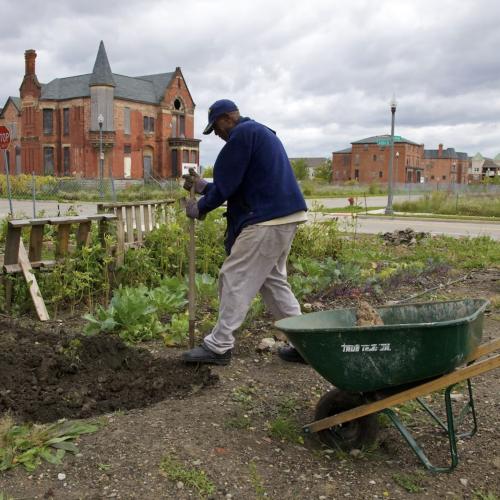
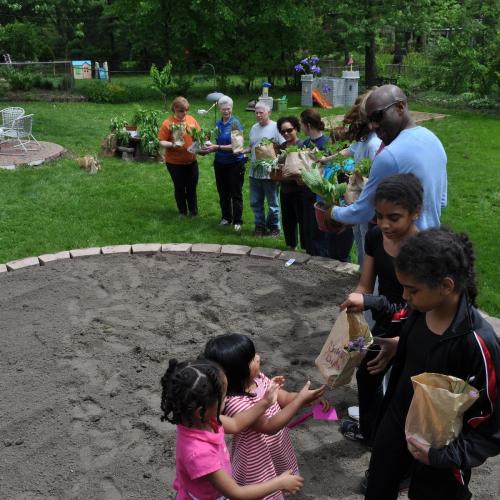
America’s biggest “food forest” is just a short drive from the world’s busiest airport, Atlanta’s Hartsfield-Jackson. When the Guardian visits the Urban Food Forest at Browns Mill there are around a dozen volunteers working. Food forests are part of the broader food justice and urban agriculture movement and are distinct from community gardens in various ways. They are typically backed by grants rather than renting plots, usually rely on volunteers and incorporate a land management approach that has a focus on growing perennials. The schemes vary in how they operate in allocating food ... but they are all aimed at boosting food access. Organizers in Atlanta stress that they properly distribute the food to the neighborhoods that the food forest is intended to support and it’s not open to the public beyond volunteer workers. Other schemes have areas where the public is free to take what they want. Celeste Lomax, who manages community engagement at the Brown Mills forest and lives in the neighborhood, believes education is key to the forest’s success and beams like sunlight when sharing her vision for the fertile soil she tends. “We’re using this space for more than just growing food. We have composting, beehives, bat boxes, and this beautiful herb garden where we’re teaching people how to heal themselves with the foods we eat. We’ll be doing walkthrough retreats and outside yoga. This is a health and wellness place. It’s so much more than just free food.”
Note: Explore a treasure trove of concise summaries of incredibly inspiring news articles which will inspire you to make a difference.
It came to be known as the Sunflower movement, a sudden three-week stand-off in 2014 between the government and Taiwanese protesters. Months later, government officials arrived at a ... university campus to ask for the help of a group that few knew even existed: the civic hackers. Taiwan's civic hackers were organized around a leaderless collective called g0v (pronounced "gov zero.") Many believed in radical transparency ... and in the idea that everyone who is affected by a decision should have a say in it. They preferred establishing consensus to running lots of majority-rule votes. These were all principles, incidentally, that parallel thinking about how software should be designed – a philosophy that g0v had begun to apply to the arena of domestic politics. As g0v saw it, the problem of politics was essentially one of information. They needed a way not to measure division, but construct consensus. The hackers' answer was called vTaiwan. The platform invites citizens into an online space for debate that politicians listen to and take into account when casting their votes. As people expressed their views, rather than serving up the comments that were the most divisive, it gave the most visibility to those finding consensus. Soon, vTaiwan was being rolled out on issue after issue, especially those related to technology, and each time a hidden consensus was revealed. "Invariably, within three weeks or four, we always find a shape where most people agree on most of the statements.” Most valuable of all, by clearing away the noise and divisiveness, vTaiwan created outcomes that the government could actually act on. It has formed the core of around a dozen pieces of laws and regulations now implemented in Taiwan, on everything from revenge porn to fintech regulation. More are waiting to be passed. The system's potential to heal divisions, to reconnect people to politics, is a solution made for the problems of our age.
Note: Explore a treasure trove of concise summaries of incredibly inspiring news articles which will inspire you to make a difference.
In 1986, [Dr. Jane Goodall] attended a conference in Chicago with researchers studying chimps in six areas of Africa, and the reports of environmental devastation shocked Goodall. After listening to the reports at the conference, Goodall felt obligated to speak. Her activism evolved quickly, from chimps, to their habitat to human welfare, and how animal rights and the future of the planet are inherently interconnected. Some of her decisions have been deemed controversial: her friendship with for US Secretary of State James Baker, her work with Conoco ... oil company to build a chimpanzee sanctuary, hard conversations with the National Institutes of Health regarding their medical research and testing practices on chimpanzees and visiting their labs. "I lost a lot of friends because of going into the labs, sitting down and talking to the people, organizing a conference to bring in the lab people, the scientists and also the animal welfare people ..."There were a lot of animal rights people who refused to speak to me — they said, 'Wow can you sit down with these evil people and have a cup of tea with them?' I was totally and completely flabbergasted. If you don’t talk to people, how can expect them to change?” When speaking to the NIH, “I didn’t stand there and accuse them of being cruel monsters. I showed slides and some film of the Gombe chimpanzees and talked about their lives, and then showed some slides of the chimps in the small cages and said, ‘You know, it’s like putting a person in a prison like that,’” said Goodall. “Many of the scientists said, ‘We really have never thought about this in this way’ a lot of them were actually crying." She stands by all of it because it produces results. It took decades, but the NIH phased out medical testing and research on chimpanzees. Conoco built the chimpanzee sanctuary, the Tchimpounga Chimpanzee Rehabilitation Center, saving all of the starving chimpanzees in the Brazzaville Zoo in the Republic of Congo.
Note: Explore more positive stories like this in our comprehensive inspiring news articles archive focused on solutions and bridging divides.
Wadded-up tissues littered Rishel Middle School's gym floor as tough teenagers sobbed, hugged their peers and told gut-wrenching stories about their lives during an all-day session intended to break down barriers. One 13-year-old said he was abandoned by his parents and that he lies awake at night scared by sounds of gunshots outside his window. A 15-year-old girl talked about attempting suicide and urged anyone with similar thoughts to reach out for help. And a teacher tearfully warned students about their actions by revealing he was a bully when he was younger – until the person he tormented tried to kill himself. The confessions were shared ... as part of "Challenge Day," a nationally recognized anti-bullying program that travels to schools around the country. Challenge Day promotes self respect and acceptance, and inspires students to become positive leaders. [The] 20-year-old program [was] designed by Yvonne and Rich St. John-Dutra. "We want to create a world where every child feels safe," said Rich St. John-Dutra. The program, which was featured on "The Oprah Winfrey Show." The events combined ice-breaking routines to get students to drop their guards with soul-searching exercises designed to reveal their true selves. Students wept as their troubles tumbled out - from worries about their parents, medical problems within the family, troubles with gangs, and battles with alcohol and drugs. Students later apologized to others who they had put down or teased over the years. "This is going to change people," said Eddie Castillo, 13. "I never knew people had problems with their families and their brothers and drugs. I never saw that sensitive side until now."
Note: For one of the most inspiring video clips ever, watch an incredibly moving 15-minute clip from an Emmy-award winning documentary on Challenge day. Learn more about this amazing program on the Challenge Day website.
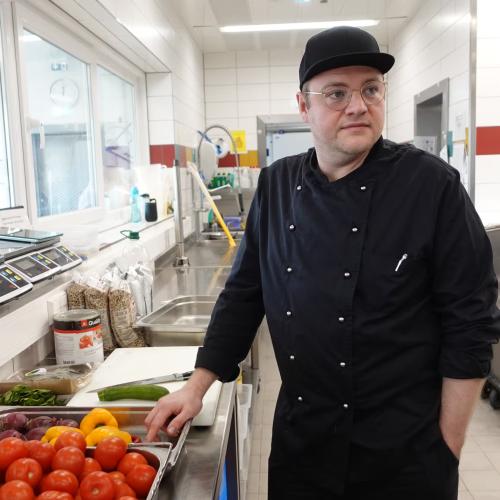
Patrick Burrichter did not think about saving lives or protecting the planet when he trained as a chef. But 25 years later he has focused his culinary skills on doing exactly that. On the outskirts of Berlin, Burrichter and his team cook for a dozen hospitals that offer patients a “planetary health” diet – one that is rich in plants and light in animals. Compared with the typical diet in Germany, known for its bratwurst sausage and doner kebab, the 13,000 meals they rustle up each day are better for the health of people and the planet. In Burrichter’s kitchen, the steaming vats of coconut milk dal and semolina dumpling stew need to be more than just cheap and healthy – they must taste so good that people ditch dietary habits built up over decades. The biggest challenge, says Burrichter, is replacing the meat in a traditional dish. Moderate amounts of meat can form part of a healthy diet, providing protein and key nutrients, but the average German eats twice as much as doctors advise. Patients on the wards of Waldfriede praise the choice of meals on offer. Martina Hermann, 75, says she has been inspired to cook more vegetables when she gets home. Followers of the planetary health diet need not abandon animal products altogether. The guidelines, which were proposed by 37 experts from the EAT-Lancet Commission in 2019, translate to eating meat once a week and fish twice a week, along with more wholegrains, nuts and legumes.
Note: Explore more positive stories like this in our comprehensive inspiring news articles archive focused on solutions and bridging divides.
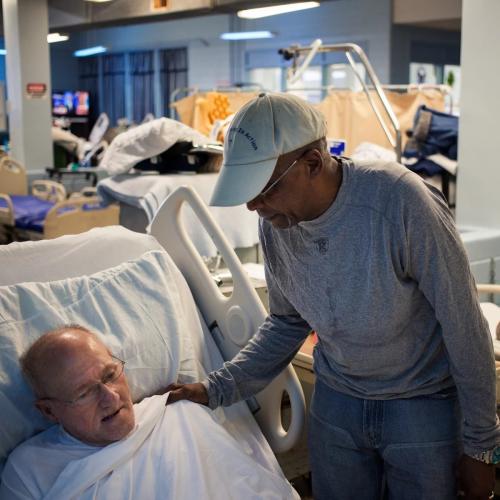
Tim Phillips, a veteran conflict-resolution expert, helped negotiate some of the most fraught conflicts in modern history — ceasefires of religious clashes in Northern Ireland and the establishment of what became South Africa's Truth and Reconciliation Commission after apartheid. Defusing an escalating situation ... first requires releasing a brain hijacked by defensive emotion. Phillips says it means saying to your opponent, for example: "I understand how important this is to you; I understand this is core to your identity and your community, and I respect your sacred values." It means reflecting your opponent's humanity back to them. A similar approach, he says, can help reduce toxic polarization. It's effective because in the heat of argument, people tend to demonize one another; counteracting that can neutralize assumptions of negative intent. Phillips says he's seen people emotionally disarm the opposition in a disagreement simply by recognizing their humanity. It can bring together fierce adversaries, and change history. Shirley Chisholm, the first Black congresswoman in the U.S., was battling for the Democratic presidential nomination with political rival ... George Wallace, a fierce segregationist. After he was shot in an attempted assassination, Chisholm visited him in the hospital and prayed at his bedside. "Wallace's daughter later said that that gesture of compassion completely changed her father," Phillips says. Wallace reportedly wept openly, and shifted his stance on racial segregation.
Note: Explore more positive stories like this in our comprehensive inspiring news articles archive focused on solutions and bridging divides.
Finland's high levels of social trust could be one reason the country has been ranked as the world's happiest for six years in a row. As the World Happiness Report, which does the ranking, notes, most Finns expect their wallet to be returned to them if they lose it. Finns have liberated children, trust their neighbors, commune with nature, and leave work on time. But ask them what they think of the happiness report, and you'll get a surprising answer. "We're always surprised that we are still the first," Meri Larivaara, a mental-health advocate, told me in [a] Helsinki coffee shop. "Every year there is a debate like, 'How is this possible?'" In fact, locals I talked to were exasperated by the survey and even annoyed by the global perception of them as happy. Finnish people are often stereotyped as introverted and keeping to themselves. But it's also true that Finns are very content with what they have. "They call us up and just ask if we like our lives. We just say there's nothing wrong right now, maybe call back tomorrow," one local said of the survey. Maybe it's not so much that Finns are happy but that they don't have some of the intense fears you might find in other places. Finland's government sponsors one of the most robust welfare systems in the world. In 2021, the Nordic country spent 24% of its gross domestic product on social protection — the highest of any other OECD country that year. Healthcare and education are free for all residents — all the way through to the Ph.D. level.
Note: Explore more positive stories like this in our comprehensive inspiring news articles archive focused on solutions and bridging divides.
Public banks are typically operated by government or tribal authorities and, in theory, would be chartered to achieve social good and invest in communities. Only two public banks currently operate in the United States: the Bank of North Dakota, founded in 1919, and the Territorial Bank of American Samoa, founded in 2018. Organizations pushing for a public banking option exist in 37 states, according to the Public Banking Institute. In contrast to private banks, which are responsible to their shareholders, public banks are responsible to their boards and are chartered to invest in public needs. The Bank of North Dakota, for instance, is chartered to offer a “revolving loan fund” to farmers, and profits from loans are directed back into the fund to keep interest rates low. The modern movement to invest in public banks grew out of the 2008 financial crisis and was galvanized during the pandemic, fueled by a populist distrust of the banking and finance sectors. In October 2020, Representatives Alexandria Ocasio-Cortez and Rashida Tlaib introduced the federal Public Banking Act, which would allow state and local governments across the country to create public banks. In the first two months of 2021 there were sixteen bills across the country designed to pave the way for public banks. Supporters of public banks are hoping that any deposits from state and local governments can be used to fund community-based projects that have trouble getting funded by private banks.
Note: Explore more positive stories like this in our comprehensive inspiring news articles archive focused on solutions and bridging divides.
What does it take to have a challenging conversation in the era of cancel culture? For MacArthur Fellow Loretta J. Ross, the answer lies in calling in: a communicative strategy rooted in compassion, accountability, and restorative justice. Cancel culture [is] a phenomenon whereby people deemed to be moral transgressors are publicly discredited on social media platforms, and in some instances, punished through cultural, social, and professional ostracism. Professor Ross thinks this readiness to cancel a person on the basis of their beliefs is toxic. Instead, she espouses empathy and stresses the importance of context in challenging conversations. Calling in is not what you do for other people–it's what you do for yourself. It gives you a chance to offer love, grace, and respect, and to showcase one's own integrity and one's own ability to hold nuance and depth. People mistakenly think that you're doing it because you're trying to change somebody else. That's not possible. And since we don't have the power to control and change others, the only power we're left with is self-empowerment. In this sense, calling in is a conscious decision to not make the world crueler than it needs to be. We're all capable of using a technique I call "the mental parking lot" where you temporarily put aside any visceral reactions you have to what others are saying. It's a technique that requires you not to pay attention to your reaction but rather to devote your focus and respect to the person you're talking to.
Note: Smith College Professor and civil rights activist Loretta Ross worked with Ku Klux Klan members and practiced restorative justice with incarcerated men convicted or raping and murdering women. Watch Loretta Ross's powerful Ted Talk on simple tools to help shift our culture from fighting each other to working together in the face of polarizing social issues.
Loretta J. Ross [identifies] the characteristics, and limits, of call-out culture: the act of publicly shaming another person for behavior deemed unacceptable. Civil conversation between parties who disagree has also been part of activism, including her own, for quite some time. “I am challenging the call-out culture,” Ross said. “I think you can understand how calling out is toxic. It really does alienate people, and makes them fearful of speaking up.” The antidote to that ... Professor Ross believes, is “calling in.” Calling in is like calling out, but done privately and with respect. “It’s a call out done with love,” she said. That may mean simply sending someone a private message, or even ringing them on the telephone to discuss the matter, or simply taking a breath before commenting, screen-shotting or demanding one “do better” without explaining how. Calling out assumes the worst. Calling in involves conversation, compassion and context. “I think we overuse that word ‘trigger’ when really we mean discomfort,” she said. “And we should be able to have uncomfortable conversations.” Ross told the students ... “I think we actually sabotage our own happiness with this unrestrained anger. And I have to honestly ask: Why are you making choices to make the world crueler than it needs to be and calling that being woke?" She thought of what her organization’s founder, the Rev. C.T. Vivian ... told her: “When you ask people to give up hate, you have to be there for them when they do.”
Note: Watch Ross's powerful Ted Talk on simple, yet deeply inspiring tools for calling people in instead of calling people out.
Students who are misbehaving are usually taken out of class and sent to the principal, who punishes the child by revoking privileges, calling home or sometimes suspending them. But students in some Baltimore schools are sent somewhere different when they are acting out: a designated meditation room where they can calm down and decompress. The Mindful Moment room is equipped with bean bags and dim lighting, and students go through calming exercises with trained staff. At Robert W. Coleman Elementary School, teachers and staff can refer students to the room for an emotional “reset” when they are worked up. The student is led through breathing exercises and is encouraged to discuss the emotions that led to an outburst. They work with the adult to come up with a plan to use mindfulness in a similar situation in the future, to prevent an outburst. After about 20 minutes in the room, they rejoin classmates. Students usually show “visible signs of relaxation and emotional de-escalation after guided practices” in the room. The program also includes a “Mindful Moment” twice a day, which leads students in breathing exercises for 15 minutes over the PA system. Students can also participate in yoga classes. It has drastically reduced suspensions, with zero reported in the 2013-14 school year. The program has also been implemented with older students, including those at Patterson High School, [which] has also seen a decrease in suspensions both in the hallways and in class.
Note: For more, see this webpage.
Ever since a 71-year-old Brazilian man rescued a struggling penguin, he's been receiving regular visits from his feathered friend. Joao Pereira de Souza, a retired bricklayer, lives ... just off the coast of Rio de Janeiro. In 2011, he spotted a starving Magellanic penguin drenched in oil on the beach near his house. Naming the penguin Dindim, Pereira de Souza fed him every day until he was strong enough to leave, according to a video from the University of Rio de Janeiro. But the penguin refused to go. Pereira de Souza decided to row a boat out into the water and drop Dindim off to encourage him to swim home. But when he rowed back to shore, he found the penguin waiting for him. "He stayed with me for 11 months and then, just after he changed his coat with new feathers, he disappeared," Pereira de Souza told TV Globo, a Brazilian TV network. Magellanic penguins regularly swim thousands of kilometres a year to breeding spots on the coast of Argentina and Chile. From time to time, penguins show up in warmer Brazilian waters. Many of Pereira de Souza's friends thought that when Dindim finally left, that was it for the human-bird friendship. But a few months later, Dindim returned and found Pereira de Souza. He visits for about four months, a ritual kept for the last five years. "He arrives in June and leaves to go home in February, and every year he becomes more affectionate," Pereira de Souza told TV Globo. De Souza appears to be the only person who can get near Dindim. If others try, he pecks them or waddles away.
Note: Don't miss a video on this incredible friendship. Explore a treasure trove of concise summaries of incredibly inspiring news articles which will inspire you to make a difference.
Meet Sam Tsemberis. He's all but solved chronic homelessness. His research, which commands the support of most scholars, has inspired policies across the nation. The results have been staggering. Late last month, Utah, the latest laboratory for Tsemberis's models, reported it has nearly eradicated chronic homelessness. Phoenix, an earlier test case, eliminated chronic homelessness among veterans. Then New Orleans housed every homeless veteran. Homelessness has long seemed one of the most intractable of social problems. For decades, the number of homeless from New York City to San Francisco surged and so did the costs. At one point around the turn of the millennium, New York was spending an annual $40,500 on every homeless person with mental issues. Tsemberis ... unfurled a model so simple children could grasp it, so cost-effective fiscal hawks loved it, so socially progressive liberals praised it. Give homes for the homeless, and you will solve chronic homelessness. Success begat success. The federal government tested the model on 734 homeless across 11 cities, finding the model dramatically reduced levels of addiction as well as shrank health related costs by half. "Adults who have experienced chronic homelessness may be successfully housed and can maintain their housing," the report declared. Utah's Gordon Walker, explain[s] how his state succeeded at eliminating homelessness and saved millions, "It was costing us in state services, health-care costs, jail time, police time, about $20,000 per person. Now, we spend $12,000 per person."
Note: Explore a treasure trove of concise summaries of incredibly inspiring news articles which will inspire you to make a difference.
Traditionally, you wouldn't gift someone a rat. Tanzania-based NGO Apopo, however, thinks rats make excellent gifts. So much so that they've launched an adopt-a-rat program, which allows participants to sponsor the animal. Despite the creatures' reputation for thieving and spreading disease, [Apopo's founder Bart] Weetjens has proven that rats can ... save lives. Apopo's rats have actually saved thousands. They are highly trained to sniff out land mines and detect tuberculosis - two scourges that have had a tremendously negative impact across the African continent. And his rats are fast. A single rat can clear 200 square feet in an hour (done manually, the same area would take 50 hours to clear). A TB-detection rat can evaluate 50 samples in eight minutes (almost a day's work for a lab technician). In 2006, Weetjens started testing his "hero rats," as he dubs them, on the mine fields in Mozambique, a country that at that time was one of the worst affected by landmines, thanks mainly to a civil war that ended in 1992. Since then, Apopo has cleared the country of 6,693 landmines, 29,934 small arms and ammunition, and 1,087 bombs. Mozambique is on track to be free of landmines by the year's end. In 2005, the World Health Organization (WHO) declared a TB crisis in Africa. It's a problem Weetjens realized he could address with his sniffer rats. So far, they've analyzed over 260,000 samples from health clinics in Dar es Salaam. They are cheap to train, cheaper to procure, and plentiful.
Note: Explore a treasure trove of concise summaries of incredibly inspiring news articles which will inspire you to make a difference.
In the 1980s, leading consultants were skeptical about cellular phones. The handsets were heavy, batteries didnt last long, coverage was patchy, and the cost per minute was exorbitant. The experts are saying the same about solar energy now. They say that solar is inefficient, too expensive to install, and unreliable, and will fail without government subsidies. They too are wrong. Solar will be as ubiquitous as cellular phones are. Futurist Ray Kurzweil notes that solar power has been doubling every two years for the past 30 years as costs have been dropping. He says solar energy is only six doublings or less than 14 years away from meeting 100 percent of todays energy needs. By Kurzweils estimates, inexpensive renewable sources will provide more energy than the world needs in less than 20 years. In places such as Germany, Spain, Portugal, Australia, and the Southwest United States, residential-scale solar production has already reached grid parity with average residential electricity prices. In other words, it costs no more in the long term to install solar panels than to buy electricity from utility companies. The prices of solar panels have fallen 75 percent in the past five years alone and will fall much further as the technologies to create them improve and scale of production increases. By 2020, solar energy will be price-competitive with energy generated from fossil fuels on an unsubsidized basis in most parts of the world. Within the next decade, it will cost a fraction of what fossil fuel-based alternatives do. Despite the skepticism of experts and criticism by naysayers, there is little doubt that we are heading into an era of unlimited and almost free clean energy.
Note: This article also points out how some big energy companies and the Koch brothers are lobbying to stop alternative technologies from flowering. Read through a rich collection of energy news articles with inspiring and revealing news on energy developments. And explore a treasure trove of concise summaries of incredibly inspiring news articles which will inspire you to make a difference.
The psychedelic drug in magic mushrooms may have lasting medical and spiritual benefits, according to new research from Johns Hopkins School of Medicine. The mushroom-derived hallucinogen, called psilocybin, is known to trigger transformative spiritual states, but at high doses it can also result in "bad trips" marked by terror and panic. "The important point here is that we found the sweet spot where we can optimize the positive persistent effects and avoid some of the fear and anxiety that can occur and can be quite disruptive," says lead author Roland Griffiths, professor of behavioral biology at Hopkins. Giffiths' study involved 18 healthy adults, average age 46. Nearly all the volunteers were college graduates and 78% participated regularly in religious activities; all were interested in spiritual experience. Fourteen months after participating in the study, 94% of those who received the drug said the experiment was one of the top five most meaningful experiences of their lives; 39% said it was the single most meaningful experience. Their friends, family members and colleagues also reported that the psilocybin experience had made the participants calmer, happier and kinder.
The Plasma Converter ... can consume nearly any type of wastefrom dirty diapers to chemical weaponsby annihilating toxic materials in a process ... called plasma gasification. A 650-volt current passing between two electrodes rips electrons from the air, converting the gas into plasma. The plasma arc is so powerful, it disintegrates trash into its constituent elements by tearing apart molecular bonds. The system is capable of breaking down pretty much anything except nuclear waste. The only by-products are an obsidian-like glass [and] a mixture of primarily hydrogen and carbon monoxide that can be converted into a variety of marketable fuels, including ethanol, natural gas and hydrogen. Perhaps the most amazing part of the process is that its self-sustaining. Once the cycle is under way, the 2,200F syngas is fed into a cooling system, generating steam that drives turbines to produce electricity. About two thirds of the power is siphoned off to run the converter; the rest can be used on-site for heating or electricity, or sold back to the utility grid. Even a blackout would not stop the operation of the facility. New York City is already paying an astronomical $90 a ton to get rid of its trash. According to Startech, a few 2,000-ton-per-day plasma-gasification plants could do it for $36. Sell the syngas and surplus electricity, and youd actually net $15 a ton. But the decision-making bureaucracy can be slow, and it is hamstrung by the politically well-connected waste-disposal industry. Startech isnt the only company using plasma to turn waste into a source of clean energy. A handful of start-upsGeoplasma, Recovered Energy, PyroGenesis, EnviroArc and Plasco Energy, among othershave entered the market in the past decade.
Note: Why hasn't this amazing, proven machine and technology made front page headlines? Read the exciting article at the link above to find how it is already being used. For why you don't know about it, read this excellent article on how such inventions are suppressed.
Important Note: Explore our full index to revealing excerpts of key major media news articles on several dozen engaging topics. And don't miss amazing excerpts from 20 of the most revealing news articles ever published.



