





















































Microchip Implants Media Articles
Below are key excerpts of revealing news articles on Microchip Implants from reliable news media sources. If any link fails to function, a paywall blocks full access, or the article is no longer available, try these digital tools.

Scientists have demonstrated proof of principle that traumatic memories can be erased from the brain as seen in the science fiction film Eternal Sunshine Of The Spotless Mind. Studies in mice demonstrated that fearful memories prompted by a sound associated with an electric shock could be turned off and on. The researchers said attempting to do this in humans was full of ethical problems. But their studies suggest it will be possible at some point in the future. Professor Sheena Josselyn said they had been able to discover the specific brain cells where a particular memory was stored. So we can target where in the brain a memory has gone, she said. We can then decrease the activity in these cells And it is as if we erase the memory. After this was done, the mice were unperturbed when they heard the sound they had previously learned to associate with the shock. Increasing the cells activity restored the memory. We can turn memory on and turn memory off, Professor Josselyn said. We can erase a fearful memory in mice, suggesting in people there might be a way of targeting just those cells that are important in just this traumatic memory, perhaps getting rid of this traumatic memory. Asked about the ethical considerations, Professor Josselyn said ... that she did not see a future in which brain cells would be killed off to remove memories. But she added: For something that really interferes with your everyday life ... a treatment that targets just those cells could be appropriate.
Note: Remember that secret military and intelligence projects are usually 10 to 20 years ahead of anything being done in the public. Could some groups already have refined the ability to erase, and possibly even implant memories? For more along these lines, see concise summaries of deeply revealing news articles on mind control and microchip implants.
Dog owners should consider flouting new laws for mandatory microchipping, according to a specialist who warns the procedure can kill puppies and small breeds. Fines of up to 500 will be issued from April 6, the deadline for all dogs over the age of eight weeks to have the chips fitted to enable wardens to scan them for the name and address of their owner. More than a million of the countrys 8.5 million dogs are still not registered and around three million more owners have failed to update their details after moving house. But Richard Allport, a senior vet and owner of the Natural Medicine Centre, said the chip can cause serious health problems for young and small dogs. I think the age by which puppies must be microchipped eight weeks is far too young, Mr Allport wrote in specialist magazine Dogs Today. My advice to people who dont want their dogs microchipped is to sit tight and do nothing. The procedure involves a sterile chip, the size of a grain of rice, implanted between the shoulder blades. If the new law fails to reduce numbers of strays, wardens could eventually be deployed to patrol parks carrying out random spot-checks. Last year 110,000 stray dogs were picked up off the streets, of which 47,596 went unclaimed in council kennels. So far 86 per cent of dogs have been chipped, but the Dogs Trust said a large percentage of details on databases were out of date.
Note: Explore an excellent website on the risks and dangers of microchipping your pets.
Felicio de Costa ... arrives at the front door and holds his hand against it to gain entry. Inside he does the same thing to get into the office space he rents [at Epicenter, a new hi-tech office development in Sweden]. He can also wave his hand to operate the photocopier. That's all because he has a tiny RFID (radio-frequency identification) chip, about the size of a grain of rice, implanted in his hand. On the day of the building's official opening, the developer's chief executive was, himself, chipped live on stage. The whole process is being organised by a Swedish bio-hacking group. While some of the people around the building were looking forward to being chipped, others were distinctly dubious. An older woman ... saw little point in being chipped just to get through a door. But [Epicenter official] Hannes Sjoblad says he and the Swedish Biohacking Group have another objective - preparing us all for the day when others want to chip us. "We want to be able to understand this technology before big corporates and big government come to us and say everyone should get chipped - the tax authority chip, the Google or Facebook chip." Then, he says, we'll all be able to question the way the technology is implemented from a position of much greater knowledge.
Note: Read about the agenda to chip all people in this powerful essay and these news articles.
Scientists have created a mind-control system that allows a person to alter the genes in a mouse through the power of thought. A person wearing the device could alter how much protein was made from a gene in the mouse. Volunteers found that they could turn the gene on or off in the mouse at will. The experiment could lead to the development of a radical new approach to the treatment of diseases. Martin Fussenegger, a bioengineer who leads the project at ETH Zurich said he hoped to see clinical trials in people with chronic pain or epilepsy in the next five years. Fusseneggers team describes a system that demonstrates the idea. The mouse was fitted with a small implant containing copper coils, a light-emitting diode (LED) and a tiny container of genetically modified cells. When the electromagnetic field switches on beneath the mouse, an electric current is induced in the implants coils which makes the LED shine. This light illuminates the cells which are designed to respond by switching on a particular gene, causing the cells to make a new protein which seeps out of the implants membrane. In the tests, the new protein ... allowed scientists to measure its levels ... while people wearing the headset changed their state of mind. In a series of follow-up experiments, volunteers wearing the headset could see when the LED came on, because the red light shone through the mouses skin. In time, they learned to control the light and so the gene simply by thinking.
Note: For more along these lines, see concise summaries of deeply revealing microchip news articles from reliable major media sources.
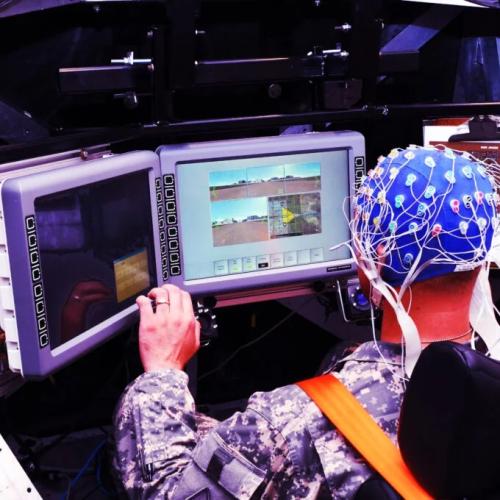
The Defense Advanced Research Projects Agency, or DARPA, is launching a $70 million program to help military personnel with psychiatric disorders using electronic devices implanted in the brain. The goal of the five-year program is to develop new ways of treating problems including depression, anxiety and post-traumatic stress disorder, all of which are common among service members who fought in Iraq or Afghanistan. The new program will fund development of high-tech implanted devices able to both monitor and electrically stimulate specific brain circuits. The effort will be led by scientists at the University of California, San Francisco and Massachusetts General Hospital. The UCSF team will begin its work by studying volunteers who already have probes in their brains as part of treatment for epilepsy or Parkinson's disease. That will allow researchers to "record directly from the brain at a level of resolution that's never [been] done before," says Eddie Chang, a neurosurgeon at UCSF. And because many of the volunteers also have depression, anxiety and other problems, it should be possible to figure out how these conditions have changed specific circuits in the brain, Chang says. The scientists ... hope to design tiny electronic implants that can stimulate the cells in faulty brain circuits. "We know that once you start putting stimulation into the brain, the brain will change in response," Chang says.
Note: Do we really want the military implanting chips in people's brains? What other behavior might they want to control? For more on microchip implants, see the deeply revealing reports from reliable major media sources available here.
Researchers from Brown University made headlines after they successfully demonstrated how a paralyzed woman who had lost the use of her arms and legs could control a robotic arm using her brainwaves. In a video, Cathy Hutchinson imagines drinking a cup of coffee, and the robotic arm brings the cup to her lips. Hutchinson is connected to the robotic arm through a rod-like pedestal driven into her skull. Researchers at UC Berkeley has been working on plans for a less invasive, wireless monitoring system. Earlier this month, they released a draft paper: Neural Dust: An Ultrasonic, Low Power Solution for Chronic Brain-Machine Interfaces. Dongjin Seo, a [UC Berkeley] graduate student ... authored the paper under the supervision of senior faculty members, including Michel Maharbiz who has famously created cyborg beetles for the US Defense Department. Seo said the researchers goal is to build an implantable system that is ultra-miniature, extremely compliant, and scalable to be viable for a lifetime, for brain-machine interfaces. The Berkeley researchers propose to sprinkle the brain with tiny, dust-sized, wireless sensors. This would reduce the risk of infection ... and limit the trauma to one initial operation. During that operation, the skull would be opened, and sensors would be inserted into the brain. At the same time a separate transceiver would be placed directly under the skull but above the brain. The transceiver would communicate with the sensors via ultrasound.
Note: For information on the risks and dangers of this invasive technology being used to control minds, see this article. For more along these lines, see concise summaries of deeply revealing news articles on microchip implants and mind control.
The real time monitoring of brain function has advanced in leaps and bounds in recent years. Thats ... led to a new engineering discipline of brain-machine interfaces, which allows people to control machines by thought alone. Today, Dongjin Seo and pals at the University of California Berkeley reveal an entirely new way to study and interact with the brain. Their idea is to sprinkle electronic sensors the size of dust particles into the cortex and to interrogate them remotely using ultrasound. The ultrasound also powers this so-called neural dust. Each particle of neural dust consists of standard CMOS circuits and sensors that measure the electrical activity in neurons nearby. This is coupled to a piezoelectric material that converts ultra-high-frequency sound waves into electrical signals and vice versa. The neural dust is interrogated by another component placed beneath the scale but powered from outside the body. This generates the ultrasound that powers the neural dust and sensors that listen out for their response, rather like an RFID system. The system is also tetherless - the data is collected and stored outside the body for later analysis. [Seo and co say] implanting the neural dust particles in the cortex ... can probably be done by fabricating the dust particles on the tips of a fine wire array, held in place by surface tension, for example. This array would be dipped into the cortex where the dust particles become embedded.
Note: For information on the risks and dangers of this invasive technology being used to control minds, see this article. For more along these lines, see concise summaries of deeply revealing news articles on microchip implants and mind control.
A Texas school district can transfer a student who is citing religious reasons for her refusal to wear an identification card that is part of an electronic tracking system, a federal judge ruled on [January 8]. The parents of 15-year-old Andrea Hernandez had requested a preliminary injunction that would have prevented the school district from transferring their daughter from her San Antonio high school while the lawsuit on whether she should be forced to wear the tracking badge went through federal court. Last fall, the Northside Independent School District began experimenting with locator chips in student ID badges on two campuses, allowing administrators to track the whereabouts of 4,200 students with GPS-like precision. Hernandezs suit against Northside the fourth-largest school district in Texas argues that the ID rule violates her religious beliefs. Her family says the badge is a mark of the beast that goes against their religion. But U.S. District Judge Orlando Garcia ... denied a request to stop her from being transferred, saying the badge requirement has an incidental effect, if any, on (Hernandez's) religious beliefs. Garcia said that if Hernandez does not accept the school districts accommodation of wearing a badge without the tracking chip, the district can transfer her to another campus. John Whitehead, president of The Rutherford Institute, a Virginia-based civil rights group that is representing Hernandez and her family in court, said his organization plans to appeal the judges ruling.
Note: For deeply revealing reports from reliable major media sources on ID tracking technologies, click here.
A court challenge has delayed plans to expel a Texan student for refusing to wear a radio tag that tracked her movements. Religious reasons led Andrea Hernandez to stop wearing the tag that revealed where she was on her school campus. The tags were introduced to track students and help tighten control of school funding. A Texan court has granted a restraining order filed by a civil rights group pending a hearing on use of the tags. ID badges containing radio tags started to be introduced at the start of the 2012 school year to schools run by San Antonio's Northside Independent School District (NISD). Ms Hernandez refused to wear the tag because it conflicted with her religious beliefs, according to court papers. Wearing such a barcoded tag can be seen as a mark of the beast as described in Revelation 13 in the Bible, Ms Hernandez's father told Wired magazine in an interview. NISD suspended Ms Hernandez and said she would no longer be able to attend the John Jay High School unless she wore the ID badge bearing the radio tag. Alternatively it said Ms Hernandez could attend other schools in the district that had not yet joined the radio tagging project. The Rutherford Institute, a liberties campaign group, joined the protests and went to court to get a restraining order to stop NISD suspending Ms Hernandez. The Rutherford Institute said the NISD's suspension violated Texan laws on religious freedom as well as free speech amendments to the US constitution.
Note: For deeply revealing reports from reliable major media sources on microchips and radio tag technologies used to track children, click here.
This week science fiction writer Elizabeth Moon argues that everyone should be given a barcode at birth. If I were empress of the Universe I would insist on every individual having a unique ID permanently attached - a barcode if you will; an implanted chip to provide an easy, fast inexpensive way to identify individuals. It would be imprinted on everyone at birth. Point the scanner at someone and there it is. Having such a unique barcode would have many advantages. In war soldiers could easily differentiate legitimate targets in a population from non combatants. This could prevent mistakes in identity, mistakes that result in the deaths of innocent bystanders. Weapons systems would record the code of the use, identifying how fired which shot and leading to more accountability in the field. Anonymity would be impossible as would mistaken identity making it easier to place responsibility accurately, not only in war but also in non-combat situations far from the war.
Note: For a powerful essay showing that the plan to microchip the masses has been part of the global elite's agenda for control for a long time, click here.
Call it high-tech hijacking. Thieves now have the capabilities to steal your credit card information without laying a hand on your wallet. Its new technology being used in credit and debit cards, and its already leaving nearly 140 million people at-risk for electronic pickpocketing. It all centers around radio frequency identification technology, or RFID. Its supposed to make paying for things faster and easier. You just wave the card, and youve paid. But now some worry its also making life easier for crooks trying to rip you off. In a crowd, Walt Augustinowicz blends right in. And thats the problem. If Im walking through a crowd, I get near peoples back pocket and their wallet, I just need to be this close to it and theres [their] credit card and expiration date on the screen, says Augustinowicz demonstrating how easily cards containing RFID can be hacked. Armed with a credit card reader he bought for less than $100 on-line and a netbook computer ... for about an hour he patrolled Beale Street, looking for RFID chips to read, and credit card information to steal. Even scarier, Augustinowicz says bad guys could work a crowd, stealing numbers and then e-mail them anywhere in the world. Its not just your credit and debit cards at-risk. While they are harder to hack, all US passports issued since 2006 contain RFID technology that can be read, and swiped. It gives me a lot of personal information like your date of birth, your photo if I wanted to make some sort of ID, said Augustinowicz demonstrating with his reader.
Note: For an excellent video showing how easy it is for someone to hijack your credit card information if the card has an RFID, click here.
Novartis AG plans to seek regulatory approval within 18 months for a pioneering tablet containing an embedded microchip, bringing the concept of "smart-pill" technology a step closer. The initial program will use one of the Swiss firm's established drugs taken by transplant patients to avoid organ rejection. But Trevor Mundel, global head of development, believes the concept can be applied to many other pills. Novartis agreed in January to spend $24 million to secure access to chip-in-a-pill technology developed by privately owned Proteus Biomedical of Redwood City, California, putting it ahead of rivals. The biotech start-up's ingestible chips are activated by stomach acid and send information to a small patch worn on the patient's skin, which can transmit data to a smartphone or send it over the Internet to a doctor. Because the tiny chips are added to existing drugs, Novartis does not expect to have to conduct full-scale clinical trials to prove the new products work. Instead, it aims to do so-called bioequivalence tests to show they are the same as the original. A bigger issue may be what checks should be put in place to protect patients' personal medical data as it is transmitted from inside their bodies by wireless and Bluetooth.
Note: It's interesting that Fox News was the only major media to pick up this revealing Reuters story. This article seriously underplays the privacy concerns raised by this new corporate strategy. For more on this, click here. For many key reports on corporate and governmental threats to privacy, click here. For more on the dangers of microchips from reliable sources, click here.
Radio frequency identification the same technology used to monitor cattle is tracking students in the Spring and Santa Fe school districts. Identification badges for some students in both school districts now include tracking devices that allow campus administrators to keep tabs on students' whereabouts on campus. Some parents and privacy advocates question whether the technology could have unintended consequences. The tags remind them of George Orwell's Big Brother, and they worry that hackers could figure a way to track students after they leave school. Identity theft and stalking could become serious concerns, some said. "There [are] real questions about the security risks involved with these gadgets," said Dotty Griffith, public education director for the ACLU of Texas. "Readers can skim information. To the best of my knowledge, these things are not foolproof. We constantly see cases where people are skimming, hacking and stealing identities from sophisticated systems." The American Civil Liberties Union fought the use of this technology in 2005 - when a rural elementary school in California was thought to be the first in the U.S. to introduce the badges. The program was dismantled because of parental concern.
Note: For key reports from reliable sources on the risks to liberty and privacy posed by RFID technologies, click here.
A Berkshire family say they are devastated at being forced to leave their pet dog in France after his pet passport microchip failed. Matt Roberts and his family returned to Arborfield, near Reading, without their dog Indy because the technology had stopped working. Indy has undergone surgery costing 1,000 to remove the chip. It could take up to six months for him to be issued with a new pet passport. Mr Roberts had just finished a two week holiday in the south of France with his wife Dorota and six-month-old daughter Harriet when he tried to return to the UK via Dunkirk. However, when the dogs tried to re-enter the country the scanners could not read Indy's microchip. The family had spent spent 400 on pet passports for his two Shih Tzu dogs, Indy and Buzz. Indy will remain in kennels in France unless the manufacturer can confirm that the chip they have removed from him matches the documentation on the pet passport. However, vets have said that the chip has corrupted and will be difficult to read. Mr Roberts may have to apply for a new pet passport for Indy or put the dog into quarantine. He said he was reluctant to do this, and was already spending 15 a night to keep his dog in kennels. A Defra spokesman said: "Around 100 pets a year have a failed or missing microchip on arrival to the UK. "In the majority of cases the microchip number can be removed and identified or read by the manufacturer, and the pet eventually allowed to enter."
Note: Another media article shows the same thing happened to a second couple. Explore an excellent website on the risks and dangers of microchipping your pets.
University of Reading researcher Mark Gasson has become the first human known to be infected by a computer virus. The virus, infecting a chip implanted in Gasson's hand, passed into a laboratory computer. From there, the infection could have spread into other computer chips found in building access cards. All this was intentional, in an experiment to see how simple radio-frequency identification (RFID) chips like those used for tracking animals can host and spread technological diseases. The research from the British university shows that as implantable bionic devices such as pacemakers get more sophisticated in the years ahead, their security and the safety of the patients whose lives depend on them will become increasingly important, said Gasson. "We should start to think of these devices as miniature computers," Gasson said. And just like everyday computers, they can get sick. "I dont think for us that (infectious technological agents) would be a particularly new concept, but implants in our bodies will make it a lot more real," Gasson told TechNewsDaily. "A denial-of-service attack on a pacemaker, if such a thing were possible, would of course be very detrimental."
Note: For lots more from reliable sources on the dangers of microchip implant technologies, click here.
Researchers at the University of Florida have combined RFID, microchips and printed nano-particle antennas to make pills that communicate with cell phones or laptops to tell doctors whether patients are taking their medicine. Still a prototype, the inventors hope their tattletale technology can be applied commercially to a range of medications in clinical trials and in treatment of patients with chronic diseases in which it is essential that the doses are taken and taken on time. The pill is a white capsule with a microchip embedded and with an antenna printed on the outside with ink containing silver nanoparticles. A device worn by the patient energizes the microchip via bursts of low-voltage electricity. The chip signal confirms the pill is in the stomach and the device sends a signal that the pill has been swallowed. The messages can go to cell phones or laptops to inform doctors or family members.
Note: For lots more on microchips from reliable sources, click here.
All dogs are to be compulsorily microchipped so that their owners can be more easily traced under a crackdown on dangerous dogs. Under the scheme a microchip the size of a grain of rice is injected under the skin of the dog between its shoulder blades. The chip contains a unique code number, the dog's name, age, breed and health as well as the owner's name, address and phone number. When the chip is "read" by a handheld scanner the code number is revealed and the details can be checked on a national database. The measures will be set out by the home secretary, Alan Johnson, who will point to rising public concern that "status dogs" are being used by some irresponsible owners to intimidate communities or as a weapon by gangs. If the scheme were made compulsory owners would face a fine for failing to microchip their dogs.
Note: Once all dogs are required to be microchipped, what will come next? To be informed of some disturbing plans to microchip all of us, click here. For lots more on microchipping from reliable sources, click here.
Climbing into his Volvo, outfitted with a Matrics antenna and a Motorola reader he'd bought on eBay for $190, Chris Paget cruised the streets of San Francisco with this objective: To read the identity cards of strangers, wirelessly, without ever leaving his car. It took him 20 minutes to strike hacker's gold. Zipping past Fisherman's Wharf, his scanner detected, then downloaded to his laptop, the unique serial numbers of two pedestrians' electronic U.S. passport cards embedded with radio frequency identification, or RFID, tags. Within an hour, he'd "skimmed" the identifiers of four more of the new, microchipped PASS cards from a distance of 20 feet. Paget's February experiment demonstrated something privacy advocates had feared for years: That RFID, coupled with other technologies, could make people trackable without their knowledge or consent. He filmed his drive-by heist, and soon his video went viral on the Web, intensifying a debate over a push by government, federal and state, to put tracking technologies in identity documents and over their potential to erode privacy. With advances in tracking technologies coming at an ever-faster rate, critics say, it won't be long before governments could be able to identify and track anyone in real time, 24-7, from a cafe in Paris to the shores of California. The key to getting such a system to work, these opponents say, is making sure everyone carries an RFID tag linked to a biometric data file. On June 1, it became mandatory for Americans entering the United States by land or sea from Canada, Mexico, Bermuda and the Caribbean to present identity documents embedded with RFID tags, though conventional passports remain valid until they expire.
Note: For lots more on corporate and government surveillance, click here.
Gov. Matt Blunt signed a bill ... prohibiting companies in Missouri from forcing workers to have microchips implanted in their bodies. You read that right. In Missouri, its now illegal for businesses to require employees to have a microchip embedded under their skin. When youre forced to have a chip put in you as a condition of employment, thats taking away your civil liberties and your freedom, said Rep. Jim Guest, a King City Republican. Guest added the microchip language to a bill concerning overtime and disability benefits. Next year, he said, he will introduce a bill to prohibit all microchip implants in humans. Only a few hundred people nationwide have been voluntarily implanted with the devices, and mandated microchips are virtually unheard of in Missouri or anywhere else. But three other states already prohibit mandatory implants. Guest ... said its crucial to ban the technology before it gains any traction. We want a law on the books so we can stop a major problem before it starts, he said. Privacy advocates and others worry that widespread use of such chips could allow individuals to be tracked or monitored without their knowledge and create identity theft issues. The chips, which use radio frequency identification [RFID] technology, are about the size of a grain of rice and are usually implanted in the upper arm. Guest and others have raised health concerns as well, citing studies that link implanted chips with cancerous tumors in laboratory animals.
Note: For lots more on microchip implants, click here.
Here's a vision of the not-so-distant future: Microchips with antennas will be embedded in virtually everything you buy, wear, drive and read, allowing retailers and law enforcement to track consumer items -- and, by extension, consumers -- wherever they go, from a distance. A seamless, global network of electronic "sniffers" will scan radio tags in myriad public settings, identifying people and their tastes instantly so that customized ads, "live spam," may be beamed at them. In "Smart Homes," sensors built into walls, floors and appliances will inventory possessions, record eating habits, monitor medicine cabinets -- all the while, silently reporting data to marketers eager for a peek into the occupants' private lives. Science fiction? In truth, much of the radio frequency identification [RFID] technology that enables objects and people to be tagged and tracked wirelessly already exists -- and new and potentially intrusive uses of it are being patented, perfected and deployed. Some of the world's largest corporations are vested in the success of RFID technology, which couples highly miniaturized computers with radio antennas to broadcast information about sales and buyers to company databases. Already, microchips are turning up in some computer printers, car keys and tires, on shampoo bottles and department store clothing tags. They're also in library books and "contactless" payment cards. With tags in so many objects, relaying information to databases that can be linked to credit and bank cards, almost no aspect of life may soon be safe from the prying eyes of corporations and governments, says Mark Rasch, former head of the computer-crime unit of the U.S. Justice Department.
Note: For lots more on microchip implants, click here.
Important Note: Explore our full index to key excerpts of revealing major media news articles on several dozen engaging topics. And don't miss amazing excerpts from 20 of the most revealing news articles ever published.