




























































Nature of Reality Media Articles
Below are key excerpts of revealing news articles on the mysterious nature of reality from reliable news media sources. If any link fails to function, a paywall blocks full access, or the article is no longer available, try these digital tools.

A strange discovery by quantum physicists at the University of California [at] Santa Barbara means that an object you can see in front of you may exist simultaneously in a "parallel universe" -- a multi-state condition that has scientists theorizing that traveling through time may be much more than just the plaything of science fiction writers. And it's all because of a tiny bit of metal -- a "paddle" about the width of a human hair, an item that is incredibly small but still something you can see with the naked eye. UC Santa Barbara's Andrew Cleland cooled that paddle in a refrigerator, dimmed the lights and, under a special bell jar, sucked out all the air to eliminate vibrations. He then plucked it like a tuning fork and noted that it moved and stood still at the same time. That sounds contradictory, ... but it actually happened. It's a freaky fact that's at the heart of quantum mechanics. Sean Carroll, a physicist at the California Institute of Technology ... accepts the scientific basis for the multi-verse -- even if it cannot be proven. "Unless you can imagine some super-advanced alien civilization that has figured this out, we aren't affected by the possible existence of other universes," Carroll said. But he does think "someone could devise a machine that lets one universe communicate with another."
Researchers at the University of Florida have combined RFID, microchips and printed nano-particle antennas to make pills that communicate with cell phones or laptops to tell doctors whether patients are taking their medicine. Still a prototype, the inventors hope their tattletale technology can be applied commercially to a range of medications in clinical trials and in treatment of patients with chronic diseases in which it is essential that the doses are taken and taken on time. The pill is a white capsule with a microchip embedded and with an antenna printed on the outside with ink containing silver nanoparticles. A device worn by the patient energizes the microchip via bursts of low-voltage electricity. The chip signal confirms the pill is in the stomach and the device sends a signal that the pill has been swallowed. The messages can go to cell phones or laptops to inform doctors or family members.
Note: For lots more on microchips from reliable sources, click here.
A U.N. report says Afghanistan, the world's biggest producer of opium, is also a "major producer of cannabis" and "the world's biggest producer of hashish." The U.N. Office on Drugs and Crime issued its Afghanistan Cannabis Survey on [March 31], documenting large-scale cannabis cultivation in half of Afghanistan's 34 provinces. "While other countries have even larger cannabis cultivation, the astonishing yield of the Afghan cannabis crop -- 145 kilograms per hectare of hashish, the resin produced from cannabis, as compared to around 40 kilograms per hectare in Morocco -- makes Afghanistan the world's biggest producer of hashish, estimated at between 1,500 and 3,500 tons a year," said Antonio Maria Costa, UNODC's executive director. The report says money "is one of the main reasons" for large-scale cannabis cultivation. "The gross income per hectare of cannabis (US $3,900) is higher than from opium (US$ 3,600)."
Note: What almost no media reports point out is that in 2000, the year before the US invasion, the Taliban had virtually eradicated opium and hashish. Is it a coincidence that under US control Afghanistan has since regained its status as top producer of these drugs? For powerful evidence suggesting rogue elements of government profit greatly from the drug trade, click here.
MIT scientists have shown that they can alter our moral judgments simply by magnetically interfering with a certain part of the brain. Studies have shown that the right temporo-parietal junction (TPJ) lights up with activity when we engage in moral judgments like evaluating the intentions of another person, indicating the region is important to making moral decisions. But while we like to think we're very consistent in our morality, the MIT team showed that an electromagnetic field applied to the scalp impairs our ability to evaluate the intentions of others, leaving us with little by which to hand down a moral judgment. The study relied on non-invasive transcranial magnetic stimulation (TMS) to interfere with the right TPJ, temporarily impeding the normal firing of neurons in that region. Control subjects were able to evaluate the harmfulness and morality of characters' intentions, whereas those exposed to TMS made judgments based purely on outcome. For example, one common question asked whether or not it was morally permissible for a man to allow his girlfriend to cross a bridge he knows is unsafe, even if in the end she makes it across safely. Control subjects found the intention to do harm morally impermissible, but those exposed to TMS largely based their judgment solely on the outcome.
Note: For more on this interesting research, click here.
Some might think that controlling the weather sounds a bit like science fiction. But military pilot Alexander Akimenkov doesn't think so. He has seeded clouds over Moscow on important state holidays for many years. He says the Russians use two different methods to try to drive the rain away. "Either there's a special machine that spits out silver iodide, dry ice or cement into the clouds, or a hatch opens and a guy with a shovel seeds the clouds manually," he explains. "As soon as the chemicals touch the cloud, a hole appears. It becomes bigger and bigger, and it either rains right there and then or, if the clouds aren't very dense, they disperse without any precipitation." The Russian government has used rain prevention methods since Soviet times, seeding clouds for major celebrations three times a year - Victory Day, City Day and, more recently, Russia Day. There are also private companies that for some $6,000 per hour say they can guarantee sunshine on your wedding day - or for any other private party. But when Moscow's mayor Yuri Luzhkov suggested the technique could shift the winter snow outside the capital - and therefore save more than $10m in snow-clearing costs - many felt the city authorities were going a bit too far.
Note: Weather modification may be much more advanced and frequently used than most would suspect. For a great resource on weather modification with links to dozens of key documents, click here.
"The Game of Death" has all the trappings of a traditional television quiz show, with a roaring crowd and a glamorous and well-known hostess urging the players on under gaudy studio lights. But the contestants did not know they were taking part in an experiment to find out whether television could push them to outrageous lengths, and which has prompted comparisons with the atrocities of Nazi Germany. "We were amazed to find that 81 percent of the participants obeyed" the sadistic orders of the television presenter, said Christophe Nick, the maker of the documentary for the state-owned France 2 channel. "They are not equipped to disobey," he added. The game: posing questions to another "player" and punishing him with up to 460 volts of electricity when he gets them wrong -- even until his cries of "Let me go!" fall silent and he appears to have died. Not knowing that the screaming victim is really an actor, the apparently reluctant contestants yield to the orders of the presenter and chants of "Punishment!" from a studio audience who also believed the game was real. Nick said 80 percent of the contestants went all the way, zapping the victim with the maximum 460 volts until he appeared to die. Out of 80 players, just 16 walked out. "When it decides to abuse its power, television can do anything to anybody," said Nick. "It has an absolutely terrifying power."
Note: For more on this powerful and disturbing phenomenon, click here.
A 50-year mystery over the 'cursed bread' of Pont-Saint-Esprit, which left residents suffering hallucinations, has been solved after a writer discovered the US had spiked the bread with LSD as part of an experiment. In 1951, a quiet, picturesque village in southern France was suddenly and mysteriously struck down with mass insanity and hallucinations. At least five people died, dozens were interned in asylums and hundreds afflicted. For decades it was assumed that the local bread had been unwittingly poisoned with a psychedelic mould. Now, however, an American investigative journalist has uncovered evidence suggesting the CIA peppered local food with the hallucinogenic drug LSD as part of a mind control experiment at the height of the Cold War. One man tried to drown himself, screaming that his belly was being eaten by snakes. An 11-year-old tried to strangle his grandmother. Another man shouted: "I am a plane", before jumping out of a second-floor window, breaking his legs. He then got up and carried on for 50 yards. Many were taken to the local asylum in strait jackets.
Note: For lots more reliable information on CIA mind control experiments, click here and here.
Following the Supreme Court decision implicitly granting corporations the right to free speech (by determining that political spending is a kind of speech), a corporation has decided to take what it believes to be democracys next step: It is running for Congress. With more than a twinge of irony, Murray Hill Incorporated, a liberal public relations firm, recently announced that it planned to run in the Republican primary in Marylands 8th Congressional District.
Note: To watch the companys first campaign ad, click on the link above.
A cat [named Oscar] with an uncanny ability to detect when nursing home patients are about to die has proven itself in around 50 cases by curling up with them in their final hours, according to a new book. Dr. David Dosa, a geriatrician and assistant professor at Brown University, said that five years of records showed Oscar rarely erring, sometimes proving medical staff at the New England nursing home wrong in their predictions over which patients were close to death. Dr Dosa first publicised Oscar's gift in an article in the New England Journal of Medicine in 2007. Since then, the cat has gone on to double the number of imminent deaths it has sensed and convinced the geriatrician that it is no fluke. When nurses once placed the cat on the bed of a patient they thought close to death, Oscar "charged out" and went to sit beside someone in another room. The cat's judgement was better than that of the nurses: the second patient died that evening, while the first lived for two more days. Far from recoiling from Oscar's presence, now they know its significance, relatives and friends of patients have been comforted and sometimes praised the cat in newspaper death notices and eulogies, said Dr Dosa. "People were actually taking great comfort in this idea, that this animal was there and might be there when their loved ones eventually pass. He was there when they couldn't be," he said.
AE911Truth will hold a press conference on Friday, February 19, at 11:00 AM at the Marines Memorial Club and Hotel in San Francisco. We will announce and honor the milestone of our achievement of obtaining 1,000 architects and engineers petitioning for a real investigation into the destruction of the 3 World Trade Center skyscrapers. The press conference will include a large-screen scrolling display of all 1,000 A/E's; statements by Richard Gage, AIA, founder of AE911Truth and several petition signers; and a short ten-minute presentation of "9/11: Blueprint for Truth" the explosive evidence for the engineered destruction of the 3 World Trade Center skyscrapers. A press kit including the AE911Truth DVD will be made available to all attendees. We will also be inviting various leaders in the 9/11 Truth movement to this milestone event. We are working with We Are Change and other 9/11 Truth organizations to deliver hardcopy petition evidence press kits to every member of Congress. Join us on February 19 in San Francisco to honor this remarkable achievement and meet some of those who have made AE911Truth one of the most respected voices in the 9/11 Truth movement.
Note: For a powerful 10-minute video clip by the founder of Architects & Engineers for 9/11 Truth, click here. WantToKnow team member, Dr. David Ray Griffin, and Dr. Steven Jones will deliver keynote speeches at the press conference luncheon at noon.
Is there life after death? Radiation oncologist Dr. Jeffrey Long says if you look at the scientific evidence, the answer is unequivocally yes. He makes the case for that controversial conclusion in a new book, Evidence of the Afterlife. He talked to TIME about the nature of near-death experience. [TIME:] How do you respond to skeptics who say there must be some biological or physiological basis for that kind of experience, which you say in the book is medically inexplicable? [Dr. Long:] There have been over 20 alternative, skeptical "explanations" for near-death experience. The reason is very clear: no one or several skeptical explanations make sense, even to the skeptics themselves. Or [else] there wouldn't be so many. [TIME:] You say this research has affected you a lot on a personal level. How? [Dr. Long:] I'm a physician who fights cancer. My absolute understanding that there is an afterlife for all of us and a wonderful afterlife helps me face cancer, this terribly frightening and threatening disease, with more courage than I've ever faced it with before. I can be a better physician for my patients.
Note: For a deeply inspiring online lesson presenting incredibly powerful near-death experiences, click here.
A clinical psychologist, [Mary Jo] Rapini had long worked with terminal cancer patients. When they told her of their near-death experiences, she would often chalk their stories up as a reaction to their pain medication. But in April 2003, she faced her own mortality. She suffered an aneurysm while working out [in] a gym and was rushed to the hospital. She was in an intensive care unit for three days when she took a turn for the worse. All of a sudden [doctors] were rushing around me and inserting things into me, and they called my husband, she [said]. I looked up and I saw this light; it wasnt a normal light, it was different. It was luminescent. And it grew. I kept looking at it like, What is that? Then it grew large and I went into it. I went into this tunnel, and I came into this room that was just beautiful. God held me, he called me by name, and he told me, Mary Jo, you cant stay. And he said, Let me ask you one thing have you ever loved another the way youve been loved here? And I said, No, its impossible. Im a human. And then he just held me and said, You can do better. While Rapinis account may seem far-fetched, [Dr. Jeffrey] Long [in his book Evidence of the Afterlife: The Science of Near-Death Experiences] says her recollections mirror nearly all stories of near-death experiences.
Note: For a powerfully inspiring online lesson focused on near-death experiences, click here. For intriguing investigations into the nature of reality from reliable sources, click here.
Where did humankind come from? If youre going to ask Zecharia Sitchin, be ready for a Planet of the Apes scenario: spaceships and hieroglyphics, genetic mutations and mutinous space aliens in gold mines. It sounds like science fiction, but Mr. Sitchin is sure this is how it all went down hundreds of thousands of years ago in Mesopotamia. Humans were genetically engineered by extraterrestrials, he said, pointing to ancient texts to prove it. [He] has spent his life arguing that people evolved with a little genetic intervention from ancient astronauts who came to Earth and needed laborers to mine gold to bring back to Nibiru, a planet we have yet to recognize. Mr. Sitchin has been called silly before by scientists, historians and archaeologists who dismiss his theories as pseudoscience and fault their underpinnings: his translations of ancient texts and his understanding of physics. And yet, he has a devoted following of readers. His 13 books, with names like Genesis Revisited and The Earth Chronicles, have sold millions of copies and been translated into 25 languages. Starting in childhood, he has studied ancient Hebrew, Akkadian and Sumerian, the language of the ancient Mesopotamians, who brought you geometry, astronomy, the chariot and the lunar calendar. And in the etchings of Sumerian pre-cuneiform script the oldest example of writing are stories of creation and the cosmos that most consider myth and allegory, but that Mr. Sitchin takes literally.
Note: To visit Sitchin's website, click here. For a site devoted to debunking his theories, click here.
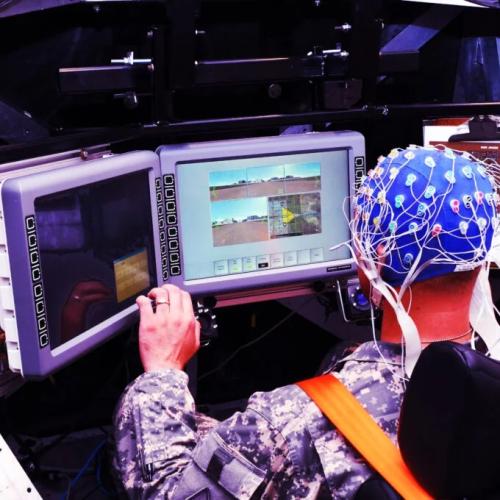
Researchers are already using brain-computer interfaces to aid the disabled, treat diseases like Parkinson's and Alzheimer's, and provide therapy for depression and post-traumatic stress disorder. Work is under way on devices that may eventually let you communicate with friends telepathically, give you superhuman hearing and vision or even let you download data directly into your brain, a la "The Matrix." Researchers are practically giddy over the prospects. "We don't know what the limits are yet," says Melody Moore Jackson, director of Georgia Tech University's BrainLab. At the root of all this technology is the 3-pound generator we all carry in our head. It produces electricity at the microvolt level. But the signals are strong enough to move robots, wheelchairs and prosthetic limbs -- with the help of an external processor. One of the more controversial uses under development is telepathy. It would require at least two people to be implanted with electrodes that send and receive signals. DARPA, the Pentagon's technology research division, is currently working on an initiative called "Silent Talk," which would let soldiers on secret missions communicate with their thoughts alone. This stealth component is attractive, but naysayers fear that such soldiers could become manipulated for evil means.
Note: Remember that secret military research such as that undertaken by DARPA is often years ahead of capabilities publicly acknowledged.
Earth's north magnetic pole is racing toward Russia at almost 40 miles (64 kilometers) a year due to magnetic changes in the planet's core. Newly analyzed data suggest that there's a region of rapidly changing magnetism on the core's surface, possibly being created by a mysterious "plume" of magnetism arising from deeper in the core. And it's this region that could be pulling the magnetic pole away from its long-time location in northern Canada. The magnetic north pole had moved little from the time scientists first located it in 1831. Then in 1904, the pole began shifting northeastward at a steady pace of about 9 miles (15 kilometers) a year. In 1989 it sped up again, and in 2007 scientists confirmed that the pole is now galloping toward Siberia at 34 to 37 miles (55 to 60 kilometers) a year. A rapidly shifting magnetic pole means that magnetic-field maps need to be updated more often to allow compass users to make the crucial adjustment from magnetic north to true North. Also, nobody knows when another change in the core might pop up elsewhere, sending magnetic north wandering in a new direction.
[Guest Host Jeff Probst]: Was a World War II fighter pilot reincarnated in a little boy's body? Bruce [and Andrea] Leininger say yes. They are authors of Soul Survivor: The Reincarnation of a World War II Fighter Pilot. Their book describes how their son James had memories of a WWII pilot who was killed in battle more than 60 years ago. James is now 11 years old. Andrea, when did you first realize that ... James was having ideas or stories that he wanted to share about this? Andrea Leininger: [It] started about two weeks after James' second birthday. He had a -- a night terror, which he had never had before. And this first nightmare began a series of nightmares that started occurring every other night, every night. And after several months of this, he was having a nightmare and ... I was able to finally determine what he was saying. And he was saying, "airplane crash on fire, little man can't get out." Probst: Bruce, even at three, he was -- James was drawing pictures of an airplane crashing. Bruce Leininger: By the time he started drawing those pictures, he'd been talking about this ... for several months. And he essentially gave us three items of information over about a three month period. One, he gave us the name of the ship, which I verified through research on the Internet. "Natoma Bay." He gave us a name Natoma. About a month later, he gave us [the] name of a guy he said he flew with. When we asked him if there was anyone else in his ... dream that he could remember. Jack -- Jack Larson.
Note: Jack Larson was confirmed to be a member of the crew of the Natoma Bay, who when contacted, remembered the incident of the crash described by this boy. Watch an excellent, intriguing four-minute Fox News clip on this fascinating case.
In the United Kingdom ... the countrys top drug adviser was recently fired for publicly criticizing his own governments drug laws. The adviser, Dr. David Nutt, said in a lecture that alcohol is more hazardous than many outlawed substances, and that the United Kingdom might be making a mistake in throwing marijuana smokers in jail. His comments werent the idle musings of a reality-insulated professor in a policy job. They were based on ... a scientifically compiled ranking of drugs, assembled by specialists in chemistry, health, and enforcement, published in a prestigious medical journal two years earlier. The list, printed as a chart with the unassuming title Mean Harm Scores for 20 Substances, ranked a set of common drugs, both legal and illegal, in order of their harmfulness - how addictive they were, how physically damaging, and how much they threatened society. Overall, alcohol is far worse than many illegal drugs. So is tobacco. Smoking pot is less harmful than drinking, and LSD is less damaging yet. Nutt says he didnt see himself as promoting drug use or trying to subvert the government. He was pressing the point that a government policy, especially a health-related one like a drug law, should be grounded in factual information.
Note: For lots more on key health issues, click here.
The Casimir effect governs interactions of matter with the energy that is present in a vacuum. Success in harnessing this force could someday help researchers develop low-friction ballistics and even levitating objects that defy gravity. For now, the U.S. Defense Department's Defense Advanced Research Projects Agency (DARPA) has launched a two-year, $10-million project encouraging scientists to work on ways to manipulate this quirk of quantum electrodynamics. Vacuums generally are thought to be voids, but Hendrik Casimir believed these pockets of nothing do indeed contain fluctuations of electromagnetic waves. He suggested [that] as the boundaries of a region of vacuum move, the variation in vacuum energy (also called zero-point energy) leads to the Casimir effect. Recent research done at Harvard University, Vrije University Amsterdam and elsewhere has proved Casimir correct and given some experimental underpinning to DARPA's request for research proposals.
Note: Debunkers of the new energy movement have long claimed that zero point energy is a theoretical construct which cannot have practical applications. This article shows that attitudes are now shifting. For lots more reliable information on what's still hidden from the public on the new energy front, click here.
Apolinario Chile Pixtun is tired of being bombarded with frantic questions about the Mayan calendar supposedly "running out" on Dec. 21, 2012. After all, it's not the end of the world. Chile Pixtun, a Guatemalan, says the doomsday theories spring from Western, not Mayan ideas. A significant time period for the Mayas does end on the date, and enthusiasts have found a series of astronomical alignments they say coincide in 2012, including one that happens roughly only once every 25,800 years. But most archaeologists, astronomers and Maya say the only thing likely to hit Earth is a meteor shower of New Age philosophy, pop astronomy, Internet doomsday rumors and TV specials. It may sound all too much like other doomsday scenarios of recent decades the 1987 Harmonic Convergence, the Jupiter Effect or "Planet X." But this one has some grains of archaeological basis. One of them is Monument Six. Found at an obscure ruin in southern Mexico during highway construction in the 1960s, the stone tablet [is] unique in that [it contains] the equivalent of the date 2012. The inscription describes something that is supposed to occur in 2012 involving Bolon Yokte, a mysterious Mayan god associated with both war and creation. However shades of Indiana Jones erosion and a crack in the stone make the end of the passage almost illegible. Archaeologist Guillermo Bernal of Mexico's National Autonomous University ... notes there are other inscriptions at Mayan sites for dates far beyond 2012 including one that roughly translates into the year 4772.
Note: The highest counter in the Mayan calendar is the alautun, which is an interval of 63 million years. Those who state the Mayan calendar ends in 2012 have not researched the Mayan system carefully. 2012 may be the equivalent of the year 10,000 in the Mayan calendar, which is significant, yet it may end up being but another Y2K. For more, click here.
A bone fragment believed to be part of Adolf Hitler's skull has been revealed as being that of an unidentified woman, US scientists have said. The section of bone - marked with a bullet hole - was used to support the theory that Hitler shot himself. Russian scientists said the skull piece was found alongside Hitler's jawbone and had put it on display in Moscow. But US scientists said DNA tests revealed it actually belonged to a woman aged between 20 and 40. An archaeologist from the University of Connecticut travelled to Moscow, where the fragment has been on show in the city's federal archive since 2000, to take a sample. Nick Bellantoni said he had suspected even before the bone was tested that the fragment did not come from an adult male. DNA tests confirmed that the bone fragment came from a female. Doubts about exactly how Hitler died have persisted for decades. Russian officials said that the bodies of Hitler and Eva Braun - who reportedly committed suicide in a Berlin bunker in 1945 - were removed from a shell crater shortly after they died. The piece of skull forms part of a collection that also includes a section of a bloodstained sofa where Hitler is believed to have shot himself after swallowing a cyanide pill.
Important Note: Explore our full index to key excerpts of revealing major media news articles on several dozen engaging topics. And don't miss amazing excerpts from 20 of the most revealing news articles ever published.