











































War News Articles
Below are key excerpts of revealing news articles on war from reliable news media sources. If any link fails to function, a paywall blocks full access, or the article is no longer available, try these digital tools.
For further exploration, delve into our comprehensive Military-Intelligence Corruption Information Center.

Fifty years ago, the US Navy locked 17-year-old Glenn Jenkins into a gas chamber within sight of the dome of the US Capitol in Washington. It then poisoned him with mustard and lewisite (arsenic) gas. He never recovered his good health. Nathan Schnurman, another 17-year-old, was asked to test summer uniforms for the navy. He was locked in a small hut heated by a furnace and with a door that could be opened only from the outside. When something went wrong with his mask, he asked over the intercom to come out, but was refused. He vomited into his mask, passed out and had a heart attack. The plight of Mr Jenkins, Mr Schnurman and 2,500 other sailors who were used in what the navy called 'man break' experiments with poison gas, has remained a secret for five decades. Only last week, under pressure from the victims, did the Pentagon agree to let them tell their stories. Many, who had been told that the Espionage Act would be used against them, did not even tell their doctors what had happened. All the survivors, now in their late sixties, tell similar stories. The navy not only volunteered its own men, but for decades after the war also refused to compensate them for crippling injuries. [And] the experiments were for nothing. Mustard gas was used just once in the Second World War by the Allies, and then by accident.
Note: The military has repeatedly condoned horrendous research on live subjects. For a revealing list of highly unethical experimentation on human over the past 75 years, click here. For a concise summary of the government's secret quest to control the mind and human behavior no matter what the cost, click here.
In a broad new policy statement that is in its final drafting stage, the Defense Department asserts that America's political and military mission in the post-Cold-War era will be to insure that no rival superpower is allowed to emerge in Western Europe, Asia or the territory of the former Soviet Union. The classified document makes the case for a world dominated by one superpower whose position can be perpetuated by constructive behavior and sufficient military might to deter any nation or group of nations from challenging American primacy. With its focus on this concept of benevolent domination by one power, the Pentagon document articulates the clearest rejection to date of collective internationalism, the strategy that emerged from World War II when the five victorious powers sought to form a United Nations that could mediate disputes and police outbreaks of violence. Though the document is internal to the Pentagon and is not provided to Congress, its policy statements are developed in conjunction with the National Security Council and in consultation with the President or his senior national security advisers. Its drafting has been supervised by Paul D. Wolfowitz, the Pentagon's Under Secretary for Policy. Mr. Wolfowitz often represents the Pentagon on the Deputies Committee, which formulates policy in an interagency process dominated by the State and Defense departments. The document is known in Pentagon parlance as the Defense Planning Guidance, an internal Administration policy statement that is distributed to the military leaders and civilian Defense Department heads to instruct them on how to prepare their forces, budgets and strategy for the remainder of the decade.
Note: For more on the long-term planning for future war, see the deeply revealing reports from reliable major media sources available here.
The Secret Government is an interlocking network of official functionaries, spies, mercenaries, ex-generals, profiteers and superpatriots, who, for a variety of motives, operate outside the legitimate institutions of government. The Russians had been our ally against the Nazis, an expedient alliance for the sake of war. Now they were our enemy. To fight them we turned to some of the very men who had inflicted on humanity the horrors of Hitlers madness. We hired Nazis as American spies. Admiral Gene La Rocque: That National Security Act of 1947 changed dramatically the direction of this great nation. It established the framework for a national security state. Never have we had a National Security Council so concerned about the nations security that were always looking for threats and looking how to orchestrate our society to oppose those threats. National Security was invented, almost, in 1947, and now it has become the prime mover of everything we do. The National Security Act also gave us the Central Intelligence Agency." In 1975 ... Congress took its first public look at the Secret Government. Senator Frank Church chaired the Select Committee to study government operations. The hearings opened the books on a string of lethal activities. From the use of electric pistols and poison pellets, to Mafia connections and drug experiments. And they gave us a detailed account of assassination plots against foreign leaders and the overthrowing of sovereign governments. This is a system easily corrupted. While freedom does have enemies in the world, it can also be undermined here at home, in the dark, by those posing as its friends.
Note: This highly revealing PBS documentary is available for free viewing on the Internet. For the link, written text, and much more on this amazingly revealing documentary, click here.
The Pentagon has spent millions of dollars, according to three new reports, on secret projects to investigate extrasensory phenomena and to see if the sheer power of the human mind can be harnessed to perform various acts of espionage and war - penetrating secret files, for example, locating submarines or blowing up guided missiles in midflight. The Pentagon denies that it is spending money on psychic research. The assertions to the contrary appear in a trio of new books, one just published and two scheduled to be released this spring, and in a series of interviews in which past Pentagon officials and scientists who study the paranormal have discussed what they contend is the military's decades-long psychic quest. What emerges is a picture of [the Pentagon] trying to master such esoteric arts as ESP (extrasensory perception), telepathy (thought transfer), clairvoyance (seeing things that are out of sight), and psychokinesis (mental influence over objects or events) - all in the name of the national defense. A Pentagon spokesman went so far as to deny that the Department of Defense today ''spent a nickel'' on psychic research, but he also suggested that he could not acknowledge the existence of highly classified projects. The most detailed study of an actual set of psychic experiments comes from The Mind Race, by Russell Targ and Keith Harary.
Note: This is one of many examples of blatant lying by the Pentagon on secret projects. The Pentagon consistently denied the existence of a remote viewing project (called Stargate) until the documents from the project were declassified in 1995. You can find the documents online at this link. For a long period of time, the US government denied the existence of the NSA, so that the moniker "No Such Agency" was jokingly used.
[Many questions] have dogged the [CIA] for years. This secret body [is] known to have overthrown governments and installed others, raised armies, staged an invasion of Cuba, spied and counterspied, established airlines, radio stations and schools. Was it in fact damaging, while it sought to advance, the national interest? Former President Truman, whose administration established the CIA in 1947, said In 1963 that by then he saw "something about the way the CIA has been functioning that is casting a shadow over our historic positions." President Kennedy, as the enormity of the Bay of Pigs disaster came home to him, said to one of the highest officials of his administration that he wanted "to splinter the CIA in a thousand pieces and scatter it to the winds." In the 19 years that the CIA has been in existence, 150 resolutions for tighter congressional control have been introduced - and put aside. Few persons in or out of the American Government know much about its work, its organization, its supervision or its relationship to the other arms of the executive branch. In 1960, CIA agents in Laos, disguised as "military advisers," stuffed ballot boxes and engineered local uprisings to help a hand-picked strongman ... set up a "pro-American" government. It was the CIA that built up Ngo Dinh Diem as the pro-American head of South Vietnam after the French ... had found him in a monastery cell in Belgium and brought him back to Saigon as Premier. The revelation that CIA agents served among Michigan State University scholars in South Vietnam from 1955 to 1959 has contributed to the fear [of infiltration of universities].
Note: For a longer, even more revealing summary of this very lengthy article, click here. To see a full copy of this article, click here. For more on the secret and illegal activities of major intelligence agencies, see the deeply revealing reports from reliable major media sources available here.
Every day since 9/11, the U.S. military has disciplined soldiers who failed to do their jobs properly. Since 2001, there have been more than 1.3 million cases of discipline in the armed forces, according to the Pentagon’s annual reports. But the generals who misled Congress and the American public about the wars in Afghanistan and Iraq have not needed to worry about negative consequences for their careers. After 20 years of conducting a disinformation campaign about what was really happening on the ground, not a single U.S. general has faced any punishment. Journalist Craig Whitlock’s new book, “The Afghanistan Papers,” [is] based on secret interviews the government conducted. Whitlock’s book offers overwhelming evidence that military leaders knew the war was failing and lied about it. Whitlock described the military’s upbeat assessments as “unwarranted and baseless,” adding that they “amounted to a disinformation campaign.” While a handful of top military officers have been punished for bribe-taking and other offenses in recent years, there has not been a whisper of the possibility of holding combat generals to account for the carnage they perpetuated. “An officer who misrepresented, misled, and lied to Congress, under the standards of the Uniform Code of Military Justice, has committed a crime,” noted Paul Yingling, a retired Army officer. “As matters stand now, a private who loses a rifle suffers far greater consequences than a general who loses a war.”
Note: For more along these lines, see concise summaries of deeply revealing news articles on military corruption and war from reliable major media sources.
According to Wikipedia, the United States has been involved in 107 wars since its founding and 41 of these were fought against the Indigenous peoples of North America. Most of these wars are ignored by schools, textbooks and the media, but the pressure to become involved in additional conflict is ever-present. At times the number of private contractors has been larger than that of enlisted troops. In April 2008, there were 163,900 contractors and 160,000 enlisted troops in Iraq. But when most media reported the number of Americans in the war zone, they reported the number of enlisted troops and not the contractors. This results in a predictable under-estimate of American involvement and additional earnings for contractor providers. Every year, the defense industry donates millions of dollars to the campaigns of members of Congress, creating pressure on the legislative branch to fund specific weapons systems, maintain an extremely high Pentagon budget, and add ever more military spending. In 2022 the weapons/defense industry donated $10.2 million to the 84 members of the House and Senate Armed Services Committees. And the wars continue. In his book “The United States of War,” David Vine reports that, “In the nearly two decades since U.S. forces invaded Afghanistan and Iraq, the U.S. military has fought in at least 22 countries.” If we are to escape a future of forever wars, all justifications for war should be questioned and debated before the killing starts.
Note: Learn more about war failures and lies in our comprehensive Military-Intelligence Corruption Information Center. For more, see concise summaries of deeply revealing news articles on war from reliable major media sources.
Rep. Ilhan Omar (D-Minn.) is asking President Biden to pardon a former Air Force intelligence analyst who exposed secrets about drone warfare in Afghanistan. In July, Daniel Hale pleaded guilty in federal court in Alexandria to violating the Espionage Act and was sentenced in July to 45 months in prison for leaking classified documents to the Intercept. In court, Hale said he felt compelled to speak out about the immorality of the drone program after realizing he had helped kill Afghan civilians, including a small child. "Not a day goes by that I don't question the justification for my actions," he wrote to the judge. "I am grief-stricken and ashamed of myself." One document he leaked showed that during a five-month operation in Afghanistan, nearly 90 percent of the people killed were not the intended targets. "I take extremely seriously the prohibition on leaking classified information, but I believe there are several aspects of Mr. Hale's case that merit a full pardon," Omar wrote in the letter sent to Biden. "The information, while politically embarrassing to some, has shone a vital light on the legal and moral problems of the drone program and informed the public debate on an issue that has for too many years remained in the shadows." This week, Hale was awarded the Sam Adams Award for Integrity in Intelligence, given by a group of whistleblowers from the national security community. Edward Snowden received the same award in 2013.
Note: Hale's leak was the basis for an article series called The Drone Papers. A 2014 analysis found that attempts to kill 41 people with drones resulted in 1,147 deaths. For more along these lines, see concise summaries of deeply revealing news articles on military corruption from reliable major media sources.
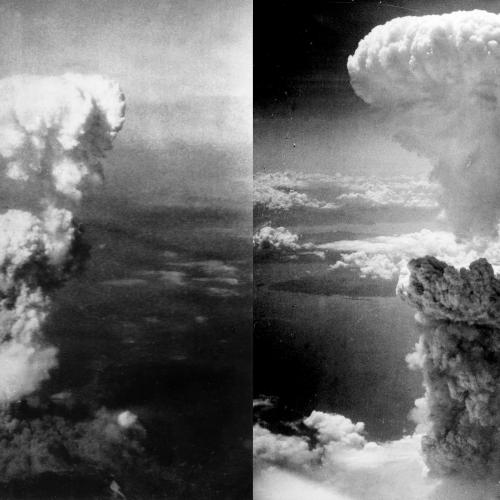
Ive always been fascinated by nuclear weapons and the self-destructive tendencies of mankind. So when I found declassified United States Civil Defense footage of soldiers maneuvering in the glare of a mushroom cloud, I wanted to learn more about their stories. I discovered that as many as 400,000 American soldiers and sailors observed nuclear explosions just a few miles from ground zero in more than 200 atmospheric tests conducted between 1946 and 1962. It was difficult to get a precise count of how many men were involved, because most information was classified including reports on the illnesses the veterans suffered and the radioactive pollution that was released into the environment around the test sites. They served near dangerous nuclear tests and it has haunted them ever since. With so little information available and the number of remaining veterans dwindling rapidly, I wanted to prevent these stories from disappearing. I decided to interview some of them as research for a fiction film on the topic and wound up making this documentary in the process. Because of secrecy agreements they had signed, some of them were hesitant to talk about their experiences. Getting to know these men was an experience I will never forget. I realized that my own generation seems to have become numb to what nuclear war could do to humanity. The accounts of the atomic soldiers can help us understand that horror.
Note: The author of this article, Morgan Knibbe, is a Dutch documentary filmmaker. The 15-minute documentary he made, available at the link above, is so important. These men were used as guinea pigs in nuclear bomb tests and have suffered in silence for decades because of those who promote war on our planet. Please watch and spread the word far and wide. For lots more on humans being used mercilessly as guinea pigs, see this webpage.
Several hundred thousand [soldiers] took part in atmospheric nuclear tests conducted in the Pacific and in Nevada. They were posted within range of exploding bombs in effect made to be guinea pigs in studies of how combat troops might stand up in a war fought with nuclear arms. Many among these atomic veterans suffered cancers and other diseases. Frank Farmer ... witnessed 18 atomic detonations in 1958. Its so bright you actually see your bones in your hands. He and his shipmates were issued no protective gear. Despite government assurances that their exposure to radiation had been insufficient to inflict physical harm, veterans could see they were getting sick in disproportionate numbers. Some began to speak out, ignoring oaths they had signed never to discuss their experiences. More and more I heard about guys that had prostate cancer and lung cancer and all kinds of cancers, said Mr. Farmer, who suffered hearing loss and a body rash that did not go away. Decades passed before corrective measures were taken. Issues raised by [these] difficulties resound in modern wars. As with the atomic veterans, officialdoms default position has generally been to wave off any suggestion of a link between a soldiers illness and a command-level decision. That was the case with Agent Orange ... in Vietnam. Years passed before the government accepted a presumptive connection between herbicides and cancers afflicting Vietnam veterans. Soldiers who served in Afghanistan and Iraq and in the 1991 Persian Gulf war complain of breathing problems, neurological damage, gastrointestinal disorders and other illnesses. Many suspect that blame lies with practices off the battlefield.
Note: Don't miss a profoundly moving 22-minute documentary in which several atomic veterans describe in detail what happened, how they suffered, and how the government denied responsibility for decades. For more along these lines, see concise summaries of deeply revealing news articles on war corruption from reliable major media sources. Then explore the excellent, reliable resources provided in our War Information Center.
In 2023, this country’s drone warfare program has entered its third decade with no end in sight. Despite the fact that the 22nd anniversary of 9/11 is approaching, policymakers have demonstrated no evidence of reflecting on the failures of drone warfare and how to stop it. Instead, the focus continues to be on simply shifting drone policy in minor ways within an ongoing violent system. Washington’s war on terror has inflicted disproportionate violence on communities across the globe, while using this form of asymmetrical warfare to further expand the space between the value placed on American lives and those of Muslims. Since the war on terror was launched, the London-based watchdog group Airwars has estimated that American air strikes have killed at least 22,679 civilians and possibly up to 48,308 of them. Such killings have been carried out for the most part by desensitized killers, who have been primed towards the dehumanization of the targets of those murderous machines. In the words of critic Saleh Sharief, “The detached nature of drone warfare has anonymized and dehumanized the enemy, greatly diminishing the necessary psychological barriers of killing.” While the use of drones in the war on terror began under President George W. Bush, it escalated dramatically under Obama. Then, in the Trump years, it rose yet again. Though the use of drones in Joe Biden’s first year in office was lower than Trump’s, what has remained consistent is the lack of ... accountability for the slaughter of civilians.
Note: A 2014 analysis found that attempts to kill 41 people with drones resulted in 1,147 deaths. For more along these lines, see concise summaries of deeply revealing news articles on military corruption from reliable major media sources.
In its newly released 2023 Trafficking in Persons Report, the Biden administration provided a glaring, but largely unnoticed, admission that it has failed to implement a key provision of U.S. law aimed at preventing the recruitment and use of child soldiers. The report acknowledged that the administration has yet to finalize a congressionally mandated list of governments complicit in child soldier recruitment or use. With this list responsible for spurring urgently needed U.S. child soldier prevention efforts, its delay could have potentially severe consequences. Despite decades of concerted action to end the use of children as tools of war, the recruitment and use of child soldiers remains one of the most widespread abuses inflicted upon children in conflict, with the UN having verified the recruitment and use of 7,622 child soldiers last year — a 21 percent increase compared to 2021. Among those implicated in the use of child soldiers are security forces and armed groups led or supported by governments that rely heavily on U.S. defense cooperation to sustain their security operations. Somalia, for example, which recruited and used dozens of child soldiers in 2022, is among the most significant recipients of U.S. military aid in sub-Saharan Africa, with U.S. security assistance to and peacekeeping operations in the country amounting to roughly $3 billion over the past decade. The Biden administration can incentive governments implicated in the recruitment or use of child soldiers to put an end to these horrendous practices.
Note: For more along these lines, see concise summaries of deeply revealing news articles on war from reliable major media sources.
Iraq invaded Kuwait in August of 1990. The Kuwait government had to find a way to "sell the war" to the American public. The Kuwait government in exile [hired] the American PR firm Hill & Knowlton ... for $10.7 million to devise a campaign to win American support for the war. It's wasn't an easy sell. The Sept. 5 edition of the London Daily Telegraph ... ran a claim by the exiled Kuwait housing minister that, "babies in the premature unit of one of the hospitals had been removed from their incubators." The Hill & Knowlton people jumped on the story. On October 10 ... a young woman named Nayirah [told a congressional] committee, "I saw the Iraqi soldiers come into the hospital with guns. They took the babies out of the incubators, took the incubators and left the babies on the cold floor to die." Hill & Knowlton immediately faxed details of her speech to newsrooms across the country. The babies in incubator stories became a lead item in newspapers, and on radio and TV. The young woman ... was the daughter of Kuwait's ambassador to the United States, and actually hadn't seen the "atrocities" she described. Similar unsubstantiated stories appeared at the UN a few weeks later, where a team of "witnesses," coached by Hill & Knowlton, gave "testimony" ... about atrocities in Iraq. Seven witnesses used false names. On November 29, 1990, the UN authorized use of "all means necessary" to eject Iraq from Kuwait. On January 12, 1991, Congress authorized the use of force. The story was later discredited.
Note: For more along these lines, see concise summaries of deeply revealing news articles on war and the manipulation of public perception.
The United States has been secretly seeding clouds over North Vietnam, Laos and South Vietnam to increase and control the rainfall for military purposes. Government sources, both civilian and military, said during an extensive series of interviews that the Air Force cloud seeding program has been aimed most recently at hindering movement of North Vietnamese troops and equipment and suppressing enemy antiaircraft missile fire. The disclosure confirmed growing speculation in Congressional and scientific circles about the use of weather modification in Southeast Asia. Despite years of experiments with rainmaking in the United States and elsewhere, scientists are not sure they understand its long term effect on the ecology of a region. The weather manipulation in Indochina, which was first tried in South Vietnam in 1963, is the first confirmed use of meteorological warfare. One well-informed source said that Navy scientists were responsible for developing a new kind of chemical agent effective in the warm stratus clouds that often shielded many key antiaircraft sites in northern parts of North Vietnam. The chemical, he said, “produced a rain that had an acidic quality to it and it would foul up mechanical equipment—like radars, [and] trucks.” “This wasn't originally our planning,” the official added, “it was a refinement.” Apparently, many Air Force cloud-seeding missions were conducted over North Vietnam and Laos simply to confuse or “attenuate” ... the radar equipment that controls anti aircraft missiles.
Note: Despite potentially grave risks, some are calling for large scale geoengineering to combat climate change. For more along these lines, see concise summaries of deeply revealing news articles on climate change from reliable major media sources.
The Taliban now has access to $85 billion worth of American military equipment and the biometric data of the Afghans who have assisted soldiers over the past 20 years, a Republican congressman has warned. Jim Banks, a former US Navy reservist, said that the vast amount of hardware left behind includes 75,000 vehicles, 200 airplanes and helicopters and 600,000 small arms and light weapons. “The Taliban now has more Black Hawk helicopters than 85 per cent of the countries in the world,” he said. Other equipment seized by the Taliban includes night-vision goggles, body armour and medical supplies, he said. Mr Banks says he is sure of the numbers because he worked as a foreign military sales officer, acquiring the equipment that America provided, then turning it over to Afghan forces. “Unfathomable to me and so many others, the Taliban now has biometric devices which have the fingerprints, eye scans and biographical information of all the Afghans who helped us and were on our side in the last 20 years," Mr Banks said. "There is no plan by this administration to get those weapons back. Already, the Taliban say they have deployed an elite unit boasting high-tech equipment to guard sites in the Afghan capital. The militants' propaganda channels released a slick film of a unit called the "Badri 313 Brigade", saying they would be on the streets of Kabul. Slow motion footage showed them wearing modern helmets, sun glasses, body armour and carrying similar rifles to the Afghan forces.
Note: Why didn’t the military prioritize removing this huge amount of equipment that they knew would be taken over by the Taliban? Do you think this equipment might have been left behind on purpose by those who profit from war? For more along these lines, see concise summaries of deeply revealing news articles on war from reliable major media sources.
Small teams of U.S. Special Operations forces are involved in a low-profile proxy war program on a far greater scale than previously known. While The Intercept and other outlets have previously reported on the Pentagon’s use of the secretive 127e authority in multiple African countries, a new document obtained through the Freedom of Information Act offers the first official confirmation that at least 14 127e programs were also active in the greater Middle East and the Asia-Pacific region as recently as 2020. In total, between 2017 and 2020, U.S. commandos conducted at least 23 separate 127e programs across the world. Separately, Joseph Votel, a retired four-star Army general who headed both Special Operations Command and Central Command, which oversees U.S. military efforts in the Middle East, confirmed the existence of previously unrevealed 127e “counterterrorism” efforts in Egypt, Lebanon, Syria, and Yemen. Basic information about these missions — where they are conducted, their frequency and targets, and the foreign forces the U.S. relies on to carry them out — are unknown even to most members of relevant congressional committees and key State Department personnel. Through 127e, the U.S. arms, trains, and provides intelligence to foreign forces. 127e partners are then dispatched on U.S.-directed missions, targeting U.S. enemies to achieve U.S. aims. “If someone were to call a 127-echo program a proxy operation, it would be hard to argue with them,” [said a former senior defense official].
Note: For more along these lines, see concise summaries of deeply revealing news articles on military corruption from reliable major media sources.
There should be a serious accounting for the Afghanistan debacle. The United States waged its longest war in a distant, impoverished country. After two decades, more than 775,000 troops deployed, far more than $1 trillion spent, more than 2,300 U.S. deaths and 20,500 wounded in action, tens of thousands of Afghani civilian deaths, the United States managed to create little more than a kleptocracy. Rather than focusing on how we got out, it would be far wiser to focus on how we got in. The accounting can draw from the ... Afghanistan Papers project. The papers come from ... the Office of the Special Inspector General for Afghanistan Reconstruction, based on interviews with hundreds of officials who guided the mission. Their words are a savage and telling indictment. Under President George W. Bush, the early mission — to defeat al-Qaeda and get Osama bin Laden in response to the terrorist attacks of Sept. 11, 2001 — quickly turned to nation-building. That mission was an abject failure from the beginning. Adjusted for inflation, the United States spent more money developing Afghan institutions than it had spent to help all of Western Europe after World War II. Yet as Ryan Crocker, a former U.S. ambassador to Afghanistan concluded, the “single biggest project” stemming from the flood of dollars “may have been the development of mass corruption.” Nearly $10 billion was spent to eradicate poppy production but as of 2018, Afghan farmers produced more than 80 percent of the global opium supply.
Note: For more along these lines, see concise summaries of deeply revealing news articles on military corruption and war from reliable major media sources.
The New York Times on February 25 published an explosive story of what purports to be the history of the CIA in Ukraine from the Maidan coup of 2014 to the present. The story, “The Spy War: How the CIA Secretly Helps Ukraine Fight Putin” ... relied on more than 200 interviews in Ukraine, the US, and “several European countries.” There is a CIA listening post in the forest along the Russian border, one of 12 “secret” bases the US maintains there. Beginning in 2016, the CIA trained an “elite Ukrainian commando force known as Unit 2245, which captured Russian drones and communications gear so that CIA technicians could reverse-engineer them.” One of the reasons that I believe the Times article was “authorized” by the intelligence community is because of what isn’t in it. There’s no mention, for example, that the United Nations has deemed Ukraine to be one of the most corrupt countries in the world, where money just seems to disappear into foreign accounts and the pockets of Ukrainian government officials. There’s no mention that Ukraine has become a “supermarket” for black market weapons and that western weapons meant for the war effort have popped up all over the world. And there is no mention at all that it was the CIA and the State Department that were responsible for the 2014 overthrow of the Ukrainian government in the first place, an action that resulted in Russia’s decision to invade eight years later.
Note: John Kiriakou is a whistleblower, former CIA counter-terrorism officer, and former senior investigator on the Senate Foreign Relations Committee. In our War Failures and Lies section in our comprehensive Military-Intelligence Corruption Information Center, we discuss how the CIA has supported Neo-Nazis in Ukraine since at least 2014, the year of the far-right coup that incorporated the Nazi group Azov Battalion into the country’s National Guard. Since then, declassified government documents show that Ukraine was systematically developed as a proxy for US war against Russia. In 2016, Congress removed a ban on funding Ukrainian neo-fascist groups, effectively paving the way for American arms and weapons to fall in the hands of Ukraine’s Nazi organizations.
2023 was a year marked by devastating conflicts from Russia’s ongoing invasion of Ukraine to Hamas’s horrific terror attacks on Israel, from that country’s indiscriminate mass slaughter in Gaza to a devastating civil war in Sudan. And there’s a distinct risk of even worse to come this year. Still, there was one clear winner in this avalanche of violence, suffering, and war: the U.S. military-industrial complex. In December, President Biden signed a record authorization of $886 billion in “national defense” spending for 2024, including funds for the Pentagon proper and work on nuclear weapons at the Department of Energy. Add to that tens of billions of dollars more in likely emergency military aid for Ukraine and Israel, and such spending could well top $900 billion for the first time. Annual spending on the costly, dysfunctional F-35 combat aircraft alone is greater than the entire budget of the Centers for Disease Control and Prevention. In 2020, Lockheed Martin’s contracts with the Pentagon were worth more than the budgets of the State Department and the Agency for International Development combined, and its arms-related revenues continue to rival the government’s entire investment in diplomacy. One $13 billion aircraft carrier costs more than the annual budget of the Environmental Protection Agency. Before investing ever more tax dollars ... the military strategy of the United States in the current global environment should be seriously debated.
Note: Learn more about unaccountable military spending in our comprehensive Military-Intelligence Corruption Information Center. For more, see concise summaries of deeply revealing news articles on military corruption from reliable major media sources.
In the past 20 years, every major US foreign policy objective has failed. The Taliban returned to power after 20 years of US occupation of Afghanistan. Post-Saddam Iraq became dependent on Iran. Syria’s President Bashar al-Assad stayed in power despite a CIA effort to overthrow him. Libya fell into a protracted civil war after a US-led NATO mission overthrew Muammar Gaddafi. Ukraine was bludgeoned on the battlefield by Russia in 2023 after the US secretly scuttled a peace agreement between Russia and Ukraine in 2022. Despite these remarkable and costly debacles ... the same cast of characters has remained at the helm of US foreign policy for decades. American foreign policy is not at all about the interests of the American people. It is about the interests of the Washington insiders, as they chase campaign contributions and lucrative jobs. In short, US foreign policy has been hacked by big money. To understand the foreign-policy scam, think of today’s federal government as a multi-division racket controlled by the highest bidders. The Wall Street division is run out of the Treasury. The Health Industry division is run out of the Department of Health and Human Services. The Big Oil and Coal division is run out of the Departments of Energy and Interior. And the Foreign Policy division is run out of the White House, Pentagon and CIA. Each division uses public power for private gain through insider dealing, greased by corporate campaign contributions and lobbying outlays.
Note: War profiteering is an old game. General Smedley Butler wrote War is a Racket in 1935. For more along these lines, see concise summaries of deeply revealing news articles on war and government corruption from reliable major media sources. Then explore the excellent, reliable resources provided in our Military-Intelligence Corruption Information Center.
Important Note: Explore our full index to revealing excerpts of key major media news articles on several dozen engaging topics. And don't miss amazing excerpts from 20 of the most revealing news articles ever published.