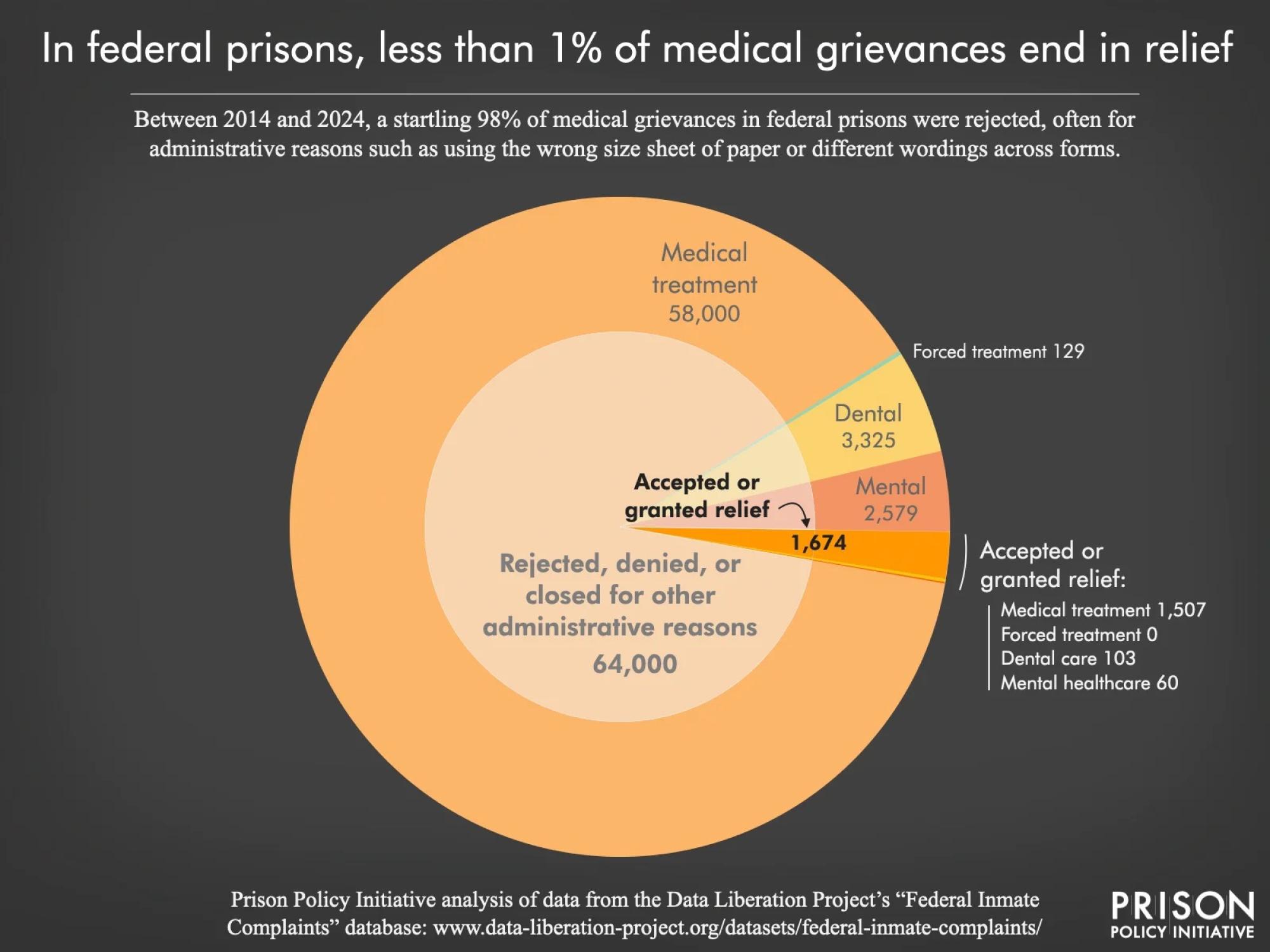
When incarcerated people face abuse and mistreatment, they can typically file a formal complaint with jail or prison administrators. In federal prisons, the system for resolving these complaints is known as the "Administrative Remedy Program," but it's more commonly referred to as a "grievance system" in state prisons and local jails. Grievance systems are supposed to provide incarcerated people with a way to challenge issues they face behind bars " such as inadequate medical care, harassment by corrections officers, or unsanitary living conditions " and (hopefully) receive some kind of relief. In practice, however, incarcerated people who turn to grievance systems are forced to run a gauntlet of rules and regulations just to be heard, and very rarely succeed. This is especially true when it comes to medical complaints: our analysis of a decade of data from the Data Liberation Project finds that, between 2014 and 2024, a startling 98% of medical grievances were rejected for reasons ranging from the bureaucratic (such as using the wrong size sheet of paper) to the substantive (actually being denied on the merits of the complaint). Less than 1% of medical cases ended in a grant of relief. Conditions are so bad on the inside that since 2000, roughly half of all state prison systems have been court-ordered to improve mental and medical healthcare. In practice ... the grievance system is a black hole, a time-waster, and a deterrent to complaining at all.
Latest
Latest News
Each news summary is created according to strict standards. Here's how we do it.
Each summary is created using a consistent editorial procedure. The target length is approximately 16 lines of 11-point Arial text in a 650-pixel-wide column. Up to 25% of a summary may be set in bold to emphasize the most important ideas. Summaries are composed of verbatim excerpts presented in the same sequence as they appear in the original news source, with very minor editorial additions. Where material has been omitted between excerpts, the omission is indicated with ellipses (...). Any words added by an editor for clarity or context appear in [brackets]. Our original news editor was Fred Burks. Tod Fletcher edited most summaries from 2007 through 2014, and Mark Bailey has served as news editor since 2014.