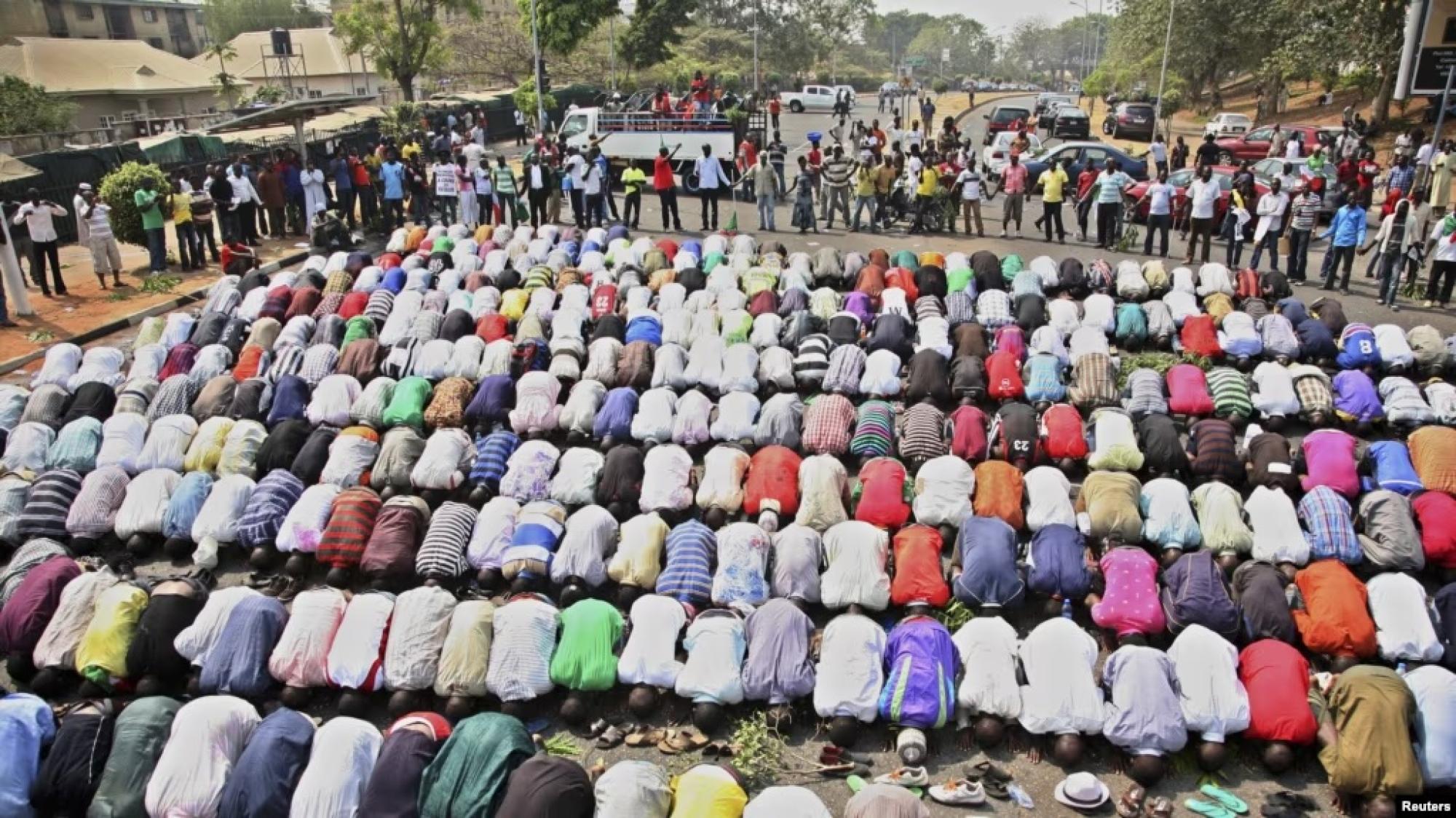
Since religious riots tore across the central Nigerian city of Jos two decades ago, its Muslim and Christian residents have largely kept apart. They have their own neighborhoods. They vote for different political parties. But the cost-of-living crisis that has swept Nigeria over the past year has blurred some of those boundaries. "If there is hunger in the land, the hunger that the Christian is feeling is not different from the hunger the Muslim is feeling," observes Tony Young Godswill, national secretary of the Initiative for a Better and Brighter Nigeria, a pro-democracy group. When nationwide anti-government protests broke out in early August, hungry, angry Jos residents from all backgrounds poured into the streets. When Muslim demonstrators knelt to pray on a busy road one Friday afternoon, hundreds of Christian marchers spontaneously formed a tight, protective circle around them. Nigeria's protests began in response to the soaring costs of food and transport over the past year and a half, which have more than doubled in some cases. Protesters blame the economic stabilization policies of President Bola Tinubu, which have included removing a heavy subsidy on petrol and devaluing the naira, Nigeria's currency. In Abuja, the capital, Ibrahim Abdullahi was among those who marched. As a Muslim, he says he previously thought it was inappropriate for him to protest against a fellow Muslim like Mr. Tinubu. Now, he held a placard that read "We regret Tinubu."
Latest
Latest News
Each news summary is created according to strict standards. Here's how we do it.
Each summary is created using a consistent editorial procedure. The target length is approximately 16 lines of 11-point Arial text in a 650-pixel-wide column. Up to 25% of a summary may be set in bold to emphasize the most important ideas. Summaries are composed of verbatim excerpts presented in the same sequence as they appear in the original news source, with very minor editorial additions. Where material has been omitted between excerpts, the omission is indicated with ellipses (...). Any words added by an editor for clarity or context appear in [brackets]. Our original news editor was Fred Burks. Tod Fletcher edited most summaries from 2007 through 2014, and Mark Bailey has served as news editor since 2014.