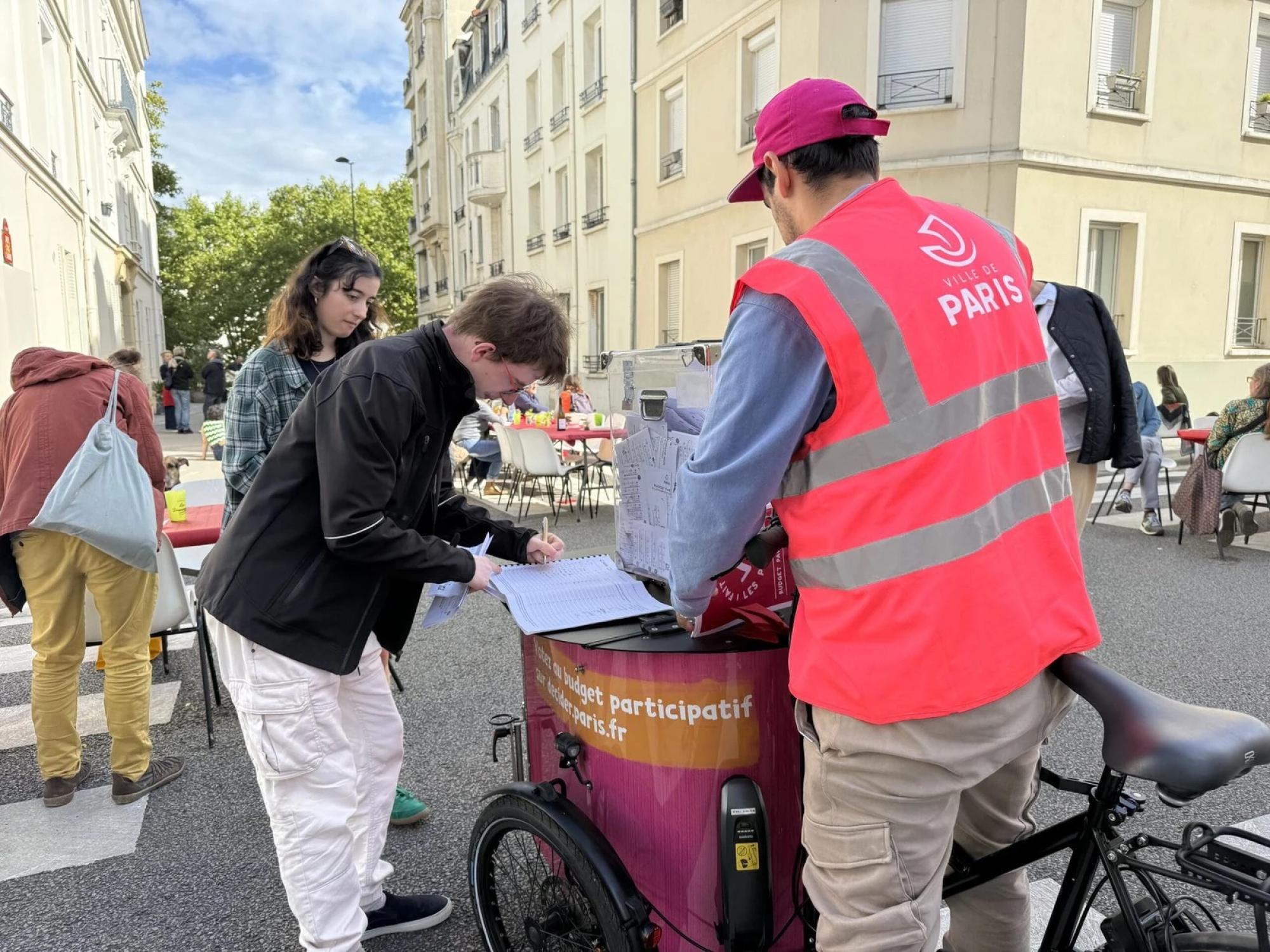
For the past decade, every year, Parisians like [Anne-Valérie] Desprez have been able to see their proposals come to life on the streets of the French capital. Under the city's Participatory Budget, any resident above the age of seven, regardless of their nationality, can propose a project to be paid for by municipal funds. The model, increasingly popular across the globe, is helping authorities spend resources efficiently and boost democratic participation. In Paris, more than 21,000 ideas have been submitted by citizens since the scheme launched in 2014, resulting in 1,345 funded projects and an expenditure of €768 million (almost $900 million), including €263 million set aside for low-income districts. Each proposal must pass a feasibility study by city hall before being voted on by residents. "It is a very good device and it's important," says Yves Sintomer, a French researcher and co-author of the book Participatory Budgeting in Europe. It's led to the creation of rooftop farms, children's play areas, community art murals, shade structures and baggage storage for the homeless, as well as a number of projects at the [Cherry Sociocultural Center], which was founded in 1999. In 2017, following the center's first successful budget proposal, benches were installed in the street out front, providing a place for people to congregate for free. Further funding from the participatory budget enabled the center to buy a cargo bike " shared with other local businesses " for short-distance deliveries in 2019.
Latest
Latest News
Each news summary is created according to strict standards. Here's how we do it.
Each summary is created using a consistent editorial procedure. The target length is approximately 16 lines of 11-point Arial text in a 650-pixel-wide column. Up to 25% of a summary may be set in bold to emphasize the most important ideas. Summaries are composed of verbatim excerpts presented in the same sequence as they appear in the original news source, with very minor editorial additions. Where material has been omitted between excerpts, the omission is indicated with ellipses (...). Any words added by an editor for clarity or context appear in [brackets]. Our original news editor was Fred Burks. Tod Fletcher edited most summaries from 2007 through 2014, and Mark Bailey has served as news editor since 2014.