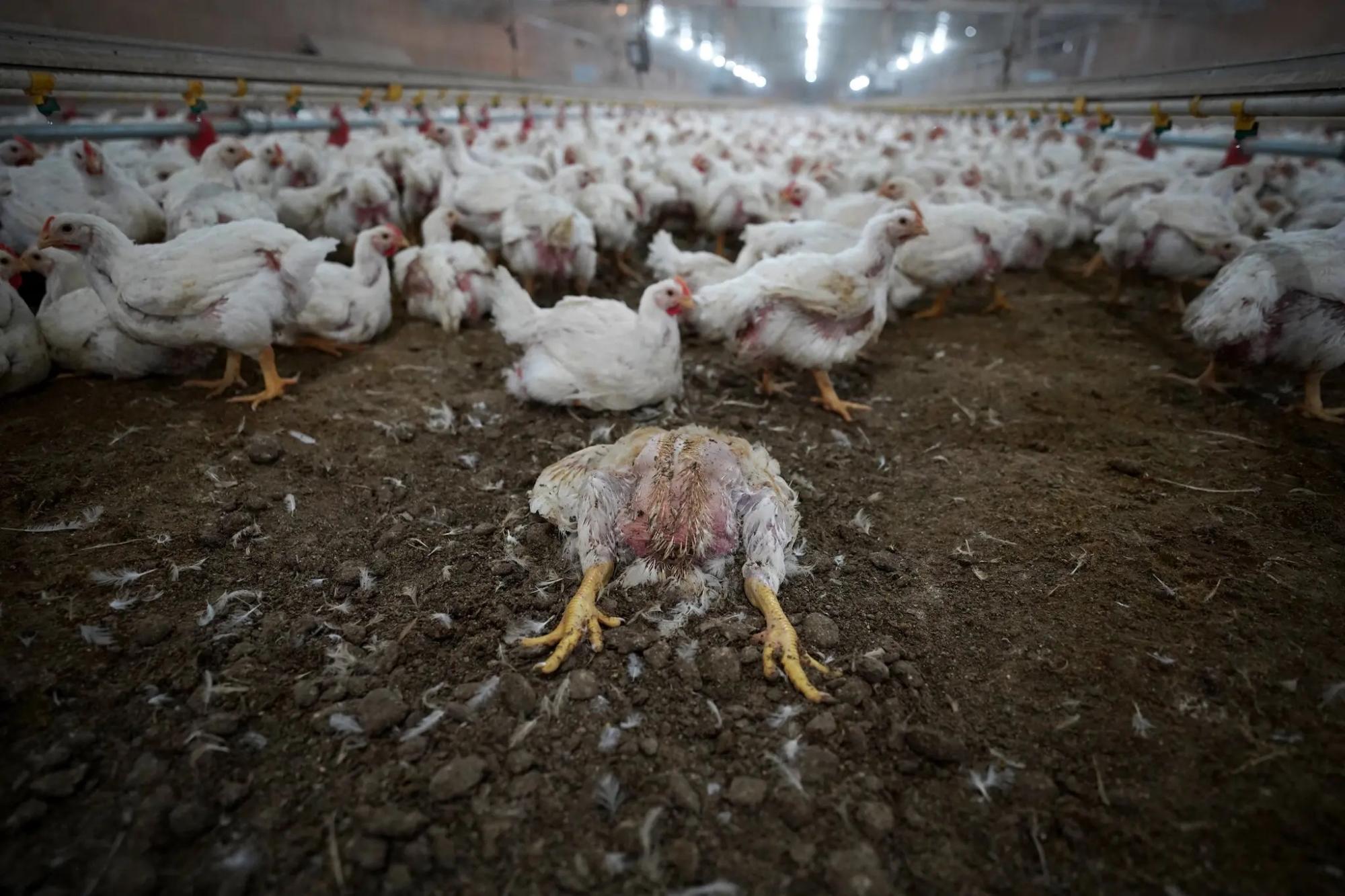
Animal factoriesindustrial-scale factory farm livestock operations"create ideal conditions for the emergence and rapid spread of disease, including avian flu. High-density confinement, genetic uniformity, and poor air quality weaken birds' immune systems and enable viruses to mutate and transmit quickly. Unlike in natural settings, where biodiversity and space act as buffers against disease, factory farms concentrate thousands or even millions of animals in close quarters, amplifying viral loads and increasing the risk of spillover to wild birds and even humans. The industry's reliance on mass culling, vaccines, and "biosecurity measures" fails to address the root cause of so many food safety and food security crises: an unnatural, high-stress system that prioritizes profit over resilience. Nowhere is this more evident than in today's egg crisis, resulting in soaring prices, plummeting availability, and over 120 million chickens killed due to avian flu scares. Under current protocols, if just one bird in a 100,000-strong confined flock is suspected of infection, the entire flock is exterminated. In conventional caged systems, as many as 500,000 hens suffer in a single facility, each trapped in a space barely larger than a sheet of printer paper. Even in so-called "cage-free" systems, up to 100,000 hens can be packed into a single barn, enduring a relentless cycle of laying, exhaustion, and slaughter.
Latest
Latest News
Each news summary is created according to strict standards. Here's how we do it.
Each summary is created using a consistent editorial procedure. The target length is approximately 16 lines of 11-point Arial text in a 650-pixel-wide column. Up to 25% of a summary may be set in bold to emphasize the most important ideas. Summaries are composed of verbatim excerpts presented in the same sequence as they appear in the original news source, with very minor editorial additions. Where material has been omitted between excerpts, the omission is indicated with ellipses (...). Any words added by an editor for clarity or context appear in [brackets]. Our original news editor was Fred Burks. Tod Fletcher edited most summaries from 2007 through 2014, and Mark Bailey has served as news editor since 2014.