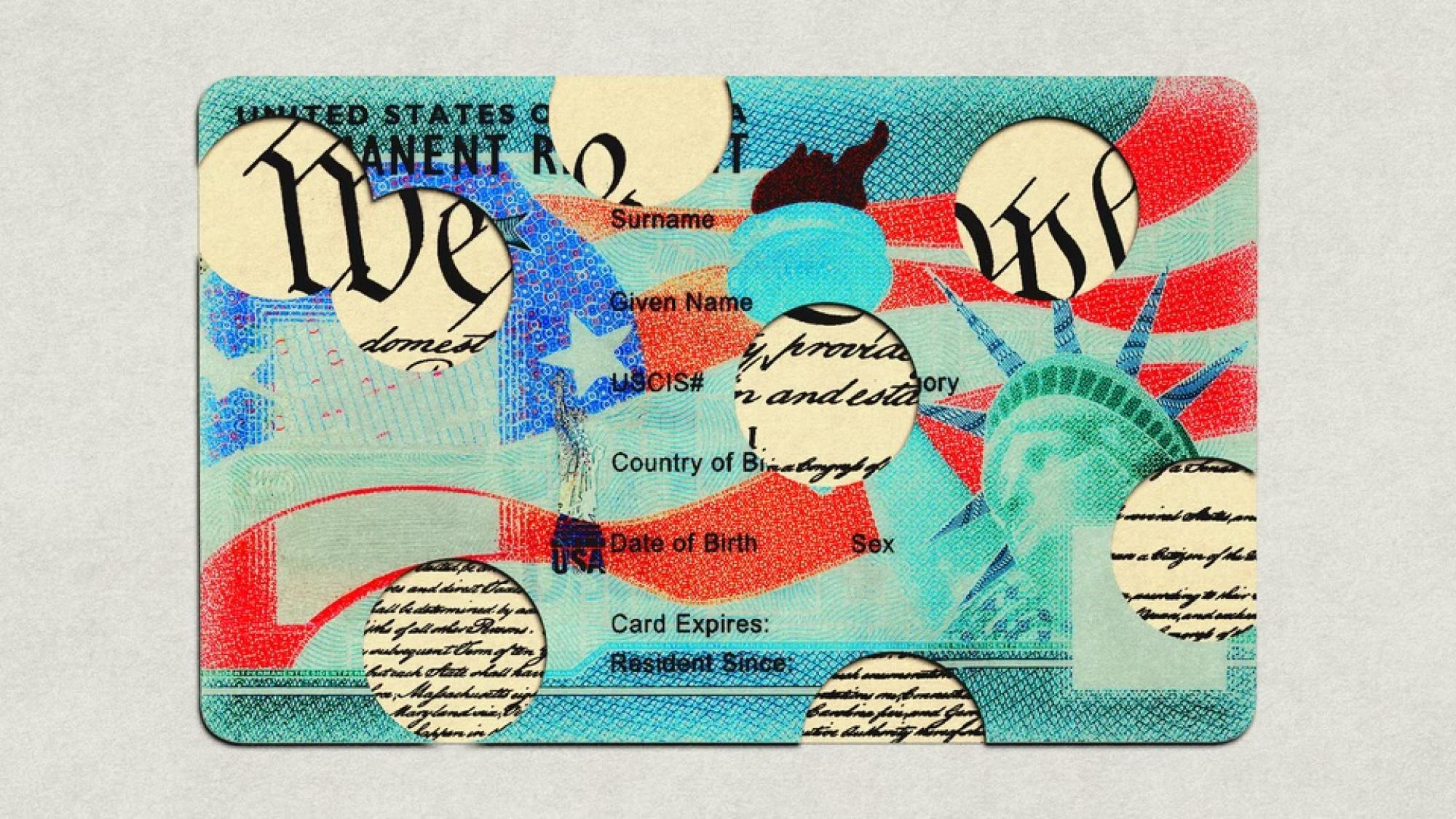
Starting this week, I once again have the privilege of teaching law students about the First Amendment. I am in the United States on a green card, and recent events suggest that I should be careful in what I sayperhaps even about free speech. The Trump administration is working to deport immigrants, including green-card holders, for what appears to be nothing more than the expression of political views with which the government disagrees. These actions ... make it difficult to work out how to teach cases that boldly proclaim this country is committed to a vision of free speech that, right now, feels very far away. In recent weeks, the Trump administration has been"is there any other way to describe it?"rounding up dissidents. To more easily chase down people with ideas it dislikes, the government is asking universities for the names and nationalities of people who took part in largely peaceful protests and engaged in protected speech. Exactly what kind of expression gets you in trouble is not clear"no doubt that's partly the point. [Deputy Secretary of Homeland Security Troy] Edgar repeatedly refused to answer [NPR journalist Michel] Martin's simple question: "Is any criticism of the United States government a deportable offense?" A 2010 Supreme Court decision upheld a law banning certain forms of speech that are classified as "material support" to foreign terrorist groups"in that case, the speech included training designated groups on how to pursue their aims peacefully. But even in that case, which upheld a stunningly broad speech restriction, the Court also insisted that ... advocacy of unlawful action is protected so long as it is not done in coordination with terrorist groups. This ... rests "at the heart of the First Amendment": "viewpoint discrimination is uniquely harmful to a free and democratic society."
Latest
Latest News
Each news summary is created according to strict standards. Here's how we do it.
Each summary is created using a consistent editorial procedure. The target length is approximately 16 lines of 11-point Arial text in a 650-pixel-wide column. Up to 25% of a summary may be set in bold to emphasize the most important ideas. Summaries are composed of verbatim excerpts presented in the same sequence as they appear in the original news source, with very minor editorial additions. Where material has been omitted between excerpts, the omission is indicated with ellipses (...). Any words added by an editor for clarity or context appear in [brackets]. Our original news editor was Fred Burks. Tod Fletcher edited most summaries from 2007 through 2014, and Mark Bailey has served as news editor since 2014.