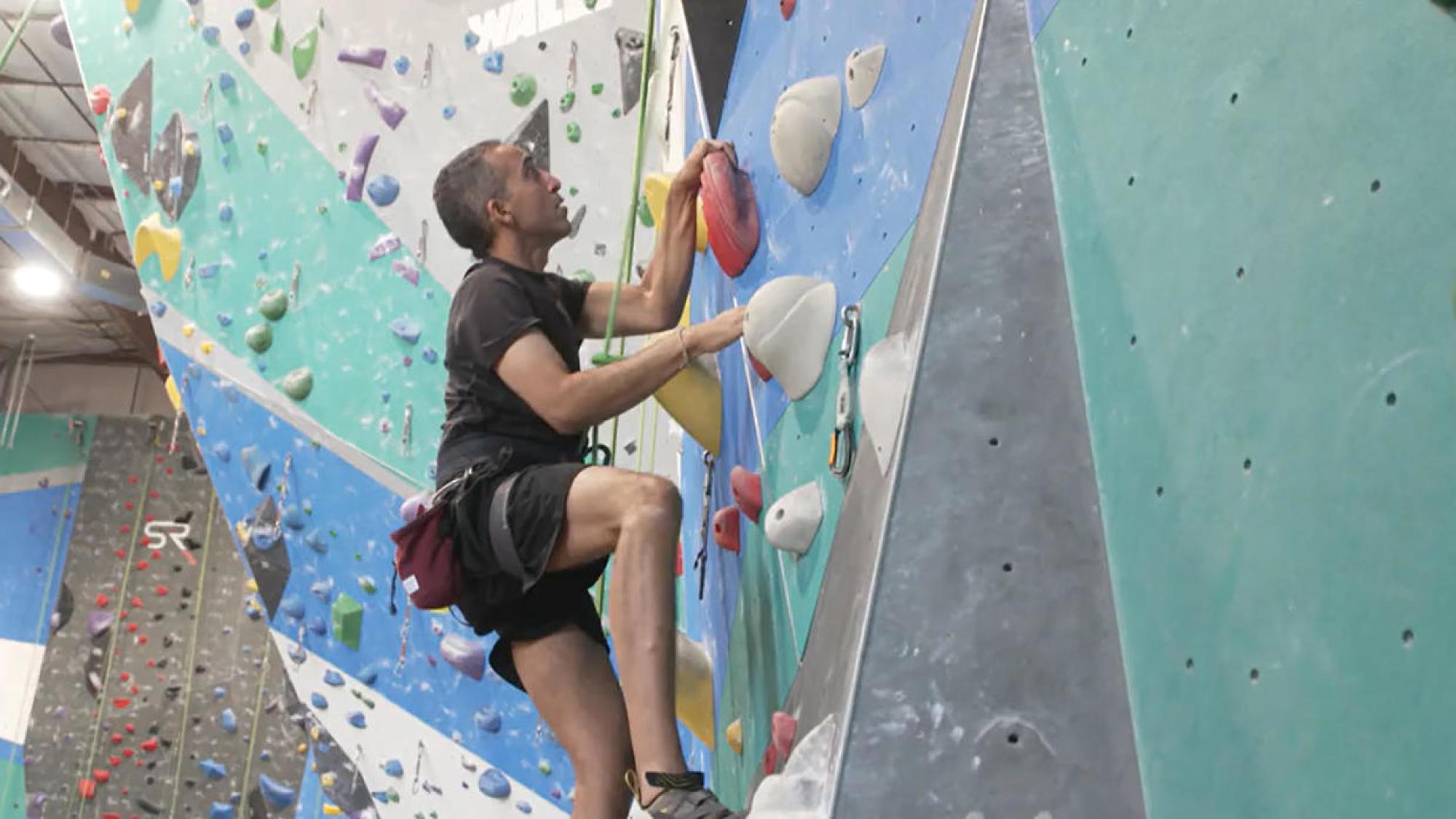
On a sweltering summer's day ... a group of people with Parkinson's Disease began rock-climbing on the Carderock Cliffs of Maryland. It's all part of their therapy, says Molly Cupka, the no-nonsense instructor and cheerleader for this community. She started this program, called UpENDing Parkinsons, as a non-profit twelve years ago. There's a lot of balance involved, mobility involved, strength, cardio, and then there's the cognitive part, where you have to look at the hold, and figure out how to get your body to move to get to that hold," she said. There's no cure for Parkinson's, which usually affects mobility, coordination, balance, and even speech. Some people with Parkinson's, like Vivek Puri, get dyskinesia (involuntary jerking motions). Puri ... was only 38 when he found out he had Parkinson's. "Fine motor skills have kind of really suffered dramatically," he said. "When I don't climb for some periods of time, I get worse." But once he gets on the wall, he calls himself Spider-Man. "Honestly, I climb like a monkey," he said. "I get my finger strength moving, which gets my fine motor skills " maybe not back, but kind of keeps that in motion." Cupka joined forces with Marymount University last year to study patients climbing for the first time. "We have people literally walking and carrying weights, you know, walking and looking, multitasking," she said. The study found that, in so many words, if you climb, you may walk better.
Latest
Latest News
Each news summary is created according to strict standards. Here's how we do it.
Each summary is created using a consistent editorial procedure. The target length is approximately 16 lines of 11-point Arial text in a 650-pixel-wide column. Up to 25% of a summary may be set in bold to emphasize the most important ideas. Summaries are composed of verbatim excerpts presented in the same sequence as they appear in the original news source, with very minor editorial additions. Where material has been omitted between excerpts, the omission is indicated with ellipses (...). Any words added by an editor for clarity or context appear in [brackets]. Our original news editor was Fred Burks. Tod Fletcher edited most summaries from 2007 through 2014, and Mark Bailey has served as news editor since 2014.