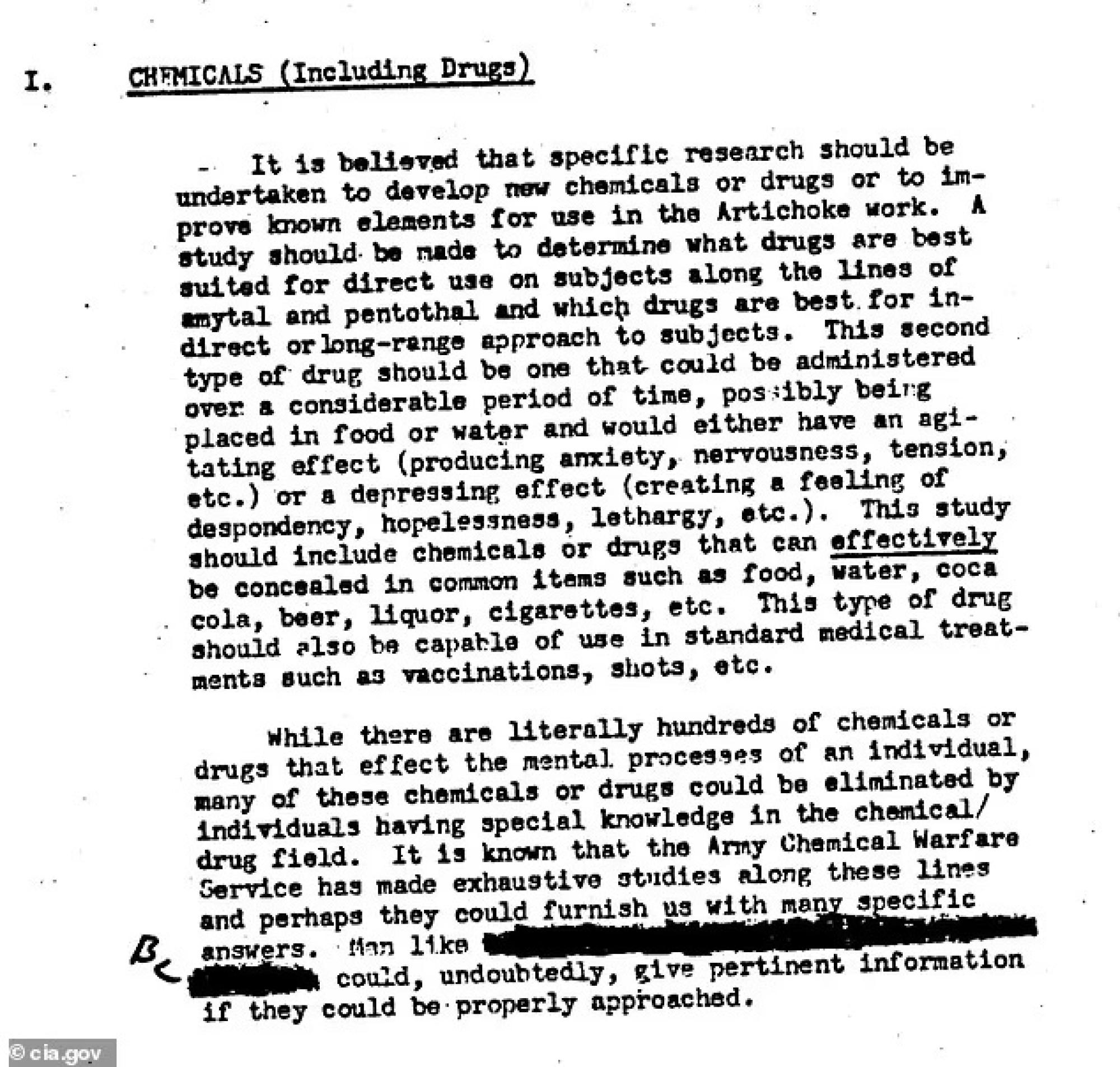
A newly released CIA document reveals a chilling blueprint to manipulate minds through covert drugging experiments. The report, added to the CIA's reading room in 2025, details the government's once top-secret Project Artichoke that ran from 1951 to 1956, focusing on behavior control, interrogation techniques and psychological manipulation. The seven-page document, titled 'Special Research for Artichoke,' with an attachment labeled 'Suggested Fields for Special Research Relative Artichoke,' outlines proposals to develop chemicals capable of altering human behavior. It discusses drugs designed for both immediate effects, like truth serums and long-term influence, potentially administered through food, water, alcohol or cigarettes. Researchers also suggested that such substances could be disguised in medical treatments such as vaccinations or injections. The CIA was also looking into methods beyond chemicals, listing hypnosis, sensory deprivation, gases and other psychological methods for interrogation and behavioral control. Artichoke served as a precursor to the CIA's MKUltra program, which later broadened mind-altering experiments on a larger scale. The researchers involved in the secret program emphasized that long-term compounds should be capable of producing 'an agitating effect (producing anxiety, nervousness, tension, etc.) or a depressing effect (creating a feeling of despondency, hopelessness, lethargy, etc.).'
Latest
Latest News
Each news summary is created according to strict standards. Here's how we do it.
Each summary is created using a consistent editorial procedure. The target length is approximately 16 lines of 11-point Arial text in a 650-pixel-wide column. Up to 25% of a summary may be set in bold to emphasize the most important ideas. Summaries are composed of verbatim excerpts presented in the same sequence as they appear in the original news source, with very minor editorial additions. Where material has been omitted between excerpts, the omission is indicated with ellipses (...). Any words added by an editor for clarity or context appear in [brackets]. Our original news editor was Fred Burks. Tod Fletcher edited most summaries from 2007 through 2014, and Mark Bailey has served as news editor since 2014.