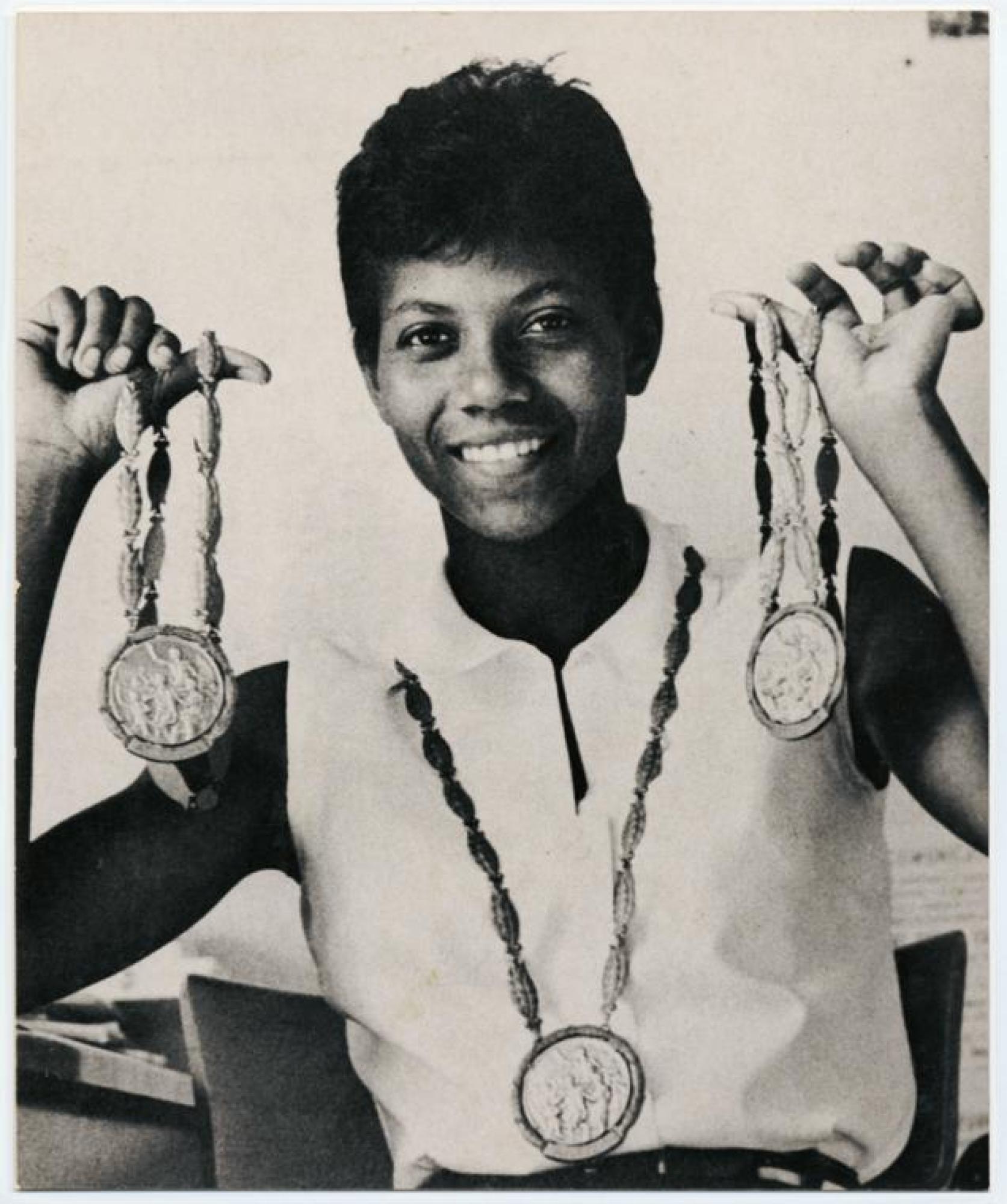
Wilma Rudolph outran poverty, polio, scarlet fever and the limits placed on black women by societal convention to win three gold medals in sprint events at the 1960 Olympics in Rome. By the time brain cancer caught Rudolph, leading to her death Saturday at age 54, she had achieved a stature that made her legend and her sport greater in the long run. The 20th of 22 children of a porter and a cleaning lady, Rudolph lost the use of her left leg after contracting polio and scarlet fever at age 4. Doctors told her parents she never would walk again without braces, but she refused to accept that prognosis and began to walk unassisted at age 9. It wasn't long before she was outrunning all the girls and boys in her neighborhood. At 16, already under the tutelage of Tennessee State University coach Ed Temple, Rudolph won a bronze medal on the 4 x 100-meter relay at the 1956 Olympics in Melbourne, Australia. Four years later, when she was the mother of a 2-year-old, Rudolph won the three golds despite running all three events with a sprained ankle. After being voted Associated Press female athlete of the year in 1960 and 1961 and the Sullivan Award as the nation's top amateur athlete in 1961, Rudolph retired at 21, a decision that reflects an era in which lack of financial incentives kept most Olympic careers short. She turned to a variety of humanitarian projects, including goodwill ambassador to West Africa, coaching at DePauw University and working for underprivileged children through the Wilma Rudolph Foundation.
Latest
Latest News
Each news summary is created according to strict standards. Here's how we do it.
Each summary is created using a consistent editorial procedure. The target length is approximately 16 lines of 11-point Arial text in a 650-pixel-wide column. Up to 25% of a summary may be set in bold to emphasize the most important ideas. Summaries are composed of verbatim excerpts presented in the same sequence as they appear in the original news source, with very minor editorial additions. Where material has been omitted between excerpts, the omission is indicated with ellipses (...). Any words added by an editor for clarity or context appear in [brackets]. Our original news editor was Fred Burks. Tod Fletcher edited most summaries from 2007 through 2014, and Mark Bailey has served as news editor since 2014.