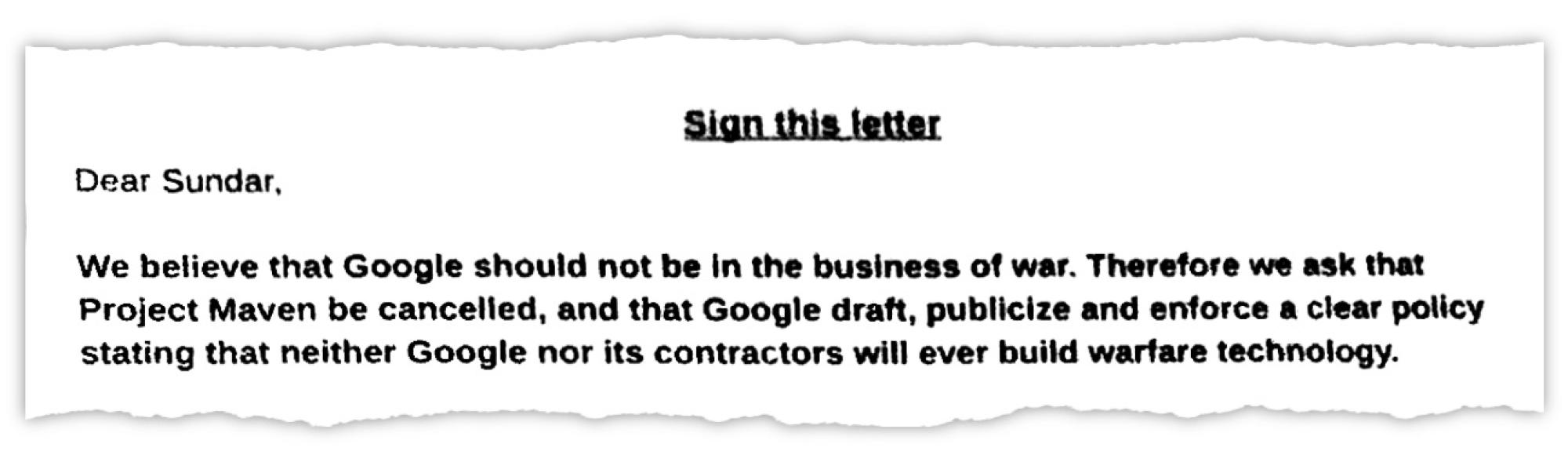
[Veteran journalist Katrina Manson's] new book, "Project Maven: A Marine Colonel, His Team, and the Dawn of AI Warfare," is an ... account of the ongoing reconfiguration of the U.S. armed forces for a new technological era. "Project Maven" is structured as an intellectual and professional biography of Drew Cukor, a Marine Corps intelligence officer largely responsible for ... this military transformation. Cukor insists that Maven was never supposed to be a weapon. He frequently defends the project as nothing more than an integrated data platform ... for a world made better and safer by A.I. warfare. In 2018, Google employees staged a massive walkout to protest the company's work on a primitive iteration of the project. In the aftermath of the Google fiasco, Cukor turns to Palantir (in addition to Microsoft and Amazon) to make Maven a reality. NATO now has its own Maven contract with Palantir, and that prompted ten member nations to pursue one, too. The Maven Smart System has become a global surveillance apparatusit can keep track of forty-nine thousand airfields all over the world"but its current work is hardly limited to intelligence provision and analysis. A "single click," [journalist Katrina] Manson reports, "could send coordinates through a tactical data link to a specific weapons platform so that it could fire at the target." The entire process, from target identification to target destruction, is four clicks. Officials told Manson that Maven was "accelerating operations and 'enabling lethality' at combat headquarters around the world." Maven is only one part of the A.I. tool kit. Manson uncovers evidence of two clandestine killer-robot programs, one aerial and the other aquatic, which are being developed in haste. For the first time, the Pentagon's proposed budget contained a line item for comprehensively self-directing systems. A machine can shoot, Manson reports, up to "ten times faster than an assassin."
Latest
Latest News
Each news summary is created according to strict standards. Here's how we do it.
Each summary is created using a consistent editorial procedure. The target length is approximately 16 lines of 11-point Arial text in a 650-pixel-wide column. Up to 25% of a summary may be set in bold to emphasize the most important ideas. Summaries are composed of verbatim excerpts presented in the same sequence as they appear in the original news source, with very minor editorial additions. Where material has been omitted between excerpts, the omission is indicated with ellipses (...). Any words added by an editor for clarity or context appear in [brackets]. Our original news editor was Fred Burks. Tod Fletcher edited most summaries from 2007 through 2014, and Mark Bailey has served as news editor since 2014.