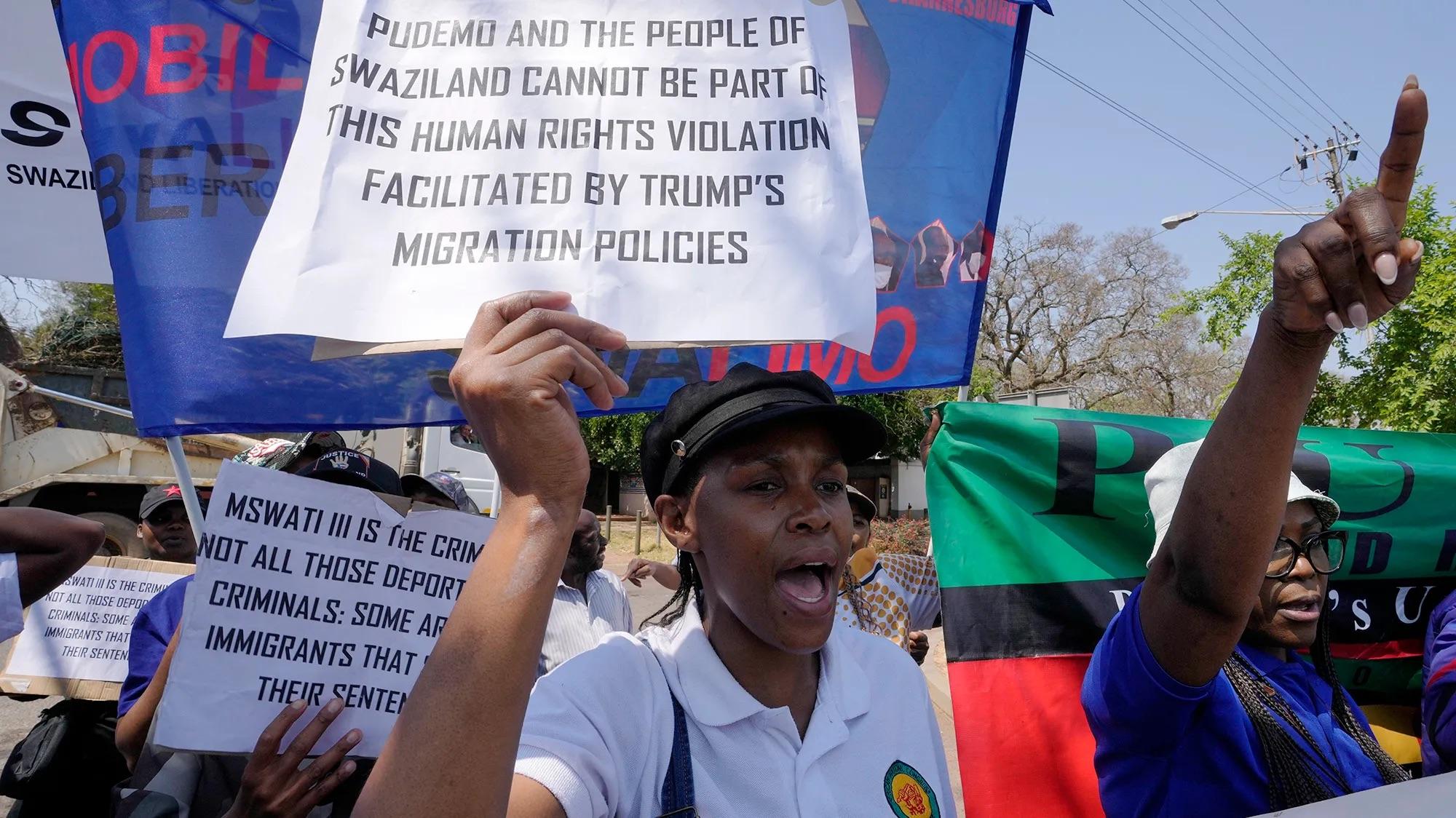
Eswatini, the landlocked nation formerly known as Swaziland, is Africa's last remaining absolute monarchy. In May, officials from the US and Eswatini signed a deal that allows the Trump administration to deport people from all over the world to the African nation. A copy of the arrangement I reviewed shows that the United States has agreed to pay Eswatini $5.1 million to take in up to 160 so-called "third-country nationals"immigrants who came to the US with no ties to the country to which they are being deported. In July, the first five of such men arrived in Eswatini, where they were sent to a maximum-security prison and detained in the country without any clear legal basis. Last weekend, the Trump administration sent 10 more people to the Eswatini prison. None of the 15 men sent to the nation are from Eswatini. But they are now under the authority of its king. The situation is a "legal black hole," according to Tin Thanh Nguyen, a North Carolina"based attorney who is representing five men from Vietnam and Laos now imprisoned in the African country. As he explained in a statement Monday: "I cannot call [my clients]. I cannot email them. I cannot communicate through local counsel because the Eswatini government blocks all attorney access." A practice that would have been unthinkable under past administrations is becoming normalized: sending ICE detainees, without due process, to far-flung prisons in countries with notorious human rights records.
Latest
Latest News
Each news summary is created according to strict standards. Here's how we do it.
Each summary is created using a consistent editorial procedure. The target length is approximately 16 lines of 11-point Arial text in a 650-pixel-wide column. Up to 25% of a summary may be set in bold to emphasize the most important ideas. Summaries are composed of verbatim excerpts presented in the same sequence as they appear in the original news source, with very minor editorial additions. Where material has been omitted between excerpts, the omission is indicated with ellipses (...). Any words added by an editor for clarity or context appear in [brackets]. Our original news editor was Fred Burks. Tod Fletcher edited most summaries from 2007 through 2014, and Mark Bailey has served as news editor since 2014.