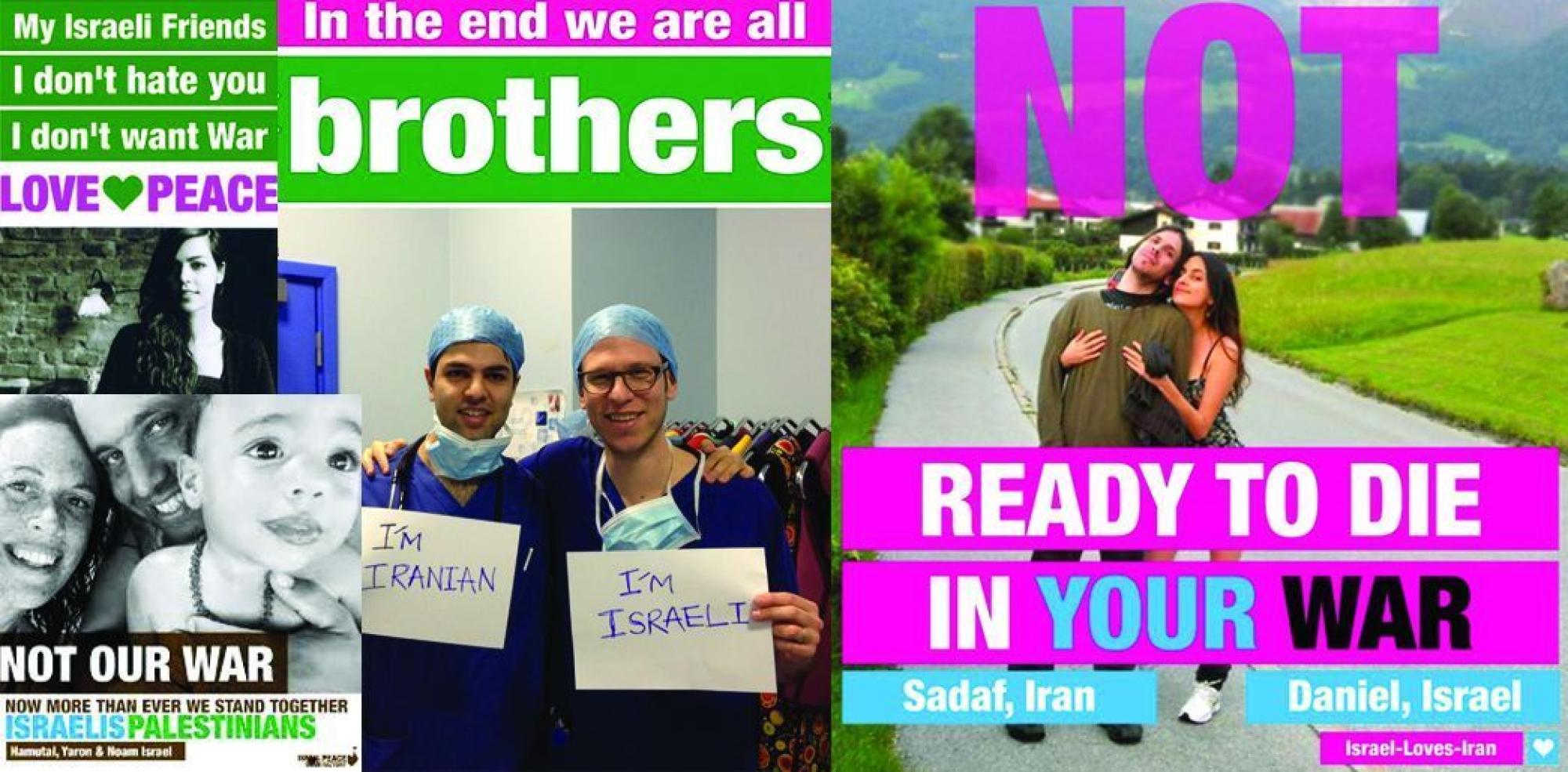
As diplomats and journalists dissect every word spoken by top Israeli, Iranian and American officials for signs of a potential Israeli military strike on Irans nuclear program, an online campaign to prevent just that has gained steam in Israel. The Israel Loves Iran campaign [was launched last week by] Israeli graphic designer Ronny Edry and his wife, Michal Tamir. For there to be a war between us, we must first be afraid of one another, we must hate, Edry says. Im not afraid of you. I dont hate you. I dont even know you. No Iranian ever did me harm. The site and its accompanying Facebook page are filled with photos of Israelis from all walks of life and the Iranians, We Love You slogan, with the subheader: We will never bomb you. On Friday evening, the page had almost 28,000 likes, and the campaign has raised more than $16,000 to print posters and keep the movement grow[ing]. Organizers say responses from Iranians around the world have poured in. Unfortunately, the stupid politicians in both countries are trying to separate these two rich cultures! wrote one responder. One of the more popular posts ricocheting around Facebook is of a man and woman kissing, with him holding up his Israeli passport as she flaunts her Iranian passport. Persian girls are sexy and adorable, the boyfriend wrote. Our cultures and backgrounds have never got in the way. We actually share the same ideals. According to a recent poll, [only] 19 percent of Israelis support a unilateral strike on Iran. Participant Talia Gorodess [commented], the more people join this campaign, the more, I hope, my government will think twice before doing anything foolish.
Latest
Latest News
Each news summary is created according to strict standards. Here's how we do it.
Each summary is created using a consistent editorial procedure. The target length is approximately 16 lines of 11-point Arial text in a 650-pixel-wide column. Up to 25% of a summary may be set in bold to emphasize the most important ideas. Summaries are composed of verbatim excerpts presented in the same sequence as they appear in the original news source, with very minor editorial additions. Where material has been omitted between excerpts, the omission is indicated with ellipses (...). Any words added by an editor for clarity or context appear in [brackets]. Our original news editor was Fred Burks. Tod Fletcher edited most summaries from 2007 through 2014, and Mark Bailey has served as news editor since 2014.