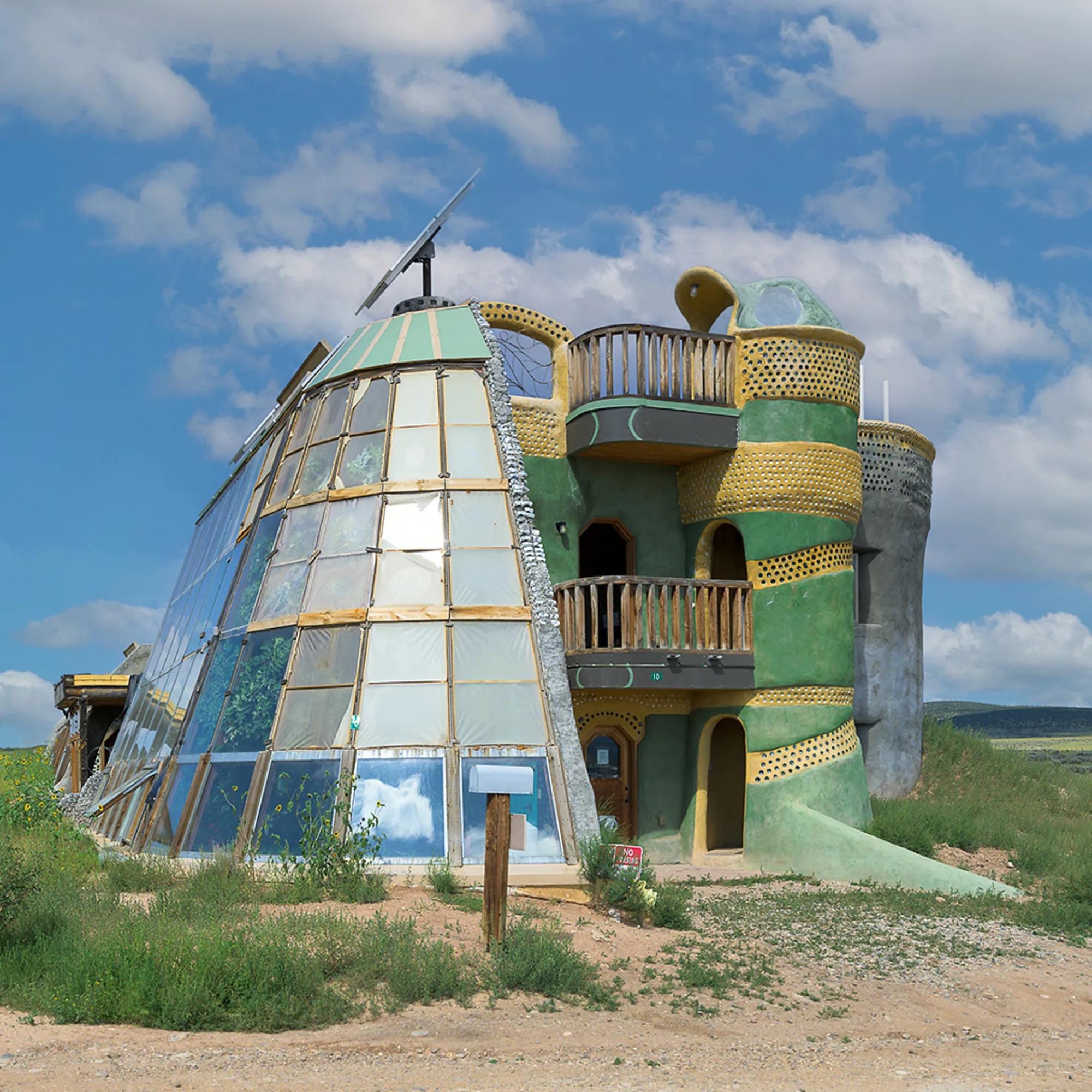
Venture into New Mexico's beautifully stark high desert and you may well stumble across some fantastical and unconventional homes some palatial and sculpturally rounded; others with an ancient temple-like form " that look like they're from a Star Wars movie. Set in and around the town of Taos where they were invented almost 40 years ago, these are Earthships: net-zero, sustainably designed homes built mostly from both natural and waste materials, such as old tyres, empty wine bottles and wood and mud. Earthship construction requires less in the way of toxic or carbon-emitting construction materials like concrete and plastics, and doesn't require precious woodland and other natural resources. An earth berm (a purposefully built bank of soil) surrounds the Earthship on three sides, providing insulating mass that controls temperature. Each has a greenhouse ... either on the north or south side depending on location. Most Earthships are purely solar powered; some also have wind turbines to supplement or a wood-burning stove as back up. Taos has cold snowy winters and often dry, hot summers, but in an Earthship, the internal temperature remains close to 72F (21C) year-round, regardless of outside weather conditions. What does it feel like to stay inside an Earthship? "It feels like you're inside the womb," says Earthship construction manager Deborah Binder. "You feel constantly hugged and snuggled. The temperature is always comfortable."
Latest
Latest News
Each news summary is created according to strict standards. Here's how we do it.
Each summary is created using a consistent editorial procedure. The target length is approximately 16 lines of 11-point Arial text in a 650-pixel-wide column. Up to 25% of a summary may be set in bold to emphasize the most important ideas. Summaries are composed of verbatim excerpts presented in the same sequence as they appear in the original news source, with very minor editorial additions. Where material has been omitted between excerpts, the omission is indicated with ellipses (...). Any words added by an editor for clarity or context appear in [brackets]. Our original news editor was Fred Burks. Tod Fletcher edited most summaries from 2007 through 2014, and Mark Bailey has served as news editor since 2014.