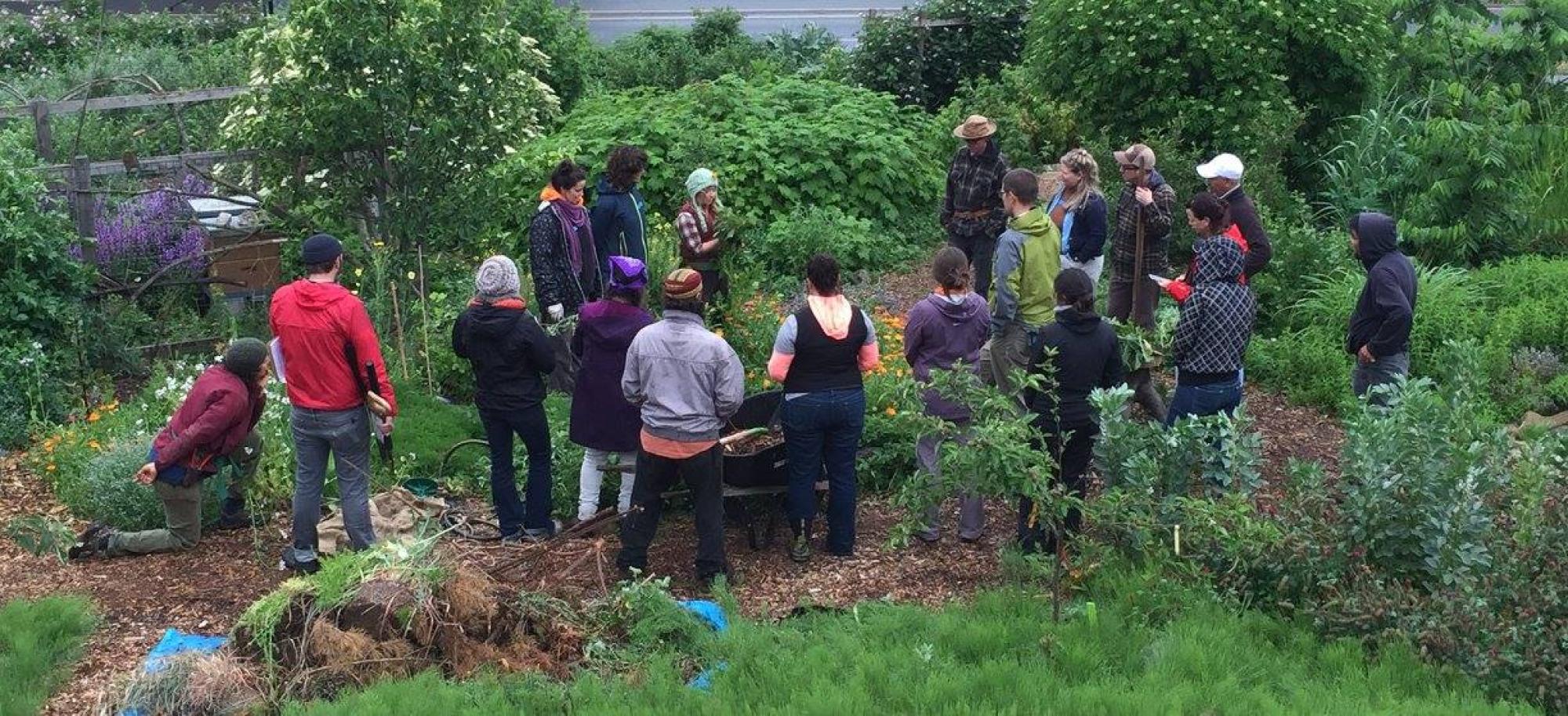
America's biggest "food forest" is just a short drive from the world's busiest airport, Atlanta's Hartsfield-Jackson. When the Guardian visits the Urban Food Forest at Browns Mill there are around a dozen volunteers working. Food forests are part of the broader food justice and urban agriculture movement and are distinct from community gardens in various ways. They are typically backed by grants rather than renting plots, usually rely on volunteers and incorporate a land management approach that has a focus on growing perennials. The schemes vary in how they operate in allocating food ... but they are all aimed at boosting food access. Organizers in Atlanta stress that they properly distribute the food to the neighborhoods that the food forest is intended to support and it's not open to the public beyond volunteer workers. Other schemes have areas where the public is free to take what they want. Celeste Lomax, who manages community engagement at the Brown Mills forest and lives in the neighborhood, believes education is key to the forest's success and beams like sunlight when sharing her vision for the fertile soil she tends. "We're using this space for more than just growing food. We have composting, beehives, bat boxes, and this beautiful herb garden where we're teaching people how to heal themselves with the foods we eat. We'll be doing walkthrough retreats and outside yoga. This is a health and wellness place. It's so much more than just free food."
Latest
Latest News
Each news summary is created according to strict standards. Here's how we do it.
Each summary is created using a consistent editorial procedure. The target length is approximately 16 lines of 11-point Arial text in a 650-pixel-wide column. Up to 25% of a summary may be set in bold to emphasize the most important ideas. Summaries are composed of verbatim excerpts presented in the same sequence as they appear in the original news source, with very minor editorial additions. Where material has been omitted between excerpts, the omission is indicated with ellipses (...). Any words added by an editor for clarity or context appear in [brackets]. Our original news editor was Fred Burks. Tod Fletcher edited most summaries from 2007 through 2014, and Mark Bailey has served as news editor since 2014.