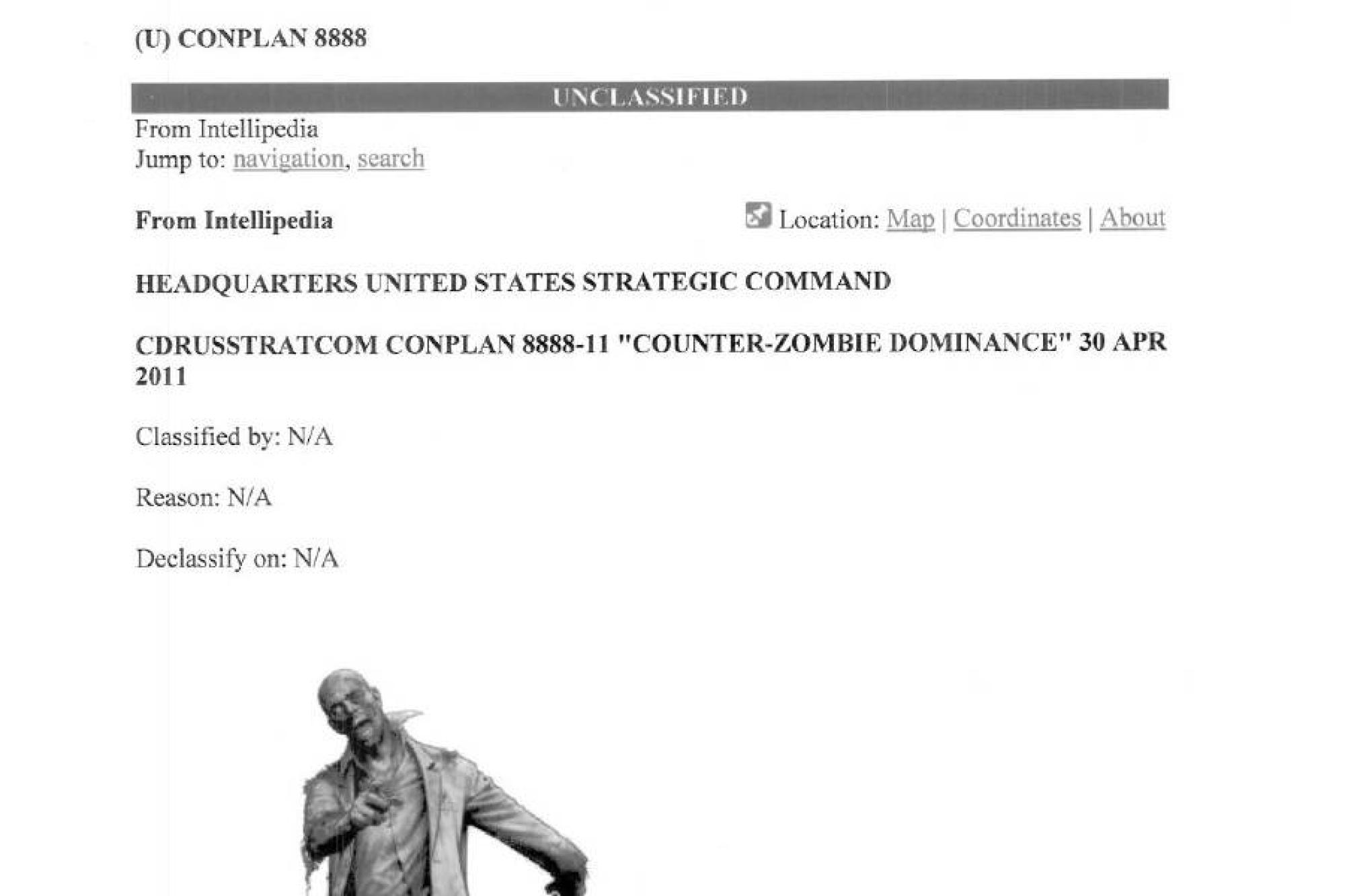
If zombies attack, the US military has a plan. Really. Upon authorization from the president or the defense secretary, US Strategic Command would begin preparations for safeguarding the civilian population, protecting vital infrastructure, and eradicating the zombie menace. And all without violating the rights of threatened humans and possibly the zombies themselves. This plan was not actually designed as a joke," says CONPLAN 8888-11 (or "Counter Zombie Dominance"), issued on April 30, 2011, by USSTRATCOM, whose normal responsibilities include overseeing America's strategic nuclear weapons, global strike capabilities, and missile defense. It originated as a scenario to train junior officers in the Department of Defense's Joint Operation Planning and Execution System, through which the US military devises contingency plans. Instructors discovered that a zombie-apocalypse scenario was a better teaching tool than using fictional scenarios about Tunisia or Nigeria as was customary at the time, which also risked being misunderstood by the public as real scenarios. One potential hurdle to deploying the US military is lawfare. Laws such as the Insurrection and the Posse Comitatus Acts strictly limit the deployment of the US military in domestic affairs. Though martial law would almost certainly be declared in the event of a mass zombie plague, deployment against undead who were formerly living US citizens could raise questions of Constitutional rights.
Latest
Latest News
Each news summary is created according to strict standards. Here's how we do it.
Each summary is created using a consistent editorial procedure. The target length is approximately 16 lines of 11-point Arial text in a 650-pixel-wide column. Up to 25% of a summary may be set in bold to emphasize the most important ideas. Summaries are composed of verbatim excerpts presented in the same sequence as they appear in the original news source, with very minor editorial additions. Where material has been omitted between excerpts, the omission is indicated with ellipses (...). Any words added by an editor for clarity or context appear in [brackets]. Our original news editor was Fred Burks. Tod Fletcher edited most summaries from 2007 through 2014, and Mark Bailey has served as news editor since 2014.