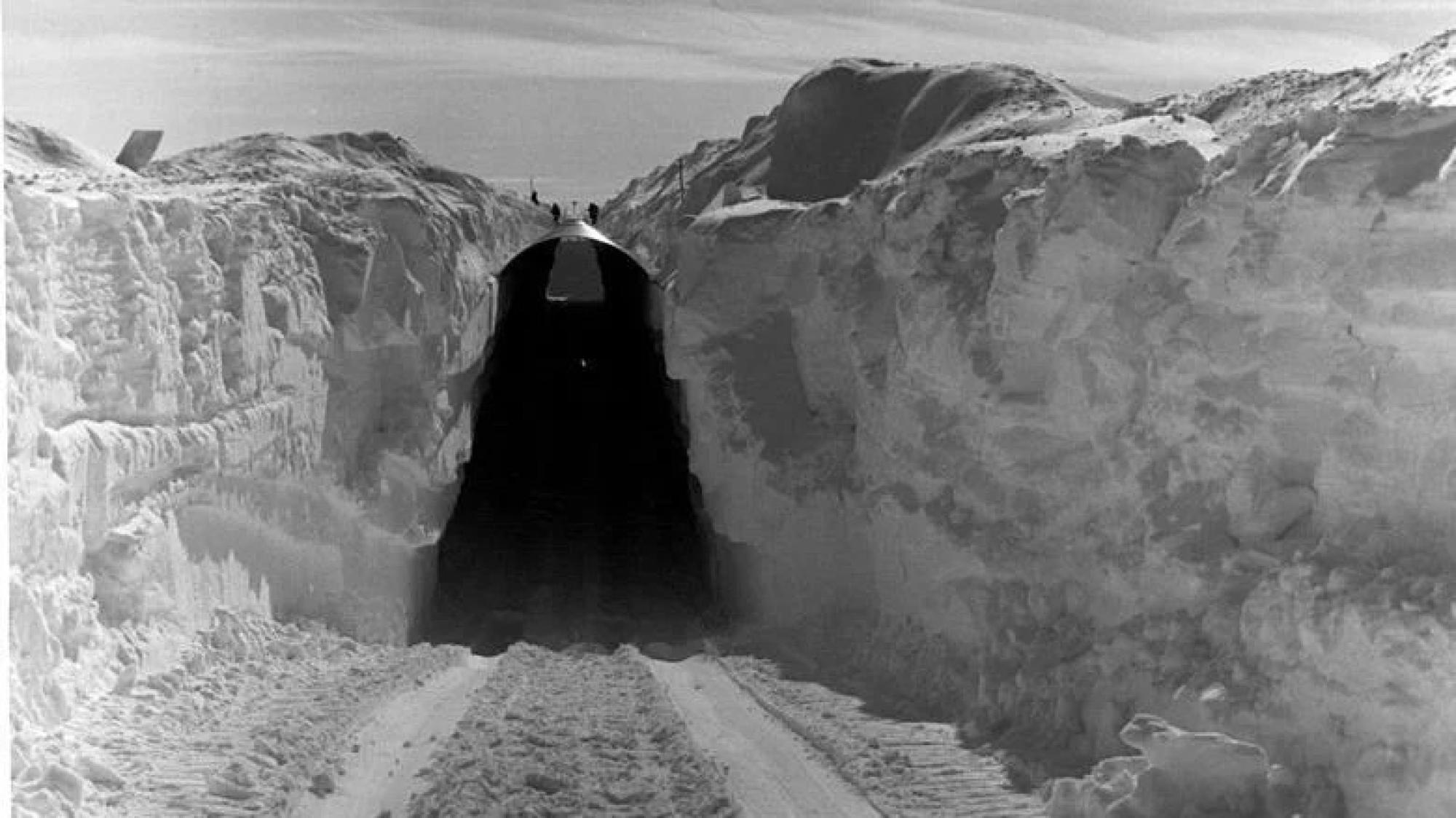
During an April flight over the Greenland Ice Sheet, NASA scientist Chad Greene [detected] a secret military base. After taking radar images of the ice, Greene was surprised to see what was shortly thereafter confirmed to be Camp Centurya 65-year-old Cold War United States military base buried 100 feet deep in the massive ice sheet. Built in secret between June of 1959 and October of 1960 by the U.S. Army Corps of Engineers, Camp Century"also known as "the city under the ice""was comprised of 21 underground tunnels spanning 9,800 feet. The U.S. and Denmark signed the Defense of Greenland agreement in 1951 "to negotiate arrangements under which armed forces of the parties to the North Atlantic Treaty Organization may make use of facilities in Greenland in defense of Greenland and the rest of the North Atlantic Treaty area," according to the National Museum of Nuclear Science and History. This allowed the U.S. to build bases in Greenland. While operating at the base, scientists made major geological breakthroughs. But that research was just a cover-up. Camp Century itself was not a secret. The Army even made a promotional video for the project. The scientific research angle, as significant as the discoveries were, was merely a front for a major U.S. nuclear weapon strategy of which the Danish government wasn't even aware. Known as "Project Iceworm," the plan was for Camp Century to house ballistic missiles under the Greenland ice.
Latest
Latest News
Each news summary is created according to strict standards. Here's how we do it.
Each summary is created using a consistent editorial procedure. The target length is approximately 16 lines of 11-point Arial text in a 650-pixel-wide column. Up to 25% of a summary may be set in bold to emphasize the most important ideas. Summaries are composed of verbatim excerpts presented in the same sequence as they appear in the original news source, with very minor editorial additions. Where material has been omitted between excerpts, the omission is indicated with ellipses (...). Any words added by an editor for clarity or context appear in [brackets]. Our original news editor was Fred Burks. Tod Fletcher edited most summaries from 2007 through 2014, and Mark Bailey has served as news editor since 2014.