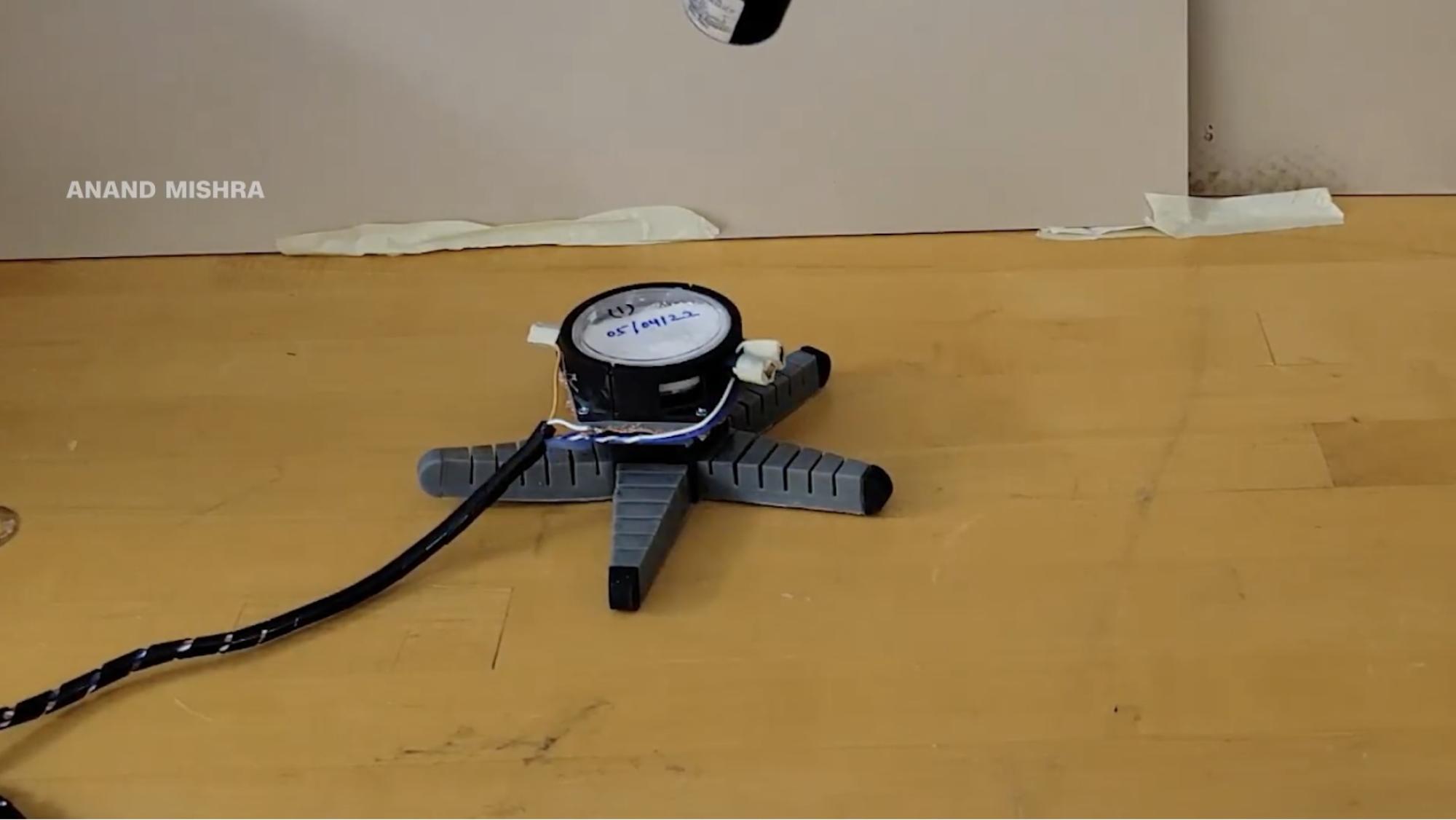
A wheeled bot rolls across the floor. A soft-bodied robotic star bends its five legs, moving with an awkward shuffle. Powered by conventional electricity via plug or battery, these simple robotic creations would be unremarkable, but what sets these two robots apart is that they are controlled by a living entity: a king oyster mushroom. By growing the mushroom's mycelium, or rootlike threads, into the robot's hardware, a team led by Cornell University researchers has engineered two types of robots that sense and respond to the environment by harnessing electrical signals made by the fungus and its sensitivity to light. The robots are the latest accomplishment of scientists in a field known as biohybrid robotics who seek to combine biological, living materials such as plant and animal cells or insects with synthetic components to make partly living and partly engineered entities. [Lead author Anand] Mishra engineered an electrical interface that accurately reads the mycelia's raw electrical activity, then processes and converts it into digital information that can activate the robot's actuators or moving parts. The robots were able to walk and roll as a response to the electrical spikes generated by the mycelia. [Professor of unconventional computing at the University of the West of England Andrew Adamatzky's] lab has produced more than 30 sensing and computing devices using live fungi, including growing a self-healing skin for robots that can react to light and touch. "When an adequate drivetrain (transmission system) is provided, the robot can, for example, monitor the health of ecological systems. The fungal controller would react to changes, such as air pollution, and guide the robot accordingly," Adamatzky said.
Latest
Latest News
Each news summary is created according to strict standards. Here's how we do it.
Each summary is created using a consistent editorial procedure. The target length is approximately 16 lines of 11-point Arial text in a 650-pixel-wide column. Up to 25% of a summary may be set in bold to emphasize the most important ideas. Summaries are composed of verbatim excerpts presented in the same sequence as they appear in the original news source, with very minor editorial additions. Where material has been omitted between excerpts, the omission is indicated with ellipses (...). Any words added by an editor for clarity or context appear in [brackets]. Our original news editor was Fred Burks. Tod Fletcher edited most summaries from 2007 through 2014, and Mark Bailey has served as news editor since 2014.