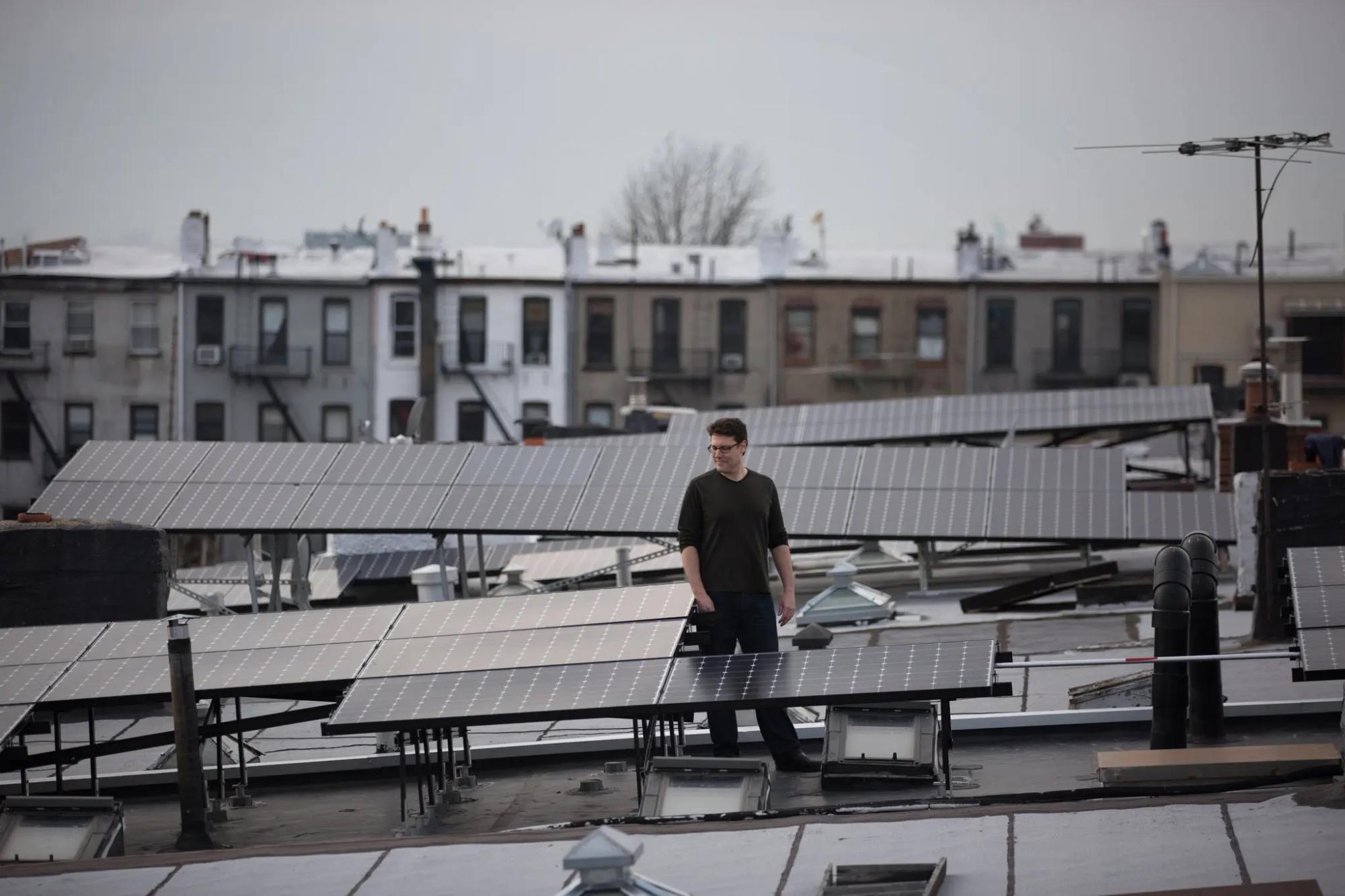
Brooklyn is known the world over for things small-batch and local, like designer clogs. In a promising experiment in an affluent swath of the borough, dozens of solar-panel arrays spread across rowhouse rooftops are wired into a growing network. Called the Brooklyn Microgrid, the project is signing up residents and businesses to a virtual trading platform that will allow solar-energy producers to sell excess-electricity credits from their systems to buyers in the group, who may live as close as next door. The project is still in its early stages it has just 50 participants thus far " but its implications could be far reaching. The idea is to create a kind of virtual, peer-to-peer energy trading system built on blockchain, the database technology that underlies cryptocurrencies like Bitcoin. The ability to complete secure transactions and create a business based on energy sharing would allow participants to bypass the electric company energy supply and ultimately build a microgrid with energy generation and storage components that could function on their own, even during broad power failures. "The long-term goal is to be at least partially independent of the grid in emergencies, which was a reasonable argument to join," said Patrick Schnell, whose Gowanus basement flooded during Hurricane Sandy in 2012. "Hopefully it will expand and more people will join and it will be more worthwhile."
Latest
Latest News
Each news summary is created according to strict standards. Here's how we do it.
Each summary is created using a consistent editorial procedure. The target length is approximately 16 lines of 11-point Arial text in a 650-pixel-wide column. Up to 25% of a summary may be set in bold to emphasize the most important ideas. Summaries are composed of verbatim excerpts presented in the same sequence as they appear in the original news source, with very minor editorial additions. Where material has been omitted between excerpts, the omission is indicated with ellipses (...). Any words added by an editor for clarity or context appear in [brackets]. Our original news editor was Fred Burks. Tod Fletcher edited most summaries from 2007 through 2014, and Mark Bailey has served as news editor since 2014.