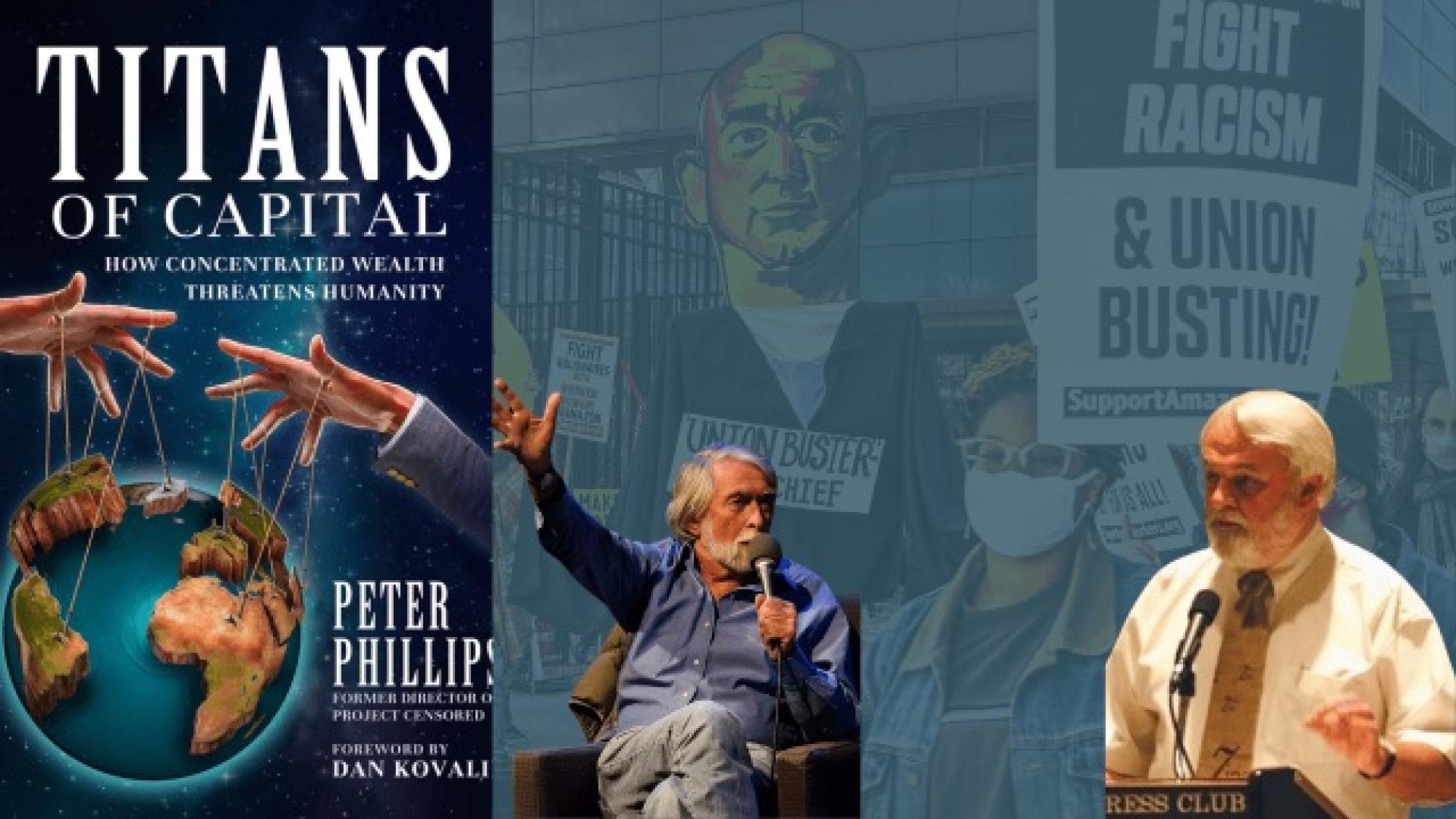
There is only one group of people that matter the most: those who Dr. Peter Phillips, professor emeritus at Sonoma State University, calls the "titans of capital." In his new book by the same name, Phillips studies the economic trends following the COVID-19 pandemic and how the wealth concentration in the world took a dramatic turn towards the already ultra-wealthy. The main problem is simple to understand: the ultra-wealthy "doubled their wealth concentration." That means, according to Phillips, that "the upper one half of 1% of the people got richer and basically, the rest of the world got poorer." Phillips names the top 10 capital investment companies, such as BlackRock, Vanguard, State Street, Morgan Stanley and others as the main culprits. Over $50 trillion are controlled by 117 people across these 10 companies, according to Phillips. This immense concentration of wealth inevitably renders any semblance of democracy almost useless, as the main decision makers are those who hold the biggest bag. And then there's policy groups. The largest now is the World Economic Forum, which is the top 2,000 to 3,000 corporations in the world send their CEOs there, to Davos every year. And there's a global leaders attend, and they're talking about a better capitalism, a state, what they call stakeholders capitalism, in other words, capitalism with a conscience. It's not working. They're not doing anything different, other than allowing the continued concentration of capital globally.
Latest
Latest News
Each news summary is created according to strict standards. Here's how we do it.
Each summary is created using a consistent editorial procedure. The target length is approximately 16 lines of 11-point Arial text in a 650-pixel-wide column. Up to 25% of a summary may be set in bold to emphasize the most important ideas. Summaries are composed of verbatim excerpts presented in the same sequence as they appear in the original news source, with very minor editorial additions. Where material has been omitted between excerpts, the omission is indicated with ellipses (...). Any words added by an editor for clarity or context appear in [brackets]. Our original news editor was Fred Burks. Tod Fletcher edited most summaries from 2007 through 2014, and Mark Bailey has served as news editor since 2014.