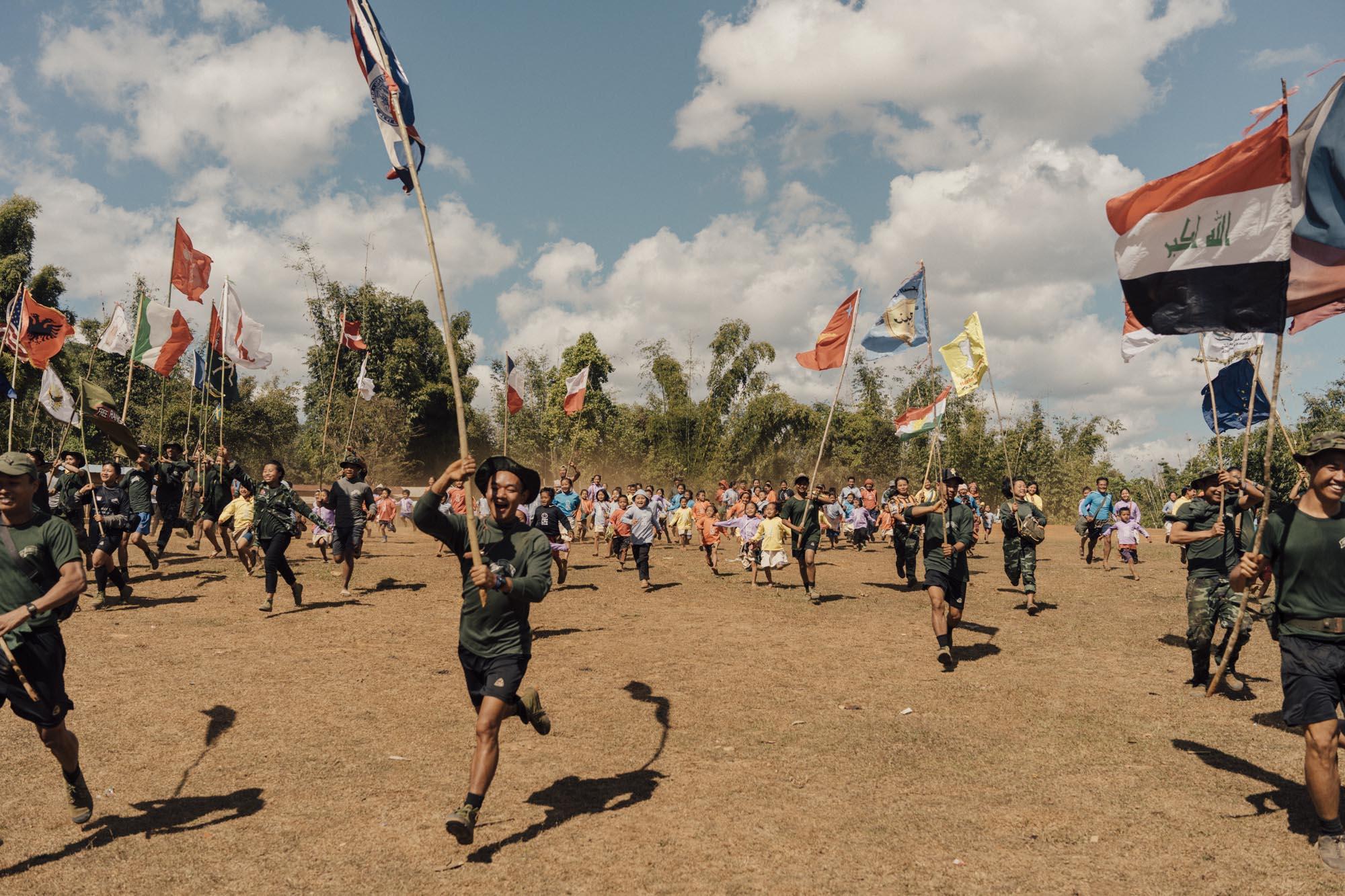
A former U.S. Special Forces officer and ordained Christian minister, [Dave Eubank] ... is a diehard humanitarian who has risked his life time and again to help the most vulnerable in a forsaken place that most Americans can't find on a map. [He] started the Free Burma Rangers (FBR) in the late 1990s to provide medical care and aid to people resisting the Southeast Asian nation's military junta, a brutal dictatorship that has crushed dissent and oppressed ethnic minorities for seven decades in what is the world's longest-running civil war. Eubank [leads] an all-volunteer staff of ethnic minorities and foreigners many of them ex-military, teachers, students, engineers, poets, and shopkeepers " working on the front line. On missions, the Rangers bring gifts and entertainment to brighten the lives of the children living in harm's way. With his own wife and kids in tow, Eubank set FBR apart with a relentless commitment to go places other humanitarian groups would not. And that's built FBR into a movement that fields teams and tracks human-rights abuses across Burma's front lines and beyond, from northern Syria to Sudan. "You could be a murderer. You only have to say 'I don't think that's the best behavior, and I'm trying not to do those things,' and then you can join us," [Eubank] says, adding that FBR includes atheists, agnostics, and spirit worshipers. Eubank insists that love is the force that drives him to take extreme risks, and also what makes FBR so effective. "[You will] run forward through the bullets, even if you don't know the person you're trying to save," he says. "If I'm shot and I'm bleeding out on the trail and dying and I can't see my wife and kids again " if I'm not doing that for love, what a disaster."
Latest
Latest News
Each news summary is created according to strict standards. Here's how we do it.
Each summary is created using a consistent editorial procedure. The target length is approximately 16 lines of 11-point Arial text in a 650-pixel-wide column. Up to 25% of a summary may be set in bold to emphasize the most important ideas. Summaries are composed of verbatim excerpts presented in the same sequence as they appear in the original news source, with very minor editorial additions. Where material has been omitted between excerpts, the omission is indicated with ellipses (...). Any words added by an editor for clarity or context appear in [brackets]. Our original news editor was Fred Burks. Tod Fletcher edited most summaries from 2007 through 2014, and Mark Bailey has served as news editor since 2014.