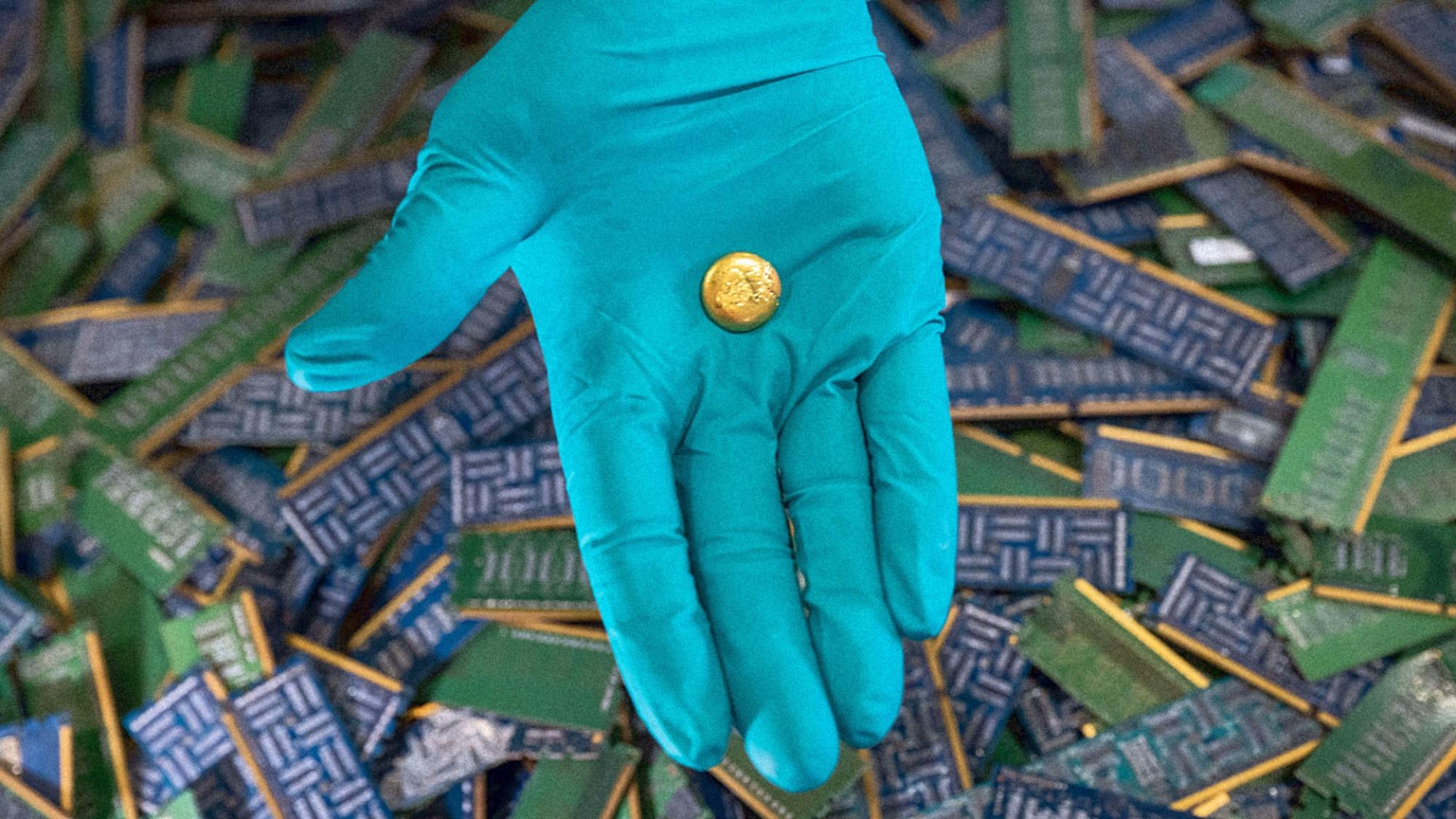
Researchers at ETH Zurich have designed a sustainable method to extract gold from electronic waste using a byproduct of cheese production. Electronic devices, from smartphones to laptops, contain small amounts of gold due to its excellent conductivity and resistance to corrosion. With the rapid turnover of electronic gadgets, e-waste has become the fastest-growing waste stream globally, reaching 62 million tonnes in 2022, and only 22.3 percent of this was formally collected and recycled, leaving vast amounts of valuable materials unused. Professor Raffaele Mezzenga and scientist Mohammad Peydayesh led the ETH Zurich team in developing a method that utilizes "whey", the liquid byproduct of cheese-making. By processing whey proteins into amyloid fibrils, they created a sponge-like aerogel capable of selectively absorbing gold ions from acidic solutions derived from e-waste. Professor Mezzenga stated, The fact I love the most is that we're using a food industry byproduct to obtain gold from electronic waste. You can't get much more sustainable than that!" In laboratory tests, this aerogel successfully extracted gold from dissolved computer motherboards. The sponge drew out gold that was about 90.8 percent pure, yielding a 22-carat nugget weighing approximately 450 milligrams. The research team is also exploring the use of other food industry byproducts, like pea protein and fish collagen, to diversify the sources of the aerogel. The process is economically viable, with operational costs significantly lower than the market value of the recovered gold, unlike traditional gold extraction techniques that rely on toxic chemicals like cyanide.
Latest
Latest News
Each news summary is created according to strict standards. Here's how we do it.
Each summary is created using a consistent editorial procedure. The target length is approximately 16 lines of 11-point Arial text in a 650-pixel-wide column. Up to 25% of a summary may be set in bold to emphasize the most important ideas. Summaries are composed of verbatim excerpts presented in the same sequence as they appear in the original news source, with very minor editorial additions. Where material has been omitted between excerpts, the omission is indicated with ellipses (...). Any words added by an editor for clarity or context appear in [brackets]. Our original news editor was Fred Burks. Tod Fletcher edited most summaries from 2007 through 2014, and Mark Bailey has served as news editor since 2014.