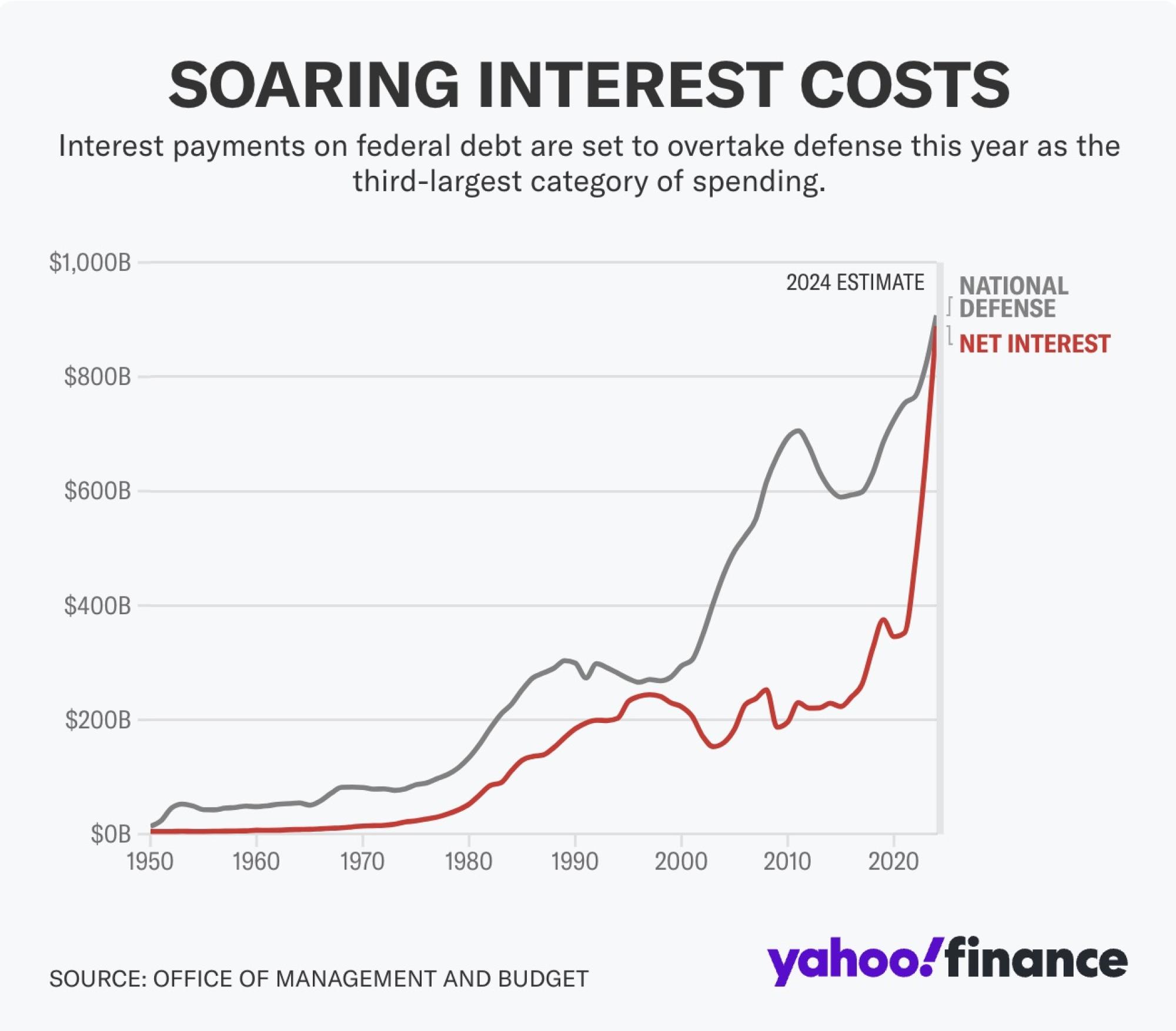
The United States has long had the world's biggest defense budget, with spending this year set to approach $900 billion. Yet this spending is rapidly being eclipsed by the fastest-growing portion of federal outflows: interest payments on the national debt. For the first seven months of fiscal year 2024, which began last October, net interest payments totaled $514 billion, outpacing defense by $20 billion. Budget analysts think that trend will continue, making 2024 the first year ever that the United States will spend more on interest payments than on national defense. Interest is now the third-biggest expenditure after Social Security and health. And not because any of the other programs are shrinking. While most government expenditures grow modestly from year to year, interest expenses in 2024 are running 41% higher than in 2023. Interest payments are ballooning for two obvious reasons. The first is that annual deficits have exploded, leaving the nation with a gargantuan $34.6 trillion in total federal debt, 156% higher than the national debt at the end of 2010. As a percentage of GDP, the annual deficit has nearly doubled in just 10 years, from 2.8% in 2014 to a projected 5.3% in 2024. The government is also paying more to borrow. From 2010 through 2021, the average interest rate on all Treasury securities sold to the public was just 2.1%. But in 2022, the Federal Reserve started jacking up rates to tame inflation, and the government now pays an average interest rate of 3.3%.
Latest
Latest News
Each news summary is created according to strict standards. Here's how we do it.
Each summary is created using a consistent editorial procedure. The target length is approximately 16 lines of 11-point Arial text in a 650-pixel-wide column. Up to 25% of a summary may be set in bold to emphasize the most important ideas. Summaries are composed of verbatim excerpts presented in the same sequence as they appear in the original news source, with very minor editorial additions. Where material has been omitted between excerpts, the omission is indicated with ellipses (...). Any words added by an editor for clarity or context appear in [brackets]. Our original news editor was Fred Burks. Tod Fletcher edited most summaries from 2007 through 2014, and Mark Bailey has served as news editor since 2014.