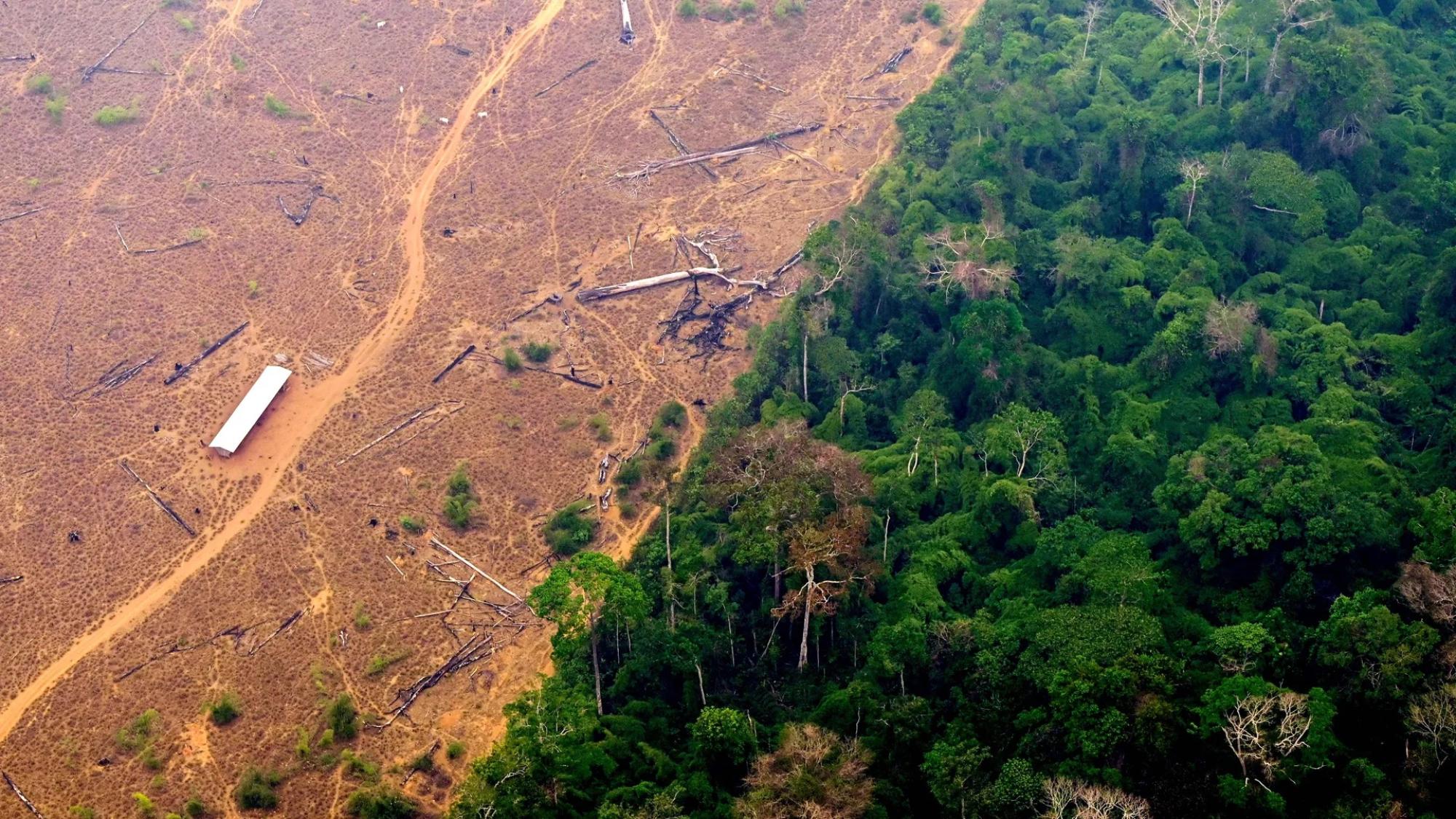
Left on their own, some deforested areas can rebound surprisingly fast with minimal help from humans, sequestering loads of atmospheric carbon as they grow. New research from an international team of scientists, recently published in the journal Nature, finds that 830,000 square miles of deforested land in humid tropical regions"an area larger than Mexico"could regrow naturally if left on its own. Five countries"Brazil, China, Colombia, Indonesia, and Mexico"account for 52 percent of the estimated potential regrowth. That would boost biodiversity, improve water quality and availability, and suck up 23.4 gigatons of carbon over the next three decades. "A rainforest can spring up in one to three years," said Matthew Fagan, a conservation scientist and ... coauthor of the paper. "In five years, you can have a completely closed canopy that's 20 feet high. I have walked in rainforests 80 feet high that are 10 to 15 years old. It just blows your mind." That sort of regrowth isn't a given, though. First of all, humans would have to stop using the land for intensive agriculture"think big yields thanks to fertilizers and other chemicals"or raising hoards of cattle, the sheer weight of which compacts the soil and makes it hard for new plants to take root. A global goal known as the Bonn Challenge aims to restore 1.3 million square miles of degraded and deforested land by 2030. More than 70 governments and organizations from 60 countries ... have signed on.
Latest
Latest News
Each news summary is created according to strict standards. Here's how we do it.
Each summary is created using a consistent editorial procedure. The target length is approximately 16 lines of 11-point Arial text in a 650-pixel-wide column. Up to 25% of a summary may be set in bold to emphasize the most important ideas. Summaries are composed of verbatim excerpts presented in the same sequence as they appear in the original news source, with very minor editorial additions. Where material has been omitted between excerpts, the omission is indicated with ellipses (...). Any words added by an editor for clarity or context appear in [brackets]. Our original news editor was Fred Burks. Tod Fletcher edited most summaries from 2007 through 2014, and Mark Bailey has served as news editor since 2014.