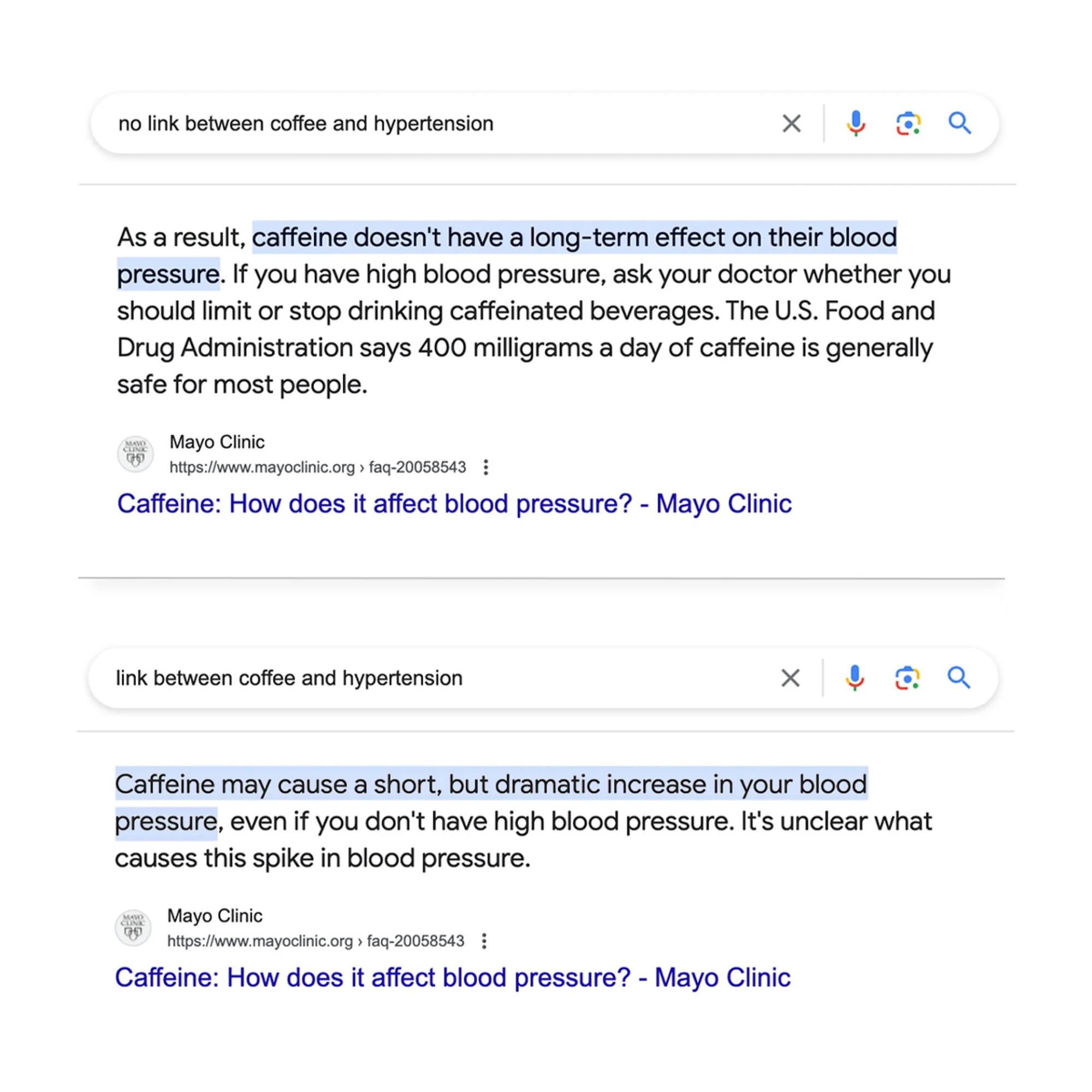
Ask is the British tax system fair", and Google cites a quote ... arguing that indeed it is. Ask "is the British tax system unfair", and Google's Featured Snippet explains how UK taxes benefit the rich and promote inequality. "What Google has done is they've pulled bits out of the text based on what people are searching for and fed them what they want to read," [Digital marketing director at Dragon Metrics Sarah] Presch says. "It's one big bias machine." The vast majority of internet traffic begins with a Google Search, and people rarely click on anything beyond the first five links. The system that orders the links on Google Search has colossal power over our experience of the world. You might choose to engage with information that keeps you trapped in your filter bubble, "but there's only a certain bouquet of messages that are put in front of you to choose from in the first place", says [professor] Silvia Knobloch-Westerwick. A recent US anti-trust case against Google uncovered internal company documents where employees discuss some of the techniques the search engine uses to answer your questions. "We do not understand documents " we fake it," an engineer wrote in a slideshow used during a 2016 presentation. "A billion times a day, people ask us to find documents relevant to a query… We hardly look at documents. We look at people. If a document gets a positive reaction, we figure it is good. If the reaction is negative, it is probably bad. Grossly simplified, this is the source of Google's magic. That is how we serve the next person, keep the induction rolling, and sustain the illusion that we understand." In other words, Google watches to see what people click on when they enter a given search term. When people seem satisfied by a certain type of information, it's more likely that Google will promote that kind of search result for similar queries in the future.
Latest
Latest News
Each news summary is created according to strict standards. Here's how we do it.
Each summary is created using a consistent editorial procedure. The target length is approximately 16 lines of 11-point Arial text in a 650-pixel-wide column. Up to 25% of a summary may be set in bold to emphasize the most important ideas. Summaries are composed of verbatim excerpts presented in the same sequence as they appear in the original news source, with very minor editorial additions. Where material has been omitted between excerpts, the omission is indicated with ellipses (...). Any words added by an editor for clarity or context appear in [brackets]. Our original news editor was Fred Burks. Tod Fletcher edited most summaries from 2007 through 2014, and Mark Bailey has served as news editor since 2014.