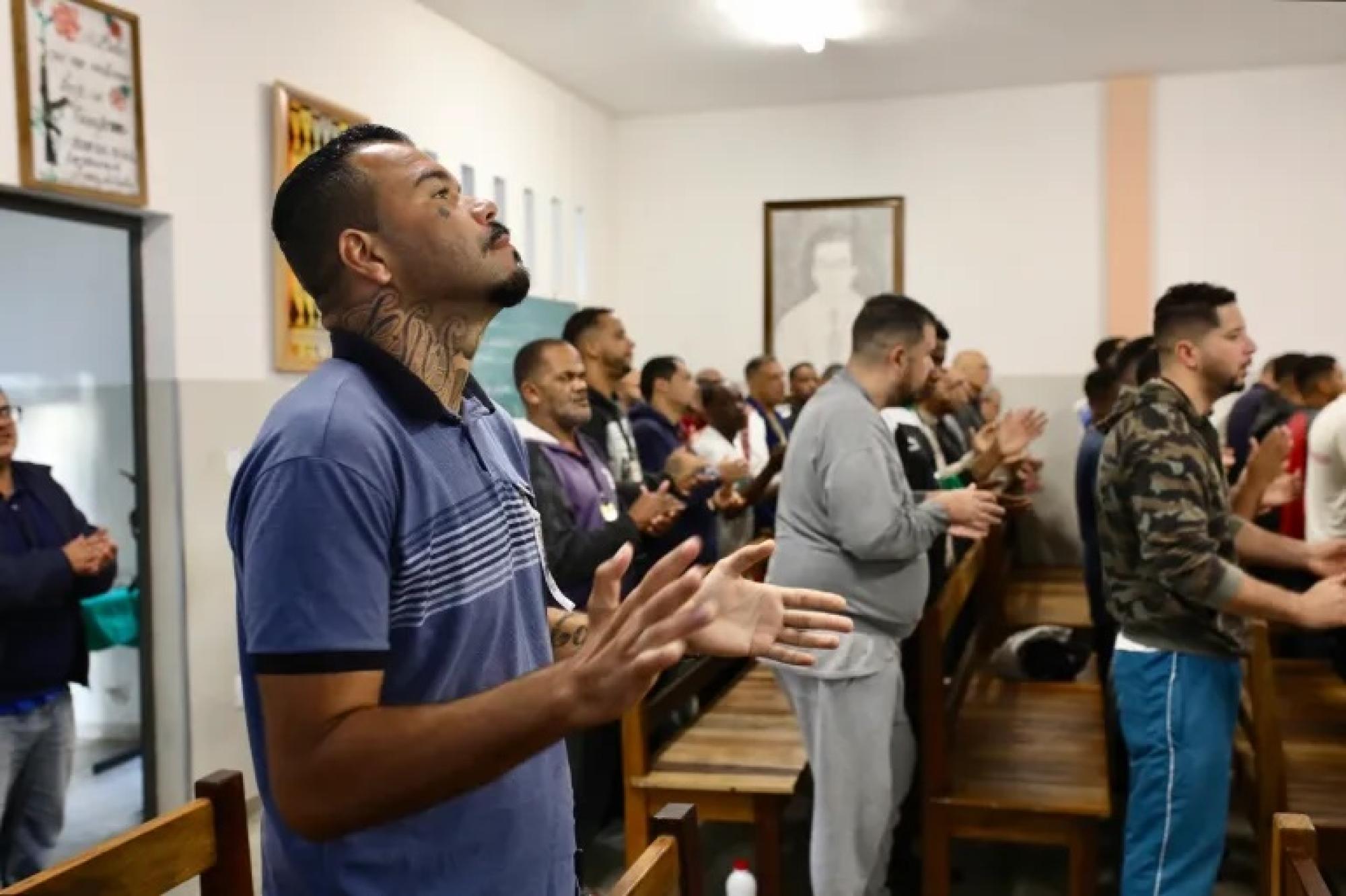
APAC, a Brazilian non-profit that advocates for better treatment of prisoners, has a unique model in the dozens of facilities it manages across the country. Inmates oversee security and discipline, make their own food and wear their own clothes. Referred to as recovering persons", prisoners are called by their name rather than by a number. The more than 400 inmates in the Sao Joao del-Rei APAC facility have the keys to their own cells - and unlike in a typical prison, there are no armed guards monitoring their movements. This is a far cry from the norm in Brazil, where the total prison population exceeds 800,000. The country's human rights ministry has cited inhumane conditions, including rotten food and torture, inside prisons in the state of Rio Grande do Norte. In 2021, a report from the Inter-American Commission on Human Rights said that across Brazil, inmates were "often held in overcrowded and structurally deficient prisons, maltreated, and frequently subjected to torture". In APAC prisons, cells appear clean, food is fresh and education is part of the rehabilitation programme. In terms of recidivism, while the Brazilian state reports its national average at 39 percent after five years - a number much lower than the 80 percent cited by international observers - APAC says its facilities have a rate of around 14 percent. New inmates entering the Sao Joao del-Rei facility are greeted by a sign bearing the words: "Here the man enters, the crime stays outside."
Latest
Latest News
Each news summary is created according to strict standards. Here's how we do it.
Each summary is created using a consistent editorial procedure. The target length is approximately 16 lines of 11-point Arial text in a 650-pixel-wide column. Up to 25% of a summary may be set in bold to emphasize the most important ideas. Summaries are composed of verbatim excerpts presented in the same sequence as they appear in the original news source, with very minor editorial additions. Where material has been omitted between excerpts, the omission is indicated with ellipses (...). Any words added by an editor for clarity or context appear in [brackets]. Our original news editor was Fred Burks. Tod Fletcher edited most summaries from 2007 through 2014, and Mark Bailey has served as news editor since 2014.