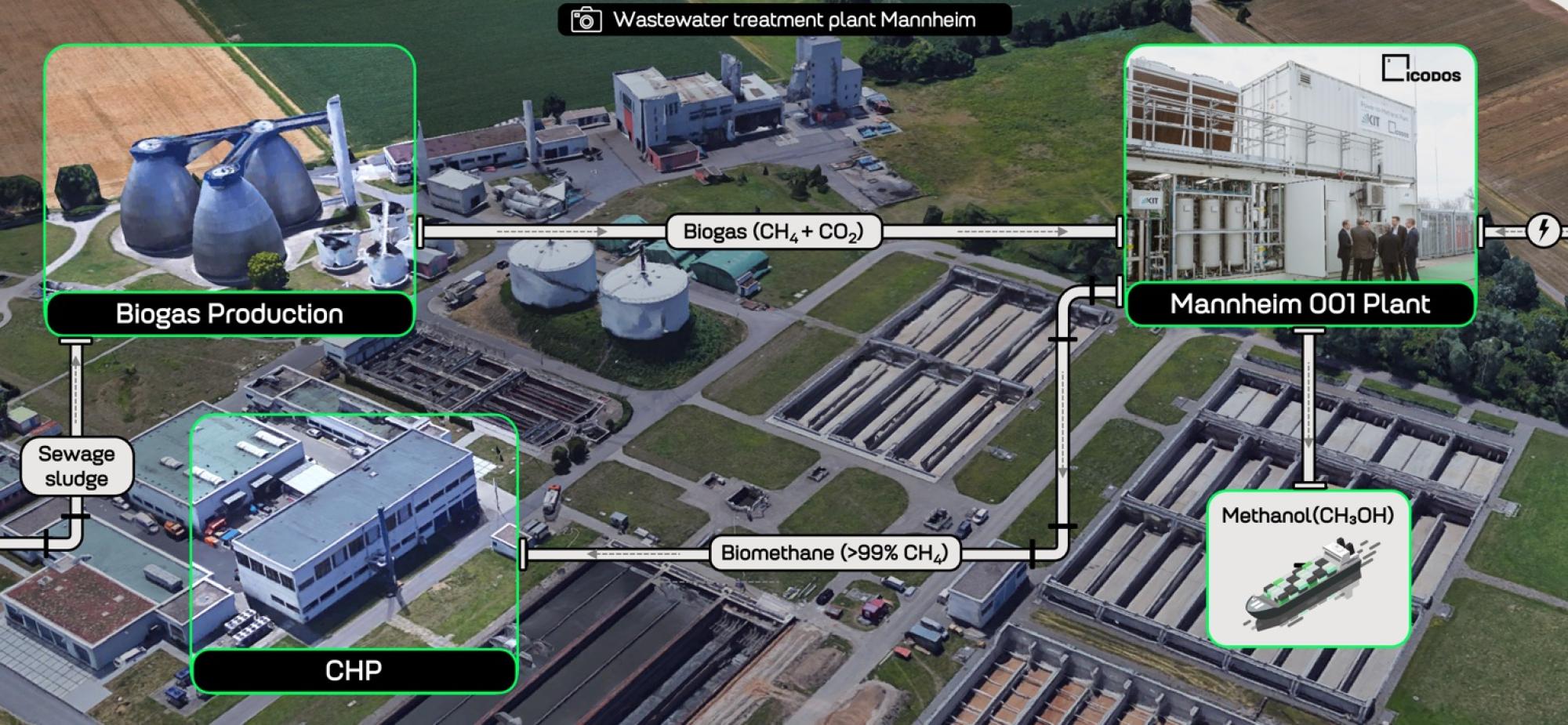
Every time somebody flushes a toilet in Mannheim, they contribute to ecological shipping. Since March 2025, the German city's wastewater treatment plant has been feeding an experiment of global relevance: Transforming sewage gases into green methanol, a cleaner, nearly-carbon-neutral alternative to heavy fuel oil. The pilot, known as Mannheim 001, is the first full case study of how human waste can be captured, processed and converted into fuel powerful enough to propel cargo ships across oceans. "It's the first time the entire value chain from sewage to finished methanol " has been demonstrated," says David Strittmatter, co-founder of Icodos, the start-up behind the project. Wastewater plants produce sludge " the thickened residue left after sewage is treated and cleaned. Mannheim's plant ferments this sludge in oxygen-free tanks, yielding biogas rich in methane and carbon dioxide, which is usually burned for heat or flared off. Icodos' innovation is to clean and upgrade that gas. "The sewage gas is dried, desulfurized, and then the carbon dioxide is separated from the rest," Strittmatter explains. Using renewable electricity, the captured carbon dioxide is then combined with hydrogen through a catalytic process to form methanol " a liquid fuel that can run ship engines. According to Icodos, scaling sewage-to-methanol worldwide could cover the entire fuel demand of the global shipping sector.
Latest
Latest News
Each news summary is created according to strict standards. Here's how we do it.
Each summary is created using a consistent editorial procedure. The target length is approximately 16 lines of 11-point Arial text in a 650-pixel-wide column. Up to 25% of a summary may be set in bold to emphasize the most important ideas. Summaries are composed of verbatim excerpts presented in the same sequence as they appear in the original news source, with very minor editorial additions. Where material has been omitted between excerpts, the omission is indicated with ellipses (...). Any words added by an editor for clarity or context appear in [brackets]. Our original news editor was Fred Burks. Tod Fletcher edited most summaries from 2007 through 2014, and Mark Bailey has served as news editor since 2014.