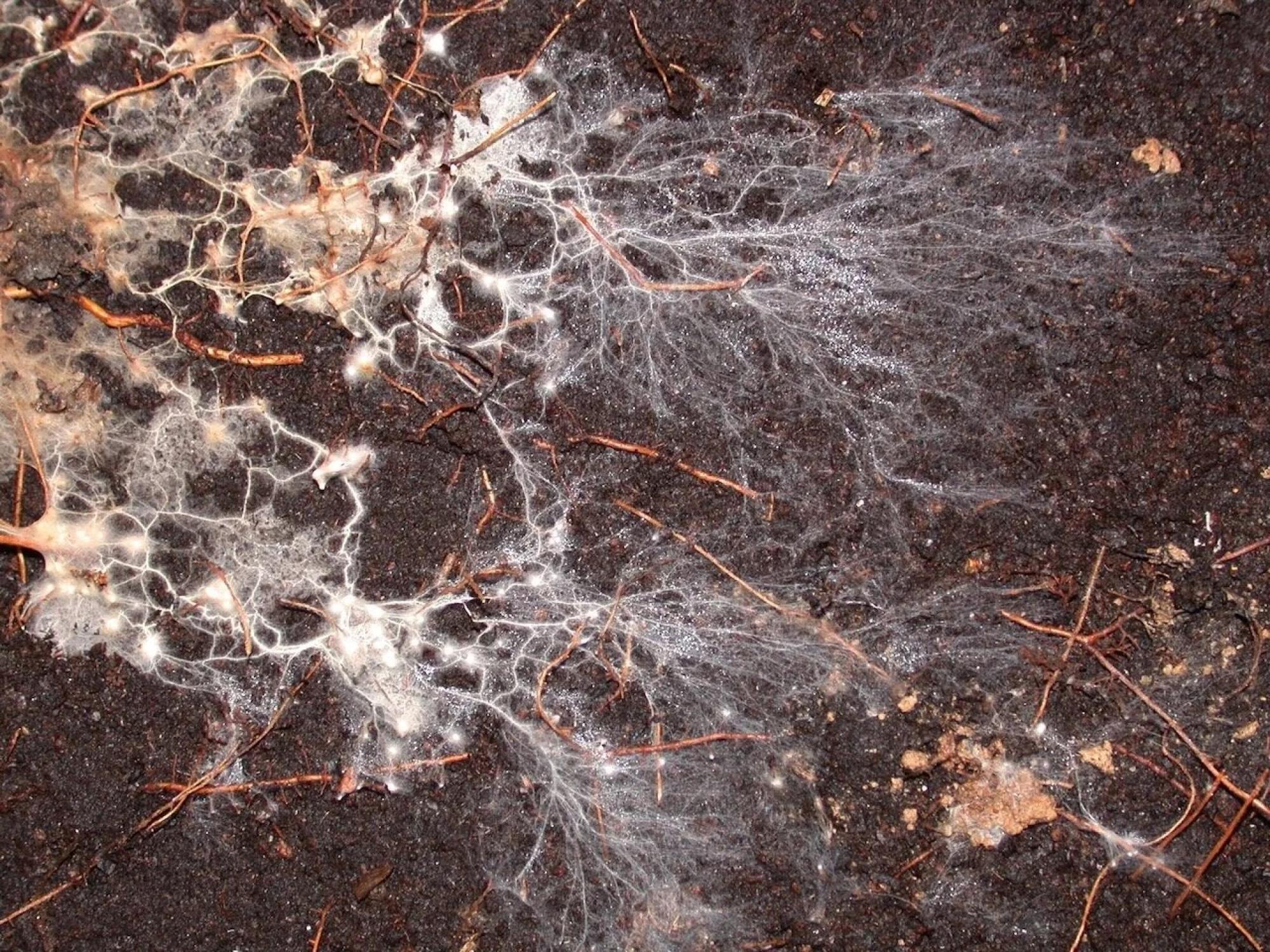
Each planting season, Claudia Bashian-Victoroff ventures out into Bole Woods. Laced throughout, weaving an intricate, microscopic web, are the mycorrhizal fungi she's after fungi that have spent 400 million years learning to live in symbiosis with plants, including the trees throughout Bole Woods and at least 80 percent of all species on the planet. Bashian-Victoroff doesn't need much soil. A single spoonful can contain miles of fungal hyphae and filaments, engaged in an ancient evolutionary exchange with the trees to which they've bonded. The fungi gather up water and nutrients, and deliver them to the trees. In return, they receive carbohydrates developed through photosynthesis, which they fix into the soil as they grow. It's a prosperous cycle, and Bashian-Victoroff is among a growing global community of researchers and conservationists taking advantage of this relationship to restore forests and other degraded ecosystems. Their goal: Promote the health of the soil beneath our feet and the plants it supports, sequester carbon and make agriculture more sustainable. Mycorrhizal fungi can be an important part of a broader suite of climate solutions, says Anne Polyakov, a fungal conservation and restoration scientist with the Society for the Protection of Underground Networks, or SPUN, which recently used machine learning to map the planet's mycorrhizal networks in an effort to promote conservation.
Latest
Latest News
Each news summary is created according to strict standards. Here's how we do it.
Each summary is created using a consistent editorial procedure. The target length is approximately 16 lines of 11-point Arial text in a 650-pixel-wide column. Up to 25% of a summary may be set in bold to emphasize the most important ideas. Summaries are composed of verbatim excerpts presented in the same sequence as they appear in the original news source, with very minor editorial additions. Where material has been omitted between excerpts, the omission is indicated with ellipses (...). Any words added by an editor for clarity or context appear in [brackets]. Our original news editor was Fred Burks. Tod Fletcher edited most summaries from 2007 through 2014, and Mark Bailey has served as news editor since 2014.