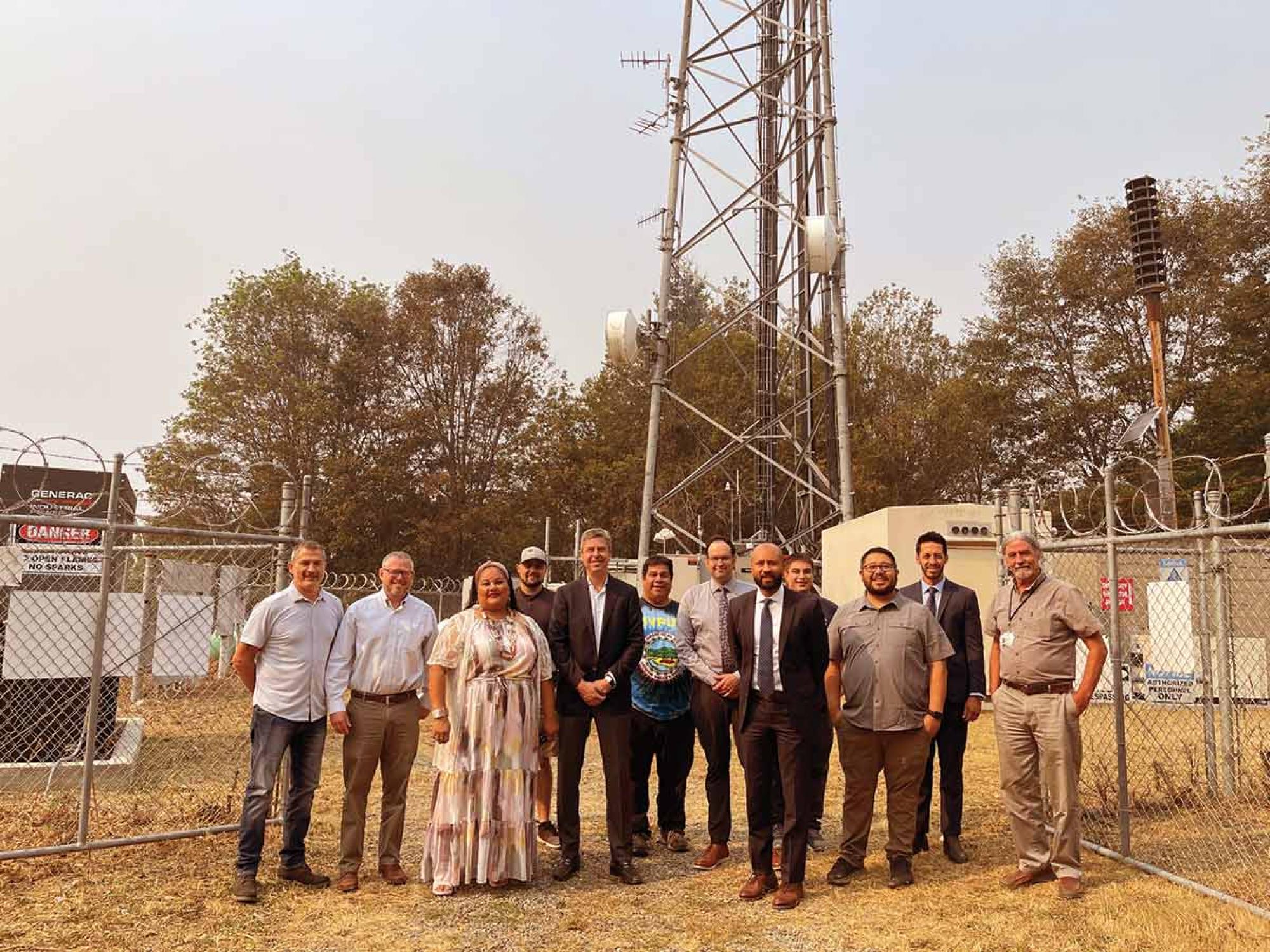
In the final bay of an old, mustard-colored mechanic's garage in the middle of the Hoopa Valley Reservation's main settlement is the headquarters of Acorn Wireless. This small, relatively young Internet service provider is owned and operated by the tribe's public utilities departmentan unusual arrangement in the United States, where Internet service is more often the purview of predatory corporations like AT&T and Verizon, whose regional monopolies enable them to charge exorbitant rates for uneven service. Before the launch of Acorn, residents had to choose between a HughesNet satellite connection (more than $100 per month), a bare-bones Starlink kit ($600), unreliable wireless hot spots"or, as was often the case, nothing. Download speeds are nearly 75 percent slower in tribal areas, yet the lowest price for basic Internet service is, on average, 11 percent higher. Acorn's operation is based on the idea that local, democratic ownership can help address the coverage disparity by eliminating the profit motive. Because it is owned by the tribe and administered by the tribe's public utilities department, Acorn can focus on equity instead of revenue. Its premium service package is set at $75 a month, [but] most Acorn customers can get service at no personal cost. Hoopa's experiment in public broadband remains a work in progress, embodying hopes (and facing hurdles) that are shared on tribal lands all over the country.
Latest
Latest News
Each news summary is created according to strict standards. Here's how we do it.
Each summary is created using a consistent editorial procedure. The target length is approximately 16 lines of 11-point Arial text in a 650-pixel-wide column. Up to 25% of a summary may be set in bold to emphasize the most important ideas. Summaries are composed of verbatim excerpts presented in the same sequence as they appear in the original news source, with very minor editorial additions. Where material has been omitted between excerpts, the omission is indicated with ellipses (...). Any words added by an editor for clarity or context appear in [brackets]. Our original news editor was Fred Burks. Tod Fletcher edited most summaries from 2007 through 2014, and Mark Bailey has served as news editor since 2014.