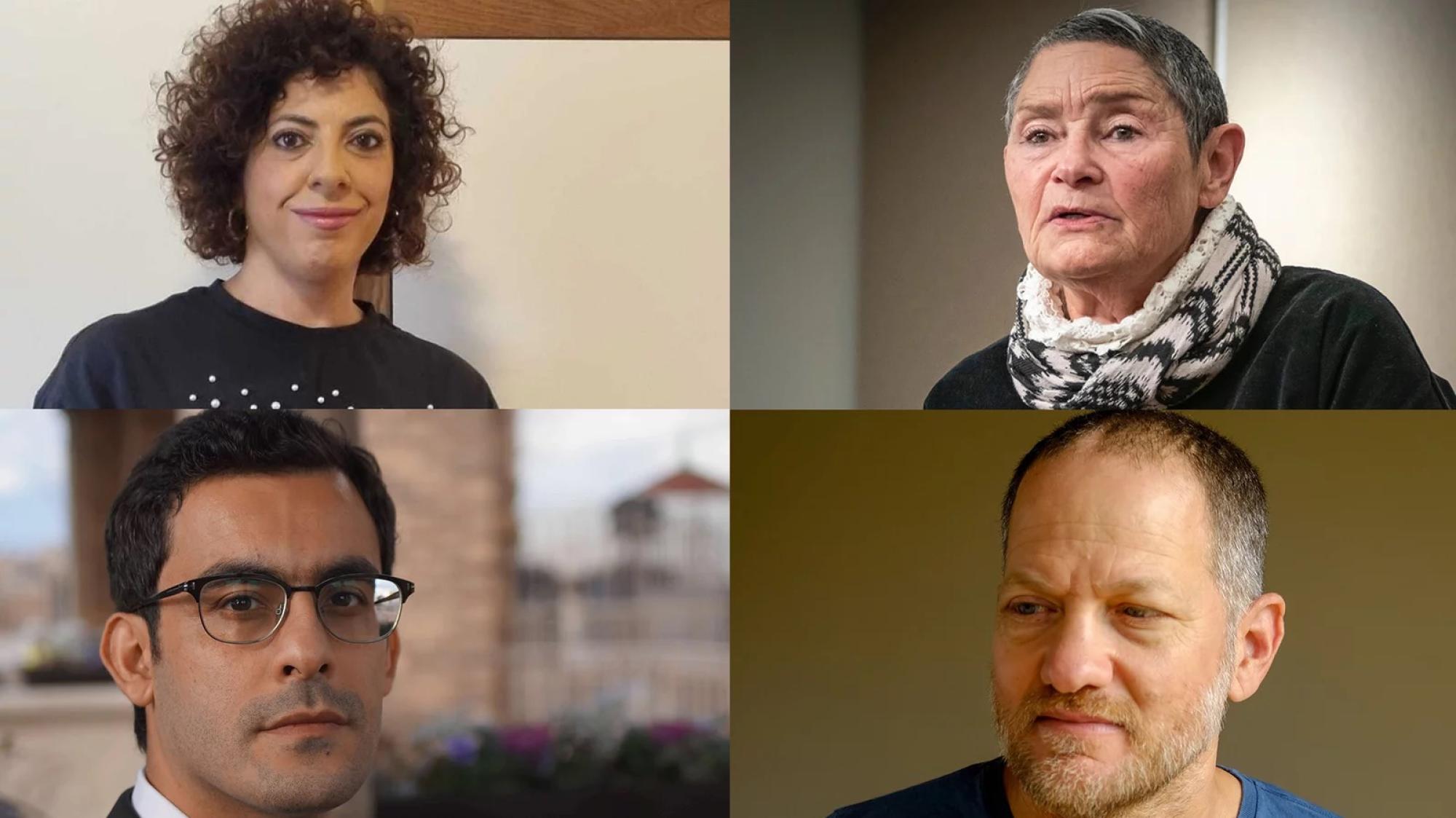
The morning of the Hamas attack, [Maoz] Inon's parents were at home in their community of Netiv HaAsara, a mere quarter-mile from Gaza. A Hamas fighter launched a rocket-propelled grenade that directly hit his parents' wooden house. Amid this sea of grief that he's cratered into, Inon says he feels no urge for revenge. I was crying, and I'm still crying, for all the innocent victims from both sides that will die," he says. "And I'm crying for this 100 years of bloodshed, of cycle of death." Inon says that this cycle can seem endless, but he has hope. "It seems like there is no solution," he says, "but there is." Inon says he had something of a vision after this war began. "I saw an image of everyone crying," he recalls. He says we shouldn't have more weapons, build higher walls and create better security systems. "That's the old world, OK? You want to start a new world? We need to cry ... And then," he says, "we'll see the path for peace." In one of [political psychologist Oded Adomi] Leshem's research studies, he shows that Jewish Israelis and Palestinians consistently underestimate the other group's hope for peace. "This underestimation actually reduces one's own hope." Unlike conflict, which Leshem says is bloody but familiar to Israelis and Palestinians, hope is different. It's unfamiliar and unpredictable. "If we kind of accept this unpredictability," he says, "take the chance [on] this uncertain thing " which is called peace between the [Jordan] River and the [Mediterranean] Sea " then this is closely related to hope."
Latest
Latest News
Each news summary is created according to strict standards. Here's how we do it.
Each summary is created using a consistent editorial procedure. The target length is approximately 16 lines of 11-point Arial text in a 650-pixel-wide column. Up to 25% of a summary may be set in bold to emphasize the most important ideas. Summaries are composed of verbatim excerpts presented in the same sequence as they appear in the original news source, with very minor editorial additions. Where material has been omitted between excerpts, the omission is indicated with ellipses (...). Any words added by an editor for clarity or context appear in [brackets]. Our original news editor was Fred Burks. Tod Fletcher edited most summaries from 2007 through 2014, and Mark Bailey has served as news editor since 2014.