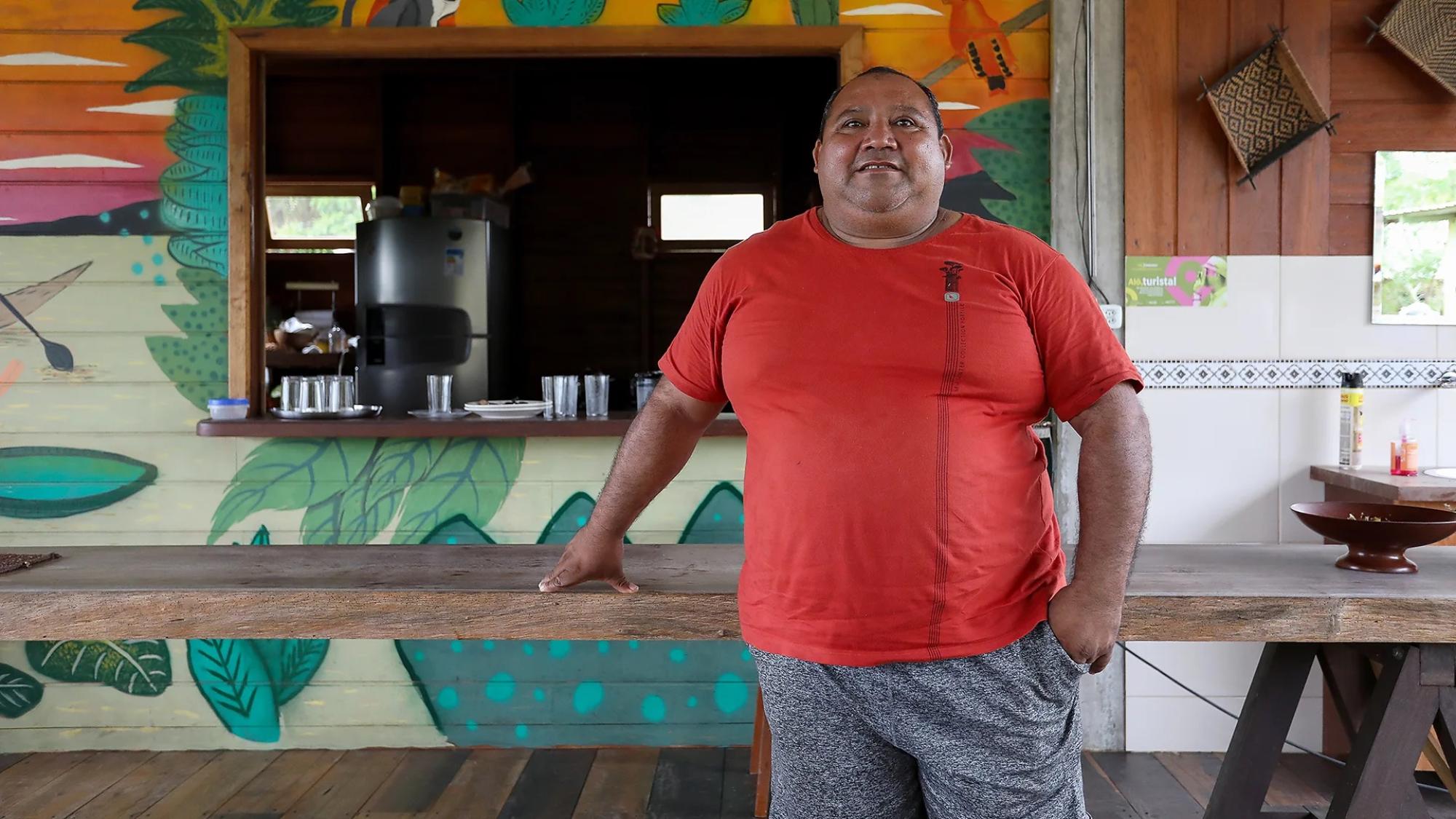
[Robert] Brito and his family, who live along the Rio Negro in the Brazilian Amazon, only saw the monetary value of logged trees. Now, when Brito looks at a tree, everything has changed. We stopped thinking about price and started thinking about [a different kind of] value. For example, when I see a beautiful cumaru [Brazilian teak] tree, 300 to 400 years old ... I still touch it, but with a different mindset. I have access to education, technology, a future for the young people living here, and I still contribute to the preservation of our planet in relation to climate change." Brito's transition ... required the support and alignment of financial, social and environmental incentives. In 2008, the government of the Brazilian state of Amazonas created the Rio Negro Sustainable Development Reserve, in order to preserve nature and to support communities living within it. The designation of the sustainable development reserve led to organisations including the Foundation for Amazon Sustainability (FAS) establishing education and health projects there. Brito recalls that one day Virgilio Viana, the director general of FAS, suggested that he might like to work in community-based tourism. "I started receiving people in my own home," Brito says. This trial was a success. He realised that he earned more in a week than he had ever seen in three months of logging. In 2011 " three years after the creation of the sustainable development reserve and over two decades since he cut down his first tree " Brito opened his nature lodge. And he put down his chainsaw. Moving away from blaming or shaming individuals can bring more people into the environmental movement. So can valuing people's prior experiences, such as Brito drawing on his decades of logging as he guides visitors around the forest in his flip-flops.
Latest
Latest News
Each news summary is created according to strict standards. Here's how we do it.
Each summary is created using a consistent editorial procedure. The target length is approximately 16 lines of 11-point Arial text in a 650-pixel-wide column. Up to 25% of a summary may be set in bold to emphasize the most important ideas. Summaries are composed of verbatim excerpts presented in the same sequence as they appear in the original news source, with very minor editorial additions. Where material has been omitted between excerpts, the omission is indicated with ellipses (...). Any words added by an editor for clarity or context appear in [brackets]. Our original news editor was Fred Burks. Tod Fletcher edited most summaries from 2007 through 2014, and Mark Bailey has served as news editor since 2014.