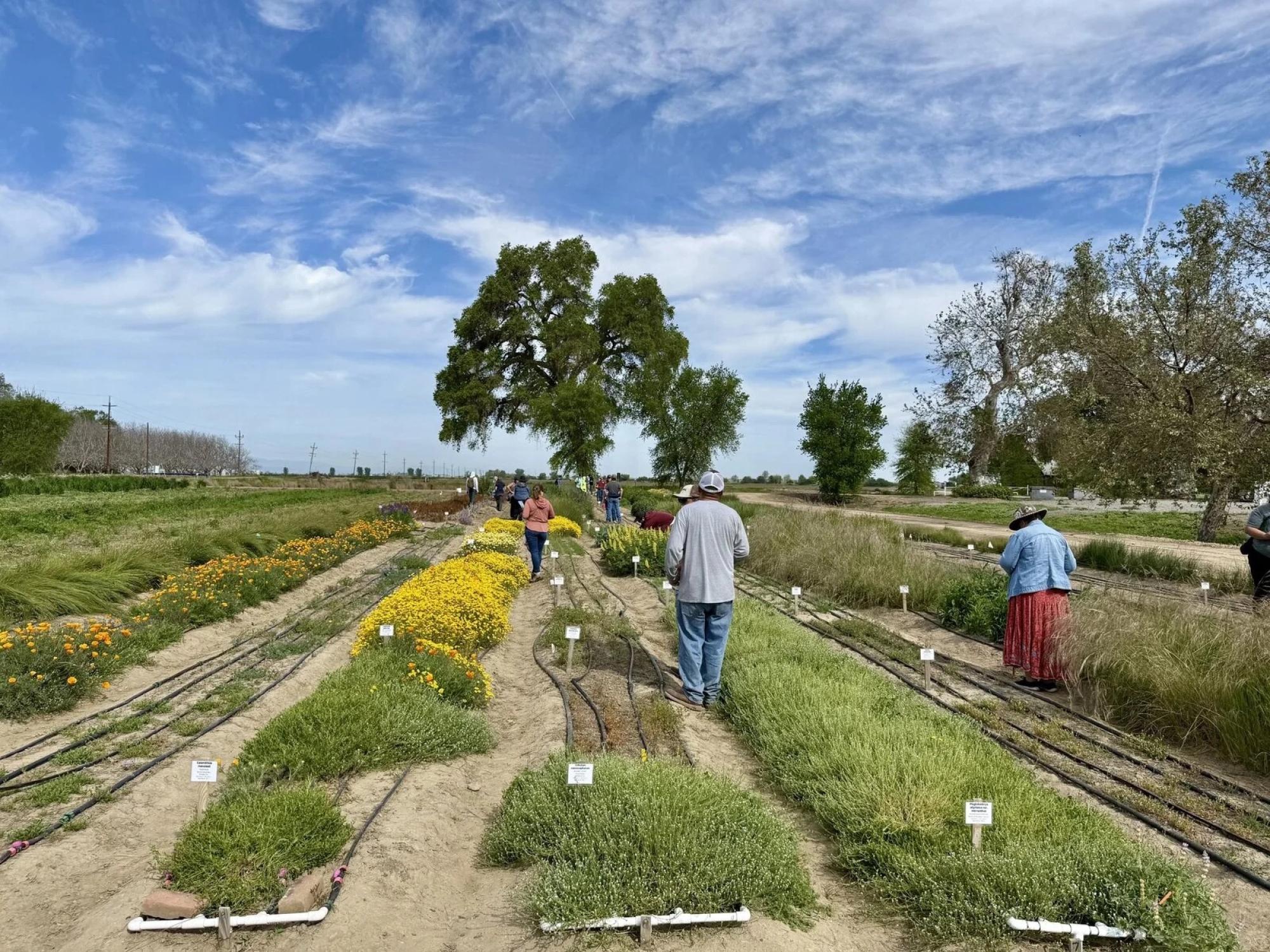
Heritage Growers, a native seed farm in Colusa founded by the nonprofit River Partners in 2021, is tackling one of the most fundamental " and least visible " environmental recovery challenges facing the American West: the shortage of locally adapted native seeds needed to restore damaged ecosystems at scale. With more than 200 acres in production, the farm grows what restoration scientists call "source-identified" seed " plant material whose genetic origin can be traced to the specific region where it will ultimately be replanted. That distinction is crucial. "It's not just any seed," says Heritage Growers' general manager Pat Reynolds, a restoration ecologist with more than 30 years of experience. "You want to take material that comes from a specific region, track and make sure those genetics are held forward, produce that seed and put it back into the region. That's a real important part of it. A poppy that's grown out in China and came from who knows what is not appropriate for habitat restoration." Some species require hand harvesting. Others, including some varieties of milkweed critical to pollinators like monarch butterflies, can cost more than $1,000 per pound to produce. "Milkweed actually is very expensive to amplify," Reynolds explains. "But we need it because if there is no milkweed, there are no monarch butterflies." Heritage Growers was created five years ago to address this systemic shortage.
Latest
Latest News
Each news summary is created according to strict standards. Here's how we do it.
Each summary is created using a consistent editorial procedure. The target length is approximately 16 lines of 11-point Arial text in a 650-pixel-wide column. Up to 25% of a summary may be set in bold to emphasize the most important ideas. Summaries are composed of verbatim excerpts presented in the same sequence as they appear in the original news source, with very minor editorial additions. Where material has been omitted between excerpts, the omission is indicated with ellipses (...). Any words added by an editor for clarity or context appear in [brackets]. Our original news editor was Fred Burks. Tod Fletcher edited most summaries from 2007 through 2014, and Mark Bailey has served as news editor since 2014.