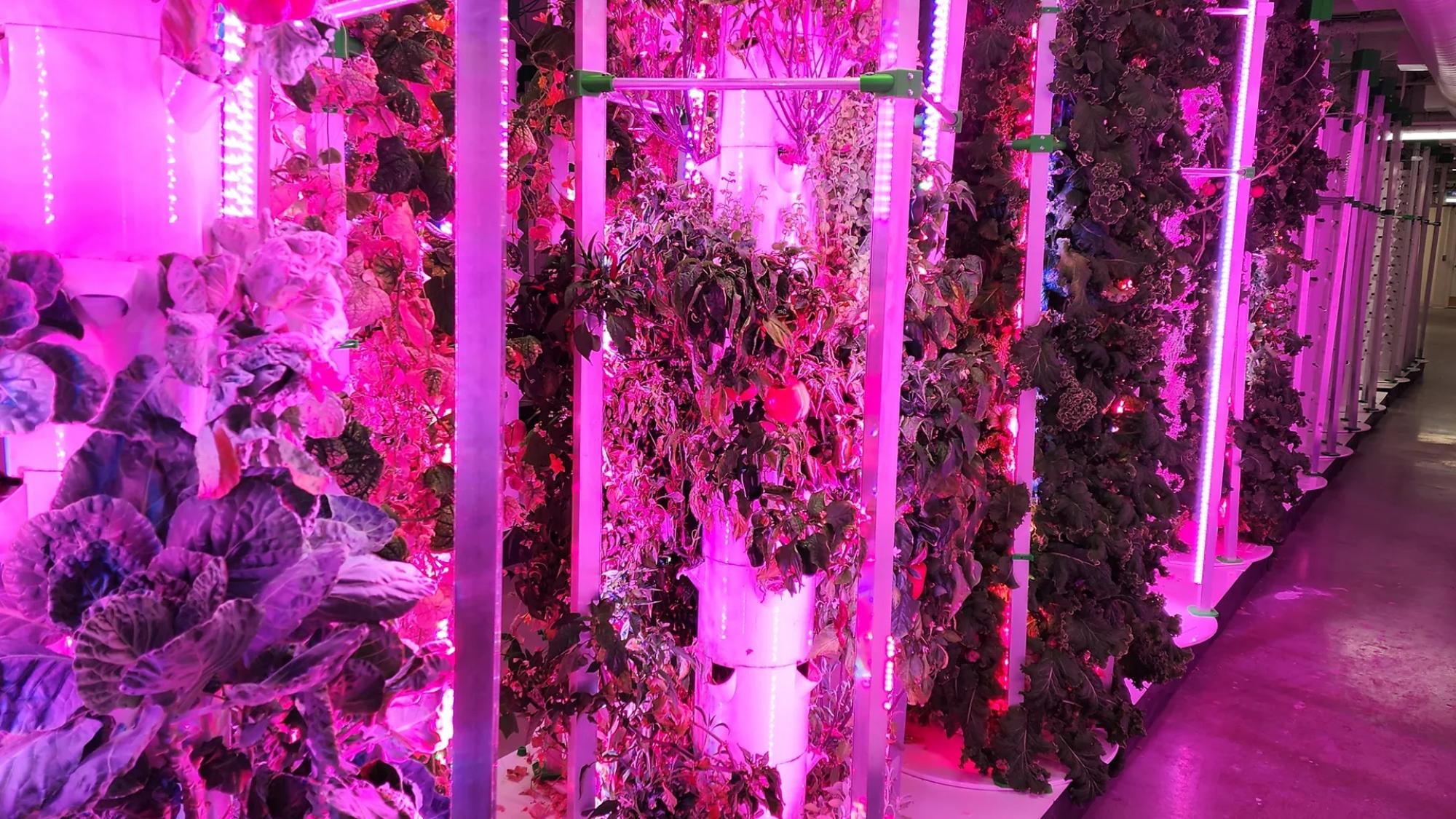
In some cities, as many as one in four office spaces are vacant. Some start-ups are giving them a second life as indoor farms growing crops as varied as kale, cucumber and herbs. In countries including Canada and Australia, landlords are struggling to fill vacant office spaces as companies embrace remote and hybrid work. In the US, the office vacancy rate is more than 20%. "Vertical farms may prove to be a cost-effective way to fill in vacant office buildings," says Warren Seay, Jr ... who authored an article on urban farm reconversions. There are other reasons for the interest in urban farms, too. Though supply chains have largely recovered post-Covid-19, other global shocks, including climate change, geopolitical turmoil and farmers' strikes, mean that they continue to be vulnerable " driving more cities to look for local food production options. Workers are currently aiming to transform a floor of 32-story historic Niels Esperson building in Houston, Texas, into an indoor farm. In September 2024, US indoor farm startup 80 Acres, which opened its first indoor farm inside a vacant building in Hamilton, Ohio, developed a 200,000-sq-ft (18,600-sq-m) facility inside a former commercial building in Florence, Kentucky. Overall, vertical farms have the potential to outperform regular farms on several environmental sustainability metrics like water usage, says [director of the Arell Food Institute] Evan Fraser.
Latest
Latest News
Each news summary is created according to strict standards. Here's how we do it.
Each summary is created using a consistent editorial procedure. The target length is approximately 16 lines of 11-point Arial text in a 650-pixel-wide column. Up to 25% of a summary may be set in bold to emphasize the most important ideas. Summaries are composed of verbatim excerpts presented in the same sequence as they appear in the original news source, with very minor editorial additions. Where material has been omitted between excerpts, the omission is indicated with ellipses (...). Any words added by an editor for clarity or context appear in [brackets]. Our original news editor was Fred Burks. Tod Fletcher edited most summaries from 2007 through 2014, and Mark Bailey has served as news editor since 2014.