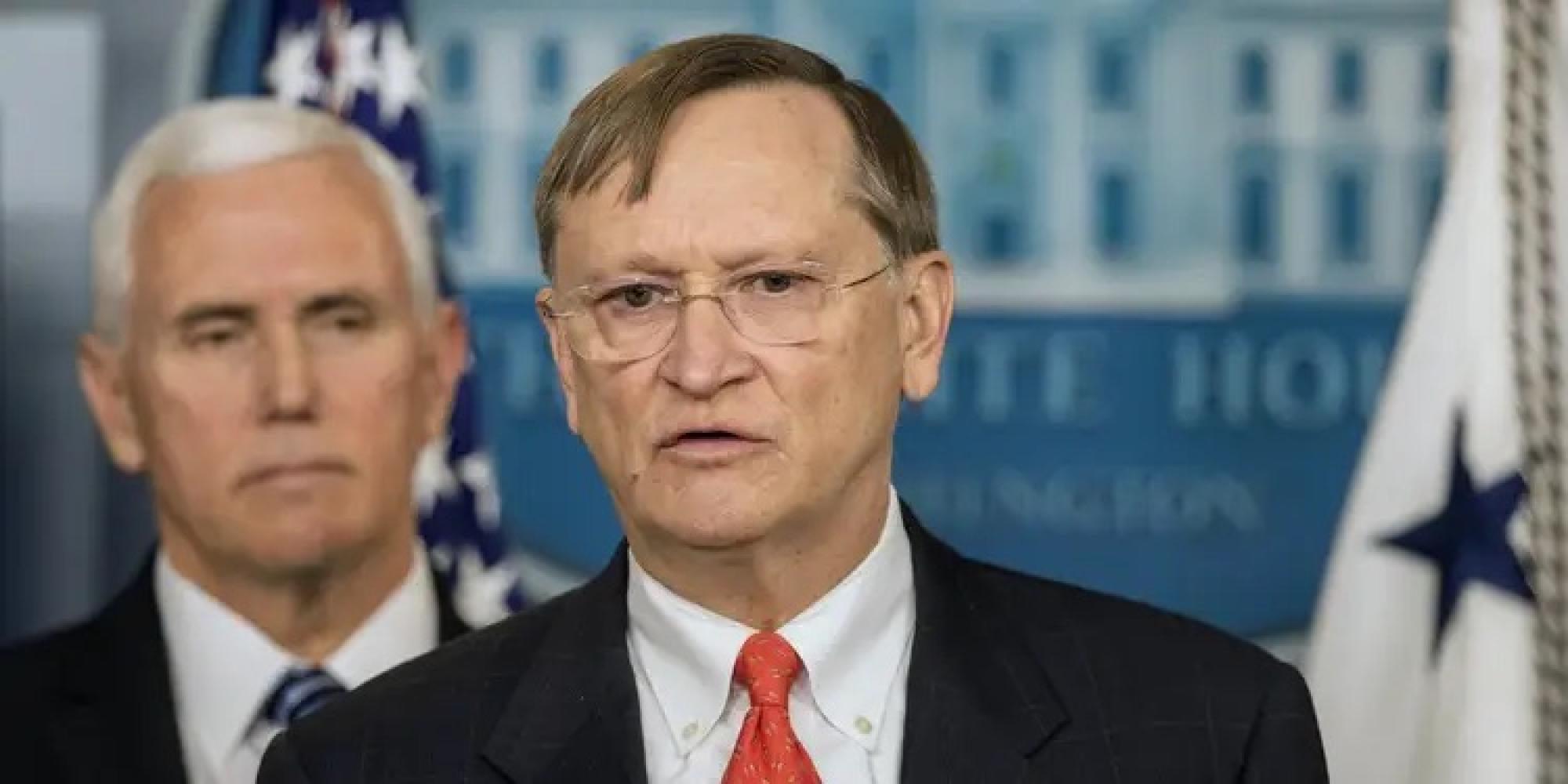
In March 2020, Dr. Robert Kadlec addressed a House committee to confirm his role and responsibilities as the federal government's top preparedness official coordinating the government's COVID-19 response. As assistant secretary for preparedness and response at the Department of Health and Human Services, Kadlec offered a lengthy statement to lawmakers on the "four principal functions" of his role. None of those functions involved downplaying without scientific evidence a theory that the virus emerged from a laboratory in the Wuhan Institute of Virology. But that's what Kadlec now says he did by assisting Dr. Anthony Fauci ... in his effort to suppress the lab leak theory. Kadlec says it's a decision that keeps him up at night. "I wake up at usually about 2 or 3 a.m. and think about it honestly, because it's something that we all played a role in," Kadlec [said]. For much of 2020 and 2021, anyone who brought up the possibility that COVID-19 emerged from Wuhan risked being labeled a conspiracy theorist by legacy media and "fact-checkers." In September, the chairman of the House Select Subcommittee on the Coronavirus Pandemic revealed that Fauci was secretly admitted to CIA headquarters while the agency conducted its analysis of the virus's origins, allegedly to "'influence' the Agency's review." A ... CIA whistleblower claims the agency attempted to bribe six analysts tasked with assessing the origin of the virus.
Latest
Latest News
Each news summary is created according to strict standards. Here's how we do it.
Each summary is created using a consistent editorial procedure. The target length is approximately 16 lines of 11-point Arial text in a 650-pixel-wide column. Up to 25% of a summary may be set in bold to emphasize the most important ideas. Summaries are composed of verbatim excerpts presented in the same sequence as they appear in the original news source, with very minor editorial additions. Where material has been omitted between excerpts, the omission is indicated with ellipses (...). Any words added by an editor for clarity or context appear in [brackets]. Our original news editor was Fred Burks. Tod Fletcher edited most summaries from 2007 through 2014, and Mark Bailey has served as news editor since 2014.