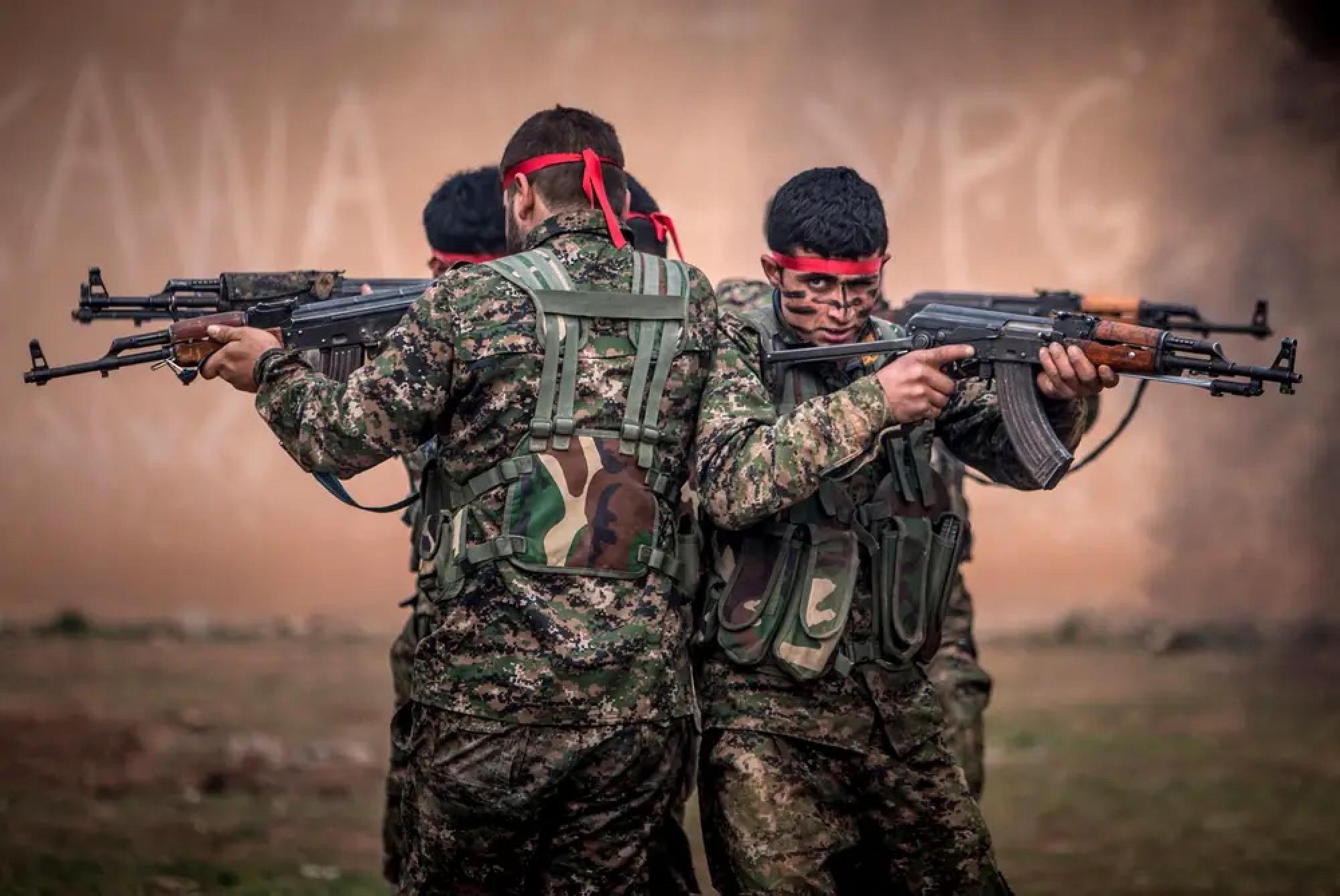
Syrian militias armed by different parts of the U.S. war machine have begun to fight each other on the plains between the besieged city of Aleppo and the Turkish border. The fighting has intensified over the last two months, as CIA-armed units and Pentagon-armed ones have repeatedly shot at each other while maneuvering through contested territory on the northern outskirts of Aleppo. Last year, the Pentagon helped create a new military coalition, the Syrian Democratic Forces ... to take territory away from the Islamic State. The group is dominated by Kurdish outfits known as People's Protection Units or YPG. It has received air-drops of weapons and supplies and assistance from U.S. Special Forces. The U.S. backing for a heavily Kurdish armed force has been a point of tension with the Turkish government, which has a long history of crushing Kurdish rebellions. The CIA, meanwhile, has its own operations center inside Turkey from which it has been directing aid to rebel groups in Syria, providing them with TOW antitank missiles from Saudi Arabian weapons stockpiles. While the Pentagon's actions are part of an overt effort by the U.S. and its allies against Islamic State, the CIA's backing of militias is part of a separate covert U.S. effort aimed at keeping pressure on the Assad government. Over the last several months ... Kurdish-led groups [expanded] their zone of control to the outskirts of Aleppo, bringing them into more frequent conflict with the CIA-backed outfits.
Latest
Latest News
Each news summary is created according to strict standards. Here's how we do it.
Each summary is created using a consistent editorial procedure. The target length is approximately 16 lines of 11-point Arial text in a 650-pixel-wide column. Up to 25% of a summary may be set in bold to emphasize the most important ideas. Summaries are composed of verbatim excerpts presented in the same sequence as they appear in the original news source, with very minor editorial additions. Where material has been omitted between excerpts, the omission is indicated with ellipses (...). Any words added by an editor for clarity or context appear in [brackets]. Our original news editor was Fred Burks. Tod Fletcher edited most summaries from 2007 through 2014, and Mark Bailey has served as news editor since 2014.