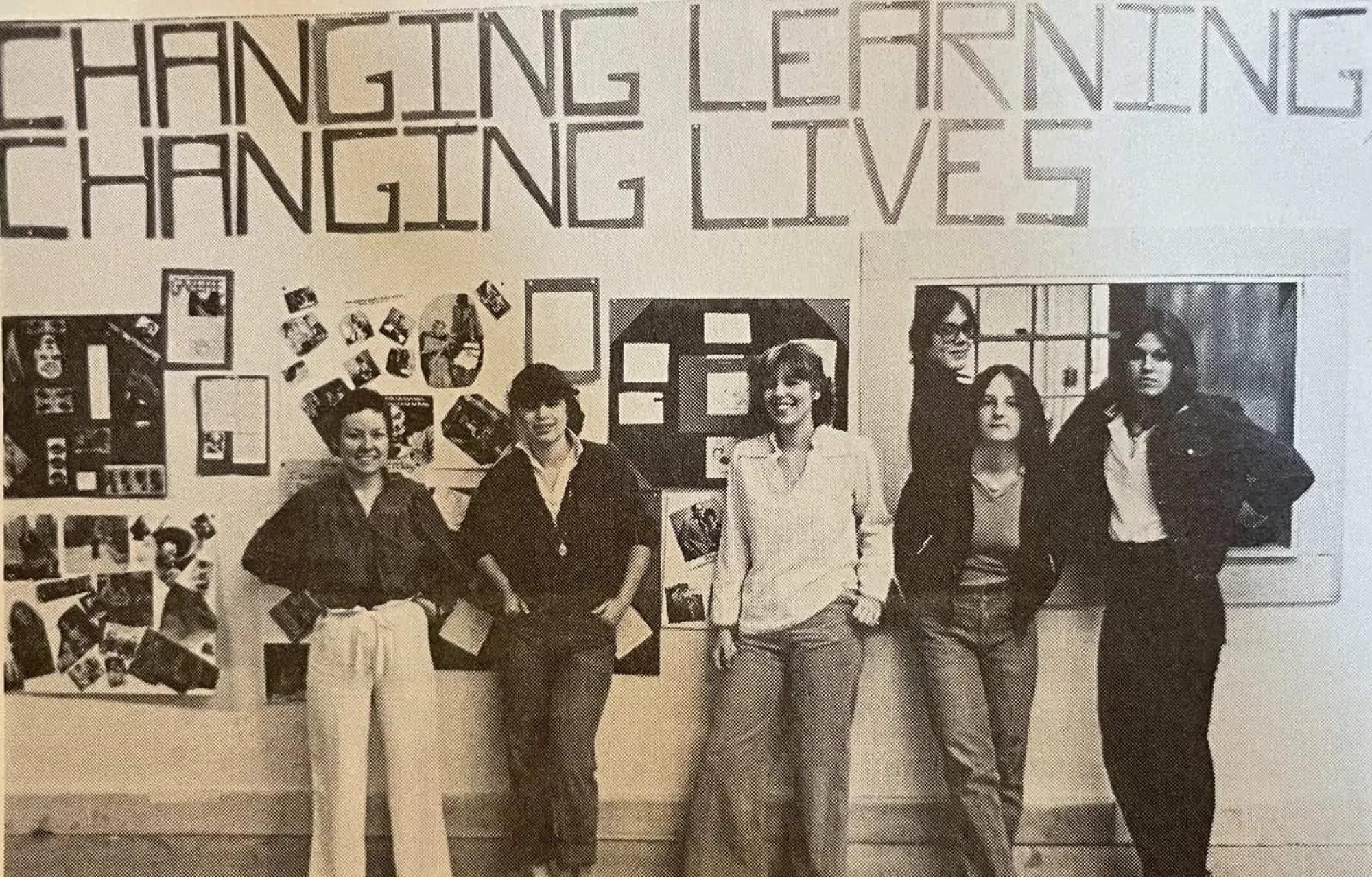
When Sean Tevlin discovered The Group School (TGS) in the 1970s, he found "a much needed safe space." A struggling teen who had dropped out of public school and battled math anxiety, he arrived at the converted industrial garage on Franklin Street in Cambridge, MA with little self-confidence after a learning disability diagnosis. But at TGS, teachers engaged with him, patiently tutored him and rekindled his love of reading. "It opened me up mentally and emotionally," Tevlin reflects decades later. TGS, known simply as "The Group" to its students, was unlike any public or private school. Between 1971 and 1982, more than 600 students like Tevlin graduated from this freewheeling schooling experiment, which combined radical democracy, intensive arts programming and a philosophy that embraced students' working-class background. The students embraced it: A school free of tuition, grading systems and hierarchy, driven instead by community meetings and collective governance. The Math Survival Skills pamphlet, designed for students who believed they "couldn't do math," ... lays out the central principle that embodies the school spirit: "The essential thrust of The Group School approach is the empowerment of the learners. We attempt to begin with and build on the strengths and skills of the students, to help them learn new skills and develop competency in areas in which they feel inadequate or insecure, to counteract the traditional ideology that leads them to turn their anger and despair inward and to blame themselves." Special ed teacher Rosalie Fay Barnes recently showed the website and parts of the 1971 documentary to her students at Berkeley High in Berkeley, California. She was surprised at the enthusiastic reactions. "Numerous students said, 'Let's do this!' i.e., let's start our own school." When she asked what students needed, she was startled to hear their responses. "Some students wanted more work, more writing, more reading. Many of my students asked me for more." Since showing the video, "the main thing that shifted is our relationship. I no longer feel like the enforcer of the rules, but the facilitator of a learning journey."
Latest
Latest News
Each news summary is created according to strict standards. Here's how we do it.
Each summary is created using a consistent editorial procedure. The target length is approximately 16 lines of 11-point Arial text in a 650-pixel-wide column. Up to 25% of a summary may be set in bold to emphasize the most important ideas. Summaries are composed of verbatim excerpts presented in the same sequence as they appear in the original news source, with very minor editorial additions. Where material has been omitted between excerpts, the omission is indicated with ellipses (...). Any words added by an editor for clarity or context appear in [brackets]. Our original news editor was Fred Burks. Tod Fletcher edited most summaries from 2007 through 2014, and Mark Bailey has served as news editor since 2014.