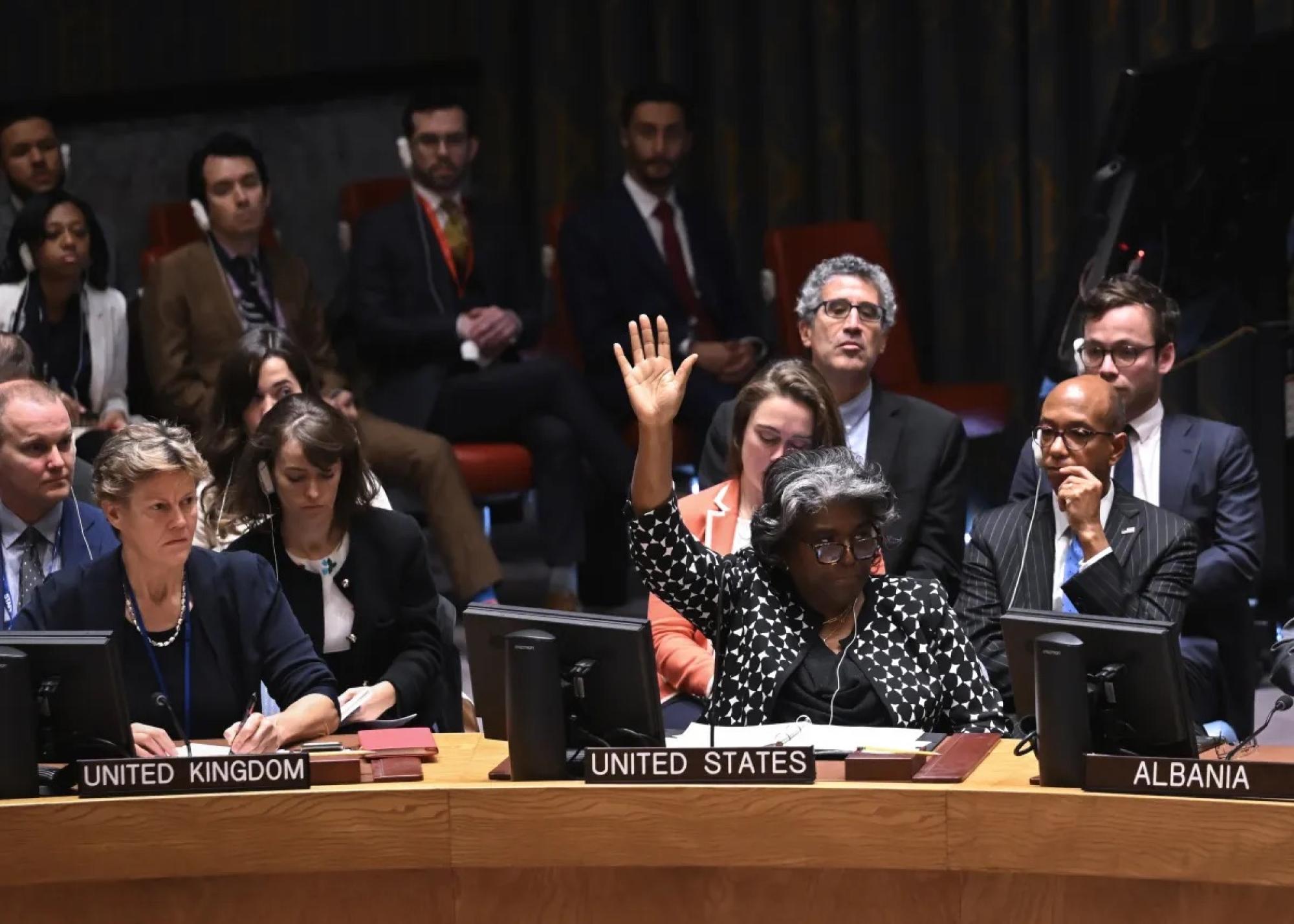
On Wednesday, the United States was the only country to vote "no" on a proposed U.N. Security Council resolution authored by Brazil that called for "humanitarian pauses" in Israel's bombing of Gaza. Twelve countries voted for the resolution, including several surprising ones, such as France and the United Arab Emirates. Two more, Russia and the U.K., abstained. But according to the Security Council's rules, America's sole "no" vote meant that the resolution failed. The Security Council has 15 countries. Ten are rotating members, elected by the U.N. General Assembly and serving on the council for a period of two years. Five are permanent members: the U.S., Russia, China, France, and the U.K. If any of the permanent members vetoes a resolution, it will not pass, no matter how many votes are in favor. The first U.S. veto to protect Israel occurred in 1972. Since then, the U.S. has vetoed about four dozen more resolutions criticizing Israel. Since the collapse of the Soviet Union, Russia has similarly vetoed numerous resolutions to protect its own client state, Syria, as well as itself concerning Ukraine. Since the U.N.'s founding, it has largely always been a debating society because the world's most powerful countries, led by the U.S., want it that way. There has recently been renewed energy at the U.N. to change things. However, given the fact that the five permanent members can block any changes, the best idea that anyone could come up with was to ask them nicely to change.
Latest
Latest News
Each news summary is created according to strict standards. Here's how we do it.
Each summary is created using a consistent editorial procedure. The target length is approximately 16 lines of 11-point Arial text in a 650-pixel-wide column. Up to 25% of a summary may be set in bold to emphasize the most important ideas. Summaries are composed of verbatim excerpts presented in the same sequence as they appear in the original news source, with very minor editorial additions. Where material has been omitted between excerpts, the omission is indicated with ellipses (...). Any words added by an editor for clarity or context appear in [brackets]. Our original news editor was Fred Burks. Tod Fletcher edited most summaries from 2007 through 2014, and Mark Bailey has served as news editor since 2014.