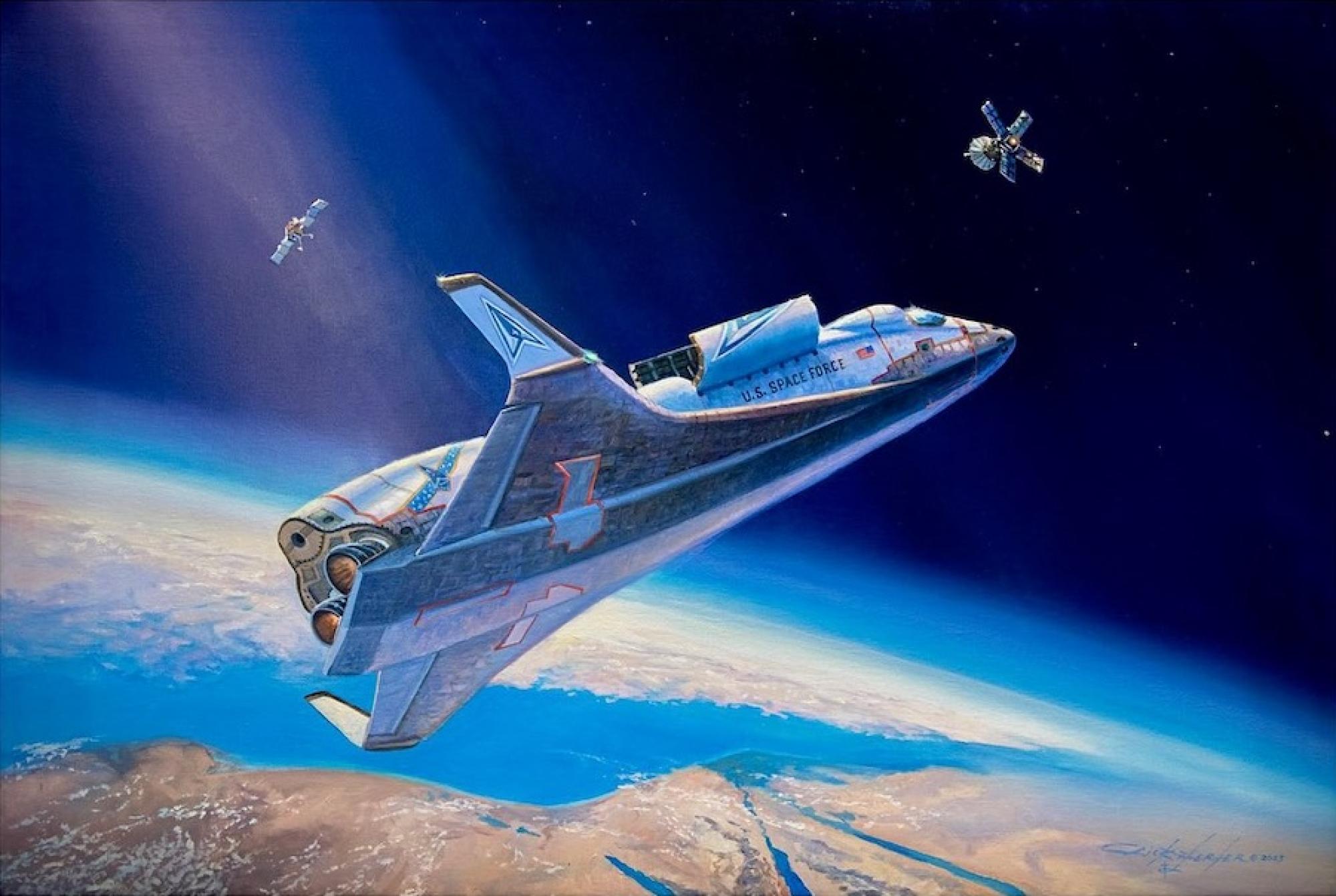
Earlier this year, officials at US Space Command released a list of priorities and needs, and among the routine recitation of things like cyber defense, communications, and surveillance was a relatively new term: integrated space fires." Essentially, "fires" are offensive or defensive actions against an adversary. The Army defines fires as "the use of weapon systems to create specific lethal and nonlethal effects on a target." The inclusion of this term in a Space Command planning document was another signal that Pentagon leaders, long hesitant to even mention the possibility of putting offensive weapons in space for fear of stirring up a cosmic arms race, see the taboo of talking about space warfare as a thing of the past. Wartime scenarios in space range from a one-off cyberattack against a satellite system ... to a destructive nuclear detonation in Earth orbit. The Pentagon is also concerned with the ability of potential adversaries, particularly China, to use their satellites to bolster their land, air, and naval forces, similar to the way the US military leans on its space-based capabilities. One concept proposed by some government and industry officials is to launch roving "defender" satellites into orbit, with the sole purpose of guarding high-value US satellites against an attack. [Space Force General Chance] Saltzman said the service is already thinking about what to do to maintain what the Pentagon now calls "space superiority""a twist on the term air superiority.
Latest
Latest News
Each news summary is created according to strict standards. Here's how we do it.
Each summary is created using a consistent editorial procedure. The target length is approximately 16 lines of 11-point Arial text in a 650-pixel-wide column. Up to 25% of a summary may be set in bold to emphasize the most important ideas. Summaries are composed of verbatim excerpts presented in the same sequence as they appear in the original news source, with very minor editorial additions. Where material has been omitted between excerpts, the omission is indicated with ellipses (...). Any words added by an editor for clarity or context appear in [brackets]. Our original news editor was Fred Burks. Tod Fletcher edited most summaries from 2007 through 2014, and Mark Bailey has served as news editor since 2014.