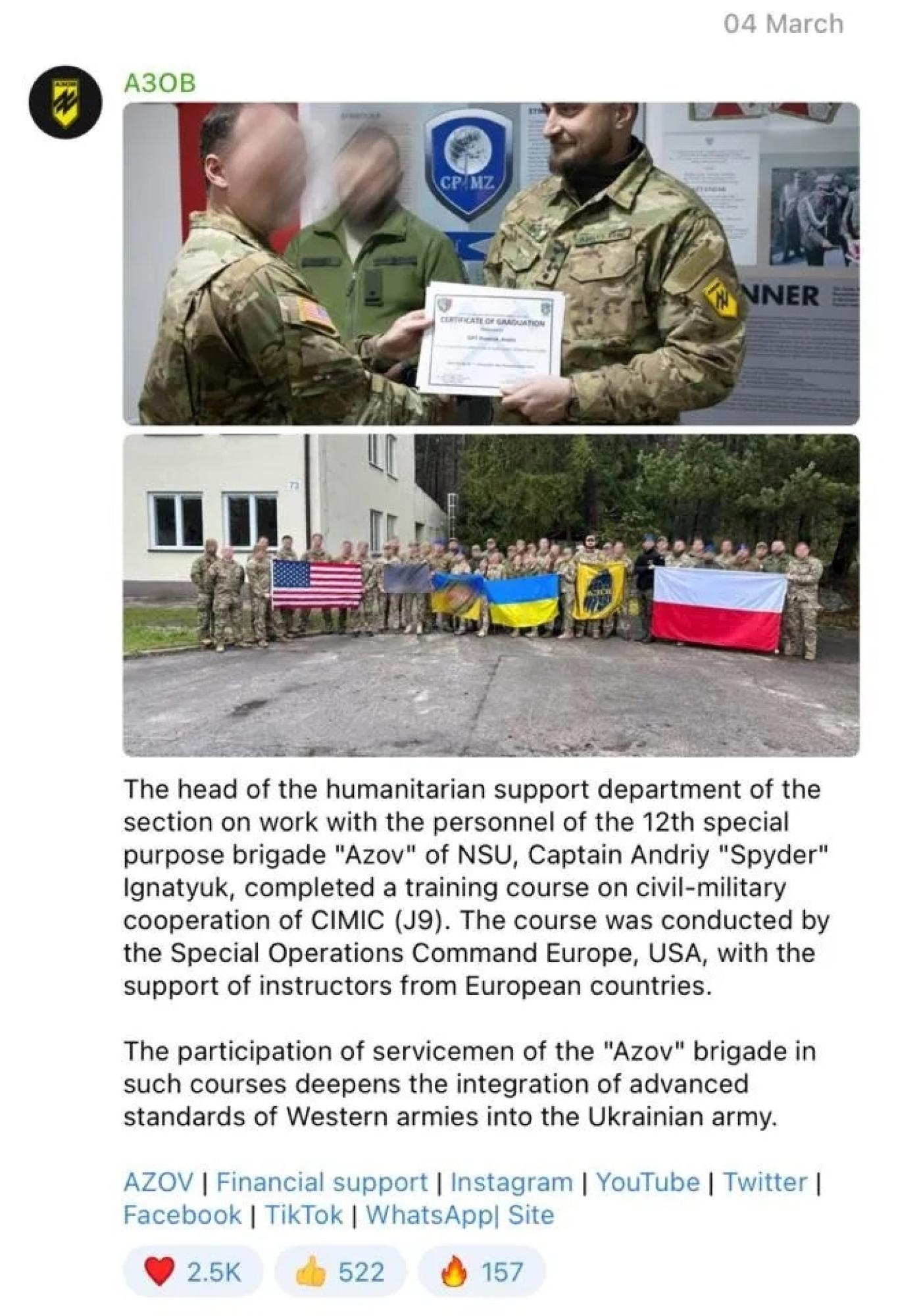
Last week, the Biden administration said it would allow the Azov Brigade, a Ukrainian military unit, to receive U.S. weaponry and training, freeing it from a purported ban imposed in response to concerns that it committed human rights violations and had neo-Nazi ties. A photo posted by the unit itself, however, seems to suggest that the U.S. was providing support as far back as December of last year. The photo, in tandem with the administration's own statements, highlights the murky nature of the arms ban, how it was imposed, and under what U.S. authority. Two mechanisms could have barred arms transfers: a law passed by Congress specifically prohibiting assistance to Azov, and the so-called Leahy laws that block support to units responsible for grave rights violations. The State Department said this month that weapon shipments will now go forward after a Leahy law review, but won't comment on if and when a Leahy ban was in effect. The congressional prohibition, the U.S. says, does not apply because it barred assistance to the Azov Battalion, a predecessor to the Azov Brigade. The original unit had earned scrutiny for alleged human rights violations and ties to neo-Nazi and white supremacist ideologies. The U.S. has not made clear about when the apparent ban started, but a deputy Azov commander and media reports indicate some type of prohibition has been in effect for nearly a decade " though the congressional ban has only been in effect since 2018.
Latest
Latest News
Each news summary is created according to strict standards. Here's how we do it.
Each summary is created using a consistent editorial procedure. The target length is approximately 16 lines of 11-point Arial text in a 650-pixel-wide column. Up to 25% of a summary may be set in bold to emphasize the most important ideas. Summaries are composed of verbatim excerpts presented in the same sequence as they appear in the original news source, with very minor editorial additions. Where material has been omitted between excerpts, the omission is indicated with ellipses (...). Any words added by an editor for clarity or context appear in [brackets]. Our original news editor was Fred Burks. Tod Fletcher edited most summaries from 2007 through 2014, and Mark Bailey has served as news editor since 2014.