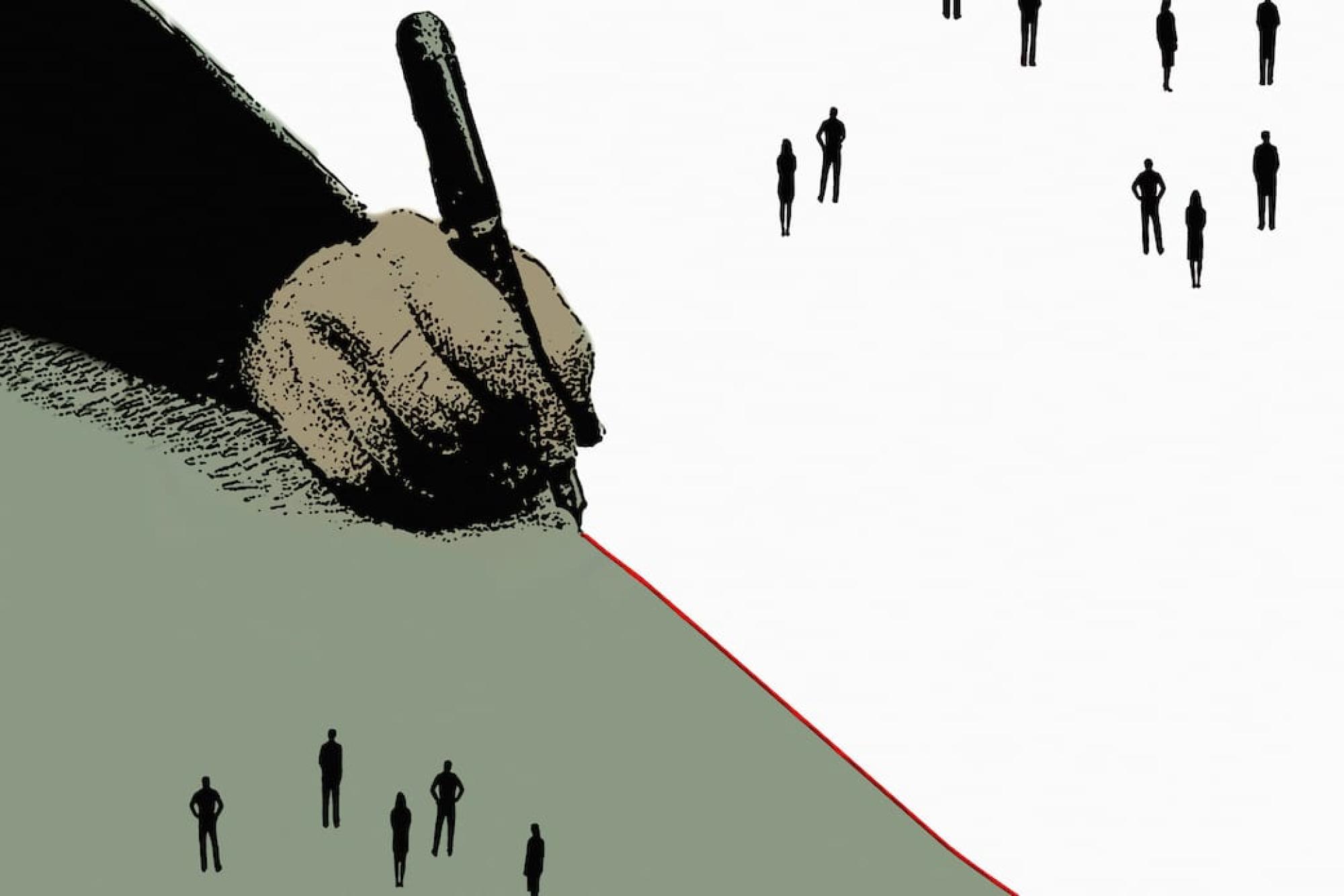
People who live in societies with wide gaps between the wealthy and everyone else turn out to live briefer lives than people who call more equal societies home. People who live in more equal societies, meanwhile, tend to live happier lives than their unequal-society counterparts. They face less crime. Their economies crash less often. Recent studies from Northwestern's Maryam Kouchaki and her colleagues ... have been illuminating how unequal distributions of income and wealth are serving to increase "the acceptability of self-interested unethical behaviors." The bottom line: People who live in highly unequal societies feel "a lower sense of control" and look less askance at unethical behaviors, either from others or from themselves, than do people who live in distinctly more equal societies. "Overall," Kouchaki and her colleagues conclude, "our results suggest inequality changes ethical standards." Other recent psychological research has come to the same core conclusion. "When are people more open to cheating?" asked the Canadian researchers Anita Schmalor, Adrian Schroeder, and Steven Heine in a paper published earlier this year. "Economic inequality makes people expect more everyday unethical behavior." The longer we let inequality define our contemporary daily lives, this new research helps us understand, the more the unethical behavior all around us will seem to reflect just the way our world naturally works. Economic inequality, in effect, normalizes unethical behavior.
Latest
Latest News
Each news summary is created according to strict standards. Here's how we do it.
Each summary is created using a consistent editorial procedure. The target length is approximately 16 lines of 11-point Arial text in a 650-pixel-wide column. Up to 25% of a summary may be set in bold to emphasize the most important ideas. Summaries are composed of verbatim excerpts presented in the same sequence as they appear in the original news source, with very minor editorial additions. Where material has been omitted between excerpts, the omission is indicated with ellipses (...). Any words added by an editor for clarity or context appear in [brackets]. Our original news editor was Fred Burks. Tod Fletcher edited most summaries from 2007 through 2014, and Mark Bailey has served as news editor since 2014.