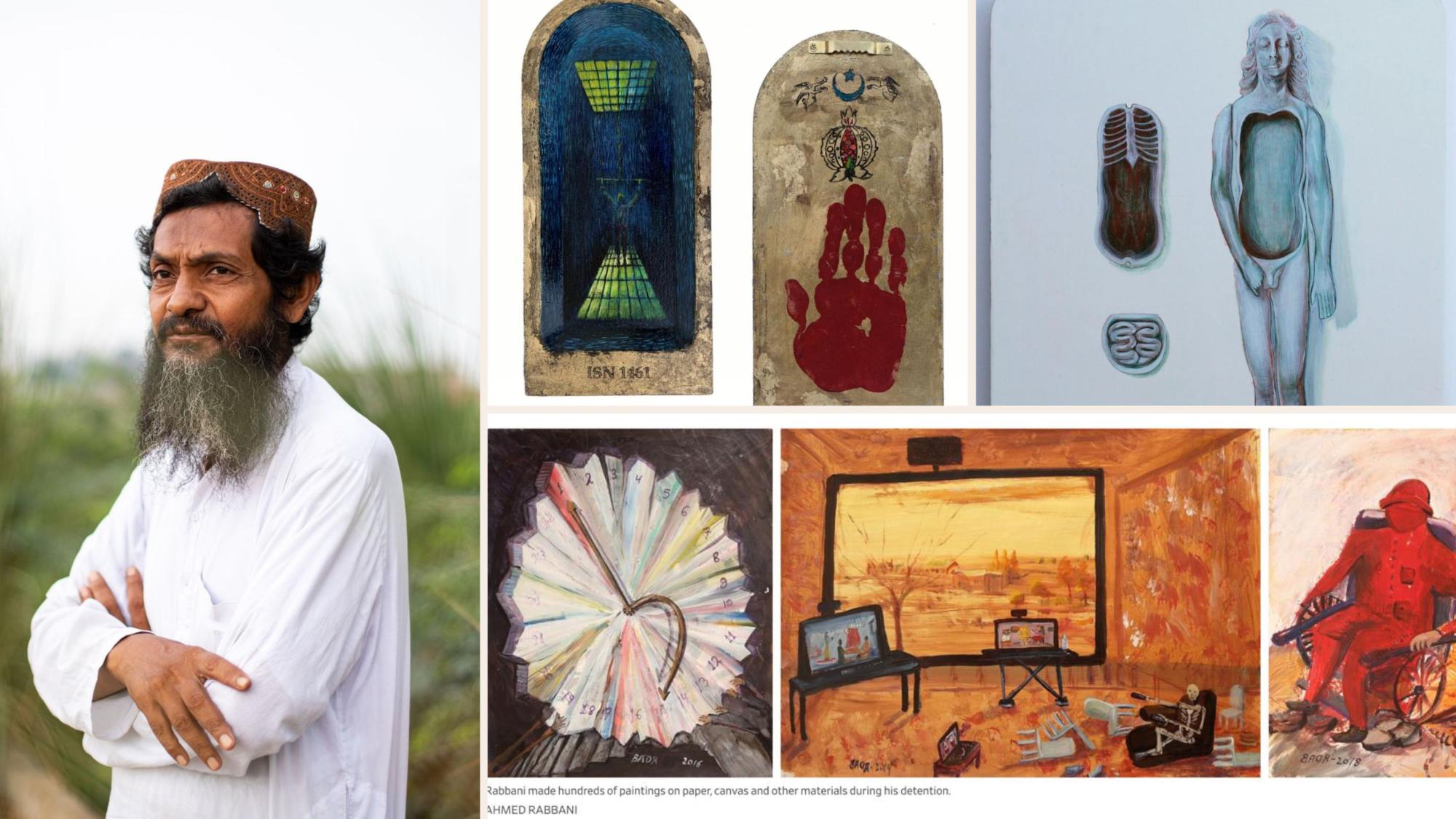
In the early days of America's war on terror, U.S. authorities detained Ahmed Rabbani thinking he was someone else. They soon realized their mistake. Rabbani ... was never charged with a crime. Rabbani's lawyer says he ... was taken by Pakistani authorities who misidentified him and handed him over to U.S. intelligence officers for a $5,000 reward. Rabbani [was] a taxi driver in Karachi. He spoke three languagesUrdu, Arabic and English. When he was detained, on Sept. 10, 2002, Rabbani didn't know his wife was pregnant. He said he found out about it three years later from a letter"the first communication he had received from her since his detention. He met his 20-year-old son, Jawwad, for the first time upon his return to Pakistan in February. After 18½ years at Guantanamo Bay, he stepped off a plane in Pakistan in February"a free but broken man. Years of hunger strikes and force feeding have left him unable to eat most solid food. "I never, never, ever sleep at night," he said. His only means of escape was art. By the time of his release, he had made hundreds of paintings. In May, 20 of Rabbani's paintings were shown at a gallery in the Pakistani city of Karachi. Rabbani said he was transferred several times to camps in Pakistan and Afghanistan known as black sites"secret CIA interrogation facilities. There, he said, he was tortured until he told his captors anything he thought they wanted to hear. A total of 779 men were at some point detained [at Guantanamo]. Like Rabbani, most were eventually released without ever having been charged with a crime. Rabbani says he doesn't expect he will ever fully recover, physically or mentally. "Some things will never be fixed," he said.
Latest
Latest News
Each news summary is created according to strict standards. Here's how we do it.
Each summary is created using a consistent editorial procedure. The target length is approximately 16 lines of 11-point Arial text in a 650-pixel-wide column. Up to 25% of a summary may be set in bold to emphasize the most important ideas. Summaries are composed of verbatim excerpts presented in the same sequence as they appear in the original news source, with very minor editorial additions. Where material has been omitted between excerpts, the omission is indicated with ellipses (...). Any words added by an editor for clarity or context appear in [brackets]. Our original news editor was Fred Burks. Tod Fletcher edited most summaries from 2007 through 2014, and Mark Bailey has served as news editor since 2014.